Silicon Carbide Grit Size Chart: How to Choose the Right Mesh for Blasting
Complete grit size reference for silicon carbide blast media — FEPA, ANSI, and JIS cross-reference tables, Ra/Rz surface profile correlations, and application-specific grit selection guidance for industrial buyers.
SECTION 01Understanding Grit Size
Grit size describes the physical diameter of individual abrasive particles, expressed as a mesh number — the number of openings per linear inch in a standardized sieve screen. Counterintuitively, higher mesh numbers = smaller particles: a #24 grit particle is approximately 800 µm in diameter, while a #600 grit particle is approximately 20 µm. The relationship is inverse because the mesh number refers to the screen that retains the particles, and finer screens require more openings per inch.
For silicon carbide abrasive blasting media, grit size is the most operationally important specification — it directly determines the surface profile depth, cutting speed, dust generation level, and media consumption rate of any blasting operation. Specifying the wrong grit size is one of the most common and costly mistakes in abrasive procurement. This guide eliminates that risk with a complete reference system and application-specific selection guidance.
For a broader overview of SiC blast media properties beyond grit selection, see: Complete Buyer’s Guide to SiC Abrasive Blasting Media.
SECTION 02Grit Standards: FEPA, ANSI, and JIS
Three major international standards govern abrasive grit classification, each with distinct mesh numbering systems for the same physical particle size ranges. When ordering silicon carbide blasting media internationally, specifying the correct standard is critical — ordering “#60 grit” without a standard qualifier can result in receiving product with a different particle size than intended, as the FEPA, ANSI, and JIS #60 designations correspond to slightly different size distributions.
| Standard | Full Name | Primary Regions | Designation Format | Notes |
|---|---|---|---|---|
| FEPA | Federation of European Producers of Abrasives | Europe, China (export), Asia | F-grit (macro) / P-grit (coated) | Dominant global export standard |
| ANSI | American National Standards Institute (B74.12) | USA, Canada | Grit number (no prefix) | Close to FEPA for macro grits |
| JIS | Japanese Industrial Standards (R6001) | Japan, South Korea | Grit number | Different D50 targets at fine sizes |
Procurement tip: When ordering from Jiangsu Henglihong Technology Co., Ltd., specify your target standard (FEPA, ANSI, or JIS) at time of order. We supply to all three and provide sieve analysis certificates confirming D10, D50, and D90 values for each production lot. For North American buyers, specify ANSI; for European/global buyers, specify FEPA; for Japanese buyers, specify JIS.
SECTION 03Master Grit Reference Chart
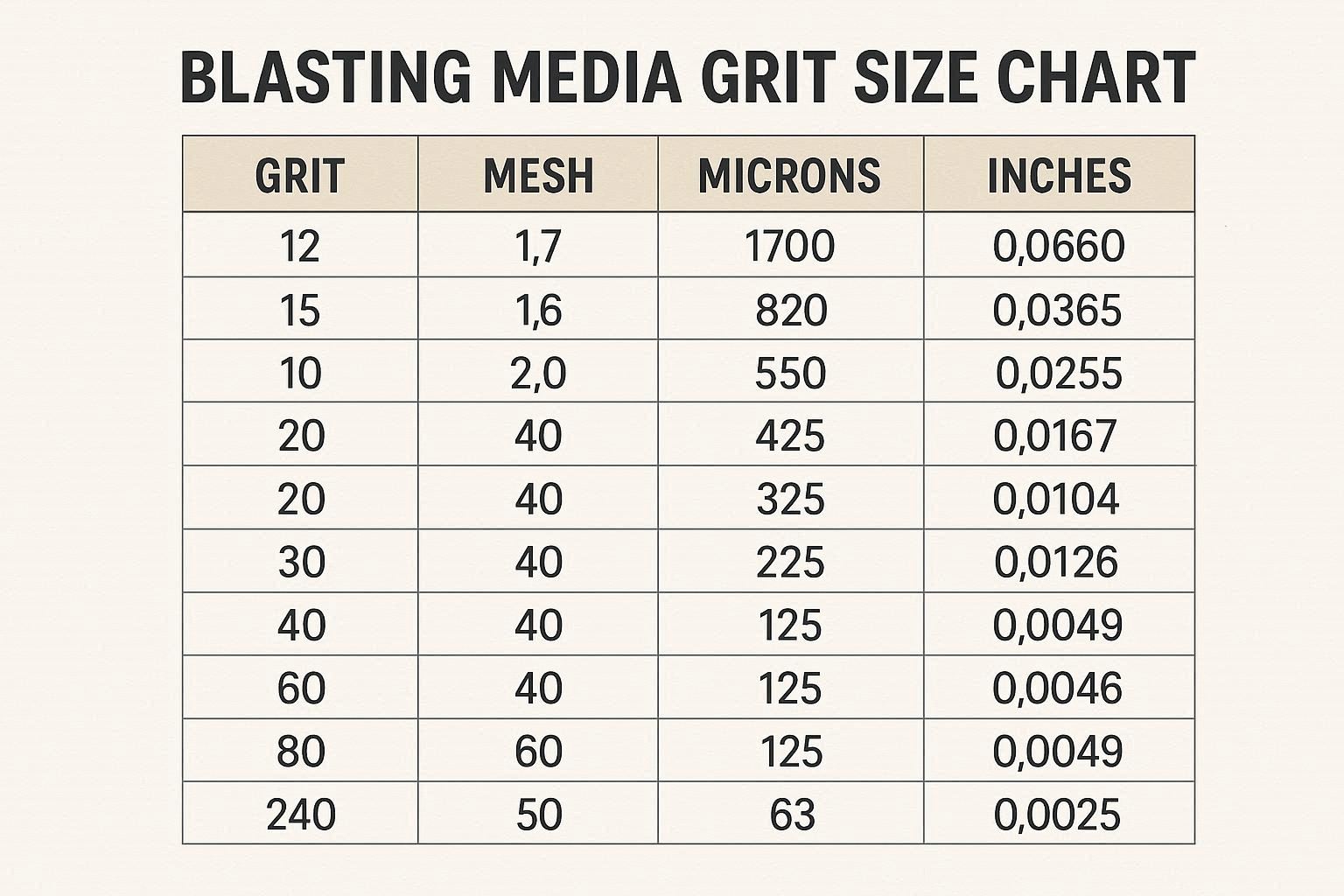
The following table provides a complete cross-reference of grit numbers, particle sizes, and equivalent designations across FEPA, ANSI, and JIS standards for silicon carbide blasting and lapping media.
| FEPA Grit | ANSI Grit | JIS Grit | D50 Particle Size (µm) | Size Range (µm) | Catégorie |
|---|---|---|---|---|---|
| F10 | #10 | #10 | ~2,000 | 2360–1700 | Very Coarse |
| F12 | #12 | #12 | ~1,700 | 2000–1400 | Very Coarse |
| F14 | #14 | #14 | ~1,400 | 1700–1180 | Very Coarse |
| F16 | #16 | #16 | ~1,180 | 1400–1000 | Coarse |
| F20 | #20 | #20 | ~900 | 1180–710 | Coarse |
| F24 | #24 | #24 | ~750 | 1000–600 | Coarse |
| F30 | #30 | #30 | ~600 | 710–500 | Coarse |
| F36 | #36 | #36 | ~500 | 600–425 | Coarse |
| F46 | #46 | #46 | ~380 | 425–300 | Medium-Coarse |
| F54 | #54 | #54 | ~310 | 355–250 | Medium-Coarse |
| F60 | #60 | #60 | ~260 | 300–212 | Medium |
| F70 | #70 | #70 | ~218 | 250–180 | Medium |
| F80 | #80 | #80 | ~185 | 212–150 | Medium |
| F90 | #90 | #90 | ~154 | 180–125 | Medium |
| F100 | #100 | #100 | ~129 | 150–106 | Medium |
| F120 | #120 | #120 | ~109 | 125–90 | Medium |
| F150 | #150 | #150 | ~92 | 106–75 | Medium-Fine |
| F180 | #180 | #180 | ~78 | 90–63 | Medium-Fine |
| F220 | #220 | #220 | ~66 | 75–53 | Fine |
| F240 | #240 | #240 | ~58 | 63–45 | Fine |
| F280 | #280 | #280 | ~52 | 53–40 | Fine |
| F320 | #320 | #360 | ~46 | 53–36 | Fine |
| F400 | #400 | #400 | ~23 | 28–17 | Very Fine |
| F500 | #500 | #600 | ~16 | 20–11 | Ultra Fine |
| F600 | #600 | #800 | ~9 | 14–7 | Ultra Fine |
| F800 | #800 | #1000 | ~6.5 | 10–5 | Ultra Fine |
| F1000 | #1000 | #1200 | ~4.5 | 7–3 | Ultra Fine |
| F1200 | #1200 | #2000 | ~3.0 | 5–2 | Ultra Fine |
SECTION 04Grit Size vs. Surface Profile (Ra and Rz)
Surface roughness is typically measured in Ra (arithmetic mean roughness) or Rz (mean peak-to-valley height). Coating manufacturers specify minimum and maximum Ra or Rz values for their coating systems — the abrasive grit must be selected to achieve a surface profile within this specification window. The following table shows typical Ra values produced by SiC on carbon steel under standard direct-pressure blasting conditions (70 PSI, venturi nozzle, 200 mm standoff).
| SiC Grit (FEPA) | D50 (µm) | Typical Ra on Steel (µm) | Rz Estimate (µm) | ISO 8501 Cleanness | Best Coating Type |
|---|---|---|---|---|---|
| F16–F24 | 750–1180 | 12–20 | 60–110 | Sa 3 | High-build epoxy, TSA thermal spray |
| F36–F46 | 380–500 | 8-13 | 42–70 | Sa 2.5–Sa 3 | Zinc-rich primer, heavy epoxy |
| F60–F80 | 185–260 | 5–9 | 28–50 | Sa 2.5 | Epoxy, polyurethane, coal tar |
| F100–F120 | 109–129 | 3–5 | 16–28 | Sa 2.5 | Standard industrial coatings |
| F150–F180 | 78–92 | 1.5–3 | 8–16 | Sa 2–Sa 2.5 | Precision coatings, glass etch |
| F220–F320 | 46–66 | 0.5–1.5 | 3–8 | Sa 2 | Thin-film coatings, lapping compounds |
| F400–F600 | 9–23 | 0.1–0.5 | 0.5–2.5 | N/A (lapping) | Optical polishing, semiconductor prep |
| F800–F1200 | 3–6.5 | <0.1 | <0.5 | N/A (lapping) | Mirror-finish optical, wafer lapping |
Remarque : Ra values are approximate and depend on blasting pressure, standoff distance, nozzle angle, blast duration, and substrate hardness. Always run a test panel to verify surface profile against your specification before committing to full-production grit selection. Values above are for 70 PSI direct-pressure blasting on carbon steel (HRC 15–20).
SECTION 05Application-Specific Grit Selection Guide
| Application | Substrate | Recommended Grit | Target Profile | Notes |
|---|---|---|---|---|
| Heavy structural steel prep | Carbon steel, rusty | F16–F36 | Ra 10–18 µm | Sa 2.5 / Sa 3; high-build epoxy |
| General metal prep (coating adhesion) | Carbon / alloy steel | F46–F80 | Ra 5–10 µm | Most industrial coatings |
| Paint stripping | Painted steel | F60–F100 | Ra 4–8 µm | Adjust for coating thickness |
| Stainless steel deburring | 304 / 316 SS | F80–F120 | Ra 2–5 µm | Use green SiC to avoid iron contamination |
| Decorative glass etching | Soda-lime glass | F80–F150 | Ra 2–5 µm | Use rubber stencil / vinyl mask |
| Precision glass etching | Borosilicate / fused silica | F150–F220 | Ra 0.8–2 µm | Lower pressure for fine detail |
| Concrete scarification | Concrete, masonry | F12–F24 | CSP 3–5 | ICRI surface profile classification |
| Granite / stone carving | Granite, marble | F24–F60 | Variable | Coarser for carving; finer for etch |
| Titanium aerospace prep | Ti-6Al-4V | F100–F180 | Ra 1.5–4 µm | Green SiC; verify MIL/NADCAP spec |
| Ceramic lapping | Alumina, SiC ceramic | F220–F400 | Ra 0.2–1 µm | Green SiC preferred |
| Silicon wafer / semiconductor | Si, GaAs, SiC wafer | F400–F1200 | Ra < 0.1 µm | Green SiC; ultra-clean process |
| Rock tumbling (coarse stage) | Hard gemstones | F46–F80 | N/A | Progress to finer grits in sequence |
| Rock tumbling (polish stage) | Hard gemstones | F220–F600 | N/A | Final polish with cerium oxide |
| Anti-slip surface prep | Concrete, steel grating | F16–F36 | Deep profile | Mixed with paint or epoxy coating |
| Marine hull prep | Steel, aluminum-free areas | F36–F80 | Ra 5–10 µm | Sa 2.5 per NORSOK M-501 |
SECTION 06Common Grit Selection Mistakes
- Using too coarse a grit for thin coatings: If the anchor profile depth exceeds 1/3 of the coating dry film thickness (DFT), coating peaks will be exposed, causing premature corrosion failures. Match profile depth to coating DFT specifications.
- Using too fine a grit for heavy rust: Fine grits (#150+) on heavily corroded steel will take hours to achieve Sa 2.5 cleanliness that a coarse grit (#36–60) achieves in minutes. Start coarser; move finer only when profile is already adequate.
- Ordering without specifying standard: Ordering “#60 SiC” without specifying FEPA, ANSI, or JIS can result in receiving a different particle size than intended. Always specify the standard for international orders.
- Ignoring wet vs. dry blasting difference: Wet (vapor) blasting produces shallower profiles than dry blasting with identical grit at the same pressure. If switching from dry to wet, compensate with 1–2 grit steps coarser.
- Not accounting for substrate hardness: SiC produces deeper profiles on softer substrates (mild steel) than on harder substrates (hardened tool steel) with the same grit. Calibrate profile testing on the actual substrate, not on a proxy material.
SECTION 07FAQ
SECTION 08Related Guides
Order the Exact Grit You Need — Direct from Manufacturer
Jiangsu Henglihong Technology Co., Ltd. stocks silicon carbide blast media from F10 to F1200 in both Black and Green grades. FEPA, ANSI, and JIS sizing available. Sieve analysis certificate with every lot.
Request Grit-Specific Quote →Filtres