Ceramic Beads vs. Plastic Media for SLS Powder Removal: Gentle Options Compared
Plastic blasting media — acrylic and melamine-formaldehyde being the most common types — is positioned as the gentle alternative to ceramic beads for SLS depowdering. For most SLS materials, this positioning is misleading: plastic media fails to clean rigid PA12 and PA11 parts adequately, costs more per part over the media lifecycle, and contaminates nylon surfaces with plastic dust that interferes with dyeing. For very soft flexible SLS materials (Shore A 70–80), the picture is more nuanced. This article provides the complete comparison so you can make the right call for your specific SLS production context.
1. Plastic Blasting Media Types Used in SLS Depowdering
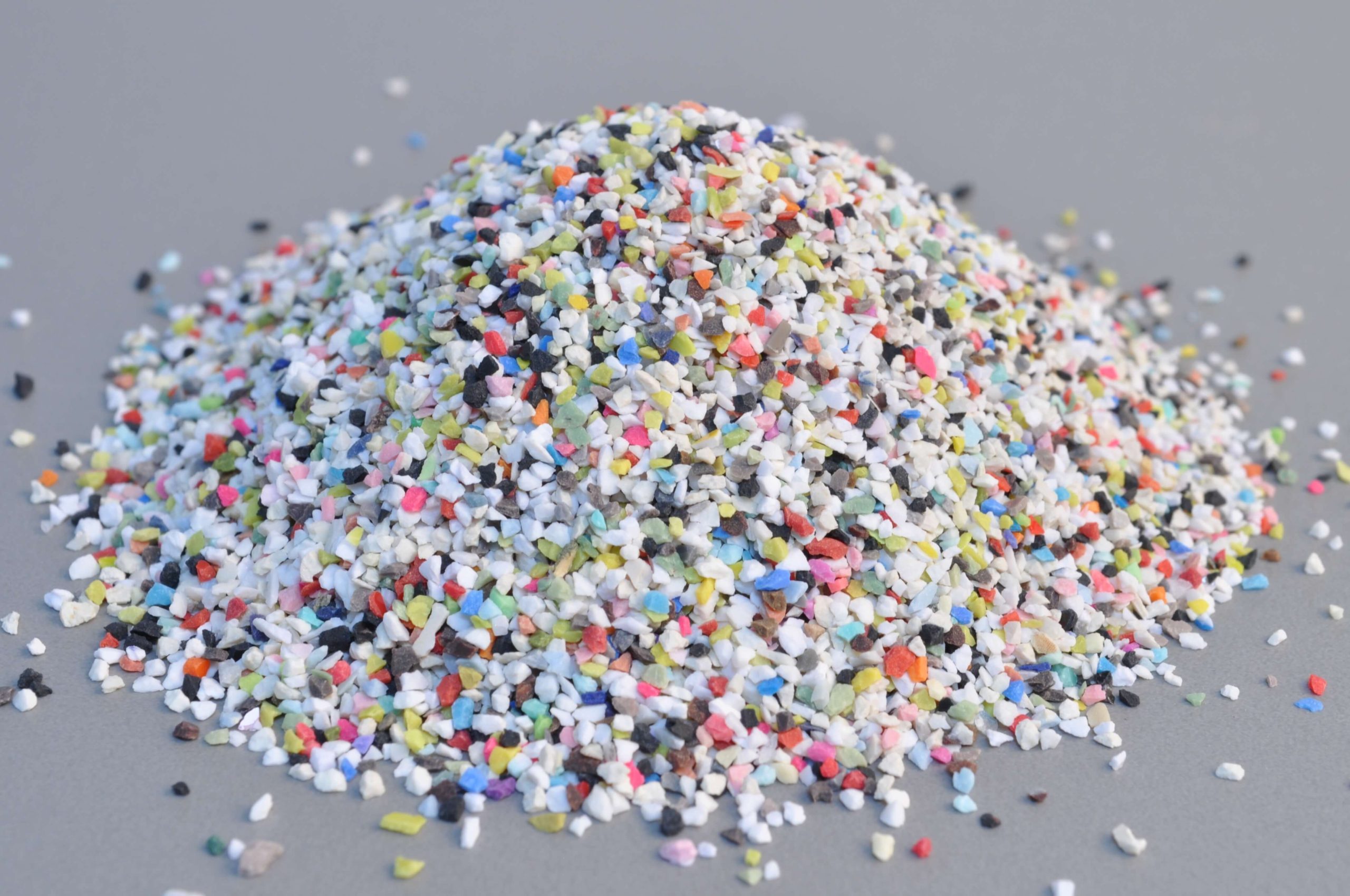
Three categories of plastic blasting media appear in SLS post-processing applications. Each has distinct density, hardness, and breakdown characteristics that determine its suitability for different SLS materials.
Acrylic (PMMA) media is the softest and lightest plastic blasting option (density 1.2–1.3 g/cm³, Mohs 3–4). It degrades quickly (300–500 cycles) and its low hardness means it produces minimal cutting action — making it extremely gentle but correspondingly limited in cleaning effectiveness on anything harder than the softest elastomers. Acrylic media is typically irregular in shape rather than spherical, producing variable surface finish output.
Melamine-formaldehyde media is the most widely used plastic media for SLS depowdering where plastic is specified (density 1.5–1.6 g/cm³, Mohs 4–5). It is available in approximately spherical particle shapes, has slightly better recycling life than acrylic (400–700 cycles), and delivers marginally more cleaning energy per impact due to its higher density. It is the best-performing plastic option for flexible SLS materials in the Shore A 70–82 range where ceramic beads carry deformation risk.
Urea-formaldehyde media (density 1.3 g/cm³, Mohs 3–4) is the lowest-cost plastic option, positioned similarly to acrylic but with somewhat different surface finish characteristics. It is less commonly specified for SLS depowdering than melamine and shares acrylic’s limitation of poor cleaning effectiveness on rigid nylon.
2. Physical Properties Comparison
| Property | Ceramic ZS | Ceramic ZrO₂ | Acrylic (PMMA) | Melamina |
|---|---|---|---|---|
| Densidad (g/cm³) | 3.8–4.0 | 5.4–5.6 | 1.2–1.3 | 1.5–1.6 |
| Hardness (Mohs) | 7.0–7.5 | 8.0–8.5 | 3–4 | 4–5 |
| Recycling cycles | 1,500–2,500 | 2,500–4,000 | 300–500 | 400–700 |
| PA12 skin removal | Excelente | Excelente | Poor | Fair (inconsistent) |
| TPU A85–95 cleaning | Good (reduced pressure) | Bien | Fair | Fair |
| TPU A70–80 cleaning | Fair-Good (min. pressure) | Not recommended | Bien | Bien |
| Breakdown product | Smaller ceramic spheres | Smaller ceramic spheres | Plastic dust + fines | Plastic dust + fines |
| Dye compatibility | Excellent (chemically inert) | Excelente | Poor (dust contamination) | Fair (some contamination risk) |
| Unit cost (relative) | Moderado | Alta | Low-Moderate | Moderado |
| Cost per 1,000 parts | Lower | Lower | Higher | Higher |
3. Cleaning Effectiveness on Rigid SLS Materials (PA12, PA11)
For rigid SLS nylon materials, the outcome is clear: ceramic beads outperform plastic media at every practically relevant blast pressure setting.
The physics are straightforward. The semi-sintered skin on PA12 SLS parts requires impact energy above a specific threshold to break the inter-particle bonds at the skin-to-substrate interface. Kinetic energy per impact = ½mv². At the same blast velocity, acrylic media (m ≈ one-third of ceramic ZS mass for the same diameter) delivers approximately one-third the kinetic energy per impact. Melamine improves on acrylic (one-third becomes closer to 40%), but is still approximately 2.5× less energetic than ceramic ZS per impact at equal velocity.
At typical SLS blast pressures (50–70 PSI), both acrylic and melamine media frequently fail to exceed the skin removal threshold on PA12 and PA11 surfaces — particularly on denser fully sintered zones and in areas where the skin has been partially compacted by the build process. The practical result: a surface that looks clean under casual inspection but retains adherent semi-sintered material that fails under Ra measurement (typically showing Ra 2–5 µm higher than an equivalent ceramic bead blast), shows patchiness after dyeing, and may fail appearance inspection.
No practical blast pressure adjustment compensates for this fundamental energy deficit: increasing pressure to improve plastic media cleaning effectiveness brings either deformation risk (for thin walls) or unacceptably high media breakdown rates, without reliably achieving the cleaning result that ceramic beads deliver at standard protocol pressures.
4. Cleaning Effectiveness on Flexible SLS Materials (TPU)
For flexible SLS materials (TPU, elastomeric grades), the comparison is less one-sided. Here the question is not just “which media cleans better?” but “which media can clean adequately without deforming the part?”
Ceramic beads at the reduced pressure required for Shore A 85–95 TPU (35–45 PSI) still deliver adequate cleaning — removing the semi-sintered skin and producing a surface uniform enough for most functional TPU applications. For Shore A 80–85 TPU, ceramic at the minimum practical pressure (30–38 PSI) is still effective but requires careful multi-cycle protocols and thorough fixturing.
For Shore A 70–80 TPU — very soft, high-elongation materials — ceramic beads at any practical pressure begin to cause deformation: lattice cell collapse, wall thinning, rounding of design-critical edges. This is the narrow hardness window where melamine media’s lower impact energy (from its lower density at equivalent velocity) provides a meaningful deformation safety margin that ceramic cannot match without going below the cleaning energy threshold.
The caveat: melamine at 30–40 PSI on Shore A 70–80 TPU does not always achieve complete semi-sintered skin removal either. The practical expectation for very soft flexible SLS with plastic media is: thorough loose powder removal and partial skin removal — better than ceramic (which deforms the part) but not as complete as the ceramic cleaning achieved on rigid PA12. A combined approach of prolonged compressed-air blow-off followed by gentle plastic media blasting often produces the best outcome for Shore A 70–80 TPU.
5. Surface Finish and Consistency Comparison
The surface finish Ra achievable with plastic media on SLS parts is generally higher (coarser) than with ceramic beads at equivalent bead size and pressure, not lower — which contradicts the intuitive assumption that a softer media would produce a finer finish.
On rigid PA12, plastic media that fails to fully remove the semi-sintered skin leaves a partially cleaned surface that shows the original as-built Ra in areas where skin remains, plus lower Ra in areas where the skin was dislodged. The combined result is a highly variable Ra surface: not uniformly smooth, and not uniformly textured, but patchy and inconsistent. A profilometer measurement on this surface gives a higher Ra than a ceramic-blasted equivalent, with a much higher standard deviation across measurement positions.
On flexible TPU, plastic media at appropriate pressure produces Ra in the range of 12–22 µm — similar to or slightly higher than ceramic at equivalent pressure, because plastic media’s lower hardness means it deforms the polymer surface slightly more visco-elastically rather than peening it cleanly. Surface finish uniformity is comparable between the two media types on flexible substrates.
6. Recycling Life and Contamination Comparison
Plastic media recycling life (300–700 cycles) is comparable to glass beads — significantly shorter than ceramic ZS (1,500–2,500 cycles) or ZrO₂ (2,500–4,000 cycles). The failure mode matters too: plastic media breaks down into fine plastic dust rather than angular fragments. This dust:
- Accumulates in the media charge and clogs the blast cabinet media flow, increasing maintenance frequency
- Settles on the SLS part surface post-blast, creating a plastic residue layer that must be blown off before dyeing or coating
- Contaminates the nylon surface at a micro-scale, potentially interfering with dye bath wetting and producing colour inconsistency under conditions where ceramic would produce clean results
- Creates an inhalation hazard in dry blast environments (plastic dust particle size overlaps with respirable range)
Ceramic bead breakdown products — smaller ceramic spheres — remain chemically inert and continue to function as blasting media until they fall below the minimum usable size. They do not create the surface contamination or media flow problems associated with plastic dust accumulation.
7. Cost-Per-Part Comparison
| Metric | Ceramic ZS | Melamina |
|---|---|---|
| 10 kg charge cost | ~USD 100 | ~USD 90–120 |
| Vida útil | 2,000 cycles | 500 cycles |
| Parts per cycle | 30 | 30 |
| Parts per charge | 60,000 | 15,000 |
| Media cost per part | ~USD 0.0017 | ~USD 0.0067 |
| Premium vs. ceramic ZS | Baseline | +290% (nearly 4× higher) |
At equivalent melamine and ceramic ZS unit price per kg, the 4× service life advantage of ceramic ZS produces a nearly 4× lower media cost per part. Since melamine often costs comparable per kg to ceramic ZS (both are moderate-cost industrial media), the cost advantage of ceramic is dramatic and unambiguous.
Adding the cleaning effectiveness factor: melamine that fails to fully clean rigid PA12 SLS parts generates rework cost (re-blasting with ceramic, or rejecting parts that fail Ra or dye inspection) that adds further to its total cost of ownership. Ceramic ZS that cleans completely in a single qualified protocol generates none of this rework overhead.
8. Decision Framework by SLS Material
| SLS Material | Shore Hardness | Recommendation | Rationale |
|---|---|---|---|
| PA12, PA11, PA12-GB | Rigid (Shore D 70–80) | Ceramic ZS or ZrO₂ | Plastic media cannot clean rigid nylon reliably |
| TPU / elastomeric SLS | Shore A 90–95 | Ceramic ZS at reduced pressure | Ceramic effective and safe at 38–48 PSI |
| TPU / elastomeric SLS | Shore A 82–90 | Ceramic ZS at low pressure | Ceramic effective at 33–42 PSI with good fixturing |
| TPU / elastomeric SLS | Shore A 75–82 | Test both; first-article qualification required | Ceramic may deform fine features; plastic may underclean |
| TPU / elastomeric SLS | Shore A 70–75 | Melamine preferred | Ceramic deformation risk outweighs cleaning advantage |
| Very soft elastomers | Shore A <70 | Air depowdering + vibration; evaluate case by case | No standard media blast appropriate |
9. Hybrid Approach: Sequential Ceramic and Plastic
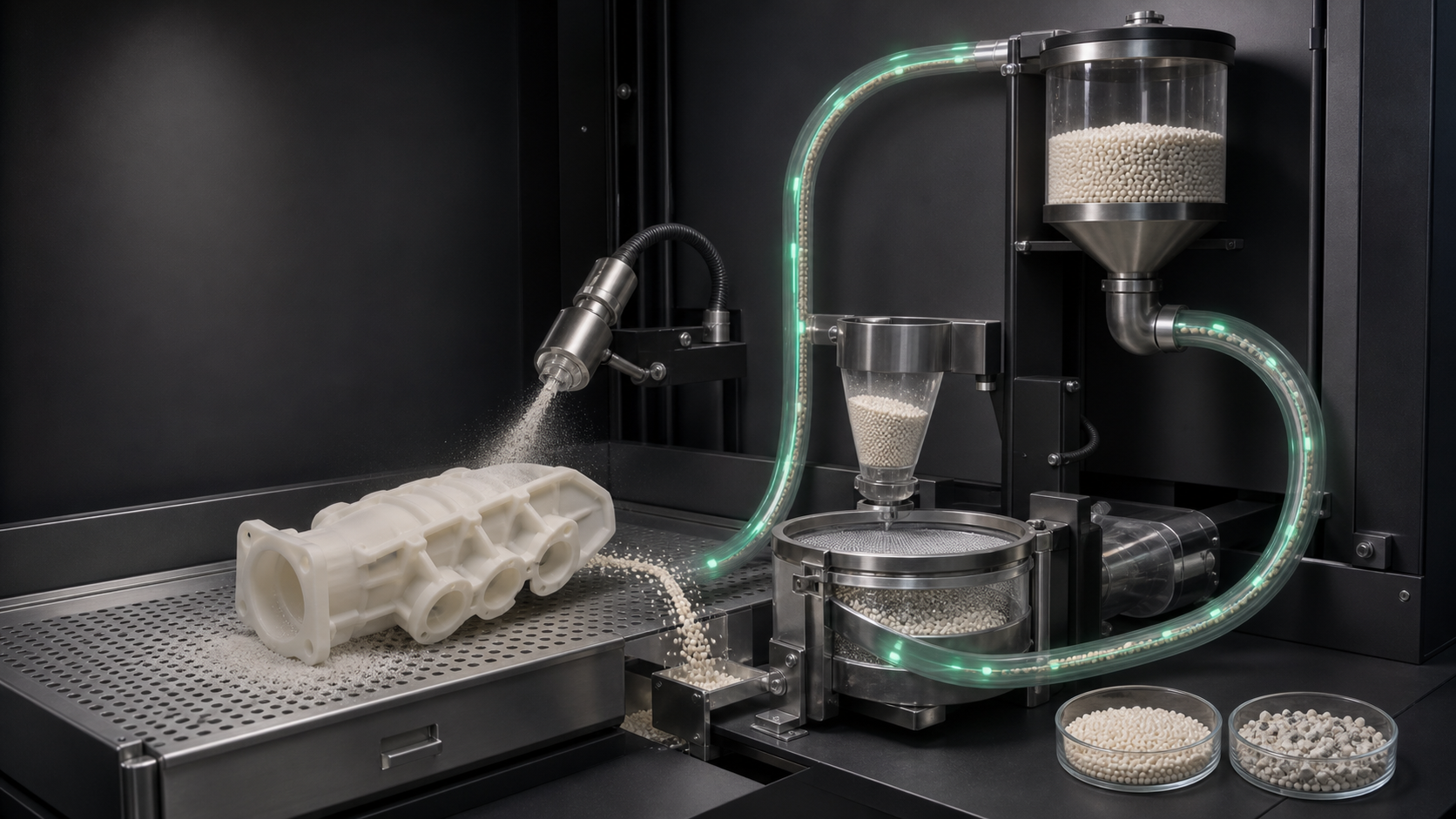
A small number of SLS post-processing operations use a sequential hybrid approach for specific applications: a primary ceramic bead blast cycle for complete powder removal and semi-sintered skin dislodgement, followed by a short plastic media cycle for final surface smoothing. This approach targets applications that require the lowest possible Ra (below 4 µm) that dry ceramic blasting cannot consistently achieve alone, while needing the complete cleaning effectiveness of ceramic for the bulk of the work.
In practice, this hybrid adds complexity — media purging between cycles, two qualified protocols to maintain, additional cycle time — and rarely provides enough Ra benefit over fine ceramic bead dry blasting to justify the overhead. It is mentioned here for completeness; wet ceramic bead blasting at fine bead size typically achieves the same Ra improvement with less operational complexity for most applications where Ra below 4 µm is required.
Preguntas frecuentes
Plastic media (acrylic or melamine) has density 1.2–1.6 g/cm³ — approximately 2.5–3× lower than ceramic ZS at 3.8–4.0 g/cm³. At the same blast velocity, plastic media delivers roughly one-third the kinetic energy per impact. The semi-sintered skin on PA12 SLS requires impact energy above a threshold to break the inter-particle bonds at the skin-substrate interface. At typical SLS blast pressures (50–70 PSI), plastic media frequently fails to exceed this threshold, leaving adherent surface residue that looks clean under casual inspection but fails Ra measurement and produces patchiness after dyeing.
Plastic media (specifically melamine at 0.10–0.20 mm) outperforms ceramic beads only for SLS materials at Shore A 70–80 and below, where even ceramic beads at the minimum practical pressure (28–35 PSI) risk permanent deformation of the part. For very soft flexible SLS elastomers, plastic media’s lower density provides a deformation safety margin that ceramic cannot match. For all rigid SLS materials (PA12, PA11, PA12-GB) and TPU grades above Shore A 82, ceramic beads at appropriately reduced pressure outperform plastic on cleaning, surface finish, cost per part, and dye compatibility.
Despite plastic media’s comparable or lower unit price per kilogram, ceramic ZS has significantly lower media cost per part. At representative prices and service lives (ceramic ZS: ~USD 10/kg, 2,000 cycles; melamine: ~USD 9–11/kg, 500 cycles), ceramic ZS media cost per part is approximately 70–75% lower than melamine on a pure media basis. Additionally, ceramic eliminates the rework cost from incomplete cleaning and dye contamination issues associated with plastic media on rigid PA12 — making the total cost advantage of ceramic even larger in practice.
Yes, but not simultaneously. Maintain separate media charges and purge the blast cabinet between media types (5–10 minutes of running to clear the hose, nozzle, and cabinet floor). For operations processing both rigid PA12 and very soft TPU, two dedicated cabinets eliminate the purge step entirely. Never mix plastic and ceramic bead charges in the same cabinet — the mixed charge produces unpredictable Ra output and the plastic dust generated by media breakdown will contaminate the ceramic charge, reducing ceramic cleaning effectiveness over time.
Related Articles in This Series
Return to the Ceramic Beads for SLS Powder Removal — Complete Guide for the full overview.
The ceramic bead protocol for flexible SLS — defining the boundary where plastic media becomes relevant.
The more common comparison — how ceramic displaced glass beads in professional SLS operations.
Low-pressure protocol development — the foundation for safe ceramic bead blasting on flexible SLS.
Why plastic dust contamination from plastic media interferes with SLS dyeing — and how ceramic eliminates it.
Fine bead selection for delicate geometry — the ceramic alternative to switching to plastic media.
How ceramic media management produces the 4× lower cost-per-part vs. plastic media.
Switch from Plastic Media to Ceramic Beads for Your SLS Operation
Jiangsu Henglihong Technology Co., Ltd. supplies fine-grade ZS ceramic blasting beads suited for all SLS materials including flexible TPU grades. Tell us your current plastic media specification and SLS material — we will recommend the right ceramic grade and pressure adjustment for your first-article qualification.
Request Ceramic Bead SamplesFiltros