Blasting Media for 3D Printed Parts: Glass Beads vs Aluminum Oxide vs Steel Shot — Selection Guide
Selecting the right abrasive blasting media for your 3D printed parts is the single most consequential decision in post-processing design. The wrong media can contaminate a titanium implant with iron, embed particles in a soft aluminum surface and ruin anodizing, damage thin-walled polymer structures, or simply fail to achieve the required surface finish in a reasonable cycle time. The right media — matched to your material, geometry, and post-processing objective — delivers consistent, cost-effective, and repeatable results at scale. This guide is the most comprehensive media selection reference for AM post-processing: a complete comparison of glass beads, aluminum oxide, steel shot and grit, zirconia, ceramic, and plastic media — with compatibility matrices, Ra outcome data, cost comparisons, and media quality management guidance.
1. Why Media Selection Is the Most Critical Decision
Every abrasive blasting decision flows from the media choice. Pressure, standoff, angle, and exposure time are adjustable to compensate for minor parameter variations, but the media type determines the fundamental character of the process: whether it cuts or peens, how hard and dense the particles are, what their shape does to the surface, whether they contaminate the substrate, and how long they survive before breaking down.
In AM post-processing specifically, media selection errors have serious consequences:
- Iron contamination of titanium or stainless steel: Renders parts unusable for medical, food-contact, or corrosion-sensitive applications — a costly and unrecoverable failure
- Al₂O₃ embedding in AlSi10Mg: Creates anodizing defects that cannot be corrected without re-blasting and re-anodizing
- Inappropriate media on thin-wall FDM parts: Structural damage or cracking that destroys the part
- Wrong anchor profile for the coating system: Coating delamination in service, requiring part rework or replacement
This guide provides the complete decision framework for media selection across all major AM materials and post-processing objectives.
2. Glass Beads: Properties, Applications, and Limitations
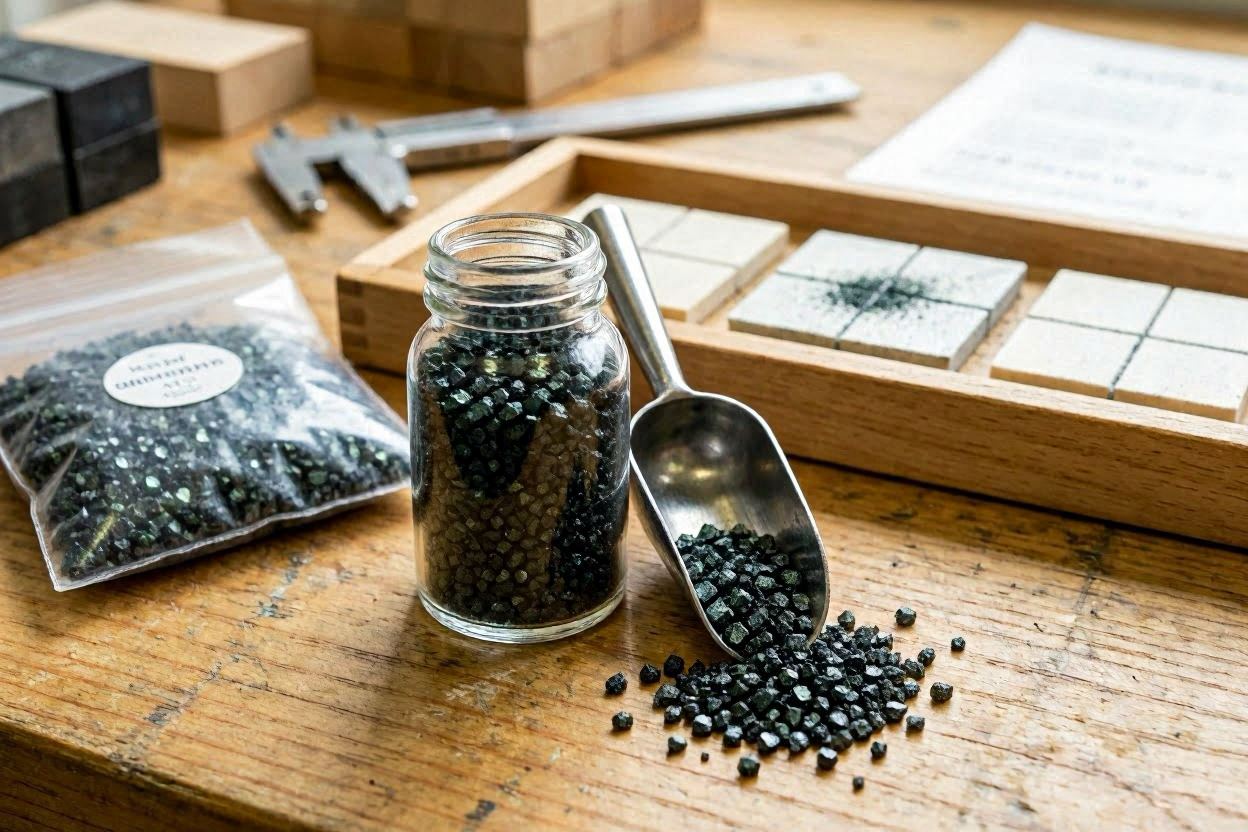
Glass beads are the most versatile and widely used abrasive medium in AM post-processing. Manufactured from borosilicate glass, screened to tight size tolerances, and selected for sphericity, they are the default first choice for most AM blasting applications.
Key Properties
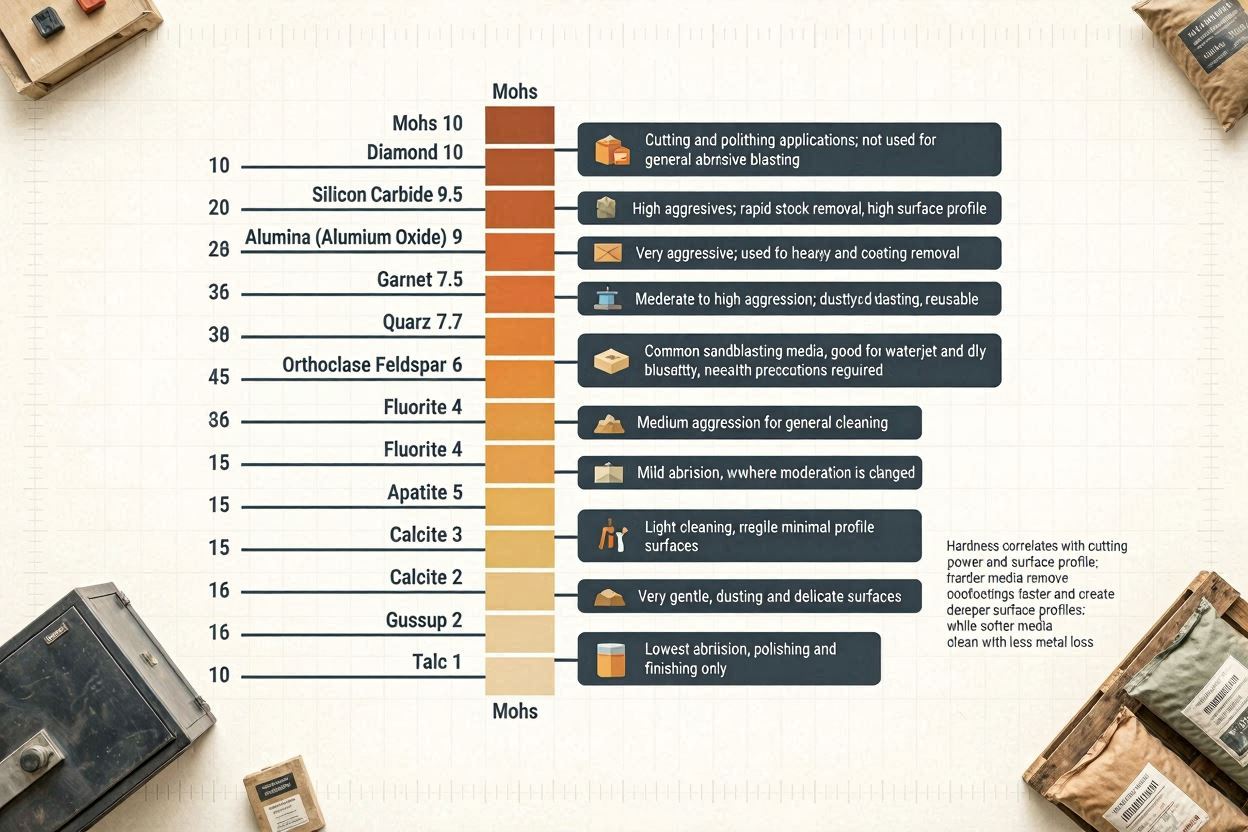
- Dureza: Mohs 6 / approximately 550–600 HV
- Forma: True spherical, typically ≥95% sphericity
- Densidad: 2.45–2.50 g/cm³
- Chemical composition: Borosilicate glass — no free crystalline silica; OSHA-compliant
- Available sizes: 40–400 mesh; most common for AM: 80–250 mesh
- Vida mediática: 300–500 effective impacts per bead before fracture
What Glass Beads Do at the Surface
Glass beads impact in peening mode: spherical contact deforms the surface peak plastically, flattening it without creating a new cutting scar. The result is a uniformly matte, non-directional surface with consistent Ra reduction, light compressive stress induction, and no directional texture. The surface appears bright-matte on metals, clean matte on polymers, with a fine, uniform dimple texture under magnification.
Aplicaciones
- Surface finishing of all SLM metals — titanium, stainless steel, Inconel, aluminum (primary choice)
- Pre-anodizing surface preparation of AlSi10Mg
- Medical titanium implant conditioning (osseointegration target Ra)
- FDM and SLS polymer part finishing
- MJF nylon surface conditioning and dye preparation
- Pre-coating anchor profile where Ra ≤ 5 µm is required
Limitaciones
- Cannot achieve the aggressive anchor profile (Ra 6–12 µm) for thermal spray
- Cannot deliver high Almen intensities for titanium shot peening at demanding specifications
- Less efficient than Al₂O₃ for removing heavy EDM recast layers
- Shorter media lifetime than zirconia or steel shot
3. Aluminum Oxide (Al₂O₃): Properties, Applications, and Limitations
Aluminum oxide (alumina, corundum) is the hardest commonly used blasting medium after diamond and silicon carbide. Its angular fracture morphology creates highly effective micro-cutting action — making it the preferred choice for aggressive surface conditioning, coating anchor profile creation, and support zone treatment on hard metal AM parts.
Key Properties
- Dureza: Mohs 9 / 2000–2100 HV
- Forma: Angular, irregular fracture surfaces with sharp cutting edges
- Densidad: 3.95–4.00 g/cm³
- Available sizes: 36–220 grit for AM applications
- Vida mediática: 50–200 effective impacts per particle
Aplicaciones
- Pre-coating anchor profile creation on steel, Inconel, and tool steel AM parts
- Support attachment zone cleaning and EDM recast layer removal
- Pre-thermal spray surface preparation (coarse grit: 36–60)
- Aggressive cleaning of heavily oxidised EBM or furnace-scale surfaces
- Pre-paint anchor profile on AlSi10Mg (cautiously)
Limitations and Prohibitions
- Embedding risk on AlSi10Mg — use 120+ grit, minimum effective pressure, single-pass only
- Not recommended for titanium AM parts (surface discontinuity risk)
- Not for pre-passivation on stainless steel — glass beads preferred
- Not for any polymer AM material — too aggressive for plastics
4. Steel Shot and Steel Grit: Properties and Applications
Steel shot and grit are the densest, highest-kinetic-energy blasting media. Their high density enables maximum peening energy for fatigue life improvement on carbon steel, alloy steel, and nickel superalloy AM components.
Steel Shot (Spherical)
- Dureza: 40–65 HRC; Densidad: 7.8 g/cm³ (3× glass beads)
- Efecto: Intense peening; compressive residual stress induction
- Primary use: Shot peening of carbon steel, alloy steel, Inconel AM parts
- Sizes for AM: S110 (0.28 mm) and S170 (0.43 mm) — smallest standard sizes for complex geometry
Steel Grit (Angular)
- Dureza: 55–65 HRC; angular crushed steel
- Efecto: Aggressive cutting; high anchor profile; rapid scale removal
- Primary use: Descaling of heavy steel AM parts; aggressive pre-coat preparation for thick coatings
Absolute prohibition: Steel shot and grit must never be used on titanium (all grades), stainless steel (all grades), cobalt-chrome (medical), or any alloy or application where iron contamination is a specification concern. The contamination is permanent and not removable by standard post-blast cleaning — ferroxyl testing will detect it as a hard failure.
5. Plastic Media: Gentle Cleaning for Delicate AM Parts
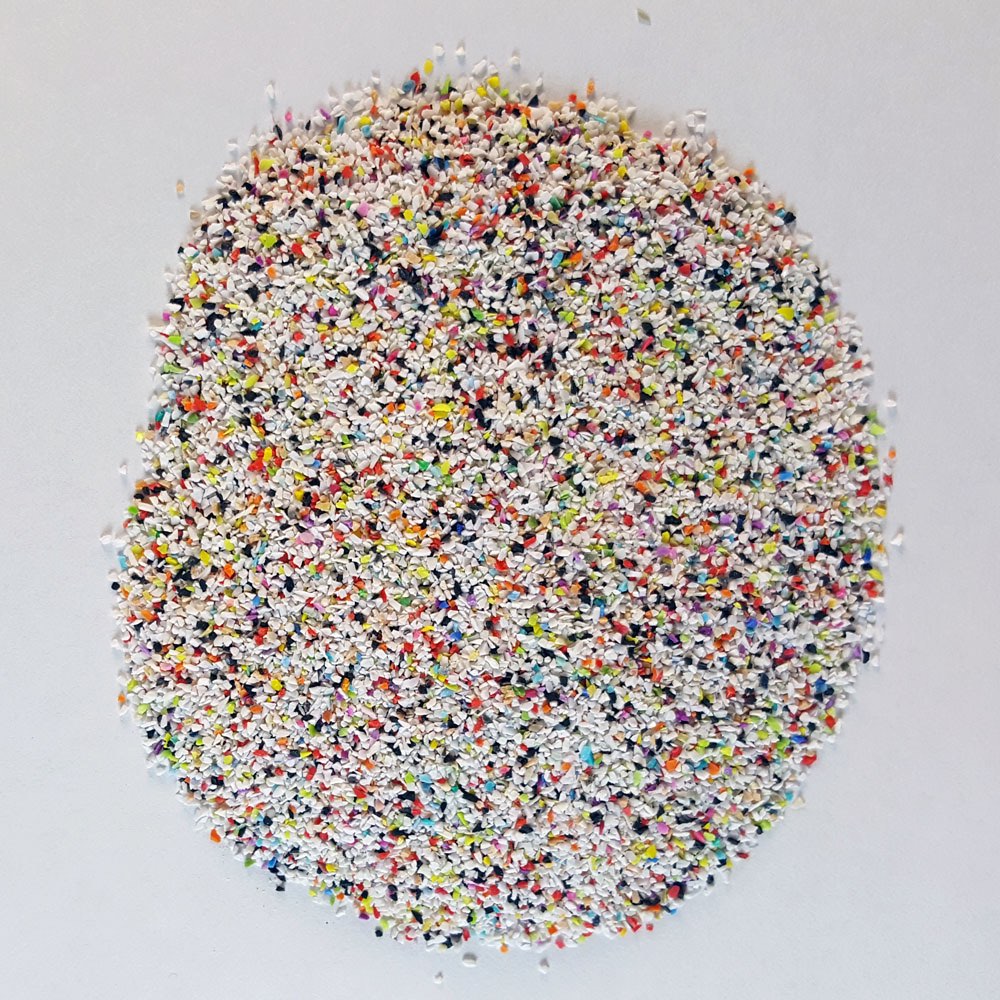
Plastic blasting media (PMB) is manufactured from polyester or acrylic polymer — the gentlest abrasive option available. Its primary role in AM post-processing is first-stage depowdering of SLS and MJF parts, and light cleaning of very thin-walled or delicate FDM/SLA polymer parts where even fine glass beads at minimum pressure are too aggressive.
- Dureza: Mohs 2–4; Densidad: 1.1–1.3 g/cm³ (lightest of all media)
- Efecto: Gentle cleaning; loosening and displacing adherent powder; negligible Ra change
- Applications: SLS/MJF stage-1 depowdering; thin-wall FDM parts; stripping old coatings
- Limitaciones: Essentially no Ra improvement; not suitable for metal AM finishing; for coating preparation on polymers, follow PMB with glass bead finishing pass
6. Specialty Media: Zirconia, Ceramic, and Organic
Zirconia Shot (ZrO₂)
The premium media for peening titanium and other alloys where steel shot is prohibited. Mohs 7.5, density 3.85 g/cm³ — significantly harder and denser than glass, enabling higher Almen intensities on hard alloys. Media life 10–30× greater than glass beads. High unit cost is justified for high-volume titanium peening where media cost per part is significant.
Tiro cerámico
Aluminium silicate or zirconia silicate: intermediate between glass and zirconia in hardness (Mohs 7) and density (3.4–3.7 g/cm³). Provides higher peening energy than glass beads with better media life, at lower cost than zirconia. Used for titanium and stainless steel applications requiring moderate Almen intensity where glass beads are insufficient and zirconia is cost-prohibitive.
Organic Media (Walnut Shell, Corn Cob)
Not recommended for AM post-processing. While used for paint stripping on extremely delicate substrates, organic media degrades rapidly, can introduce organic contamination, and is difficult to fully remove from complex AM geometries. Plastic media provides equivalent gentleness with better process consistency for AM applications.
7. Material Compatibility Matrix
| AM Material | Cuentas de vidrio | Al₂O₃ Grit | Disparo de acero | Zirconia | Soportes de plástico |
|---|---|---|---|---|---|
| Ti-6Al-4V (SLM/EBM) | ✓ Primary | ⚠ Not recommended | ✗ Prohibited | ✓ Peening | ✓ Depowdering only |
| 316L Stainless (SLM) | ✓ Primary | ⚠ Pre-coat only | ✗ Prohibited | ✓ Acceptable | ✓ Cleaning only |
| AlSi10Mg (SLM) | ✓ Primary | ⚠ Pre-coat; embed risk | ✗ Prohibited | ⚠ Overkill/expensive | ✓ Thin-wall parts |
| Inconel 718/625 (SLM) | ✓ Finishing | ✓ Pre-coat / cleaning | ✓ Peening | ✓ Alternative | ✗ No benefit |
| Maraging Steel (SLM) | ✓ Finishing | ✓ Pre-coat | ✓ Peening | ✓ Acceptable | ✗ No benefit |
| CoCr (SLM — medical) | ✓ Primary | ✓ Dental apps | ✗ Medical prohibited | ✓ Acceptable | ✗ No benefit |
| FDM (ABS, Nylon, PC) | ✓ Primary | ✗ Too aggressive | ✗ Prohibited | ✗ Overkill | ✓ Thin walls |
| SLS/MJF PA12 Nylon | ✓ Stage 2 | ✗ Too aggressive | ✗ Prohibited | ✗ Not needed | ✓ Stage 1 depowder |
| SLA / DLP Resin | ⚠ Very low pressure | ✗ Prohibited | ✗ Prohibited | ✗ Not needed | ✓ Primary |
Legend: ✓ = Recommended / Acceptable; ⚠ = Conditionally acceptable (see notes); ✗ = Prohibited or not recommended
8. Media Selection by Post-Processing Objective
| Objective | Best Media Choice | Ra Target |
|---|---|---|
| General surface finish / matte | Glass beads 150–200 mesh | 1–4 µm |
| Medical implant (osseointegration) | Glass beads 150–200 mesh | 1.5–4 µm |
| Pre-anodizing (AlSi10Mg) | Glass beads 100–200 mesh | 1–4 µm |
| Pre-paint / pre-epoxy primer | Al₂O₃ 80–120 grit (metals); glass beads (Ti/SS) | 2.5–5 µm |
| Pre-powder coat | Al₂O₃ 80–120 + conversion coat (steel/Al); glass beads (SS) | 3–7 µm |
| Pre-thermal spray (ceramic TBC) | Al₂O₃ 36–60 grit | 6–12 µm |
| Pre-PVD coating | Glass beads → then electropolish | ≤0.5 µm post-polish |
| Shot peening (Ti, SS, CoCr) | Zirconia Z150–Z425 or ceramic | 2–4 µm post-peen |
| Shot peening (Inconel, steel) | Steel shot S110–S230 | 2–5 µm post-peen |
| Support zone cleaning (Ti) | Glass beads 80–120 mesh at high pressure | Match surrounding surface |
| Support zone cleaning (steel/Inconel) | Al₂O₃ 60–80 grit | Match surrounding surface |
| SLS/MJF depowdering | Plastic media (stage 1) | Minimal change |
| FDM polymer finishing | Glass beads 150–200 mesh | 3–8 µm |
9. Cost, Lifecycle, and Quality Management
Media Cost Comparison
Unit cost ranking from lowest to highest (approximate, per kilogram): Steel grit < Steel shot < Aluminum oxide < Glass beads < Ceramic shot < Zirconia shot. However, cost per blast cycle — not unit cost per kilogram — is the correct metric, since media with longer life costs less per cycle despite higher unit price. Steel shot S110 has service life approximately 10–15× longer than aluminum oxide grit at equivalent pressure, making it competitive on a per-cycle basis.
| Tipo de medio | Relative Unit Cost | Approx. Impacts to Fracture | Cost per Part |
|---|---|---|---|
| Al₂O₃ grit | Bajo | 50–150 | Moderate (fast consumption) |
| Cuentas de vidrio | Medium | 300–500 | Low-medium |
| Steel shot S-type | Medium-high | 2,000–5,000 | Low (long life) |
| Tiro cerámico | Alta | 3,000–6,000 | Medium |
| Zirconia shot | Very high | 5,000–10,000 | Medium-high (life justified) |
| Soportes de plástico | Very high per kg | 200–500 | High (specialty use) |
Media Quality Management
- Incoming inspection: Verify sieve size distribution against specification on every new lot; check sphericity for glass beads and zirconia; verify chemical and hardness certification for steel shot
- In-service monitoring: Periodic sieve analysis to confirm size distribution has not degraded; visual inspection for angular fragments in spherical media; contamination checks
- Media replacement: Replace when sieve analysis shows more than 20% of media by weight has degraded below minimum specified size, or when visual inspection shows more than 30% angular or broken particles in spherical media
- Cross-contamination prevention: Dedicated media circuits for each media type; clear labelling of blast cabinets; ferroxyl test of first parts after any media change in titanium or stainless circuits
For the complete application of these media in specific AM contexts, reference: Ti-6Al-4V titanium, AlSi10Mg aluminum, 316L stainless steely metal AM shot blasting protocol.
Preguntas frecuentes
How do I choose between glass beads and aluminum oxide for a metal AM part?
The decision depends on alloy contamination sensitivity and post-processing objective. For contamination sensitivity: titanium and stainless steel require iron-free media — glass beads only. For aluminum (AlSi10Mg): glass beads preferred to prevent embedding; Al2O3 only if a pre-coating anchor profile is needed and contamination is acceptable. For Inconel, tool steel, and carbon steel: either media is acceptable. For objective: glass beads produce a matte finish, mild peening, and relatively smooth Ra. Al2O3 produces a higher anchor profile for coating adhesion and more aggressive oxide removal. Use glass beads for general finishing and pre-anodizing; use Al2O3 for pre-painting, pre-thermal spray, and aggressive cleaning of support zones.
What size glass beads should I use for SLM metal AM parts?
For most SLM metal AM applications, the 100 to 200 mesh range (75 to 150 µm diameter) is the most useful. Finer breakdown: 80 to 100 mesh for initial cleaning passes on heavily roughened EBM or down-skin surfaces; 100 to 150 mesh for general cleaning and first-pass Ra reduction on SLM side walls; 150 to 200 mesh for finishing passes and applications requiring Ra below 3 µm; 200 to 250 mesh for fine surface conditioning where the lowest achievable Ra from bead blasting is required. For FDM and SLS polymer parts, 150 to 250 mesh is the standard range — coarser beads risk surface damage on plastics.
How does zirconia shot compare to glass beads for titanium AM parts?
Zirconia shot (ZrO2, Mohs 7.5) is denser (3.85 g per cm3) and harder than glass beads (Mohs 6, density 2.5 g per cm3). At equivalent pressure and standoff, zirconia delivers approximately 1.5 times more impact energy per particle than glass beads. For titanium AM blasting, glass beads at standard parameters (55 to 75 psi) produce the required Ra range (1.5 to 4 µm) and are the most economical choice. Zirconia is specified when the required Almen peening intensity exceeds what glass beads can achieve, when faster cycle times are needed for production efficiency, or when the EBM titanium starting Ra is too high for glass beads to address efficiently in a single pass. Zirconia costs 5 to 10 times more than glass beads per kilogram but lasts 10 to 30 times longer.
Can I use the same blast cabinet for both steel shot and glass beads?
Technically possible, but not recommended for titanium or stainless steel parts. When a blast cabinet is used for steel shot, small steel particles adhere to the cabinet walls, media circuit, and residual media in the hopper. When glass beads are subsequently loaded, steel particle contamination can mix into the glass bead media and transfer iron to titanium or stainless steel parts. For facilities processing both steel-peened carbon steel parts AND glass-bead-finished titanium or stainless AM parts, maintain separate dedicated blast cabinets for each media type. If a shared cabinet is unavoidable, perform thorough cabinet cleaning and purge cycles between media changes, and confirm absence of iron contamination on test specimens by ferroxyl test before processing production parts.
What happens to glass beads as they are recycled over time?
Glass beads break down progressively with use. Each impact either leaves the bead intact (most common at low pressures) or fractures it into smaller, angular pieces. As the bead population ages, average size decreases and the proportion of angular fractured pieces increases. This produces two effects: decreased peening and conditioning effectiveness as average kinetic energy per impact drops; and increased surface cutting action from angular fragments, which can produce a coarser or more irregular surface texture than fresh spherical beads. Monitor media quality by periodic sieve analysis to confirm the size distribution remains within the specified mesh range. Replace the media when the sieve analysis shows the distribution has shifted more than one mesh size below specification, or when visual inspection shows more than 30% angular or broken particles.
What is the most economical media for high-volume SLM metal AM post-processing?
For high-volume SLM production operations, the most economical media choice balances unit cost per kilogram against usage life and cost per part. Glass beads: moderately economical for moderate production volumes (300 to 500 impacts per bead before fracture). Steel shot: most economical for carbon steel, alloy steel, and Inconel AM parts where iron contamination is not a concern — steel shot lasts 2,000 to 5,000 impacts, making per-part media cost very low. Zirconia: highest unit cost but longest life (5,000 to 10,000 impacts); most economical for continuous-production facilities blasting titanium AM parts where the media cannot be steel. The optimal strategy for high-volume operations is a cost-per-part analysis including media cost, usage rate, and cycle time for each alloy, rather than selecting media on unit price alone.
Source the Right Blasting Media for Your AM Post-Processing Line
Jiangsu Henglihong Technology Co., Ltd. manufactures the complete range of blasting media for AM post-processing: glass beads in 40–400 mesh, aluminum oxide in 36–240 grit, steel shot in S70–S780, zirconia shot, ceramic beads, and plastic media — all available with full batch documentation. Contact our technical team for media specification support.
Contact Our Technical TeamPublished July 2026 by Jiangsu Henglihong Technology Co., Ltd. — Specialists in industrial abrasive blasting media for additive manufacturing post-processing.
Filtros