Total Cost of Ownership for Abrasive Media Pumps: Why Cheap Pumps Cost More in the Long Run
Procurement decisions for abrasive media pumps are frequently made on the basis of initial purchase price alone. It is a systematic error—and one that almost always results in higher total spending over a three-to-five-year operating horizon. In high-duty abrasive applications, the pump’s initial cost typically represents only 10–20% of its five-year total cost of ownership. The remaining 80–90% is determined by energy consumption, maintenance materials, and unplanned downtime—variables that are directly controlled by pump quality, materials specification, and correct selection for the application.
This guide explains how to build a rigorous Total Cost of Ownership (TCO) model for abrasive media pumps, illustrates the cost difference between low-cost and quality pump selection with a worked example, and shows how abrasive media quality itself is a variable in your pump TCO equation. For the full pump selection framework, see: Pumps for Abrasive Media: The Complete Selection & Buying Guide.
1. Why Purchase Price Is the Wrong Metric for Abrasive Media Pumps
The purchase price of an industrial pump is a single, known number that appears prominently on a supplier quotation. It is easy to compare. Unfortunately, it is also largely irrelevant as a standalone decision metric for pumps handling abrasive media—because purchase price captures only the initial cash outflow, not the stream of operating costs that follow over the pump’s working life.
Consider that a medium-duty abrasive slurry pump operates for 2,000 hours per year. Over five years, that is 10,000 operating hours. During this time, the pump consumes electricity continuously, requires planned maintenance on liners and seals at regular intervals, and may experience several unplanned failures that cause production stoppages. The cumulative cost of these events typically dwarfs the initial purchase price—often by a factor of 5 to 15×. A pump that costs USD 600 more at purchase but consumes 15% less energy and lasts twice as long between liner replacements will almost certainly deliver lower total cost over five years.
The “False Economy” PatternThe most common pattern observed in abrasive pump procurement: a facility selects the cheapest available option, experiences rapid liner wear, unplanned downtime, and seal failures, and then upgrades to a quality pump after 12–18 months—having already incurred the full costs of both the failed cheap pump and the correct replacement. A five-year TCO analysis before the initial purchase would have identified the correct pump on the first procurement cycle.
2. The Six Components of Abrasive Pump TCO
A complete TCO model for abrasive media pumps captures six distinct cost categories, each of which must be estimated separately and then summed over the analysis period:
Note: percentages are indicative for a medium-duty continuous-service abrasive slurry pump in a process application. Distribution varies with pump size, duty factor, and local energy prices.
The most important insight from this breakdown is that energy and planned maintenance together account for 60–65% of five-year TCO—dwarfing the initial purchase price. A pump that is more efficient at the design duty point, and whose liner and seal materials produce longer service intervals in your specific media, will deliver lower TCO regardless of a higher purchase price.
3. Energy Cost: The Dominant Long-Term Driver
For electrically-driven centrifugal slurry pumps operating at significant duty—say 7.5 kW motor at 2,000 hours/year—annual energy cost at $0.12/kWh is approximately $1,800. Over five years, this is $9,000 in energy alone, versus an initial pump purchase price that might be $1,200–2,000. Energy cost already exceeds purchase cost within the first two years of operation, even before maintenance and downtime costs are added.
Two factors critically affect pump energy cost in abrasive service:
- Hydraulic efficiency at the operating duty point: Pumps operating far from their Best Efficiency Point (BEP)—as often happens when a pump is oversized or undersized for the actual system curve—consume 15–30% more energy than a correctly selected pump at the same flow and head. For abrasive slurry pumps specifically, the slurry-corrected BEP shifts compared to the water curve. Always verify that the slurry duty point falls within 85–115% of the pump’s corrected BEP.
- Efficiency degradation with liner wear: As impeller-to-liner clearance increases with wear, volumetric efficiency drops and energy consumption rises for the same output. A pump with clearance worn to 2–3× its designed gap may be consuming 20–25% more energy than a new pump at identical flow and head. This wear-driven energy penalty is invisible on energy bills unless baseline consumption is tracked and trended. Maintaining designed clearance—through regular impeller adjustment or timely liner replacement—is as much an energy management measure as a maintenance measure.
Variable frequency drives (VFDs) offer a third lever: in processes with variable flow demand, VFDs can reduce pump speed during low-demand periods, cutting energy consumption by 20–40% annually while simultaneously reducing wear rate (since wear scales approximately with velocity cubed). For guidance on optimizing operating speed for abrasive media applications, see: Optimal RPM & Flow Rate for Abrasive Media Pumps.
4. Maintenance Cost Modeling for Abrasive Service
Planned maintenance cost for abrasive media pumps is the sum of wear-part replacement costs at their respective replacement intervals. The primary wear items and their cost drivers are:
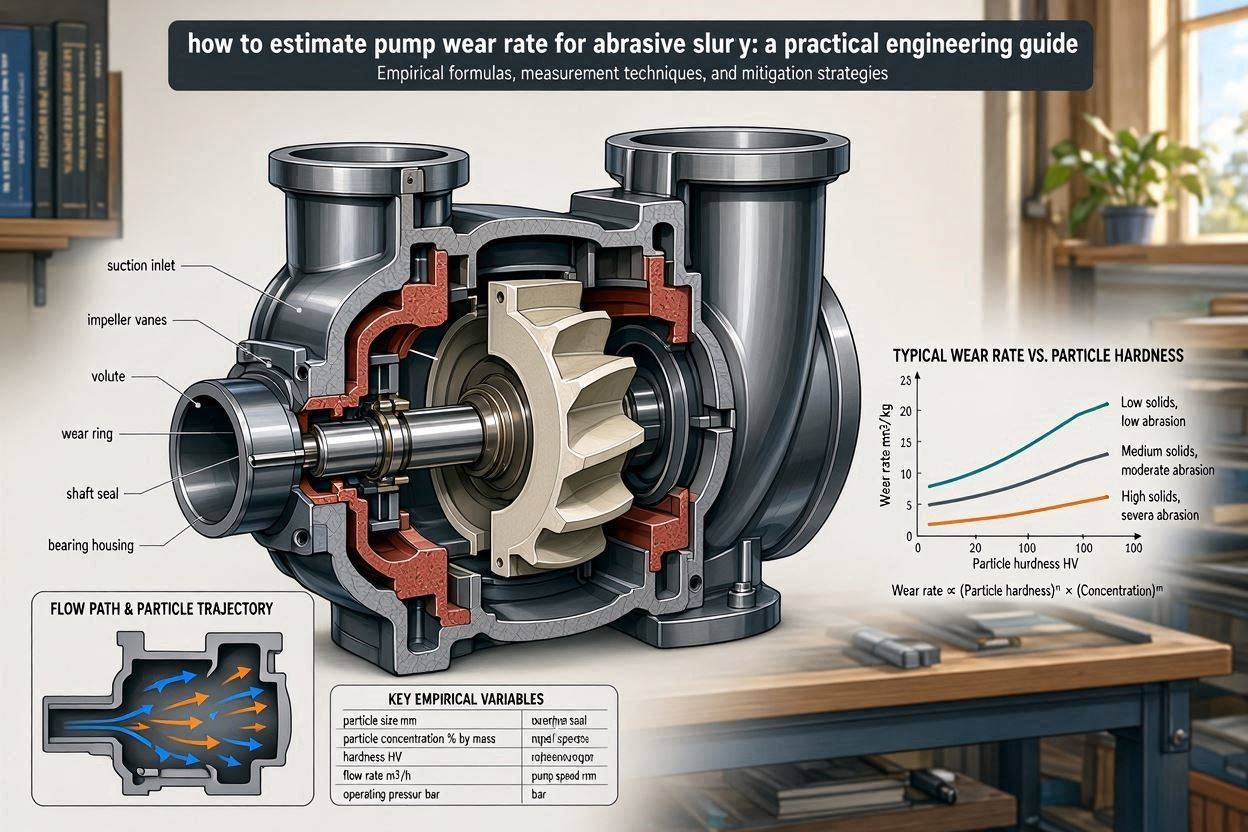
- Impeller and liner (or hose for peristaltic): The dominant maintenance cost item. Replacement interval ranges from 4 weeks (severe mining applications) to 12–24 months (gentle fine-particle service). Correctly predicting this interval requires a wear rate estimate based on your media characteristics; see: How to Estimate Pump Wear Rate for Abrasive Slurry.
- Mechanical seal: Seals fail most frequently from abrasive ingestion at the seal faces. Replacement intervals of 3–12 months are typical, depending on seal design (double mechanical seal with flush water is significantly more durable than a single seal without flush in abrasive service).
- Bearings: Heavy radial loads from slurry density and wide impeller clearances shorten bearing life compared to clean-water service. Replace on a schedule rather than at failure to avoid secondary damage to shaft and seal housing.
- Maintenance labor: Do not overlook the labor cost of planned maintenance. A liner change that requires 4 hours of mechanic time at $60/hour adds $240 per event—significant if events occur monthly. Pump designs with tool-free or quick-access wet ends reduce labor cost per maintenance event by 40–60%.
To build the maintenance cost model: multiply the cost per replacement event by the predicted number of events per year for each wear item, then sum all items and multiply by the analysis period. For the full maintenance framework, see: Abrasive Media Pump Maintenance Guide.
5. Downtime Cost: The Hidden Multiplier
Unplanned downtime is typically the most underestimated cost in abrasive pump TCO analyses. When a pump fails unexpectedly in a continuous-process application, the consequences extend far beyond the pump repair cost:
- Lost production value: In a process producing $500/hour of output, a 6-hour emergency repair represents $3,000 in lost production—more than the pump’s purchase price in a single incident.
- Emergency parts premium: Sourcing wear parts on an emergency basis from non-primary suppliers can cost 30–80% more than planned purchases, and expedited freight adds further cost.
- Secondary damage: Catastrophic pump failure (impeller fracture, seal failure leading to flooding, cavitation damage) can cause collateral damage to bearings, shaft, pump housing, and connected piping—multiplying the repair cost well beyond the initial failure component.
- Safety incident risk: In chemical processing or mining applications, uncontrolled pump failure can create safety hazards from uncontrolled slurry releases, adding regulatory and liability costs.
A pump that reduces unplanned failure frequency from 4 events to 1 event per year—achieved through better material selection, correct duty point operation, and planned maintenance adherence—delivers downtime cost savings that often exceed the entire pump purchase price within 12 months.
6. Worked Example: 5-Year TCO Comparison
The following example compares two pump options for a medium-duty abrasive slurry application: 8 hours/day operation, 250 days/year (2,000 hours/year), mineral slurry with 25% solids by weight, particles Mohs 6.5, d95 = 1.2 mm. Energy cost: $0.12/kWh. Production value lost during downtime: $300/hour.
| Cost Item | Pump A — Low-Cost Option | Pump B — Quality Option |
|---|---|---|
| Purchase price | $1,200 | $1,850 |
| Installation cost | $400 | $400 |
| Annual energy (7.5 kW, 60% eff.) | $1,800 / yr | $1,440 / yr (75% eff.) |
| Liner replacement interval | Every 3 months = 4×/yr @ $350 | Every 6 months = 2×/yr @ $420 |
| Liner replacement cost/yr | $1,400 / yr | $840 / yr |
| Seal replacement cost/yr | $540 / yr (3× @ $180) | $200 / yr (1× @ $200) |
| Unplanned downtime events/yr | 3 events × 8 hrs × $300 = $7,200/yr | 0.5 events × 8 hrs × $300 = $1,200/yr |
| Emergency parts premium / yr | $350 / yr | $0 / yr |
| Annual operating cost | $11,290 / yr | $3,680 / yr |
| 5-Year total (incl. purchase) | $58,050 | $20,650 |
| 5-Year cost difference | Pump A costs $37,400 MORE over 5 years despite a $650 lower purchase price | |
This example illustrates the pattern consistently observed in abrasive pump procurement: the lower-priced option has 2–3× higher liner replacement frequency, 3–6× more unplanned downtime events, and lower hydraulic efficiency—producing a total five-year cost nearly three times higher than the quality alternative. The $650 purchase price advantage of Pump A is recovered by Pump B’s operating cost advantage within the first three months of operation.
Key InsightIn this example, unplanned downtime alone costs Pump A $36,000 over 5 years—versus $6,000 for Pump B. Preventing catastrophic failures through correct pump selection and maintenance adherence is the single highest-return investment in abrasive pump ownership.
7. How to Build Your Own TCO Model
Building a TCO model for your specific application requires the following inputs. Gather these before presenting any pump proposal to management for approval:
- Operating hours per year: Shifts × hours per shift × operating days per year
- Motor power and efficiency: From the pump’s performance data at your slurry duty point
- Local electricity cost: In $/kWh, at your facility’s industrial tariff
- Predicted liner/impeller replacement interval: Estimate from the pump manufacturer’s wear data for your specific media, or use the methodology in our guide: How to Estimate Pump Wear Rate for Abrasive Slurry
- Wear part costs: Liner set, impeller, seal kit, bearing set — priced from the pump manufacturer’s spare parts list
- Production value at risk per hour of downtime: From your finance team or operations manager
- Historical unplanned failure frequency: For incumbent equipment; for new equipment, estimate based on pump type and your duty conditions
- Maintenance labor cost per event: Hours required × labor rate
Once all inputs are gathered, multiply annual costs by the analysis period (typically 5 years) and add initial capital cost. Compare the resulting TCO figures across competing pump options to make an evidence-based procurement decision rather than a price-based one.
8. How Abrasive Media Quality Affects Pump TCO
One variable in the TCO model that is frequently overlooked by pump procurement teams is the quality of the abrasive media itself. The wear rate in a pump is determined by the interaction between the pump material and the abrasive particles—and particle characteristics are determined at the point of media manufacture.
Abrasive media with wide particle size distribution (poor grading control) introduces oversize particles that cause disproportionate impact wear at valve seats, impeller clearances, and casing wear zones. This accelerates liner replacement intervals and increases unplanned failure frequency—both of which drive TCO upward. Precisely graded media from a controlled manufacturing process produces predictable, uniform wear behavior, allowing accurate maintenance scheduling and making the TCO model’s wear rate inputs reliable.
Similarly, media with inconsistent hardness (poor heat treatment control) creates batch-to-batch wear rate variance. A facility that bases its liner replacement schedule on Batch A’s behavior may experience premature failure when Batch B arrives with higher-than-specified hardness. Sourcing abrasive media from manufacturers who provide certified hardness documentation on every delivery is an important TCO risk management measure.
Häufig gestellte Fragen
Start with Certified-Quality Abrasive Media
Controlling your pump TCO begins with controlling your media inputs. Jiangsu Henglihong Technology Co., Ltd. manufactures steel shot, steel grit, glass beads, and stainless steel shot with certified particle size distribution and hardness documentation on every batch — giving you the reliable wear rate data you need to build an accurate TCO model and maintain pump service intervals with confidence.
Request Product Specifications →Filter