Jiangsu Henglihong Technology Co, Ltd.
Steel Grit vs. Steel Shot: Which Blasting Media Is Right for Heavy Work?
A detailed technical comparison of steel shot and steel grit — covering hardness grades, particle geometry, surface profiles, peening applications, recyclability, and the industry standards that govern their use in structural steel surface preparation.
Steel Abrasives: The Industrial Standard for Heavy Work
Steel shot and steel grit are the two primary categories of metallic abrasive blasting media. Together they represent the dominant media type by volume in heavy industrial surface preparation worldwide — used extensively in the structural steel, automotive, shipbuilding, oil and gas pipeline, castings, and rail sectors. Their defining advantages over mineral abrasives are extraordinary recyclability (200–300 effective reuse cycles in properly maintained reclaim systems), very low dust generation, and the lowest cost per square meter of treated surface among all commercially available blasting media when operated in closed-loop systems.
Both steel shot and steel grit are manufactured by atomizing molten steel and then processing the resulting particles to specific hardness levels and particle geometries. The critical difference between the two products — and the key to understanding when to specify one versus the other — is their shape: steel shot is spherical, steel grit is angular. This geometric distinction governs every significant difference in their surface finishing performance.
This guide is part of Henglihong’s comprehensive blasting resource hub. For the complete overview of all sandblasting material types and selection logic, see our complete guide to sandblasting material.
Steel shot = round = peening and cleaning. Steel shot compresses and smooths the surface, introduces compressive residual stress, and is ideal for high-volume structural steel cleaning in continuous blast equipment. Steel grit = angular = cutting and profiling. Steel grit cuts into the surface aggressively, creating the deep anchor profiles required for heavy-duty epoxy and zinc-rich coating systems.
Steel Shot: Properties & Best Applications
Steel shot consists of spherical particles produced by atomizing molten steel through high-pressure water or air jets, then heat-treating the solidified particles to controlled hardness levels. Shot is available in a range of hardness grades (GP, GL, GH) corresponding to increasing hardness on the Rockwell C scale.
What Steel Shot Does to a Surface
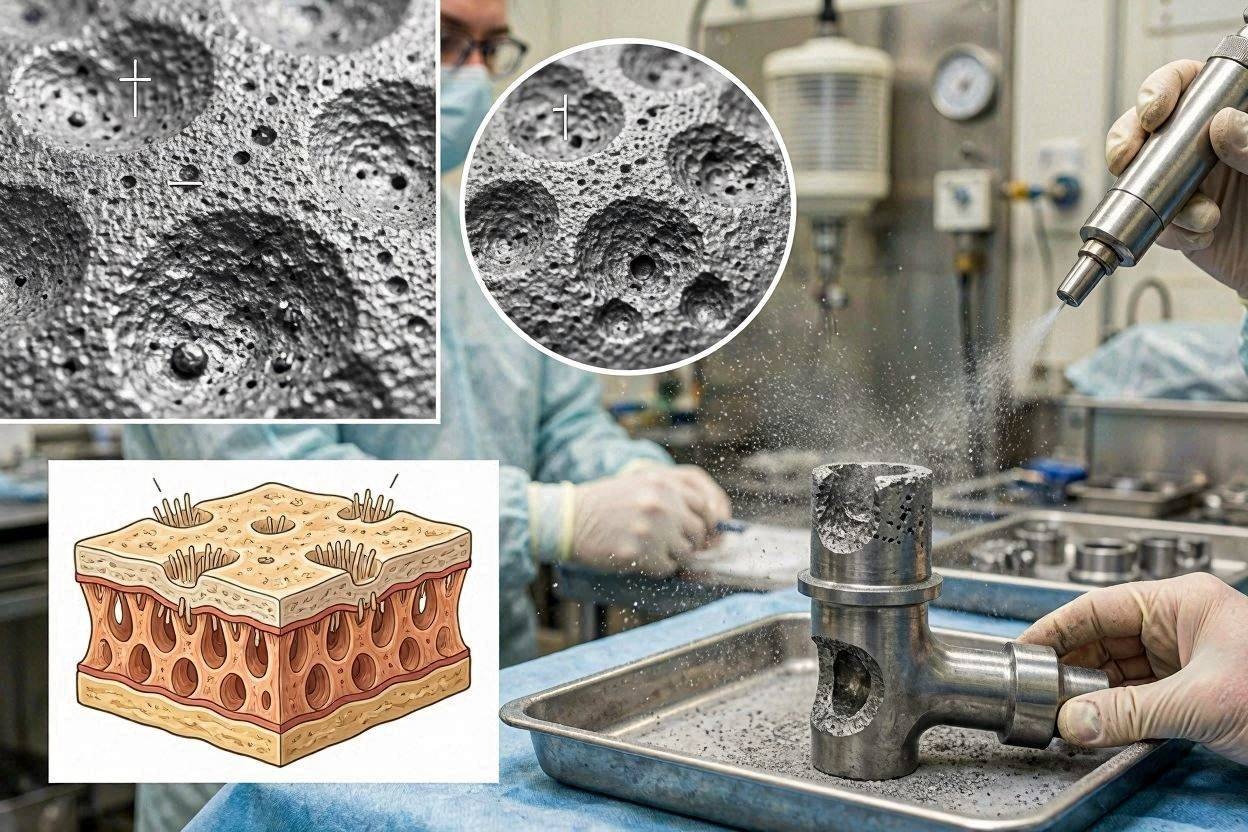
When a steel shot particle strikes a metal surface, it delivers a compressive impact that displaces contaminants (rust, scale, paint) and creates a dimpled, orange-peel texture on the base metal. This dimpled profile is relatively smooth — Ra values of 3–15 µm depending on shot size and blast intensity — and is characterized by a compressive residual stress layer in the surface. Shot blasting is the standard process for cleaning continuous webs of structural steel plate, reinforcing bar (rebar), H-beams, and other long-product steel in automated roller conveyor blast lines. The smooth, clean profile it produces is acceptable as a primer adhesion surface for many industrial coating systems.
Shot Peening with Steel Shot
Beyond cleaning, steel shot of controlled size and hardness is used for shot peening — the intentional introduction of compressive residual stress to improve fatigue life and resistance to stress corrosion cracking. Common peening applications include automotive springs, gears, crankshafts, and aerospace structural components. For extremely tight peening tolerances in aerospace applications, glass beads are often preferred due to their more consistent sphericity and cleaner surface chemistry. For high-throughput automotive and industrial peening where glass bead costs are prohibitive, cast steel shot is the standard.
Steel Grit: Properties & Best Applications
Steel grit is produced by crushing hardened steel shot particles, then screening and classifying the resulting angular fragments to specific size ranges. The crushing process creates irregular, multi-faceted angular particles with sharp edges and corners — analogous in shape to angular mineral abrasives like aluminum oxide but with far superior recyclability due to their metallic toughness.
What Steel Grit Does to a Surface
Steel grit particles strike the surface edge-on and corner-on, cutting into the substrate and creating a deeply jagged anchor profile with sharp peaks and valleys. This aggressive cutting action produces Ra values of 15–50 µm and Rz values of 60–150 µm or more with coarse grit grades — profiles that provide exceptional mechanical adhesion for heavy-duty coating systems: zinc-rich primers, high-build epoxy, fusion-bonded epoxy (FBE), and polyurea coatings. Steel grit is the specified abrasive when coating specifications demand a high anchor profile depth, particularly for oil and gas pipeline coating, offshore platform structures, and aggressive industrial environments where coating durability is critical.
Mixing Shot and Grit
Many production operations use blends of steel shot and steel grit to achieve a balance between cleaning speed (contributed by the shot) and anchor profile depth (contributed by the grit). The optimal blend ratio depends on the target surface profile specification and the coating system being applied. Ratios of 70:30 to 50:50 shot-to-grit are common in structural steel fabrication.
Hardness Grades Explained
Steel abrasives are available in three standard hardness grades, designated by SAE International (Society of Automotive Engineers) standards. Hardness is measured on the Rockwell C scale. The appropriate hardness grade depends on the substrate hardness, the required surface profile, and the operating pressure.
| Grade | Hardness (HRC) | Merkmale | Best For |
|---|---|---|---|
| GP (General Purpose) | HRC 40–51 | Tough, ductile, low fracture rate | High-volume structural steel cleaning, continuous blast lines |
| GL (Low Carbon) | HRC 45–52 | Balanced hardness and toughness | General industrial surface preparation |
| GH (High Carbon / Hard) | HRC 55–66 | Harder, more aggressive cutting, higher fracture rate | Deep anchor profiles on hard substrates, heavy coatings removal |
Always match the abrasive hardness grade to the substrate. Using GH (very hard) steel grit on soft or thin substrates risks excessive material removal, dimensional change, and substrate distortion. GP or GL grades are sufficient for most structural steel applications and deliver better recyclability (fewer fractures) than GH.
Size Standards: SAE & ISO Classification
| SAE Size | ISO Size | Nominal Diameter (mm) | Typical Application |
|---|---|---|---|
| S-780 | 2.0 | 2.0 | Very heavy scale, large castings |
| S-660 | 1.7 | 1.7 | Heavy structural steel, ship plate |
| S-550 | 1.4 | 1.4 | General structural steel fabrication |
| S-460 | 1.2 | 1.2 | Pipe & plate, balanced throughput/profile |
| S-390 | 1.0 | 1.0 | Automotive parts, lighter structural work |
| S-330 | 0.85 | 0.85 | General fabrication, lighter sections |
| S-230 | 0.6 | 0.6 | Precision parts, automotive castings |
| S-110 | 0.3 | 0.3 | Shot peening, fine finishing |
For steel grit, the equivalent size designations use the G prefix (e.g., G-25, G-40, G-50, G-80, G-120) with smaller numbers indicating coarser particles. Grit size selection follows the same principles as mineral abrasive grit size selection — coarser grit for heavier scale and deeper profiles, finer grit for lighter contamination and smoother finish requirements. For the full grit size reference, see our grit size chart and surface profile guide.
Surface Profiles Produced by Steel Abrasives
⬤ Steel Shot Profile
- Dimpled, orange-peel texture
- Ra: 3–15 µm (size-dependent)
- Rz: 10–60 µm
- Rounded peaks and valleys
- Compressive residual stress layer
- Suitable for: light to medium industrial coatings, primers
⬤ Steel Grit Profile
- Angular, jagged anchor pattern
- Ra: 10–50 µm (grade-dependent)
- Rz: 40–150 µm
- Sharp peaks, deep valleys
- Tensile stress layer possible with very hard grit
- Suitable for: high-build epoxy, FBE, zinc-rich, polyurea
Recyclability & Cost Per Cycle
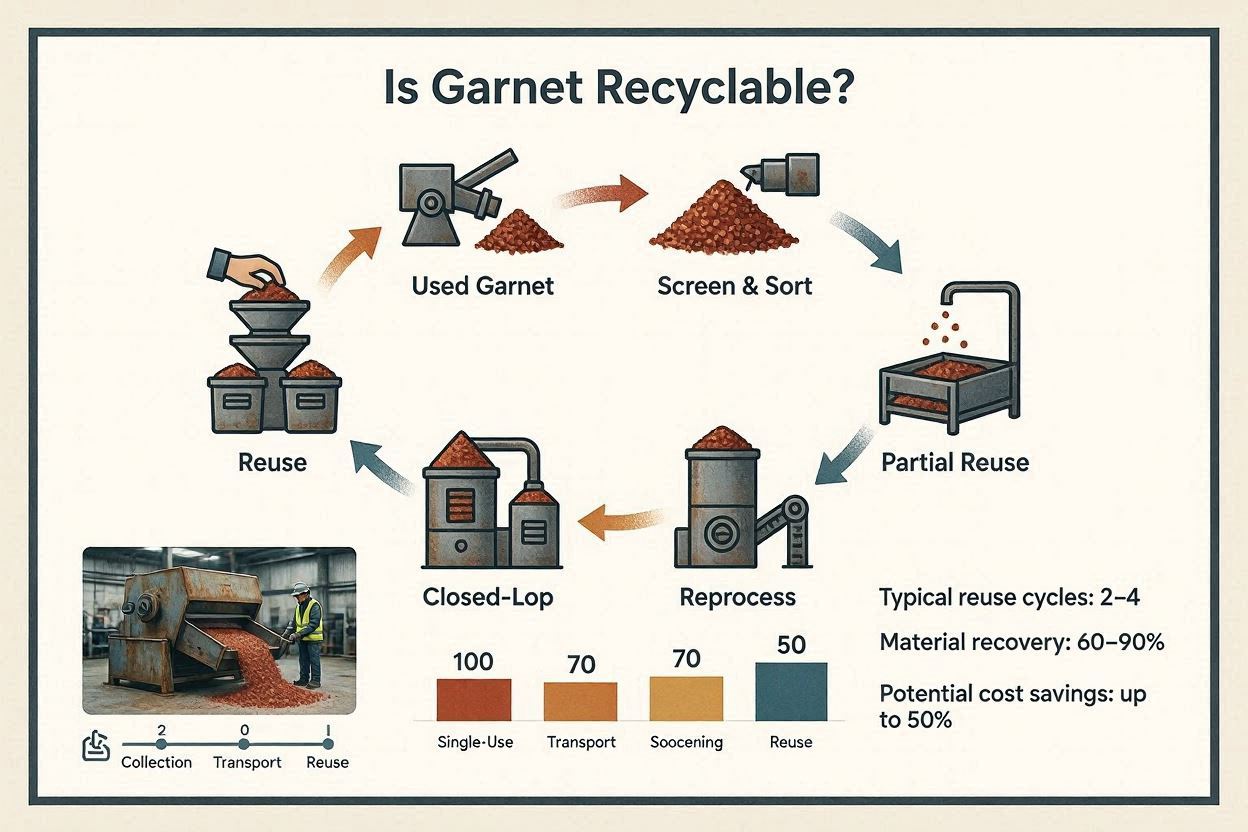
Steel abrasives deliver unmatched recyclability among all blasting media categories. In a well-designed closed-loop blast room or blast cabinet with mechanical floor reclaim, magnetic separator, bucket elevator, air wash separator, and size classifier, steel shot or grit can sustain 200 to 300 effective blast cycles before the accumulated fines and breakdown products require a full media change. This extraordinary reuse life means the cost per square meter of treated surface is far lower than any mineral or organic alternative, even after accounting for the higher initial purchase cost of steel media.
The key to maximizing steel media life is maintaining the reclaim and classification system in optimal condition. The air wash separator must be adjusted to remove fines (broken particles smaller than the minimum effective size) while returning intact, on-size particles to the blast circuit. Magnetic separators must be functioning to remove heavily fractured and non-magnetic contamination from the media charge. Regular sampling and sieve analysis of the circulating media is the standard method for monitoring media condition.
For a full cost-per-cycle comparison with mineral abrasives, see our sandblasting media comparison chart.
Applications by Industry
Roller conveyor blast lines cleaning H-beams, plates, box sections before shot primer application. Steel shot (S-330 to S-550) at high throughput is the standard.
Blasting steel plate to Sa 2.5 before shop primer application. Steel shot in automated plate blasting lines is the dominant process for large steel plate producers.
Steel grit (G-25 to G-40) for pipe external and internal surface prep to Sa 2.5 or Sa 3 before FBE or polyethylene coating. Anchor profile depth critical for adhesion to high-performance coatings.
Shot peening of crankshafts, connecting rods, coil and leaf springs, gear teeth. Cleaning of engine block castings and brake rotors in automated tumble blast machines.
Removing sand, scale, and casting skin from iron and steel castings in tumble blast or hanger-type blast machines. Steel shot is the standard foundry media worldwide.
Surface preparation of rail sections, bridge components, and structural infrastructure elements before protective coating systems. High-volume, continuous operations favor steel media economics.
For guidance on applying blasting media specifically in metal surface preparation before painting, see our dedicated resource on best sandblasting material for metal surface prep before painting and coating.
Steel Media vs. Mineral Abrasives: When to Choose
| Factor | Steel Shot/Grit Advantage | Mineral Abrasive Advantage |
|---|---|---|
| Cost per m² (closed-loop) | Significantly lower — 200–300 cycles | Moderate (Al₂O₃: 15–30 cycles) |
| Iron contamination | Introduces iron — problem for SS & non-ferrous | None — safe for all metals |
| Staubentwicklung | Very low — dense particles fracture less | Moderate (Al₂O₃) to high (slag) |
| Open-blast operations | Not suitable — heavy media, disposal issues | Preferred (garnet, crushed glass) |
| Profile depth range | Very wide — shot for low, hard grit for deep | Wide but slightly less range than hard steel grit |
| Equipment requirement | Closed-loop blast room or cabinet required | Works in open blast, cabinet, or room |
Häufig gestellte Fragen
Steel abrasives are not well-suited to open-air blasting in most situations. Their high density means they fall rapidly and cannot be effectively collected and recycled without specialized ground reclaim equipment. Spent steel media on a construction site also becomes a contamination and safety hazard — loose steel particles on surfaces and the ground create traction issues and can cause corrosion where they come into contact with other metals. For open-air construction blasting, garnet, crushed glass, or aluminum oxide are the standard alternatives. Steel media is primarily an indoor blast room/cabinet media where closed-loop reclaim is feasible.
Yes — this is a critical restriction. Steel grit and steel shot embed microscopic iron particles into the blasted surface during impact. On carbon steel, this is irrelevant — the substrate is already iron. On stainless steel, titanium, or other non-ferrous metals, embedded ferrous particles will corrode rapidly, producing rust staining on the surface and destroying the passivation layer that gives stainless steel its corrosion resistance. For blasting stainless steel, only non-ferrous abrasives must be used: white aluminum oxide, glass beads, or garnet. The blasting equipment (cabinet, blast room, blast hose, nozzle) must also be dedicated exclusively to non-ferrous blasting and kept completely free of steel media contamination.
Cast steel shot is produced by atomizing molten steel into a spherical form — the most common type. Cut wire shot is produced by cutting steel wire into short cylindrical segments, which are then conditioned (tumbled or peened) to round off their sharp edges into an approximately spherical form. Cut wire shot typically offers better sphericity consistency, longer service life, and lower dust generation than cast shot because it starts from drawn wire of controlled composition rather than atomized droplets of variable composition. It is more expensive per kilogram but delivers better economics in high-precision peening applications (aerospace, medical) where consistent Almen intensity and coverage are critical process requirements.
Request a Quote
Specify your required grade (shot or grit), hardness (GP/GL/GH), SAE size, and volume. Competitive FOB/CIF pricing within 24 hours.
Get a Free Quote →Talk to a Technical Advisor
Not sure whether shot or grit — or which hardness grade and size — is optimal for your blast system? Our engineers will recommend the right specification.
Contact Our Team →Filter