How to Select a Pump for Abrasive Media: 8 Critical Parameters Every Engineer Must Evaluate
Pump selection for abrasive media is not a matter of browsing a catalog and picking the cheapest model that moves the right flow rate. Done incorrectly, it produces equipment that fails within weeks, generates unplanned downtime, and costs two to four times more over five years than a correctly specified pump would have. Done correctly, it results in predictable maintenance intervals, steady energy costs, and a pump that performs for years with minimal surprises.
This guide introduces a structured eight-parameter framework that engineers and procurement managers can apply to any abrasive media pumping application—from abrasive blasting slurry recirculation to mining tailings, ceramic glaze, and chemical process slurries. For a broader overview of all aspects of abrasive media pump design and selection, see our comprehensive reference guide: Pumps for Abrasive Media: The Complete Selection & Buying Guide.
Why Getting Pump Selection Right Is So Consequential
Abrasive media pumping is unforgiving. The same physical properties that make abrasive particles effective for blasting, cutting, or grinding surfaces are identical to the properties that destroy pump components: high hardness, angular shape, and solid mass in high-velocity contact with metal or elastomeric surfaces.
A pump selected without rigorously evaluating the eight parameters below may perform adequately for a few weeks before wear accelerates beyond design rates. Liner replacement intervals that should be six months collapse to six weeks. Seal failures that should happen once per year happen every month. Impeller efficiency drops, energy consumption rises, and the facility is repeatedly forced into unscheduled shutdowns to conduct emergency maintenance. The initial purchase price—which seemed like a good deal—becomes irrelevant compared to the ongoing operational cost of under-specification.
The eight parameters presented in this guide are not equally weighted. Particle size, particle hardness, and solids concentration together determine roughly 70% of the wear rate in most applications and therefore drive the most consequential selection decisions. The remaining five parameters further refine the selection and eliminate materials or pump types that might otherwise appear to be viable options. All eight must be evaluated before engaging a pump supplier.
Before You BeginGather laboratory or supplier data for each parameter listed below before making any pump selection decision. Many equipment failures in abrasive applications trace back not to poor pump engineering but to incomplete process data at the point of specification. Request a formal particle size analysis and hardness certification from your abrasive media supplier—these documents form the technical foundation of a correct pump selection.
Particle size is specified by two values, not one. The d50 (median particle size) represents the particle diameter below which 50% of the particles by mass fall. It is the primary input for wear rate estimation and liner material selection. The d95 (95th-percentile size) represents the particle diameter below which 95% of particles fall—it is the governing dimension for pump clear passage sizing.
All internal pump passages, impeller clearances, and port openings must exceed the d95 by a margin of at least 20–30% to prevent particle bridging, impeller jamming, or accelerated localized wear at constriction points. Specifying only d50 and ignoring d95 is one of the most common causes of pump blockage and premature wear in abrasive applications.
Particle size data is obtained through sieve analysis (for particles above 75 micron) or laser diffraction analysis (for finer particles below 75 micron). Note that these two methods do not always produce identical results—sieve analysis reports by mass distribution while laser diffraction reports by volume. For pump selection, confirm which basis your supplier’s data uses. Reputable abrasive media manufacturers provide formal particle size certificates with each batch, giving you the consistent data needed for accurate pump sizing.
Solids concentration is most commonly expressed as percentage by weight (Cw)—the mass of solids divided by total slurry mass. However, the hydraulic behavior of slurry and the critical transport velocity calculation require volumetric concentration (Cv). The two are related through the specific gravity of the solid particles:
Cv = Cw / [SGsolids × (1 – Cw) + Cw]
This distinction matters significantly for dense media. Steel shot has a specific gravity of approximately 7.8, meaning 30% w/w steel shot slurry contains only around 5% by volume of solid particles—far less volumetrically than its weight fraction implies. Silica sand (SG 2.65) at 30% w/w occupies approximately 14% by volume. The pipeline design and critical velocity calculations must use Cv, not Cw.
For centrifugal pump performance, solids concentration requires head derating. As a practical guideline: below 5% Cv, minimal correction is needed; between 5–15% Cv, derate head by approximately 5–15%; above 15% Cv, significant deration applies and progressive cavity or specialist centrifugal designs become preferable.
Establish both your normal operating concentration and the worst-case upset concentration. Pump selection must be verified at both conditions to ensure stable operation across the full operating range.
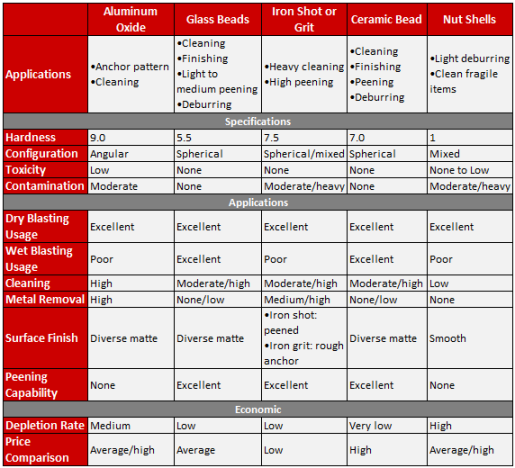
Particle hardness, measured on the Mohs scale, is the single most important predictor of pump wear rate. The Mohs scale runs from 1 (talc) to 10 (diamond). A particle harder than the pump material surface will scratch and cut it; a softer particle will cause comparatively minor polishing wear. The key material matching rule for metal pumps is: pump material hardness must substantially exceed particle hardness. For rubber and elastomeric pumps, the protective mechanism is elastic deformation rather than hardness—but this only works reliably for particles up to approximately Mohs 6.5.
The following table shows Mohs values for abrasive media commonly encountered in industrial pumping applications:
Particle shape interacts critically with hardness in material selection decisions. Angular, sharp-edged particles—such as crushed steel grit or garnet—can cut through rubber liners even at hardness values where rubber would otherwise perform adequately against rounded particles. If your abrasive is angular, reduce your rubber viability threshold by approximately half a Mohs unit and verify with supplier service life data before committing. For a full material selection guide, see: Pump Materials for Abrasive Media: Chrome vs. Rubber vs. Ceramic vs. Polyurethane.
Flow rate specification for abrasive slurry has two boundaries rather than one: the upper boundary is the maximum process demand flow rate; the lower boundary is the critical transport velocity (CTV)—the minimum fluid velocity in the pipeline below which solid particles settle and progressively block the line.
Critical transport velocity depends on particle density, particle size, pipe diameter, and slurry concentration. For most mineral slurries in 50–150 mm diameter pipelines, CTV falls between 1.5 and 3.5 m/s. A practical approach for estimating CTV uses the Durand-Condolios correlation:
Vc = FL × √(2gD × (Sm – 1))
where FL is a particle-pipe factor (typically 0.9–1.8), g = 9.81 m/s², D = pipe internal diameter (m), Sm = relative density of slurry
Design the system so the pump maintains fluid velocity at 10–30% above CTV at all pipeline sections, including partial-load and startup conditions. In systems with variable process demand, a variable frequency drive (VFD) with a minimum speed interlock set at 110% of CTV is the recommended configuration. Allowing velocity to drop below CTV—even briefly—can initiate progressive settling that leads to a complete pipeline blockage requiring manual intervention to clear.
Also establish a future capacity requirement and size the pump to handle at least 110–120% of current maximum demand. Oversized pumps run inefficiently when throttled; where future expansion is uncertain, consider installing a correctly sized pump with pipe connections sized for a future additional parallel pump.
Total dynamic head (TDH) for a slurry system comprises four components: static head (elevation difference between suction and discharge), friction losses in the pipeline, velocity head, and fitting losses. The single most consequential error in slurry pump sizing is applying water-based friction loss figures without applying a slurry correction factor—an error that can result in a pump that cannot achieve the design flow rate under actual operating conditions.
For fine-particle slurries (d50 below approximately 74 micron) at low concentrations, friction losses are reasonably close to water. For coarser or more concentrated slurries, friction losses increase significantly:
- 15–25% w/w mineral slurry: friction losses approximately 1.2–1.5× equivalent water friction
- 25–40% w/w mineral slurry: friction losses approximately 1.5–2.2× equivalent water friction
- Above 40% w/w or d50 above 500 micron: friction losses can be 2.5–3.5× water or higher; use a heterogeneous flow model or specialist slurry hydraulics software
Fitting losses (elbows, tees, reducers, valves) should be estimated using the equivalent pipe length method and then multiplied by 1.3–1.5 for slurry service. Also add a 10–15% head margin to the calculated TDH to account for pipeline wall roughening over time as the abrasive slurry progressively erodes internal pipe surfaces—a factor that increases system resistance over the pump’s service life.
Document the system curve as a TDH vs. flow relationship, plot it against the pump curve (corrected for slurry), and verify that the operating point falls within 85–115% of the pump’s best efficiency point (BEP) at design conditions.
Many abrasive slurries are low-viscosity fluids (close to water at 1 cP), and viscosity plays no significant role in pump selection for these applications. However, certain abrasive slurries—bentonite drilling mud, ceramic glaze, cement grout, concentrated polymer slurries, and biological sludge—exhibit significant viscosity that fundamentally changes the pump selection decision.
Centrifugal pumps suffer progressive performance degradation with increasing viscosity. As a practical guide:
- Below 150 cP: Centrifugal pumps perform adequately with minor head and efficiency correction
- 150–500 cP: Centrifugal performance degrades meaningfully—consider positive displacement alternatives. At 500 cP, centrifugal pump efficiency may fall to 50% of its water-based rated value
- Above 500 cP: Positive displacement pumps—progressive cavity, AODD, or peristaltic—are strongly preferred for both efficiency and flow stability
An additional complexity arises with thixotropic slurries—fluids that exhibit high apparent viscosity at rest but thin significantly under shear. Bentonite drilling mud and certain ceramic glazes are thixotropic. Viscosity must be measured at the relevant shear rate for your application, not at rest. A thixotropic slurry may appear far too viscous for centrifugal pumping when measured statically but behave much like water under the shear rates produced inside a running pump. Confirm viscosity behavior with a rheological measurement before ruling out any pump type on this basis.
Progressive cavity pumps offer constant volumetric efficiency regardless of fluid viscosity, which is a significant advantage in applications where viscosity varies with temperature or concentration over the course of a production run.
Chemical compatibility analysis is often treated as a secondary check—something to confirm after the pump type and material have been chosen on other grounds. This is a mistake. In applications where the carrier fluid is chemically aggressive, the chemical compatibility requirement should be evaluated simultaneously with particle hardness, because both constraints independently narrow the viable material selection space, and the intersection of both constraints may be smaller than either alone.
The starting point for chemical compatibility is the pH of the carrier fluid, measured at operating temperature:
- pH 6–9 (near-neutral): Most pump materials are compatible. High-chrome alloy and natural rubber are both viable—select primarily based on particle hardness and size
- pH 3–6 (mildly acidic): High-chrome alloy is borderline acceptable; natural rubber (verify with the specific acid), EPDM, polypropylene, and PVDF are preferred. Avoid stainless steel if chloride content exceeds 200 ppm
- pH < 3 (strongly acidic): Limited options—PVDF, PTFE-lined, Hastelloy C-276, or ceramic. Require full chemical analysis including dissolved oxygen and temperature for final selection
- pH 9–11 (mildly alkaline): High-chrome alloy acceptable; EPDM and polypropylene preferred. Avoid natural rubber with strong caustic solutions
- pH > 11 (strongly alkaline): Careful elastomer selection required—EPDM and PVDF are generally viable; consult supplier for specific caustic concentrations and temperatures
Beyond pH, identify the specific dissolved chemical species. Chlorides attack stainless steel through pitting corrosion even at neutral pH. Oxidizing acids (sulfuric acid above 70% concentration, nitric acid) require specialist material selection that differs from dilute acid guidance. Ferric ions in acid mine drainage create particularly aggressive erosion-corrosion conditions that require detailed specialist input.
In all combined abrasion-corrosion applications, remember that the abrasive wear component continuously removes protective surface oxide layers—exposing fresh metal to chemical attack. The synergistic effect of simultaneous mechanical and chemical attack can produce material loss rates two to five times higher than either mechanism alone. For a detailed treatment of combined corrosive and abrasive pump challenges, see: Pumps for Corrosive AND Abrasive Media: Solving the Toughest Chemical Slurry Applications.
Operating temperature is the parameter that most often disqualifies elastomeric pump materials after initial hardness and chemical compatibility screening. Natural rubber—which performs well for many abrasive applications—begins to lose its mechanical properties above 65°C, degrading its elastic energy-absorption mechanism and accelerating cut-through wear at elevated temperatures. Many abrasive processes involve heated fluids: hot water in paper mill applications, elevated-temperature process slurries, steam-traced pipelines, and process streams downstream of heat-generating unit operations.
Temperature limits by key pump construction materials:
- Natural rubber (NR): Continuous service to 65°C; short peaks to 70°C
- Neoprene (CR): Continuous service to 80°C
- Nitrile rubber (NBR): Continuous service to 100°C; good oil resistance
- EPDM: Continuous service to 120°C; suitable for hot water and mild chemical service
- PVDF: Continuous service to 150°C; excellent chemical resistance
- PTFE (Teflon): Continuous service to 260°C; universal chemical resistance
- High-chrome alloy (Cr27): Continuous service to approximately 350°C (with appropriate bearing and seal specifications)
- Silicon carbide ceramic: Stable to above 1,400°C; used in extreme-temperature abrasive applications
Temperature + Chemistry = Compounding EffectChemical attack rates approximately double for every 10°C increase in temperature. An elastomer that performs adequately in dilute acid at 20°C may fail rapidly at 50°C in the same acid. Always evaluate chemical compatibility at the actual operating temperature, not at ambient conditions.
Temperature also affects the fluid itself: higher temperature reduces slurry viscosity (beneficial for flow), raises vapor pressure (increases cavitation risk—particularly important for centrifugal pumps with long suction lines), and may cause crystallization or precipitation of dissolved species that then add abrasive load to the system. Document all temperature extremes—not just the normal operating temperature, but startup (potentially cold) and any upset conditions (potentially hot) as well.
Quick-Reference Decision Matrix
The table below summarizes the key thresholds for each parameter and the corresponding selection implications. Use it as a rapid screening tool after gathering your process data. Note that this matrix provides initial guidance—any application near a threshold boundary warrants detailed engineering review before finalizing pump type and material selection.
| Parameter | Low / Below Threshold | Threshold Value | High / Above Threshold |
|---|---|---|---|
| Particle size (d95) | Any pump; rubber liners OK | 6 mm | Recessed impeller or peristaltic |
| Solids concentration (Cw) | Standard centrifugal slurry | 40% w/w | Progressive cavity or specialist centrifugal |
| Particle hardness (Mohs) | Rubber liners viable | Mohs 6.5 | High-chrome or polyurethane above 6.5; ceramic above 8 |
| Partikelform | Rounded — rubber performs well | — | Angular — reduce rubber Mohs threshold by ~0.5; verify |
| Flow rate (vs. CTV) | Below CTV — settling risk, pipeline blockage | Critical transport velocity | 10–30% above CTV — design target |
| Fluid viscosity | Below 150 cP — centrifugal viable | 500 cP | Positive displacement required |
| Carrier fluid pH | pH < 5 — rubber/PVDF/Hastelloy; avoid chrome alloy | pH 5–9 | pH > 10 — EPDM or polypropylene; check elastomer |
| Betriebstemperatur | Below 65°C — natural rubber viable | 120°C | Above 120°C — PVDF, PTFE, or metal seals required |
Where multiple parameters simultaneously push toward different pump types—for example, high solids concentration (favoring centrifugal) combined with high viscosity (favoring positive displacement)—the more restrictive constraint governs. When genuinely uncertain, run a comparative analysis across two or three candidate pump types using the total cost of ownership framework described in our resource: Total Cost of Ownership for Abrasive Media Pumps.
5 Common Pump Selection Mistakes to Avoid
Even engineers who have specified many abrasive media pumps make predictable, recurring errors. The following five mistakes account for the majority of field failures encountered in abrasive pumping applications.
-
Specifying only d50, ignoring d95
The median particle size looks representative, but it is the outlier particles at the 95th percentile that cause catastrophic pump failures—blocking impeller passages, jamming between impeller and liner, and creating concentrated impact wear at constriction points. Always obtain and specify both d50 and d95, and size all pump clearances to d95. This single practice eliminates the most common cause of unexpected early-life pump failure in abrasive service.
-
Applying water pump curves without slurry correction
Pump manufacturers provide performance curves based on water testing. Slurry degrades both head and efficiency compared to water curves, and the degradation increases with solids concentration and particle size. Using uncorrected water curves produces a pump that operates at the wrong duty point—typically running at a higher flow and lower head than intended, leading to settling in horizontal pipelines and vibration from off-BEP operation. Always apply the Warman or equivalent slurry correction factor before plotting the operating point.
-
Ignoring particle shape when selecting liner material
Rubber liner suitability is usually evaluated based on particle hardness alone. However, highly angular particles—such as crushed steel grit, fractured garnet, or crushed slag—can cut through rubber liners at hardness levels where rubber would perform adequately against rounded particles of the same material. When specifying rubber for abrasive service, verify the particle angularity and obtain liner service life data from the pump manufacturer for that specific angular media type before committing. For a full materials analysis, see: How Abrasive Particles Damage Pumps: Wear Mechanisms Explained.
-
Underestimating pipeline friction losses for slurry
The single most common cause of undersized abrasive media pumps is using standard water friction tables without applying a slurry correction factor. For a 30% w/w mineral slurry in a 75 mm pipeline, actual friction losses can be 60–80% higher than equivalent water friction. The resulting pump cannot achieve the design flow rate, runs far to the left on its curve, and may not maintain critical transport velocity—causing progressive pipeline settling and eventual blockage. Always calculate TDH using slurry-corrected friction factors and add a 10–15% head margin for pipe wall roughening over time.
-
Evaluating pumps on purchase price rather than total cost of ownership
In high-duty abrasive applications, the initial pump purchase price represents only 10–20% of five-year total ownership cost. Energy consumption, liner and seal replacements, and production losses during downtime account for the rest. A pump that costs 30–40% more at purchase but runs 15% more efficiently and requires half the liner replacements will consistently deliver lower five-year total cost. Build a five-year TCO model before making final procurement decisions. See our full cost analysis methodology: Total Cost of Ownership for Abrasive Media Pumps.
Zusammenfassung
Correct pump selection for abrasive media is a structured, data-driven process. Work through the eight parameters in this guide systematically, using confirmed laboratory data or supplier certifications for each input—not estimates or assumptions. The parameters most likely to drive your initial pump type selection are particle size (d95), particle hardness (Mohs), and solids concentration. The remaining five parameters—flow rate, TDH, viscosity, chemical compatibility, and temperature—further narrow the material and configuration options within the pump type you have identified.
Where parameters conflict, the more restrictive constraint governs. Where you are genuinely uncertain between two or three candidates, build a five-year TCO model and select based on total cost rather than initial price. For additional guidance on the comparison between specific pump types, see: Peristaltic vs. AODD vs. Progressive Cavity Pumps for Abrasive Media und Centrifugal vs. Positive Displacement Pumps for Abrasive Media.
Finally, remember that the quality of the abrasive media itself is an integral input to every parameter in this selection framework. Media with inconsistent particle size distribution makes d95 unreliable as a design input. Media with variable hardness across batches creates unpredictable wear rate variance. Precision-graded abrasive media from controlled manufacturing processes gives you the stable, certified parameter values that accurate pump selection depends on.
Precision-Graded Abrasive Media for Consistent, Predictable Pump Performance
Accurate pump selection begins with accurate media data. Jiangsu Henglihong Technology Co., Ltd. manufactures steel shot, steel grit, stainless steel shot, glass beads, and aluminum cut wire shot to SAE and ISO standards—with certified particle size distribution and controlled hardness grades on every shipment. Give your pump engineers the reliable media specifications they need.
Request Specifications & Quotation →Filter