Ceramic Media Size Chart: Engineering Rules for Safe Selection, Lodging Prevention & Process Stability
Why Ceramic Media Size Is a Critical Engineering Variable
Unlike abrasive belts or grinding wheels, ceramic tumbling media operates as discrete bodies that move freely relative to the workpiece. Media size directly determines contact frequency, contact pressure, kinetic energy per impact, and access to internal features. Oversized media may fail to reach burr roots, while undersized media dramatically increases the risk of lodging, clogging, or wedging inside holes and slots.
From a mechanical perspective, impact energy scales with media mass, while contact stress scales inversely with contact area. Therefore, even small changes in media size can result in disproportionate changes in cutting aggressiveness.
Standard Ceramic Media Size Chart (Industry Reference)
| Media Shape | Nominal Size | Typical Dimensions | Common Applications |
|---|---|---|---|
| Angle Cut Triangle | Small | 3×3 mm | Micro-deburring, fine edges |
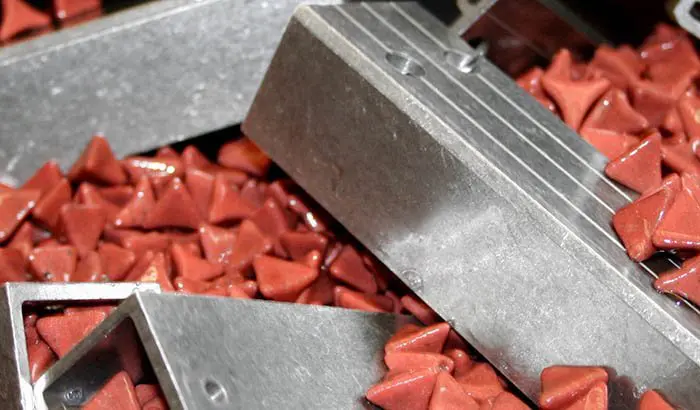
| Angle Cut Triangle | Medium | 6×6 mm | General CNC deburring |
| Angle Cut Triangle | Large | 10×10 mm | Heavy burr removal |
| Cylinder | Ø3 mm | Ø3 × 3 mm | Fine surface smoothing |
| Cylinder | Ø6 mm | Ø6 × 6 mm | General-purpose finishing |
| Ball / Sphere | Ø3 mm | Ø3 mm | Cosmetic aluminum finishing |
| Ball / Sphere | Ø6 mm | Ø6 mm | Blending and polishing |
The Golden Rule of Media Size Selection (Anti-Lodging Rule)
The most important engineering rule in ceramic media sizing is the anti-lodging rule. Media dimensions must be selected relative to the smallest opening, hole diameter, or slot width on the part.
Engineering Rule:
- Media dimension < 30% of the smallest opening, or
- Media dimension > 130% of the smallest opening
Any media size falling between 30% and 130% of the smallest feature carries a high risk of lodging.
Media Size Selection Based on Hole Diameter
| Smallest Hole Diameter | Safe Media Size | Risk Level |
|---|---|---|
| Ø4 mm | < Ø1.2 mm or > Ø5.2 mm | Niedrig |
| Ø6 mm | < Ø1.8 mm or > Ø7.8 mm | Niedrig |
| Ø8 mm | < Ø2.4 mm or > Ø10.4 mm | Niedrig |
| Ø10 mm | < Ø3.0 mm or > Ø13.0 mm | Niedrig |
Media Size vs Cutting Aggressiveness
Media size directly influences cutting force through mass and contact mechanics. Larger media generates higher impact energy but lower contact frequency, while smaller media produces higher contact frequency with reduced individual impact force.
| Größe der Medien | Impact Energy | Contact Frequency | Typical Result |
|---|---|---|---|
| Small | Niedrig | Hoch | Smooth, controlled finish |
| Medium | Balanced | Balanced | General deburring |
| Large | Hoch | Niedrig | Fast burr removal |
Size Selection for Aluminum Parts
Aluminum is particularly sensitive to media size due to its low hardness and tendency to deform. Oversized ceramic media may cause edge rollover, while undersized media may embed abrasive residue or lodge in thin features.
For aluminum-specific recommendations, media sizes are usually one step smaller than those used for steel parts with similar geometry. Detailed aluminum guidance is provided in Ceramic Media for Aluminum.
Media Size and Shape Interaction
Media size cannot be selected independently of shape. For example, a Ø6 mm cylinder behaves very differently from a 6×6 mm triangle. Elongated shapes require stricter sizing rules due to their ability to bridge openings.
Shape-dependent behavior is explained in detail in Ceramic Tumbling Media Shapes.
Media Size Selection Based on Process Objective
| Process Goal | Recommended Size Range | Rationale |
|---|---|---|
| Heavy deburring | Medium to large | Higher impact energy |
| Edge breaking | Medium | Controlled material removal |
| Surface smoothing | Small to medium | Higher contact frequency |
| Cosmetic finishing | Small | Minimal geometry change |
Ceramic Media Size vs Plastic Media Size
Even at the same nominal size, ceramic media behaves more aggressively than plastic media due to higher density and hardness. Therefore, size equivalence between ceramic and plastic media is not linear. A Ø6 mm ceramic media often produces similar cutting results to a Ø8–10 mm plastic media.
Material-level differences are explained in Ceramic vs Plastic Tumbling Media.
Common Failures Caused by Incorrect Media Size
- Media lodging inside holes and slots
- Edge deformation and loss of tolerances
- Inconsistent Ra values across batches
- Excessive cycle time due to poor contact
- Machine overload or separator blockage
Integration with Ceramic Tumbling Media Pillar
This size chart is a core component of our Ceramic Tumbling Media knowledge system. Optimal finishing results are achieved only when media size, shape, composition, and process parameters are selected as a unified system rather than isolated variables.
Recommended Image and Diagram Placement
[Image Placeholder] Media size vs hole diameter illustration [Image Placeholder] Media lodging vs safe clearance diagram [Diagram Placeholder] Impact energy vs media size curveRequest a Size Validation for Your Parts
If you are unsure which ceramic media size is safe for your parts, provide your smallest feature dimensions, material type, and target surface finish. Our technical team can validate media size selection through experience-based rules and pilot testing.
Filter