Abrasive Blasting Media for Rust Removal: Best Types & Techniques
A complete application guide to selecting abrasive blasting media for rust and corrosion removal — covering cleanliness grades, surface profile requirements, media selection by corrosion severity, and industry-specific best practices.
- Why Abrasive Blasting Is the Gold Standard for Rust Removal
- ISO 8501-1 Cleanliness Grades Explained
- Media Selection by Corrosion Severity
- Best Media Types for Rust Removal
- Grit Size Selection for Rust Removal
- Surface Profile Requirements Before Coating
- Industry-Specific Applications
- Common Mistakes in Rust Removal Blasting
- Häufig gestellte Fragen
Why Abrasive Blasting Is the Gold Standard for Rust Removal
Abrasive blasting is the most effective and widely specified method for removing rust, mill scale, and corrosion products from steel surfaces — simultaneously achieving the cleanliness grade and surface profile depth required for long-term protective coating adhesion in a single operation.
Unlike mechanical cleaning methods (wire brushing, needle gun descaling, grinding) or chemical rust conversion treatments, abrasive blasting removes corrosion products completely, activates the steel surface by exposing fresh metal, and creates the micro-roughness that coatings mechanically interlock with. The combination of these three effects in one process is what makes blast cleaning the dominant surface preparation method in structural steel, pipeline, marine, and industrial equipment coating operations worldwide.
The effectiveness of rust removal blasting depends critically on two variables: the cleanliness grade achieved (how much rust and contamination is removed) and the surface profile depth created (how rough the cleaned surface is). Both are driven by the choice of blasting media, grit size, and process parameters. For the complete media selection framework, see: How to Choose Abrasive Blasting Media: 7 Key Factors Explained.
ISO 8501-1 Cleanliness Grades Explained
ISO 8501-1 (and the equivalent Swedish Standard SIS 05 59 00) defines four blast cleanliness grades based on visual assessment of the blasted surface. These grades are universally referenced in coating specifications and procurement contracts for corrosion protection work on steel.
Light Blast Cleaning
Removes loose rust, loose mill scale, and loose paint. Tightly adhering contamination may remain. Minimum acceptable for any coating. Used only for non-critical temporary protection.
Thorough Blast Cleaning
Removes nearly all loose and most tightly adhering rust, scale, and paint. Residual staining less than 33% of any unit area. Suitable for some primer systems in mild environments.
Near-White Metal
Removes all visible contamination except for slight staining on no more than 5% of each unit area. The most commonly specified grade for industrial protective coatings worldwide.
White Metal
Completely clean, uniform grey-white steel — no visible rust, scale, paint, or staining anywhere. Required for the highest-performance coating systems in severe environments.
Sa 2.5 (near-white metal) is specified by the vast majority of industrial protective coating systems — from marine epoxy to pipeline FBE to structural steel primers. Achieving Sa 3 (white metal) typically requires 20–40% more blasting time for marginal improvement in coating adhesion in most applications. Always confirm the required grade from the coating manufacturer’s TDS before specifying media and process parameters.
Media Selection by Corrosion Severity
The severity of existing corrosion on the substrate — from light surface rust to heavy mill scale and pitting — significantly influences which media and grit size will achieve the required cleanliness grade within an acceptable number of blast passes.
| Corrosion Level | Beschreibung | Recommended Media | Grit Size | Target Grade |
|---|---|---|---|---|
| Light surface rust | Thin rust film, no pitting, mill scale mostly intact | Aluminum oxide or Garnet | F60–F80 / 36/60 mesh | Sa 2.5 |
| Moderate rust | Visible rust, some pitting, partial scale loss | Steel Grit GL or Aluminum Oxide | G-40–G-50 / F36–F60 | Sa 2.5 |
| Heavy rust | Deep rust, significant pitting, heavy scale | Steel Grit GL/GH or Coarse Al₂O₃ | G-25–G-40 / F24–F36 | Sa 2.5–Sa 3 |
| Mill scale + rust | New steel with intact mill scale and surface rust | Steel Grit GH or Coarse Al₂O₃ | G-18–G-25 / F16–F36 | Sa 2.5–Sa 3 |
| Severely pitted steel | Deep pitting with rust product embedded in pits | Steel Grit GH (multiple passes) | G-14–G-25 | Sa 2.5 min |
Best Media Types for Rust Removal
Steel Grit — The High-Volume Standard
For high-volume structural steel operations — fabrication shops, shipyards, pipe mills, and bridge construction — steel grit in GL or GH hardness grades is the dominant choice. Its combination of aggressive cutting action, exceptional recyclability (200–300 cycles), and very low per-cycle cost makes it economically unbeatable at scale. GL grade (60–63 HRC) provides the best balance of cutting aggressiveness and media longevity for the majority of rust removal applications. GH grade (63–65+ HRC) is reserved for the most tenacious mill scale and deepest pitting.
The primary limitation of steel grit for rust removal: it cannot be used on stainless steel or non-ferrous metals due to iron contamination risk. For carbon steel, it is the first-choice media. Full technical details: Steel Shot & Steel Grit Blasting Media: Angular vs Round for Surface Prep.
Aluminum Oxide — Precision and Versatility
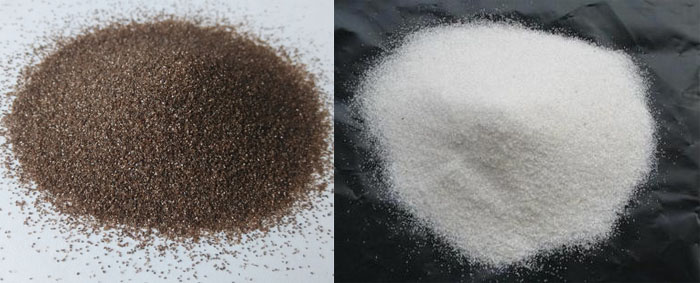
Aluminum oxide is the preferred media for rust removal on precision components, smaller-scale cabinet blasting, and applications requiring a tightly controlled grit size distribution for consistent surface profiles. Its Mohs 9 hardness removes rust and mill scale effectively across a wide range of grit sizes, and white aluminum oxide is safe for stainless steel and non-ferrous metals where iron contamination from steel grit would be unacceptable. For operations consuming less than 50 tonnes of steel per month — below the economic threshold where a steel media reclaim system justifies its capital cost — aluminum oxide with air-wash reclaim often delivers the best total cost of use. Full technical details: Aluminum Oxide Blasting Media: Properties, Grit Sizes & Best Uses.
Garnet — Open-Site and Eco-Sensitive Operations
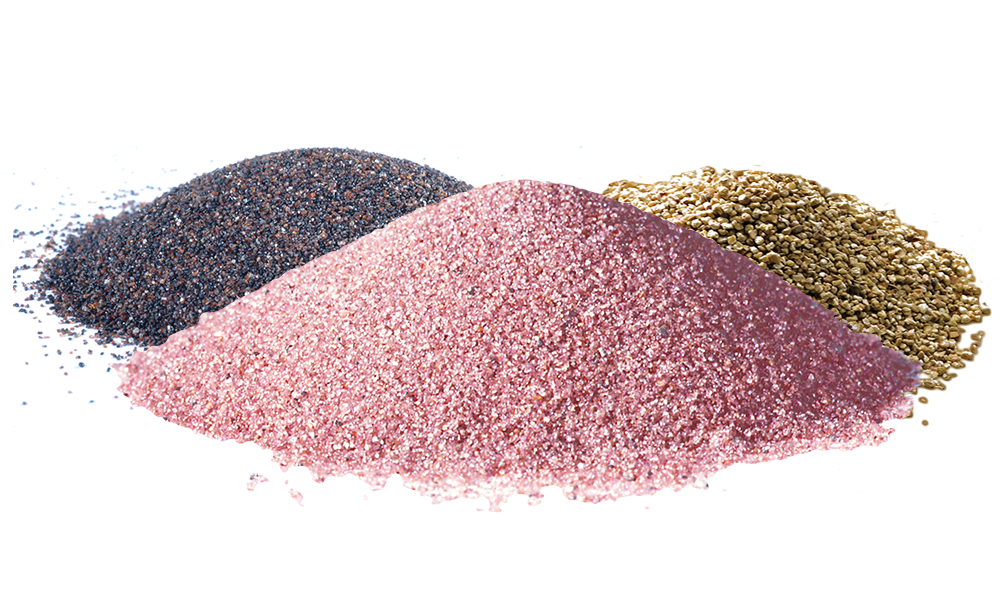
Garnet is the preferred media for open-site rust removal blasting — field pipeline work, bridge rehabilitation, offshore maintenance — where portable pneumatic equipment is used without full media reclaim, and where dust generation, site contamination, and waste disposal are under environmental scrutiny. Its very low dust generation (30–50% less than aluminum oxide at equivalent pressure), low free silica content (<1%), and non-hazardous waste classification make it the practical choice for blasting in environmentally regulated settings. Full technical details: Garnet Blasting Media: Eco-Friendly Performance for Wet & Dry Blasting.
Silicon Carbide — Rust on Hardened Steel
For rust removal from hardened tool steels (above HRC 55) or hard alloy surfaces where aluminum oxide fails to generate adequate cutting pressure, silicon carbide provides the additional hardness needed. This is a niche application — the vast majority of rust removal work occurs on carbon or mild alloy steel where steel grit or aluminum oxide are fully adequate. Full technical details: Silicon Carbide Blasting Media: Hardness, Applications & Reusability.
Grit Size Selection for Rust Removal
| Anmeldung | Target Profile (Rz µm) | Al₂O₃ FEPA | Steel Grit SAE | Garnet US Mesh |
|---|---|---|---|---|
| Light rust removal only (no coating prep) | 20–40 | F60–F80 | G-50 GP | 36/60–60/100 |
| Rust removal + standard epoxy primer prep | 40–60 | F46–F60 | G-40–G-50 GL | 30/60–36/60 |
| Rust + mill scale removal + heavy coating prep | 60–90 | F36–F46 | G-25–G-40 GL/GH | 20/40 |
| Heavy mill scale + deepest profiling | 80–130 | F16–F24 | G-18–G-25 GH | 16/20 |
| Zinc-rich primer prep (requires deeper profile) | 50–100 | F36–F46 | G-25–G-40 GL | 20/40 |
Surface Profile Requirements Before Coating
Achieving the correct cleanliness grade is necessary but not sufficient for long-term coating performance — the surface profile depth must also fall within the range specified by the coating system. Insufficient profile depth reduces mechanical adhesion; excessive depth can create “holidays” (thin coating areas at profile peaks) that initiate corrosion under the coating.
| Coating Type | Typical Cleanliness Grade | Minimum Rz (µm) | Maximum Rz (µm) | Notes |
|---|---|---|---|---|
| Epoxy primer (standard) | Sa 2.5 | 40 | 75 | Most common specification worldwide |
| Zinc-rich primer | Sa 2.5–Sa 3 | 50 | 100 | Zinc needs deep profile for mechanical adhesion |
| High-build epoxy (500 µm+ DFT) | Sa 2.5 | 60 | 120 | Thicker coatings tolerate deeper profiles |
| FBE pipeline coating | Sa 2.5 | 50 | 90 | Per ISO 21809 / API 5L requirements |
| 3LPE pipeline coating | Sa 2.5 | 50 | 85 | Outer PE layer applied over FBE primer |
| Marine antifouling system | Sa 2.5 | 40 | 70 | IMO PSPC requirements for ballast tanks |
| Thermal spray (HVOF / plasma) | Sa 3 | 60 | 120 | Mechanical bonding requires deep anchor |
| Powder coating | Sa 2.5 | 40 | 80 | Always check TDS — varies by powder system |
After blasting for rust removal and prior to coating application, always measure the actual surface profile using either Testex Press-O-Film replica tape (read with a spring micrometer) or a portable contact profilometer. Visual assessment alone cannot reliably confirm that the required profile depth has been achieved. Profile measurement is a contractual requirement on most marine, offshore, and infrastructure coating projects — and a sound quality assurance practice on all others.
Industry-Specific Applications
Structural Steel Fabrication
Fabricated beams, columns, plates, and assemblies are blast-cleaned before shop-primer application using automated wheel blast lines with steel grit. The standard specification is Sa 2.5 with 40–75 µm Rz using G-25 to G-50 steel grit. High throughput (hundreds of tonnes per shift) makes the economics of closed-loop steel media reclaim compelling. For extremely heavy mill scale on hot-rolled sections, GH grade grit or a coarser size (G-18 to G-25) may be required for single-pass Sa 2.5 achievement.
Oil & Gas Pipeline Field Coating
Field-applied corrosion protection on oil and gas pipelines — typically FBE or 3LPE systems — requires Sa 2.5 with 50–90 µm Rz. Portable pneumatic equipment is used at construction sites and in pipeline corridors. Garnet (20/40 to 30/60 mesh) is most commonly specified for this application due to its low dust in often confined or semi-enclosed blasting operations, non-hazardous waste disposal in environmentally sensitive pipeline corridors, and consistent profile within the narrow Rz band that FBE application requires.
Marine Vessel Maintenance and New Build
Rust removal and surface preparation for marine coatings — hull external surfaces, ballast tanks, cargo holds, and structural elements — is governed by IMO MSC/Circ. 1330 (PSPC for ballast tanks) and equivalent specifications, almost universally requiring Sa 2.5 with 40–70 µm Rz. New-build shipyards predominantly use automated roller conveyor wheel blast lines with steel grit for plate and section preparation. Maintenance blasting uses portable equipment with garnet or steel grit, depending on media recovery practicality. For full marine application guidance: Blasting Media for Shipbuilding & Marine Steel Structures.
Bridge and Infrastructure Rehabilitation
Rust removal from existing bridge structures and infrastructure involves working in-situ with containment systems to capture spent media and blast debris. The environmental and safety constraints of this application — proximity to water, traffic, and the public — make low-dust, non-hazardous media essential. Garnet and aluminum oxide are most commonly specified. The presence of existing lead-based paint on older structures requires careful management of all spent media as potentially hazardous waste, regardless of the media type used. Safe media handling: Abrasive Blasting Media Safety: PPE, Ventilation & Dust Control.
Common Mistakes in Rust Removal Blasting
Abrasive blasting cannot effectively remove oil, grease, or chemical contamination — it can drive these into the surface, making subsequent paint adhesion worse, not better. Always degrease and clean steel surfaces before blasting. ISO 8504-1 specifies surface preparation sequence: cleaning before blasting, not the other way round.
Freshly blasted carbon steel begins to re-rust within hours in humid conditions — sometimes visible as “flash rust” within 2–4 hours at relative humidity above 60%. The maximum acceptable interval between blasting and primer application is defined by the coating manufacturer’s TDS (typically 4–8 hours in normal conditions). Blasting and leaving steel exposed overnight without primer application wastes the blasting work entirely.
Steel shot and glass beads (spherical media) cannot effectively remove mill scale or heavy rust because they peen rather than cut. Angular media — steel grit, aluminum oxide, or garnet — is always required for rust removal to Sa 2.5 or above. Using shot instead of grit results in a surface that fails cleanliness assessment and produces inadequate profile depth for coating adhesion.
Source Rust Removal Blasting Media from Jiangsu Henglihong Technology
We supply aluminum oxide (F16–F220), silicon carbide, glass beads, and steel shot/grit — the complete range of media for rust removal and coating preparation. All products carry full chemical analysis certificates and compliance documentation. Contact us for volume pricing and grit size recommendations for your specific corrosion removal application.
Request a Quote or Technical ConsultationHäufig gestellte Fragen
Filter