When NOT to Use Silicon Carbide Blasting Media: 5 Situations to Avoid
An honest guide to SiC limitations — the five most common scenarios where silicon carbide blasting media is the wrong choice, and the alternative abrasive that delivers better results in each case.
SECTION 01Why Limitations Matter
Silicon carbide abrasive blasting media is the hardest commercially available blasting abrasive — and that extreme hardness makes it the ideal choice for a wide range of demanding applications. But it also makes SiC genuinely wrong for certain substrates and situations. Specifying SiC where it does not belong does not simply waste money — it can cause irreversible damage to precision components, create safety hazards from equipment failure, and produce surface conditions that are worse than doing nothing.
This guide is deliberately honest about SiC’s limits. Understanding when NOT to use SiC is as important as knowing when it is the best choice. For the full picture of where SiC excels, see: Complete Buyer’s Guide to SiC Abrasive Blasting Media.
SITUATION 01Blasting Soft, Non-Ferrous Metals (Aluminum, Copper, Brass, Zinc)
Silicon carbide at Mohs 9.5 is dramatically harder than aluminum (Mohs ~2.5), copper (Mohs ~3.0), brass (Mohs ~3–4), and zinc (Mohs ~2.5). The hardness differential is so extreme that SiC will not clean these surfaces — it will destroy them. Angular SiC particles will:
- Remove significant substrate material, causing dimensional loss and surface waviness
- Embed SiC particles into the soft metal surface — a phenomenon called “particle impregnation” that is impossible to remove without additional machining
- Create an irregular, torn surface topography (not an anchor profile) that is unsuitable for most coating applications
- Potentially cause galvanic corrosion if SiC particles remain embedded at the coating interface
Use instead: Glass bead (MIL-G-9954) for cosmetic finishing and light cleaning of aluminum. White aluminum oxide at very low pressure (30–50 PSI) for light scale removal on aluminum. Plastic blast media for paint stripping on aluminum aircraft skins. Walnut shell or corn cob for ultra-gentle cleaning of delicate soft metal components.
SITUATION 02Thin-Walled or Precision Dimensioned Components
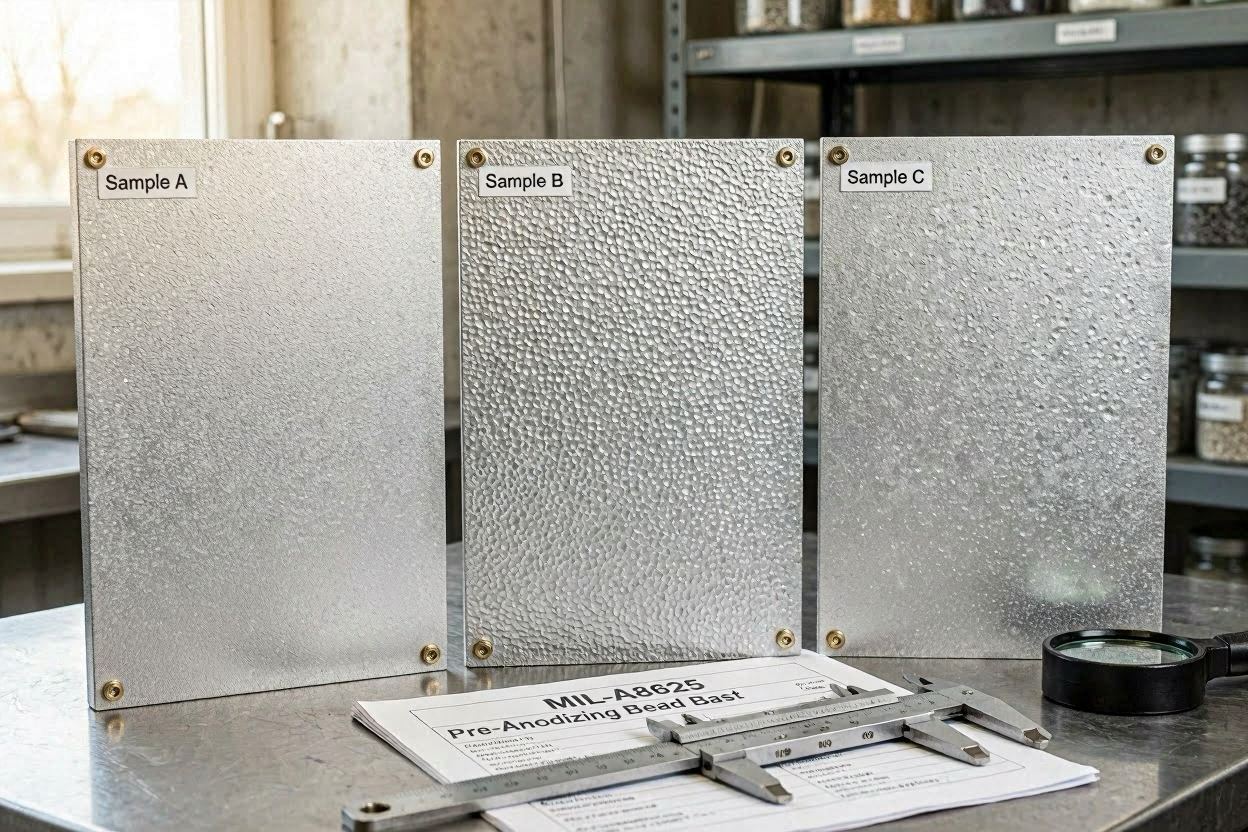
Silicon carbide’s aggressive cutting action results in measurable material loss from the substrate surface — in the range of 5–50 µm per blasting pass depending on grit size, pressure, and substrate hardness. For most structural steel applications this is negligible. For precision machined components with dimensional tolerances of ±25 µm or tighter — turbine airfoil trailing edges, bearing journals, hydraulic valve spools, injection mold cavity surfaces — this material loss is unacceptable and can render expensive components scrap.
The risk is not just material removal on the first blast — it is also that SiC’s aggressive profile depth can exceed the coating DFT, causing coating peaks to be exposed above the film, creating initiation sites for corrosion failure. Always verify that the SiC surface profile (Ra or Rz) is within your coating manufacturer’s specified range before production blasting.
Use instead: Glass bead for precision components requiring dimensional preservation. Fine aluminum oxide (#150–220) at reduced pressure for controlled profile on precision steel parts. Vapor blasting (wet blasting) with fine SiC if abrasive cutting is required — the water cushion reduces profile depth by 30–40% versus dry blasting at equivalent pressure.
SITUATION 03Wood, Composite Decking, and Organic Substrates
Silicon carbide is dramatically too aggressive for wood and organic substrates. Wood has a Mohs hardness of approximately 2–3 and very limited resistance to lateral shear force. SiC at blasting velocities will not clean wood surfaces — it will rapidly abrade the soft wood fiber, raise the grain severely, and potentially cause localized fiber tearing and damage to the substrate structure. Even at very low pressures (30–40 PSI), SiC will produce an uncontrolled and uneven surface on wood that is unsuitable for finishing.
The same caution applies to glass-fiber reinforced polymer (GFRP) composites where the fiber-resin interface is susceptible to delamination from SiC impact — particularly at elevated pressures or with coarser grits. CFRP and aerospace composites may tolerate SiC at carefully controlled parameters, but this requires engineering validation, not empirical field testing.
Use instead: White aluminum oxide (#100–180) at 30–50 PSI for light sanding effects on hard wood species. Corn cob or walnut shell for gentle cleaning or paint stripping on wood surfaces. Plastic blast media for composite paint stripping. Soda blasting for delicate organic substrate cleaning.
SITUATION 04Equipment Not Rated for Hard Abrasive Service
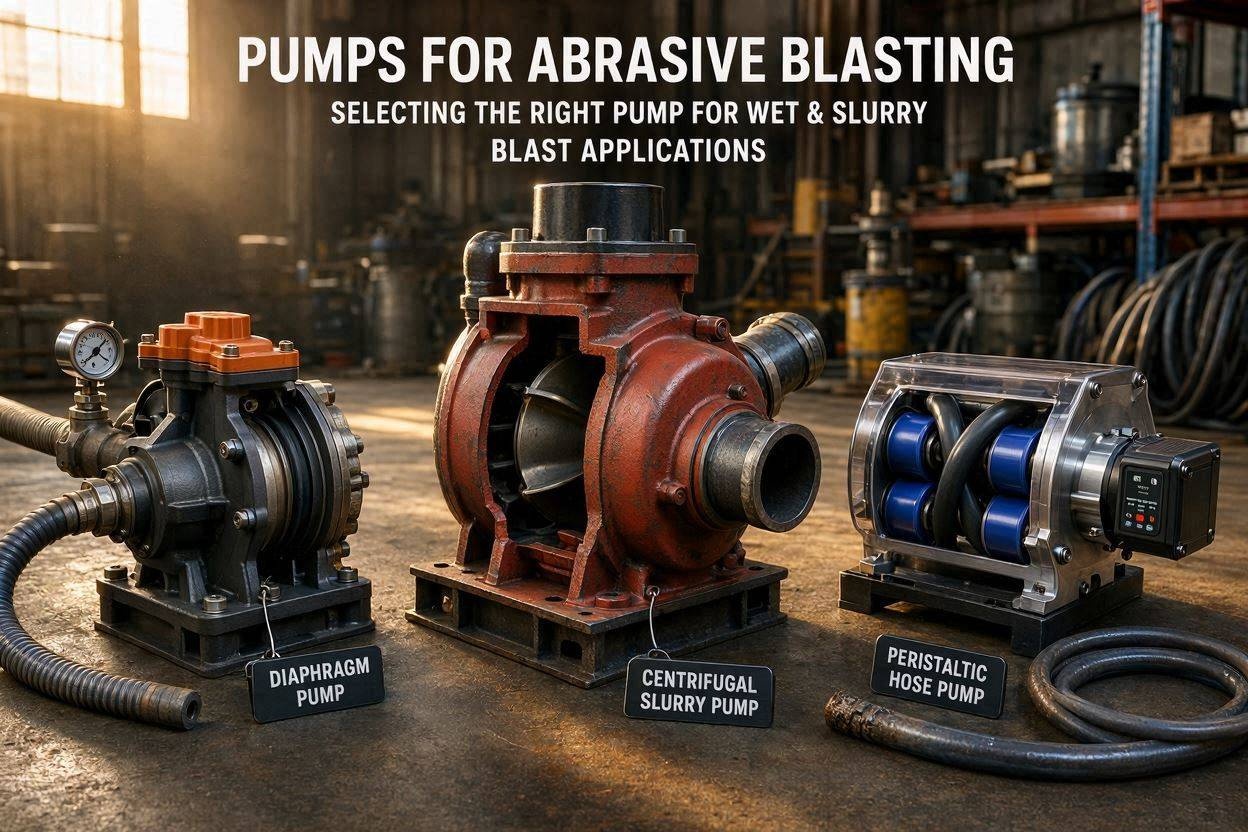
Silicon carbide’s Mohs 9.5 hardness makes it one of the most abrasive materials that can flow through a blasting system — not just abrasive to the substrate, but to every component it contacts: blast nozzles, hoses, media valves, hoppers, and pot liners. Equipment designed for soft media (glass bead, plastic bead, baking soda, walnut shell) will be rapidly and catastrophically destroyed by SiC at blasting pressures.
- Standard ceramic nozzles will fail within 30–60 minutes of SiC service
- Lightweight suction hose inner liners will wear through within 2–4 hours
- Standard rubber pinch valves will show severe erosion after a single operating shift
- Glass bead blast cabinets have thin cabinet liners that SiC will perforate within days
Equipment required for SiC service: Boron carbide or tungsten carbide blast nozzles · Heavy-wall rubber pressure hose (12 mm+ wall) · Tungsten carbide or polyurethane-lined media valves · Rubber-lined blast pot interior · SiC-rated blast cabinet with heavy-duty cabinet liner. Do not introduce SiC into equipment rated only for soft abrasives without upgrading all wear components first.
SITUATION 05Very Small Projects Where Media Cost Dominates Total Cost
SiC’s economic advantage over slower abrasives (garnet, aluminum oxide) arises from labor savings at scale — the faster production rate reduces operator hours, which represents 60–70% of total blasting project cost. On very small projects where blasting time is less than 2–3 hours and media cost represents a larger fraction of total cost, SiC’s unit price premium may not be recovered in labor savings.
For example: a small job blasting 10 m² of rusty steel might take 1 hour with SiC or 3 hours with garnet. At $65/hr labor rate, the labor saving is $130 — which may not offset SiC’s higher media cost for a single-use, non-recovered application. The break-even analysis depends on media recovery capability, local labor rate, and project scale. For projects under 50 m², run the cost calculation before defaulting to SiC; for projects over 100 m², SiC’s economics are almost always favorable on hard substrates.
Use instead for small projects: Aluminum oxide (good balance of cost and speed for general steel prep). Garnet (lower cost per ton, acceptable for one-time small jobs on mild steel). If labor cost is minimal (DIY / hobbyist), garnet or aluminum oxide offer adequate performance at lower total spend.
SECTION 07Quick Reference: SiC vs. Alternative Decision Chart
| Scenario | Use SiC? | Recommended Alternative |
|---|---|---|
| Aluminum, copper, brass substrate | No | Glass bead, plastic media |
| Precision machined part (±25 µm tolerance) | No | Glass bead, vapor blast |
| Wood, painted wood surface | No | Walnut shell, corn cob, white Al₂O₃ |
| Equipment rated for soft media only | No | Glass bead, garnet (match to equipment rating) |
| Small job (<10 m²) with no media recovery | Evaluate | Garnet or Al₂O₃ may be more economical |
| Carbon steel Sa 2.5 prep, large project | Yes | SiC #36–80 |
| Hardened steel (>HRC 35) | Yes | SiC #46–100 |
| Ceramics / glass etching | Yes | SiC #80–220 |
| Semiconductor / precision ceramic lapping | Yes (Green SiC) | Green SiC #320–1200 |
SECTION 08When SiC IS the Right Choice
Despite these five important limitations, silicon carbide is unequivocally the best abrasive blasting media across a broad and commercially important range of applications — hard substrate surface preparation, precision glass etching, aerospace component conditioning, ceramic and semiconductor processing. Its combination of extreme hardness, chemical inertness, and cutting speed makes it irreplaceable in these contexts.
For detailed guidance on all the applications where SiC excels, compare it against the leading alternatives, or learn to source it efficiently from Chinese manufacturers, explore the full resource library below.
SECTION 09Related Guides
Not Sure Which Abrasive Is Right for Your Application?
The technical team at Jiangsu Henglihong Technology Co., Ltd. can help evaluate your substrate, surface requirement, and equipment — and recommend the correct abrasive grade, grit size, and process parameters for your specific application.
Contact Our Technical Team →Filter