China vs USA Sandblasting Media Suppliers: Quality, Lead Time & Cost Reality
The question of whether to source abrasive blast media domestically (in North America or Europe) or import from China, India, or other major producing countries is one that most high-volume blast operations eventually confront. The answer is not simple — it depends on your volume, quality requirements, cash flow, risk tolerance, and supply chain sophistication. This guide provides an honest, data-driven comparison across all the dimensions that matter to buyers.
This page is part of the complete Sandblasting Media Suppliers: Industrial Buyer’s Complete Guide, published by Jiangsu Henglihong Technology Co., Ltd. — a Chinese manufacturer that exports globally. We aim to give you the unvarnished picture, including the legitimate reasons to buy locally and the genuine advantages of direct import when conditions are right.
1. Market Context: Where Abrasives Are Made
The global abrasive blast media industry is geographically concentrated by product type:
- Steel grit & steel shot: China dominates global production, followed by Brazil, India, and South Korea. The U.S. has domestic producers (Wheelabrator, Ervin, Pellets LLC), but at significantly higher price points driven by labor and energy costs.
- Aluminum oxide (BFA & WFA): China produces approximately 70–75% of global supply. Bauxite availability and low electricity cost for electric arc furnace processing give Chinese producers a structural cost advantage.
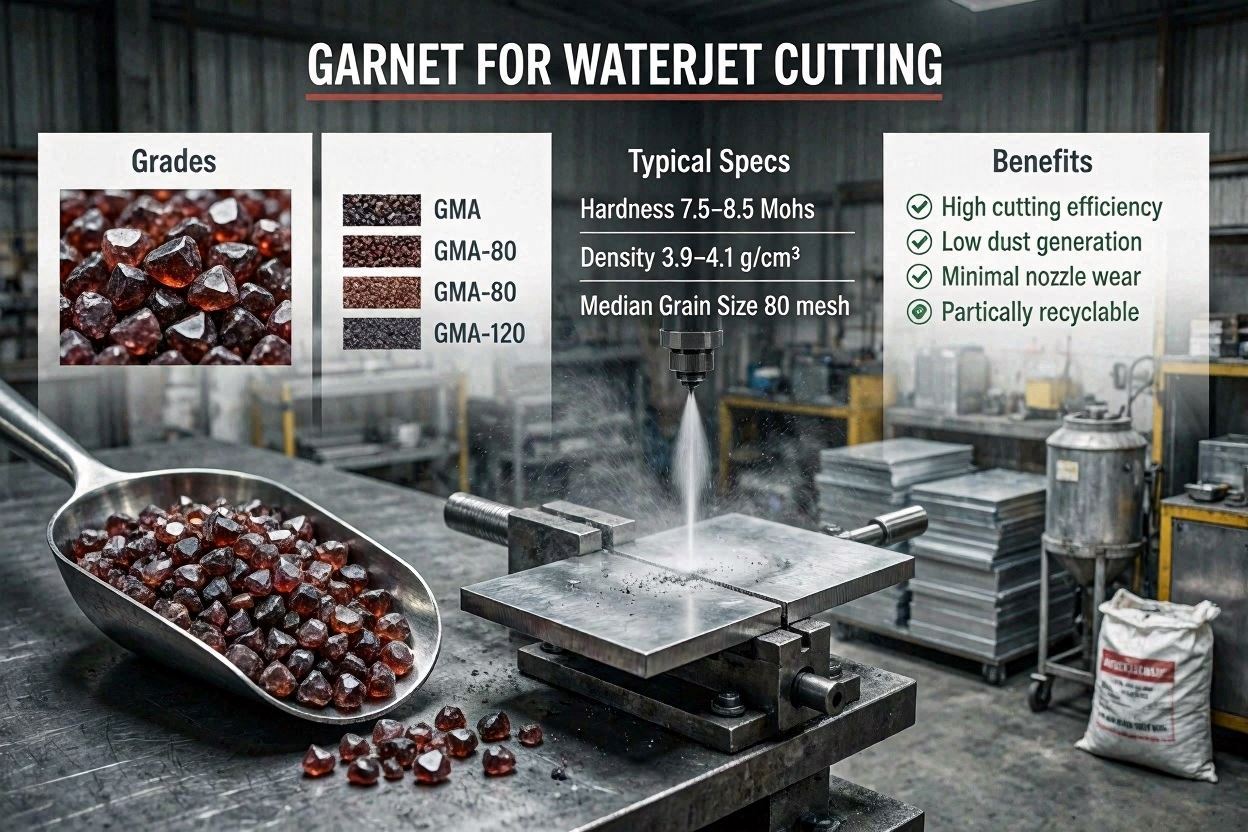
- Granat: Australia (GMA Garnet Group) and India dominate global supply. Limited North American production exists.
- Glasperlen: Manufactured globally by several large producers (Potters Industries in the U.S., Sovitec in Europe, Chinese manufacturers). Multiple domestic options exist in most markets.
- Plastic blast media: U.S.-based manufacturers (Maxi-Blast, Composition Materials) hold strong positions; Chinese production is growing.
2. Quality Comparison: The Reality
The assumption that “domestic = higher quality, imported = lower quality” does not hold across the board for abrasive blast media. A more accurate framing:
| Quality Dimension | Top-Tier Chinese Manufacturers | US / European Manufacturers |
|---|---|---|
| ISO 9001 certification | Available from major manufacturers | Standard across all major producers |
| SAE J444 / ISO 11124 compliance | Available and verifiable | Standard |
| Batch-to-batch consistency | High at established large-scale manufacturers; variable at smaller traders | Very high — automated production with tight SPC |
| Chemical composition control | Good — requires verification | Very good — well-documented production control |
| Documentation quality | Variable — requires active verification | Comprehensive, standardized |
| AMS / MIL-spec certification | Limited (mainly for commodity grades) | Widely available for specialty applications |
| Third-party lab testing | Available (SGS, Bureau Veritas active in China) | Routine |
3. Cost Comparison: FOB vs. Landed
| Produkt | US Domestic Price (delivered) | China FOB Price | China Landed (US East Coast, est.) | Savings from Import |
|---|---|---|---|---|
| Steel grit G25, Medium (per MT) | $750–$1,100 | $480–$580 | $700–$850 | 5–25% |
| Steel shot S230, Standard (per MT) | $700–$1,000 | $440–$540 | $660–$790 | 5–25% |
| BFA #36 (per MT) | $900–$1,300 | $580–$750 | $800–$1,000 | 10–30% |
| WFA #60 (per MT) | $1,400–$2,000 | $900–$1,250 | $1,200–$1,600 | 10–25% |
*Landed cost estimates include ocean freight (~$2,500 per 20′ FCL), port charges, customs duty (2–3% for steel, 0% for Al₂O₃), and customs clearance (~$400). Calculations assume 20 MT per container. Prices as of May 2026.
The cost advantage of importing from China narrows significantly when you account for the capital tied up in transit inventory (30–50 days of stock in motion), minimum order quantities (full container loads vs. smaller domestic orders), freight volatility risk, and the management overhead of international procurement. For buyers with annual consumption above 50–100 MT, the landed cost savings typically justify the additional supply chain complexity.
4. Lead Time & Supply Reliability
| Factor | China Import | US Domestic |
|---|---|---|
| Order-to-delivery lead time | 45–75 days (production + ocean transit + clearance) | 7–21 days (truck delivery) |
| Minimum order size | 18–24 MT (1 FCL typically) | Often 1–5 MT; some suppliers less |
| Emergency supply capability | Poor — cannot expedite ocean shipments | Good — express domestic delivery possible |
| Supply disruption risk | Higher — port congestion, weather, trade policy | Lower — domestic logistics |
| Safety stock required | 60–90 days consumption recommended | 15–30 days consumption typical |
| Forecast accuracy required | High — must plan 60+ days ahead | Lower — can respond to short-term demand |
5. Certification & Compliance Comparison
For most general industrial applications (Sa 2.5 surface preparation for epoxy coatings), standard commercial-grade media from a certified Chinese manufacturer fully meets project requirements. Situations where domestic sourcing may have a compliance advantage include:
- AMS-certified media for aerospace peening: AMS 2431 certification for shot peening media is available from very few Chinese suppliers; most aerospace peening programs specify U.S. or European-sourced media.
- Defense / government contracts: Some U.S. federal contracts require domestic sourcing under the Buy American Act or specific contract clauses. Verify with your contracting officer before specifying imported abrasives on government projects.
- Classification society-approved abrasives: Lloyd’s Register, DNV, ABS, and other marine classification societies approve abrasive products for use on classified vessels. Several major Chinese manufacturers hold class approvals, but verify before specifying on classified vessel work.
- REACH compliance (EU): EU imports must comply with REACH chemical registration requirements. Major Chinese exporters to Europe maintain REACH compliance documentation. Verify before EU import.
6. Risk Factors by Source
China Import — Key Risks
- Supplier substitution: Trading companies may substitute product from a different manufacturer without notice. Mitigate by dealing directly with manufacturers and specifying factory identification on all documentation.
- Trade policy volatility: U.S.-China trade tensions can affect tariff rates. Steel products have been subject to Section 232 tariffs; abrasives have also faced tariff changes. Monitor trade policy when planning long-term contracts.
- Quality drift between orders: A supplier’s first few orders may be high quality, followed by substitution of lower-grade raw materials in subsequent shipments. Batch-level MTC verification for every shipment is the countermeasure.
- Longer dispute resolution: Recovering compensation for non-conforming product from an overseas supplier is significantly more complex and time-consuming than with a domestic supplier.
US / European Domestic — Key Risks
- Price premium: 20–50% higher delivered cost than comparable imported product in most categories — a real and ongoing competitive disadvantage for high-volume users.
- Limited product range: Some specialty grades or custom specifications may not be available from domestic producers who focus on high-volume commodity grades.
- Single-source dependency: If a domestic supplier has capacity constraints, labor actions, or facility issues, alternative supply may require a long international lead time to establish.
7. When to Buy Locally vs. When to Import
| Factor | Buy Domestically If… | Import from China If… |
|---|---|---|
| Annual volume | <20 MT/year | >40 MT/year |
| Order regularity | Irregular, unpredictable demand | Regular, forecastable demand |
| Storage capacity | Limited — cannot hold 60+ days stock | Adequate storage for FCL quantities |
| Specification | AMS-certified, MIL-spec, or classified vessel | Standard commercial grade (SAE/ISO) |
| Project type | Government contract with Buy American requirements | Private sector industrial projects |
| Cash flow | Cannot tie up capital in transit inventory | Can finance 60+ days of in-transit stock |
| Supply chain team | No international procurement capability | Experienced international procurement function |
8. Frequently Asked Questions
Evaluate Import vs. Domestic for Your Operation
Contact Jiangsu Henglihong Technology Co., Ltd. for a full cost comparison — we will provide a CIF quotation to your nearest port, a complete documentation package, and a sample shipment so you can make an informed comparison against your current domestic supplier.
Get a CIF Quote →Filter