Zirconia Beads vs Glass Beads vs Steel Shot — Which Should You Choose?
A data-driven comparison of the four principal spherical blasting media — YSZ zirconia, glass beads, steel shot, and alumina ceramic — covering material properties, application performance, contamination risk, total cost of ownership, and worked selection examples.
📅 Updated 2026
⏰ ~18 min read
🏭 Jiangsu Henglihong Technology Co, Ltd.
1. Why Media Selection Is the Most Important Blasting Decision
Every surface treatment process — whether Shotpeening, Entgraten, polishing, Beschichtungsentfernung, or Oberflächenvorbereitung — derives its fundamental characteristics from the physical and chemical properties of the media used. The equipment, process parameters, and operator technique all matter, but they work within constraints set by the media. Choose the wrong media and no amount of parameter optimisation will fully compensate.
Despite this, media selection in many facilities is driven by habit, initial unit price, or simple availability — not by a systematic evaluation of which medium best fits the application. This guide exists to change that. It presents the evidence for each major media type across the full range of performance criteria that matter in industrial surface treatment.
💬
How to Use This Guide
If you already know your application, jump to Section 6 (Decision Matrix) for a quick reference, then read the relevant worked example in Section 7. If you are evaluating a switch from your current media, read Section 8 (switching from glass to zirconia) or Section 9 (when steel shot still wins) for a direct comparison focused on your situation. The master comparison table in Section 3 is the most comprehensive single reference if you need detailed property data.
2. Media Profiles: Material Properties at a Glance
CompositionSiO₂ + Na₂O + CaO
Dichte2.45 – 2.55 g/cm³
Härte500 – 600 HV
Fracture Toughness0.7 – 0.8 MPa·m½
Sphericity95 – 99%
ColourClear / translucent
Size Range0.05 – 2.0 mm
Special PropertyNone — fractures readily into angular shards
High Impact
Steel Shot (Cast / Cut Wire)
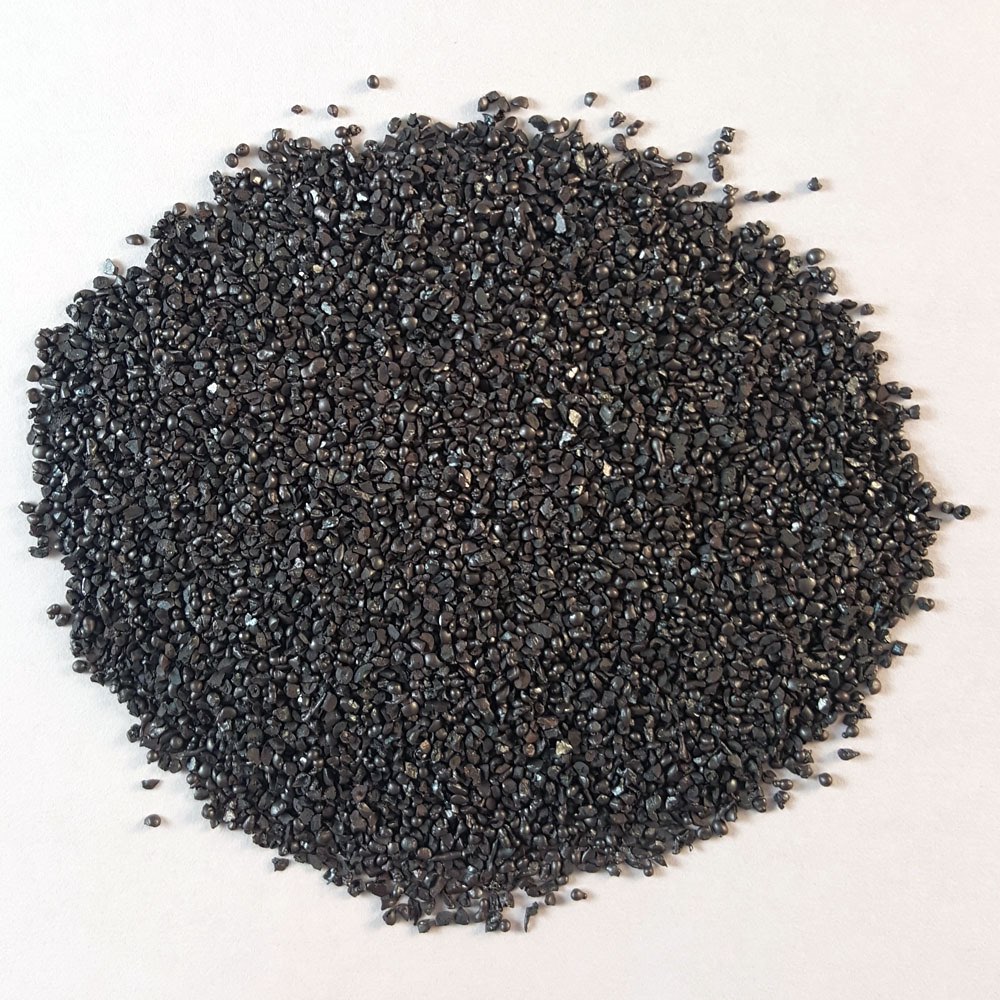
CompositionFe + C (0.85–1.2%) alloy
Dichte7.6 – 7.9 g/cm³
Härte400 – 700 HV (varies by grade)
Fracture ToughnessHigh (metallic — does not fracture)
Sphericity70 – 90% (cast); 95–99% (cut wire)
ColourMetallic grey
Size Range0.2 – 2.4 mm
Special PropertyHighest density of spherical media; introduces Fe contamination
Alternative
Alumina Ceramic Beads
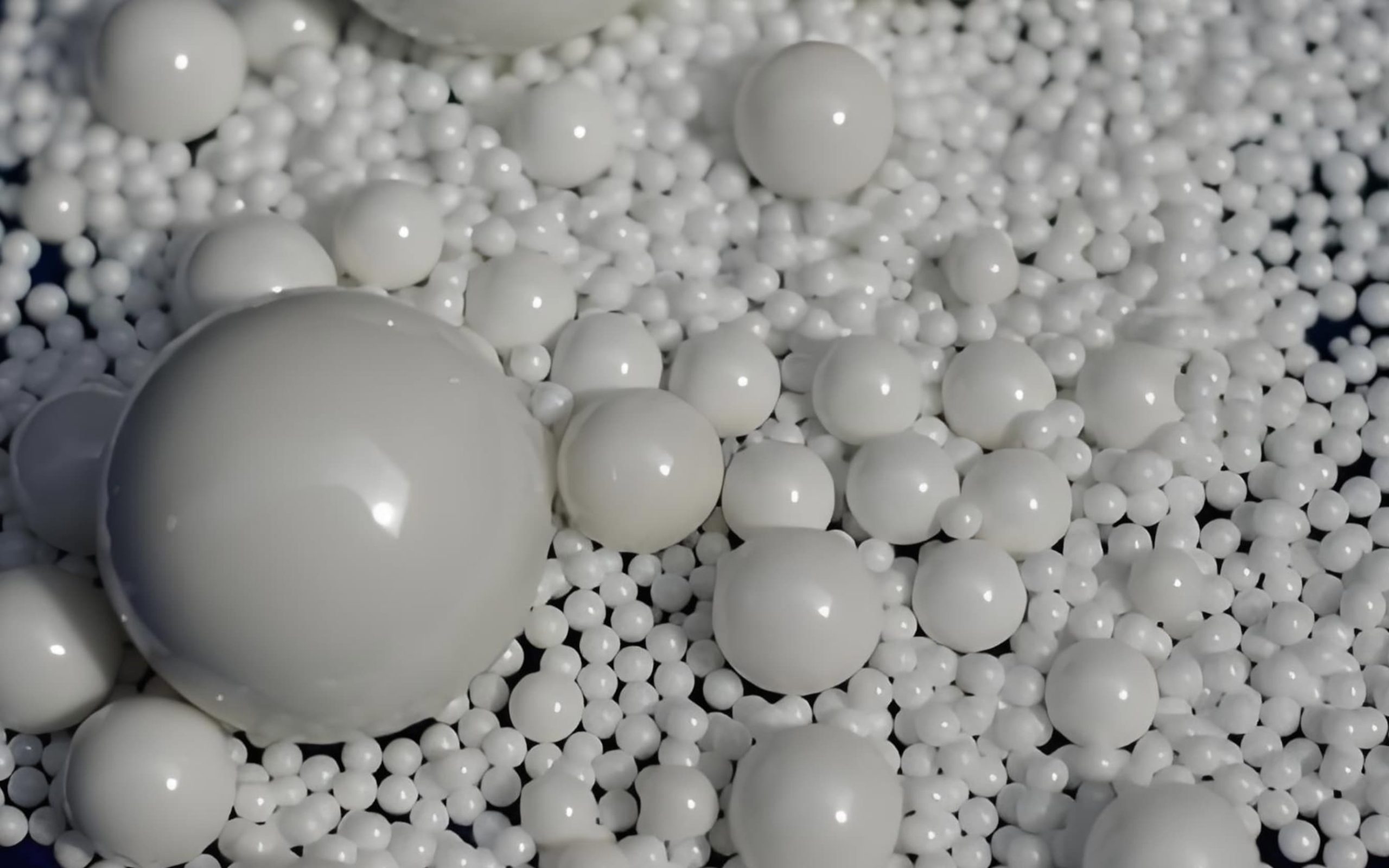
CompositionAl₂O₃ (≥92%)
Dichte3.7 – 3.9 g/cm³
Härte1400 – 1600 HV
Fracture Toughness3 – 5 MPa·m½
Sphericity80 – 95%
ColourWhite / grey
Size Range0.1 – 3.0 mm
Special PropertyHardest common ceramic bead; lower toughness than YSZ
3. Master Comparison Table — 15 Key Criteria
Criterion
YSZ Zirconia
Glasperlen
Stahlkugel
Alumina Ceramic
Dichte (g/cm³)
6.0 – 6.1
2.45 – 2.55
7.6 – 7.9
3.7 – 3.9
Hardness (HV)
1100 – 1300
500 – 600
400 – 700
1400 – 1600
Fracture Toughness (MPa·m½)
6 – 12
0.7 – 0.8
N/A (ductile)
3 – 5
Sphericity
>98%
95 – 99%
70 – 90%
80 – 95%
Media lifespan (relative cycles)
5000+
300 – 600
2000 – 4000
1500 – 3000
Fe contamination
Keine
Keine
Hoch
Keine
Silica (SiO₂) content / dust hazard
Keine
High (silicosis risk)
Keine
Keine
Shot peening intensity (Almen)
Deep & consistent
Shallow, drifts
Deep
Medium
Surface finish (Ra) achievable
Ra 0.05 µm
Ra 0.4 µm
Ra 0.5 – 1.0 µm
Ra 0.3 µm
Suitable for titanium alloys
Yes
Yes
No
Yes
Suitable for nickel superalloys
Yes
Yes
No
Yes
Unit cost per kg (relative)
High (5×glass)
Lowest
Niedrig
Medium
Cost per 1000 processed parts (relative)
Lowest
Highest
Niedrig
Medium
NADCAP aerospace documentation
Full lot traceability
Available
Available
Available
Best application fit
All precision applications
Low-cost general
High-energy steel parts
High-hardness substrates
4. Performance Scoring by Application Category
The radar chart below translates the raw property data into application-specific performance scores (1–10 scale) for each media type across the five primary surface treatment categories.
⚡ Shot Peening Performance
YSZ Zirconia
9.5
Glasperlen
3.5
Stahlkugel
7.5
Tonerde
6.0
🔧 Deburring & Edge Finishing Performance
YSZ Zirconia
9.2
Glasperlen
5.5
Stahlkugel
6.0
Tonerde
7.2
✨ Surface Polishing Performance
YSZ Zirconia
9.7
Glasperlen
6.2
Stahlkugel
4.0
Tonerde
5.5
🛡 Coating Removal Performance
YSZ Zirconia
9.0
Glasperlen
4.8
Stahlkugel
7.2
Tonerde
7.8
🏭 Surface Cleaning & Preparation Performance
YSZ Zirconia
8.8
Glasperlen
5.2
Stahlkugel
7.0
Tonerde
6.8
5. Total Cost of Ownership: The Real Numbers
Unit purchase price is the most visible cost in media selection — and the most misleading. The total cost of ownership (TCO) per unit of production output accounts for all cost elements over the full service life of a media charge. On this basis, the ranking of media by cost is almost always the reverse of their ranking by purchase price.
YSZ Zirconia
1.0×
Indexed TCO per 1,000 parts
Unit cost: High (5× glass)
Charge life: 5,000+ cycles
Media top-up frequency: Monthly
Post-blast cleaning needed: No
Almen recertification: Monthly
Reject rate from contamination: <0.1%
✓ Lowest TCO overall
Glasperlen
2.8×
Indexed TCO per 1,000 parts
Unit cost: Lowest
Charge life: 300–600 cycles
Media top-up frequency: Weekly
Post-blast cleaning needed: No (but low quality)
Almen recertification: Weekly (drifting charge)
Reject rate from contamination: 0.5–2%
Stahlkugel
1.6×
Indexed TCO per 1,000 parts
Unit cost: Low
Charge life: 2,000–4,000 cycles
Media top-up frequency: Bi-weekly
Post-blast cleaning needed: Yes (Fe removal)
Almen recertification: Bi-weekly
Reject rate from contamination: 0.3–1.5%
📈
The Glass Bead TCO Trap
The logic trap with glass beads is straightforward: a $2/kg purchase price feels attractive versus $10/kg for YSZ. But glass bead charges require replacement 8–10× more frequently. Add the cost of weekly Almen recertification (2–4 engineering hours), increased reject rates from contaminated parts, and the disposal cost of more frequent charge changes, and the true cost per 1,000 processed parts for glass beads is typically 2.5–3× that of a YSZ process. The facilities that understand this switch to YSZ and do not go back.
6. Application Decision Matrix
Use this matrix to identify which media type is optimal for your specific combination of application and substrate material. ✓ = recommended, ~ = acceptable with conditions, ✗ = not recommended.
Situation: A tier-1 aerospace supplier was peening Ti-6Al-4V compressor blades to AMS 2430 specification using glass beads at 0.3 mm. They were experiencing Almen intensity drift requiring weekly recertification (8 engineering hours/week), a 1.8% blade reject rate due to silica contamination on fluorescent penetrant inspection, and media charge replacement every 400 cycles.
Switch: Replaced glass bead charge with 0.3 mm YSZ beads from Henglihong at the same blast parameters. Initial Almen calibration required no pressure change — the higher YSZ density compensated for the same nominal bead size.
Results after 6 months: Almen recertification frequency reduced from weekly to monthly (saves 6 engineering hours/week). Blade reject rate on FPI dropped from 1.8% to 0.08%. Media charge life extended from 400 cycles to 3,800 cycles. YSZ unit cost was 5× higher per kg, but total media and quality cost per 1,000 blades decreased by 58%.
✓ Net saving: 58% reduction in total process cost per blade. ROI on media switch achieved in 6 weeks.
🔍 Case Study 2 — Medical Devices
CoCr Hip Implant Deburring: Steel Shot → YSZ Switch
Situation: An orthopaedic implant manufacturer was using steel shot for vibratory deburring of cobalt-chrome hip stems. Approximately 12% of parts were failing the iron contamination check (ferroxyl test) and required acid passivation re-treatment before release, adding $18 per part in rework cost.
Switch: Replaced steel shot with 0.8 mm YSZ beads. Media-to-part ratio adjusted from 5:1 to 6:1 to compensate for the lower density of YSZ versus steel. Cycle time increased by 15% to achieve equivalent deburring completeness.
Ergebnisse: Iron contamination failure rate dropped from 12% to 0%. The $18/part acid re-treatment cost was eliminated entirely. The 15% longer cycle time cost was offset 4:1 by elimination of rework. No YSZ media cost the same per kg but lasted 2.5× longer than the steel shot charge.
✓ Net saving: $16.20 per implant. On a production volume of 5,000 implants/month, annual saving: $972,000.
🔍 Case Study 3 — Luxury Goods
316L Stainless Steel Watch Case Mirror Polishing: Glass → Fine YSZ Upgrade
Situation: A watch component manufacturer was using 0.2 mm glass beads in centrifugal barrel finishing to polish 316L stainless steel watch cases. Plateau Ra was 0.42 µm — below the brand specification requirement of Ra ≤ 0.15 µm. Parts required manual buffing after bead finishing to reach specification, adding 4 minutes of skilled labour per case.
Switch: Replaced 0.2 mm glass beads with 0.1 mm YSZ beads in a two-stage process: Stage 1 with 0.3 mm YSZ (deburring / macro-smoothing, 15 min), Stage 2 with 0.1 mm YSZ and burnishing compound (mirror finish, 25 min).
Ergebnisse: Achieved Ra 0.09 µm consistently — exceeding specification. Manual buffing step eliminated entirely. Total process time increased by 10 minutes (bead stages) but eliminated 4 minutes of skilled buffing labour. Net time saving: 30 seconds per case. At the labour rate for skilled buffers, this saved the equivalent of 1.2 headcount across 3 production shifts.
✓ Net saving: Ra improved from 0.42 to 0.09 µm. Manual buffing eliminated. Labour saving equivalent to 1.2 FTE annually.
8. When to Switch from Glass Beads to Zirconia
Glass beads are still widely used, and in some low-volume, low-criticality applications they remain cost-effective. But there are clear trigger conditions that indicate a switch to YSZ would deliver immediate ROI:
Almen intensity drift requiring recertification more than twice per month — a clear sign the glass bead charge is degrading faster than the process can absorb
Any application on titanium, nickel superalloy, stainless steel, or aluminium where downstream coating adhesion or corrosion resistance is specification-critical
Part reject rates above 0.5% attributable to surface contamination — the rework cost alone typically justifies YSZ on a 4–6 week payback
Surface finish (Ra) requirements below 0.4 µm — glass beads cannot reliably achieve this; YSZ can reach Ra 0.05 µm
NADCAP or AS9100 audit findings related to media traceability or process stability — YSZ lot documentation is more complete and the charge life stability is demonstrably better
Worker health and safety pressure around silica dust — YSZ contains no silica; glass bead breakdown generates respirable silica particles that are a regulated occupational hazard
9. When Steel Shot Remains the Right Choice
Steel shot is not the wrong choice for every application — it is the wrong choice for applications where iron contamination matters. For applications on carbon steel and low-alloy steel where iron contamination is irrelevant, steel shot’s very high density (7.8 g/cm³) makes it the most cost-effective medium for generating deep compressive stress profiles in shot peening, and the fastest medium for Sa 2.5 cleaning of heavily rusted carbon steel structures.
Steel shot is the preferred choice when: the substrate is carbon steel or low-alloy steel with no corrosion-critical coating; the target is deep compressive stress (>0.4 mm) with maximum peening intensity on thick-section components; the volume is very high and the cost sensitivity is extreme; and the surface finish requirement after peening is Ra > 0.8 µm (where the surface roughness from steel shot is acceptable).
The one scenario where steel shot should never be used is any application involving titanium, nickel superalloy, stainless steel, aluminium, or any substrate destined for a high-performance corrosion-critical environment. In those cases, YSZ is the only mechanically effective, contamination-free spherical blasting medium.
🔗
This comparison guide is the analytical foundation for Henglihong’s complete surface treatment knowledge base. For full technical specifications on YSZ zirconia beads — including product grades, size ranges, and application engineering — refer to our complete zirconia beads guide.
10. Related Application Guides
Each guide below provides deep technical coverage of a specific application — the data in this comparison article is put to practical use in each of these process guides.
Is zirconia bead blasting always better than glass bead blasting?
+
From a performance standpoint, yes — YSZ delivers better Almen intensity, better surface finish, longer charge life, and zero contamination risk across all blasting applications. From a pure unit cost standpoint, no — glass beads are cheaper per kilogram. The question is always whether the performance advantages of YSZ translate into sufficient production cost savings to justify the higher unit price. In our experience, for any application involving precision components, safety-critical specifications, or non-ferrous alloys, the TCO calculation consistently favours YSZ. For very high-volume, low-value applications on carbon steel where surface contamination is irrelevant, glass beads or steel shot may remain cost-effective. The worked examples in Section 7 show how to calculate this for your specific case.
Can I mix zirconia beads and glass beads in the same equipment charge?
+
Technically possible but not recommended for process-controlled applications. The two media have very different densities (6.0 vs 2.5 g/cm³) and fracture behaviours. A mixed charge will have unpredictable Almen intensity behaviour — the glass fraction fractures and reduces intensity while the YSZ fraction maintains it, creating a charge that starts at one intensity and drifts erratically as the glass fraction breaks down. For quality-controlled production, always use a single media type per charge. If trialling the switch from glass to YSZ, replace the charge completely rather than topping up with YSZ into a partially depleted glass charge.
How do I calculate whether switching to YSZ beads will save money in my operation?
+
Use this five-factor TCO calculation: (1) Current annual media cost = (annual production cycles ÷ current charge life) × charge weight × current media unit cost. (2) Current recertification cost = recertification frequency per year × hours per recertification × engineering hourly rate. (3) Current reject/rework cost = annual production volume × reject rate × rework cost per part. (4) Disposal cost = (annual production cycles ÷ current charge life) × disposal cost per charge change. Sum these four factors for your current media. Then repeat for YSZ, using: charge life = 8–12× your current glass bead charge life; unit cost = 4–6× current unit cost; reject rate = 0.05–0.1%; recertification frequency = monthly. If the YSZ total is lower — which it will be in virtually all precision manufacturing contexts — the switch saves money from day one of full implementation.
What are the health and safety differences between zirconia, glass, and steel shot media?
+
Glass beads present the most significant occupational health concern. As they fracture during blasting, they generate respirable silica (crystalline SiO₂) dust — a known cause of silicosis, an irreversible and potentially fatal lung disease. In many countries, silica dust exposure is subject to strict occupational exposure limits (OELs) and requires medical surveillance, ventilation controls, and respiratory protection equipment. YSZ beads contain no silica — the ZrO₂/Y₂O₃ composition does not generate hazardous respirable fibres on fracture. Steel shot generates metallic iron dust, which is less acutely hazardous than silica but requires general industrial dust controls. From an HSE standpoint, YSZ is the safest media option for operators.
Does the higher hardness of alumina ceramic beads make them better than YSZ for hard substrates?
+
Hardness and performance are not synonymous in blasting media. Alumina at 1400–1600 HV is harder than YSZ at 1100–1300 HV, but its fracture toughness (K₁c 3–5 MPa·m½) is significantly lower than YSZ (6–12 MPa·m½). In practice, this means alumina beads fracture more readily than YSZ under repeated impact — their charge life is shorter, and as they fracture, they transition from spherical to angular, changing the surface texture they produce. For hard substrate deburring (hardened steel, carbide), alumina’s hardness advantage is real and useful. But for shot peening, polishing, and any application where spherical geometry must be maintained throughout the charge’s service life, YSZ’s combination of adequate hardness plus superior toughness outperforms alumina. YSZ remains spherical for far longer — which is what makes it the premium choice across the broadest range of applications.
HLH
Jiangsu Henglihong Technology Co, Ltd.
YSZ zirconia bead manufacturer and surface treatment process specialist. Providing comparative media analysis, total cost of ownership modelling, and free application engineering consultations to help precision manufacturers select the optimal blasting medium for their specific process requirements.
Ready to Run the Numbers for Your Process?
Share your current media type, production volume, and application — our engineers will calculate your specific TCO comparison and recommend the optimal YSZ bead size for a direct trial.