Aluminum Oxide Abrasive Media: Uses, Grit Sizes & Where to Buy
The complete technical guide to aluminum oxide blast media — brown vs white fused alumina, grit selection, surface profiles, industrial applications, and factory-direct sourcing from Jiangsu Henglihong Technology.
What Is Aluminum Oxide Abrasive Media?
Aluminum oxide — chemical formula Al₂O₃, also known as alumina or corundum — is the world’s most widely used synthetic abrasive material. In blast media form, it is manufactured by fusing high-purity bauxite ore in a tilting arc furnace at temperatures exceeding 2,000°C, then crushing, grading, and classifying the resulting crystalline mass into precise particle size distributions.
The result is an extremely hard, angular abrasive with a blocky, fractured crystal structure that delivers consistent, aggressive cutting action on virtually any substrate. At Mohs hardness 9 — harder than any mineral found in common industrial surfaces, and second only to diamond and silicon carbide among commercial abrasives — aluminum oxide cuts through rust, mill scale, old coatings, and surface oxides with high efficiency.
Its combination of hardness, angular particle shape, chemical inertness, thermal stability, and recyclability has made aluminum oxide the default choice for industrial abrasive blasting, grinding wheel manufacture, lapping compounds, refractory ceramics, and thermal spray coating preparation across every major manufacturing sector worldwide.
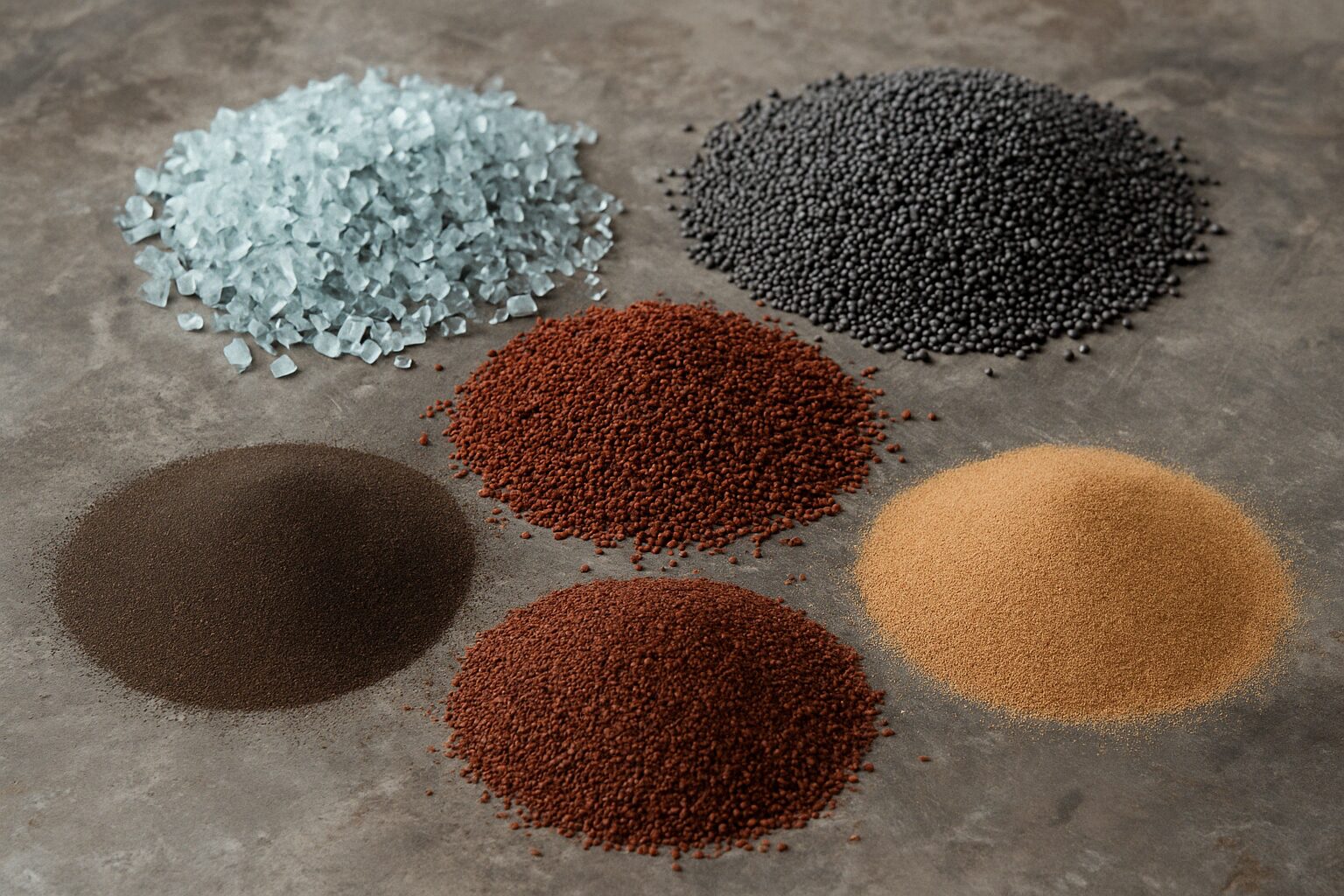
For context on how aluminum oxide compares to garnet, glass beads, steel grit, and other blast media types, see our Abrasive Media Comparison Chart or our full guide to all 10 types of abrasive blasting media.
Brown Fused Alumina vs White Fused Alumina: Which Grade Do You Need?
Aluminum oxide blast media comes in two primary commercial grades that differ significantly in purity, hardness, crystal structure, and application suitability. Choosing between them is the first specification decision for any aluminum oxide project.
- Al₂O₃ content: 94–97%
- Contains TiO₂ (1.5–4%) which improves toughness
- Slightly lower hardness than WFA — more impact-resistant, less friable
- Cost-effective for high-volume industrial applications
- Not suitable where iron or titanium contamination is a concern
- Al₂O₃ content: 99%+
- Near-zero iron, titanium, and trace element contamination
- Slightly more friable than BFA — creates sharper, self-renewing cutting edges
- Higher cost — justified by purity and contamination-critical applications
- Required for stainless steel, aerospace alloys, and electronics
If your substrate is carbon steel or cast iron and contamination is not a concern, Brown Fused Alumina (BFA) is the correct and cost-effective choice. If your substrate is stainless steel, a non-ferrous alloy, or a precision aerospace component — or if the specification prohibits iron contamination — specify White Fused Alumina (WFA).
Key Technical Specifications
The table below summarises the principal technical parameters of Jiangsu Henglihong Technology’s aluminum oxide abrasive media grades, in accordance with FEPA (Federation of European Producers of Abrasives) and GB/T (Chinese National Standard) specifications.
| Parameter | BFA Standard Grade | BFA Premium Grade | WFA Standard Grade | WFA Premium Grade |
|---|---|---|---|---|
| Al₂O₃ (min %) | 94.5 | 96.0 | 99.0 | 99.5 |
| TiO₂ (max %) | 4.0 | 3.0 | 0.08 | 0.05 |
| Fe₂O₃ (max %) | 0.50 | 0.30 | 0.12 | 0.08 |
| SiO₂ (max %) | 1.50 | 1.00 | 0.20 | 0.10 |
| Bulk density (g/cm³) | 1.70–1.85 | 1.70–1.85 | 1.55–1.70 | 1.55–1.70 |
| Mohs hardness | 9.0 | 9.0 | 9.0–9.1 | 9.0–9.1 |
| Crystalline silica | None detected — OSHA compliant | |||
| Available grits | F16 – F220 (FEPA); 16 – 220 mesh (US) | F16 – F320 (FEPA); 16 – 320 mesh (US) | ||
| Packaging | 25kg bags · 1-ton super sacks · Bulk container | |||
Grit Size Guide: Which Grit Do You Need?
Grit size is the most frequently misspecified variable in aluminum oxide media selection. The correct grit is determined by the required surface profile depth — which in turn is set by your coating system’s adhesion requirement. Below is a comprehensive grit selection reference covering the full commercial range.
| Grit Size | Approx. Particle Size (µm) | Typical Profile Depth | SSPC Cleanliness | Primary Applications | Recommended Grade |
|---|---|---|---|---|---|
| 16 – 24 | 1,180 – 710 | 3.5 – 5.0+ mil | SP5 / SP10 | Very heavy rust removal, deep profile for thermal spray prep, refractory surface preparation | BFA |
| 30 – 36 | 600 – 425 | 2.5 – 4.0 mil | SP5 / SP10 | Heavy rust and mill scale removal, structural steel prep for high-build coatings, pipe coating | BFA |
| 46 – 60 | 355 – 250 | 1.5 – 2.5 mil | SP10 / SP6 | General industrial steel prep, standard epoxy and polyurethane coating systems, fabrication shops | BFA |
| 80 | 180 | 1.0 – 1.8 mil | SP10 / SP6 | Medium-duty prep, powder coat prep, automotive chassis, light industrial equipment | BFA |
| 100 – 120 | 150 – 125 | 0.5 – 1.2 mil | SP10 | Precision coating prep, automotive body panels, stainless steel light prep, aerospace primer prep | BFA / WFA |
| 150 – 180 | 106 – 90 | 0.2 – 0.6 mil | SP10 | Fine surface conditioning, stainless steel cleaning, precision part deburring, pre-anodize prep | WFA |
| 220 – 320 | 75 – 45 | Surface haze only | N/A | Lapping compounds, precision grinding, electronics substrate preparation, optical component finishing | WFA |
Profile ranges in the table above are based on standard operating conditions. Your specific coating system’s datasheet specifies a minimum and maximum acceptable profile range — and that range takes precedence. An under-profiled surface reduces coating adhesion; an over-profiled surface allows coating peaks to rust through the film. Both cause premature coating failure.
Surface Profile Depth by Grit Size — Visual Reference
The bars below visualise the typical anchor profile depth range produced by each major grit band at standard air blast pressure (80–100 psi). The scale runs from 0 to 5 mil (0–127 µm). Use this alongside your coating manufacturer’s specified profile range to confirm grit selection.
Industrial Applications of Aluminum Oxide Blast Media
Aluminum oxide’s hardness, angular shape, and chemical inertness make it suitable for a broader range of applications than any other single abrasive media type. The following are the primary industrial use cases across the four sectors Jiangsu Henglihong Technology serves.
Structural Steel Surface Preparation
The most common use case globally. Al₂O₃ removes rust, mill scale, and existing coatings to SSPC-SP10 or SP5 cleanliness while creating the anchor profile required for epoxy, polyurethane, and zinc-rich primer systems.
Recommended: BFA 36–60 grit · Profile: 1.5–3.0 milAerospace Component Preparation
WFA is specified for aluminum alloy, titanium, and Inconel components where iron contamination would compromise corrosion resistance or bonding. Used for adhesive bonding surface prep, primer adhesion, and thermal barrier coating prep on turbine parts.
Recommended: WFA 80–150 grit · Grade: 99%+ Al₂O₃Automotive Restoration
Medium-grit BFA effectively strips rust and old paint from steel chassis, frames, and suspension components before coating. Fine-grit WFA is used for precision prep of alloy wheels and engine components where dimensional change must be minimised.
Recommended: BFA 60–80 grit for chassis; WFA 120 for alloy partsPrecision Deburring & Deflashing
Fine-grit aluminum oxide in suction blast cabinets removes burrs and flash from machined metal, die castings, and investment castings without altering critical dimensions. WFA is preferred where contamination of bores or threads must be avoided.
Recommended: WFA 100–180 grit · Suction cabinetThermal Spray Coating Preparation
Thermal spray coatings (HVOF, plasma spray, arc spray) require the highest surface cleanliness and deepest anchor profiles of any coating process — often 3.0–5.0 mil. Coarse BFA is the standard prep media for thermal spray bond coats on aerospace and industrial components.
Recommended: BFA 16–36 grit · Profile: 3.0–5.0 milElectronics & Semiconductor Substrates
Ultra-fine WFA (220–320 grit) is used for micro-scale surface conditioning of ceramic substrates, wafer carriers, and PCB components. The near-zero iron contamination and tight particle size distribution of premium WFA are critical in this application.
Recommended: WFA 220–320 grit · 99.5% Al₂O₃ purityGrinding & Lapping Wheels
Bonded aluminum oxide is the primary abrasive grain in conventional grinding wheels, honing sticks, and sharpening stones. Both BFA (for general toolroom use) and WFA (for tool steel and HSS grinding) are key raw materials in the abrasive products manufacturing industry.
Supply grade: F-series FEPA grit for bonded abrasivesRefractory & Industrial Ceramics
Coarse aluminum oxide is a primary raw material in high-temperature refractory castables, kiln furniture, and alumina ceramics. Henglihong supplies fused alumina for refractory manufacturing in addition to blast media grade products.
Supply grade: Tabular alumina, calcined alumina, fused alumina aggregatePros & Cons of Aluminum Oxide Abrasive Media
✅ Advantages
- Extremely hard (Mohs 9) — aggressive, fast, effective on virtually all metals
- Angular shape — creates strong anchor profiles required by industrial coating systems
- Wide grit range (16–320) — one media family covers everything from structural prep to precision finishing
- Recyclable 5–10× — substantially lower per-cycle cost than single-use alternatives
- Two purity grades (BFA/WFA) — cost-effective for general use, ultra-pure for contamination-critical applications
- Silica-free — OSHA compliant in all jurisdictions
- Chemically inert — does not react with most substrates or coating systems
- Self-sharpening — particle fracture during use maintains cutting edges
❌ Limitations
- Too aggressive for composite, fiberglass, thin aluminum, plastic, and wood substrates
- BFA contains iron traces — not suitable for stainless steel without WFA specification
- Generates significant dust — requires effective dust collection and respiratory PPE
- Not compatible with wheel blast machines — use steel grit/shot in centrifugal wheel systems
- Contamination accumulates over cycles — media must be properly reclaimed and replenished to maintain quality
- Higher purchase cost than single-use mineral alternatives (garnet, crushed glass) — though lower per-cycle cost in practice
Aluminum Oxide vs Alternative Blast Media
Understanding when aluminum oxide is the right choice — and when another media type outperforms it — prevents specification errors. The comparison below covers the most common decision points. For a comprehensive side-by-side data table across all media types, see our Abrasive Media Comparison Chart.
| Comparison | Aluminium-Oxid | Alternative | When to Choose the Alternative |
|---|---|---|---|
| Al₂O₃ vs Granat | Harder, recyclable 5–10×, deeper profile, more aggressive | Lower dust, lower chloride, better for confined spaces and marine coating specs | Choose garnet when dust control is critical, for marine projects, or when spec explicitly requires low-chloride media |
| Al₂O₃ vs Glasperlen | Angular — creates strong anchor profile | Spherical — produces smooth peened finish, no profile | Choose glass beads when a satin finish is required without anchor profile, or for stainless steel decorative finishing |
| Al₂O₃ vs Stahlkies | Suitable for pressure blast; recyclable 5–10× | Recyclable 100+×; exclusively for wheel blast; very deep profile | Choose steel grit for high-volume wheel blast operations where lowest per-cycle cost at scale is the priority |
| Al₂O₃ vs Plastische Medien | Aggressive — can damage soft or thin substrates | Very gentle — strips coatings without substrate damage | Choose plastic media for aircraft composite / aluminum skin stripping or any substrate where dimensional integrity is critical |
| Al₂O₃ vs Silicon Carbide | Mohs 9 — effective on most industrial substrates | Mohs 9.5 — required for ceramics, carbide, and hardened glass | Choose silicon carbide only when substrate is harder than Mohs 9 — ceramics, tungsten carbide tooling, or stone engraving |
Recyclability & Media Management
One of aluminum oxide’s key economic advantages over single-use media is its ability to be recycled through a blast system multiple times before replacement. Achieving the full 5–10 cycle lifespan requires a properly designed and maintained media reclaim system and a disciplined media management protocol.
What Happens to Aluminum Oxide During Blasting
Each blast cycle fractures a proportion of particles into smaller fragments. This is actually part of what maintains cutting effectiveness — fresh fracture surfaces are sharp and angular. However, as the proportion of fine particles increases over successive cycles, the overall particle size distribution shifts finer, which reduces profile depth and blast efficiency. Without reclaim, the accumulating fines and contamination degrade performance rapidly.
Reclaim System Requirements
An effective reclaim system for aluminum oxide requires three stages:
- Mechanical screening: Removes particles above and below the acceptable size range, as well as coarse contaminants picked up from the substrate.
- Air wash classification (elutriator): Removes fine dust particles — typically <45 µm — that are too small to contribute to effective blasting but add to respiratory hazard and contaminate the media charge.
- Periodic replenishment: As the working media charge degrades, fresh media is added to maintain the correct particle size distribution. A working charge typically requires 10–15% replenishment per cycle in a well-managed system.
Media that has been used on painted steel surfaces — particularly older painted structures of unknown coating history — may contain lead, chromium, or cadmium absorbed from the blasted coatings. This contaminated media must not be reused on clean or food-contact substrates, and spent media from such projects should be characterised for hazardous waste classification before disposal. Always keep substrate-specific media batches separate.
Safety & Regulatory Compliance
Aluminum oxide abrasive media is one of the safest blast media options available from a regulatory standpoint, but it is not hazard-free. Standard blast safety protocols apply.
OSHA Crystalline Silica Compliance
Aluminum oxide contains no free crystalline silica. It is fully compliant with OSHA’s crystalline silica standard (29 CFR 1910.1053 and 1926.1153) and does not require the enhanced engineering controls and exposure monitoring mandated for silica-containing materials. This makes it a straightforward, compliant replacement for conventional silica sand in all jurisdictions that regulate silica exposure.
Required PPE During Use
- Supplied-air respirator (NIOSH-approved Type CE): Required for all abrasive blasting operations regardless of media type, due to general airborne dust hazard and substrate contamination particles.
- Blast helmet or hood: Eye, face, and head protection against particle rebound.
- Leather or canvas blast suit: Full body protection from abrasive particle impact.
- Hearing protection: Blast operations routinely exceed 90 dB(A) at operator position.
- Steel-toed boots: Required in all industrial blasting environments.
For a comprehensive overview of blast safety requirements including engineering controls, ventilation, and hazard communication, see our Abrasive Media Safety Guide: OSHA Standards & PPE Requirements.
Ordering Aluminum Oxide from Jiangsu Henglihong Technology
Jiangsu Henglihong Technology manufactures both BFA and WFA grades at our Jiangsu Province facility, supplying customers across North America, Europe, the Middle East, and Southeast Asia. Factory-direct purchasing eliminates distributor margins, and our in-house quality laboratory verifies particle size distribution, chemistry, and bulk density on every production batch before dispatch.
Custom specifications — non-standard grit mixes, specific chemistry targets, specialised packaging — are available for OEM and project-specific requirements. Contact our technical sales team to discuss your requirements.
Häufig gestellte Fragen
What is aluminum oxide abrasive media used for?
Aluminum oxide is used across a broad spectrum of industrial and precision applications: structural steel surface preparation for protective coatings, aerospace component prep and deburring, automotive restoration, thermal spray coating preparation, precision lapping and grinding, electronics substrate finishing, and refractory manufacturing. Its combination of Mohs 9 hardness, angular particle shape, and recyclability makes it the most versatile abrasive blast media available.
What is the difference between brown and white aluminum oxide?
Brown fused alumina (BFA) contains 94–97% Al₂O₃ with trace amounts of TiO₂ and Fe₂O₃ that give it a reddish-brown colour and slightly greater toughness. It is the cost-effective standard grade for general industrial blasting and grinding. White fused alumina (WFA) is reprocessed to 99%+ Al₂O₃ purity — near-zero iron and titanium — giving it a bright white colour, marginally higher hardness, and a self-sharpening friable crystal structure. WFA is required for stainless steel, aerospace alloys, electronics substrates, and any application where contamination from trace elements is not acceptable.
How many times can aluminum oxide blast media be reused?
With a properly designed reclaim system — mechanical screening to remove oversize and undersize particles, air wash classification to remove fine dust, and periodic replenishment of depleted charge — aluminum oxide typically achieves 5 to 10 blast cycles before the particle size distribution has degraded sufficiently to require full replacement. Operating pressure, nozzle size, substrate hardness, and reclaim system efficiency all affect the actual cycle count. Without a reclaim system, aluminium oxide is effectively single-use and loses its economic advantage over lower-cost alternatives.
What grit size of aluminum oxide should I use for blasting steel?
For standard industrial steel surface preparation to SSPC-SP10 Near-White with a 1.5–2.5 mil profile, 60 or 80 grit BFA is the most common and correct specification. For heavier rust or deeper profiles (2.5–4.0 mil) required by high-build epoxy or zinc-rich systems, use 36–46 grit. For light-duty prep, powder coat, or thin-film coatings requiring less than 1.5 mil, use 80–120 grit. Always cross-check against the coating manufacturer’s surface preparation datasheet before finalising grit selection.
Is aluminum oxide safe to blast stainless steel?
Brown fused alumina (BFA) should not be used on stainless steel because its residual iron content (Fe₂O₃ up to 0.5%) can embed in the stainless surface and initiate corrosion. White fused alumina (WFA) — with Fe₂O₃ below 0.08–0.12% — is the correct grade for stainless steel blasting, and is widely specified for this application in food processing equipment, pharmaceutical plant, and architectural stainless work. Specify WFA at 120–180 grit for a clean, fine profile on stainless without contamination risk.
Can I use aluminum oxide in a suction blast cabinet?
Yes — aluminum oxide is one of the most commonly used media in suction (siphon) blast cabinets. Grit sizes from 46 to 220 mesh work well in standard cabinet systems. Coarser grits (16–36) are typically too heavy for efficient siphon action and are better suited to direct pressure blast pots. For cabinet use, 60–150 grit BFA or WFA covers the vast majority of deburring, cleaning, and light surface prep applications. Ensure your dust collector is rated for the media volume and particle size before starting.
What is the difference between FEPA F-series grit and US mesh size?
FEPA (Federation of European Producers of Abrasives) F-series and US mesh sizes both describe particle size, and for most practical purposes they use the same numbering at equivalent sizes — F60 FEPA and 60 US mesh refer to essentially the same particle size range. Minor differences exist at the fine end of the range (above F150/150 mesh) where the sizing standards diverge slightly. When ordering from international suppliers, specify both the FEPA and US mesh designation if you want to be certain of receiving the correct grade, and request a particle size distribution certificate to verify compliance.
Ready to Order Aluminum Oxide Abrasive Media?
Factory-direct BFA and WFA in all commercial grit sizes — 25 kg bags to full container loads. Free technical consultation and COA documentation included with every order.
Request a Quote View All Abrasive Media Products →Filter