How to Choose the Right Abrasive Media for Your Project
Six questions. One clear answer. Follow this decision framework to select the correct blast media for any substrate, specification, or budget — the first time, every time.
Why Getting Abrasive Media Selection Wrong Is Expensive
The abrasive media you select costs somewhere between $0.30 and $3.00 per pound. The coating system applied on top of it costs ten to one hundred times more. The steel structure or component underneath costs orders of magnitude more still. Yet media selection is routinely treated as an afterthought — the cheapest available bag, or whatever was used on the last job.
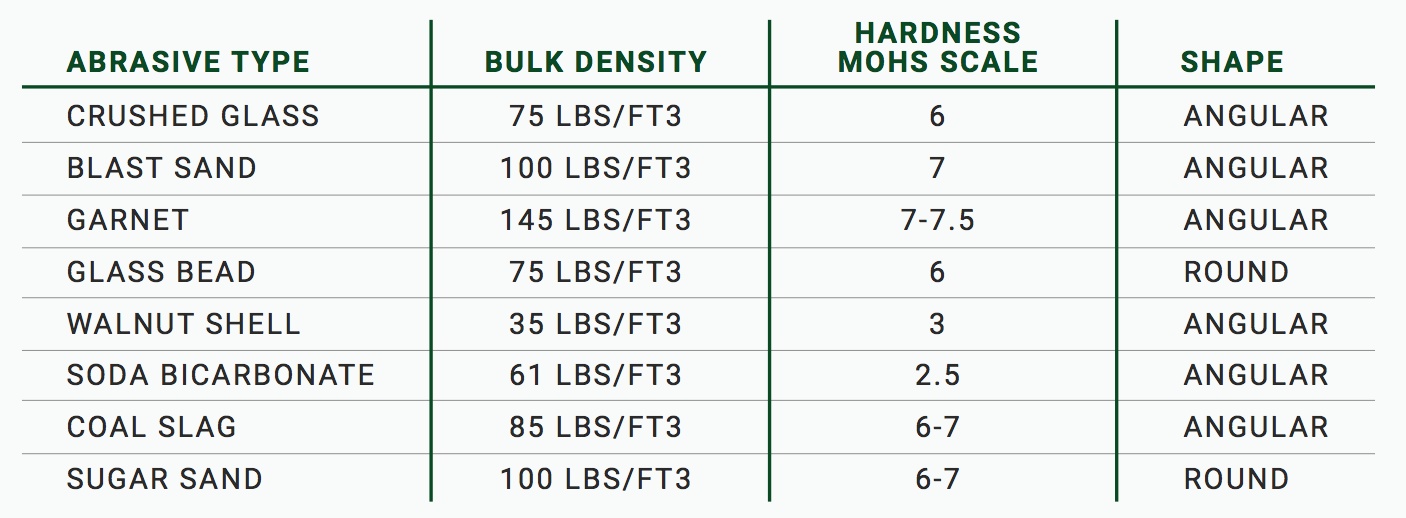
The consequences of a wrong choice show up at two ends of the hardness spectrum. Use a media that is too aggressive for your substrate and you warp thin metal panels, abrade composite fiber reinforcement, introduce iron contamination into stainless steel, or erode precision-machined tolerances beyond the allowable range. Use a media that is too soft and you leave surface contaminants in place, fail to produce the required anchor profile for coating adhesion, and create conditions for premature coating delamination — often within the first year of service.
Both failure modes are avoidable. They require answering six questions in the correct order before purchasing a single bag of media. That is what this guide walks you through. If you want a full technical breakdown of every available media type and their specifications before working through the selection process, start with our overview of 10 Types of Abrasive Blasting Media: Pros, Cons & Best Uses.
Identify Your Substrate Material
Your substrate — the material being blasted — sets the absolute upper limit on media hardness and aggressiveness. No other factor overrides it. Blasting a carbon fiber reinforced composite panel with aluminum oxide will destroy it, regardless of your coating requirements. Blasting a heavy steel weldment with walnut shells will leave it inadequately prepared, regardless of your budget constraints.
The key properties to assess in your substrate are: hardness (how hard is the base material?), thickness (can it absorb aggressive impact without deforming?), contamination tolerance (will residual iron from steel abrasives cause a problem?), and dimensional criticality (are there tight tolerances that media abrasion could violate?).
| Substrate | Sensitivity Level | Maximum Recommended Media Hardness | Media to Avoid |
|---|---|---|---|
| Structural carbon steel (≥6mm) | Niedrig | Any — including steel grit HRC 66 | — |
| Carbon steel (thin, <3mm) | Medium | Aluminum oxide (fine grit) or garnet | Steel grit, coarse silicon carbide |
| Rostfreier Stahl | Medium | Mohs 9 (Al₂O₃ WFA) — no iron-bearing media | Steel grit, steel shot, garnet (iron traces) |
| Aluminum alloy (aircraft) | Hoch | Mohs 3.5 max — plastic media or glass beads | All angular mineral media, all steel abrasives |
| CFRP / composite | Very high | Mohs 3.5 max — plastic media or walnut shell only | All mineral and metallic media |
| Fiberglass / GRP | Hoch | Plastic media, walnut shell, glass beads (fine) | Angular mineral media coarser than 80 grit |
| Brass / bronze / copper | Medium | Glass beads or corn cob (tumbling) | Steel abrasives, coarse angular media |
| Stone / concrete | Low–medium | Garnet, aluminum oxide, crushed glass | Steel abrasives, organic media |
| Wood / historic surfaces | Very high | Walnut shell, corn cob, sodium bicarbonate | All mineral and metallic media |
If you are blasting previously coated surfaces and cannot confirm the base material, start with a test panel using your proposed media type before committing to full production. This is standard practice in aerospace MRO and automotive restoration — and it should be in any precision application.
Define the Required Surface Outcome
Once you know what your substrate can tolerate, the next question is what the process needs to achieve. There are four fundamentally different surface outcomes, and each one points toward a different category of media:
| Required Outcome | What This Means | Media Category Required |
|---|---|---|
| Deep anchor profile for heavy-duty coatings | 2.0–5.0 mil peak-to-valley profile; SSPC-SP10 or SP5 cleanliness | Angular / hard — Steel grit, Al₂O₃ coarse |
| Standard coating profile | 1.0–2.5 mil profile; SSPC-SP10 or SP6 cleanliness | Angular / medium — Garnet, Al₂O₃ medium grit |
| Smooth satin finish (no profile) | Peened surface with compressive stress; no coating or thin-film only | Spherical — Glass beads, steel shot |
| Cleaning / stripping only | Remove paint, grease, or light oxidation without altering surface | Soft angular — Plastic media, walnut shell, corn cob |
The most critical distinction is between profile creation und surface cleaning. If a coating system is going back on the surface, you almost certainly need an anchor profile — and that requires an angular abrasive with sufficient hardness to mechanically abrade the substrate. If you are stripping a coating for inspection, repair, or reapplication to a sensitive substrate, you need a media that removes the coating without touching the base material.
For a full breakdown of the profile depths each media type produces, see our Abrasive Media Comparison Chart.
Check the Governing Specification
In industrial, marine, aerospace, and infrastructure applications, surface preparation is almost never at the discretion of the contractor alone. It is defined by a governing specification that names the required cleanliness grade, surface profile range, and sometimes the acceptable — or explicitly prohibited — media types. Ignoring or misreading the spec is one of the most common and expensive mistakes in surface preparation contracting.
Key Standards to Know
| Standard / Body | Cleanliness Grades | Common Application |
|---|---|---|
| SSPC / AMPP | SP5 (White Metal), SP10 (Near-White), SP6 (Commercial), SP7 (Brush-Off) | Structural steel, bridges, industrial facilities, marine |
| ISO 8501 | Sa 3 (equivalent SP5), Sa 2.5 (SP10), Sa 2 (SP6) | International projects, European specifications |
| NACE | No. 1–4 (now merged into SSPC/AMPP) | Oil and gas, pipeline, offshore |
| MIL-SPEC | Various — MIL-A-22262, MIL-S-851 etc. | US military equipment, aerospace depot maintenance |
| Coating Manufacturer Datasheet | Specified per product — always project-specific | All applications — overrides generic standards |
When a coating manufacturer specifies a surface profile range — say, 1.5–3.0 mil — that range is engineered for the adhesion mechanics of that specific product. A profile outside that range, even if technically “cleaner,” can cause adhesion failure. Always pull the current coating product datasheet before finalizing media and grit selection.
Some specifications also explicitly prohibit certain media types. Common restrictions include: no silica sand (near-universal in regulated jurisdictions), no steel abrasives on stainless steel or galvanized surfaces, no chloride-bearing media on offshore structures, and no coal slag on projects with environmental restrictions on heavy metals. Check the spec for media restrictions before ordering.
Match Media to Your Blast Equipment
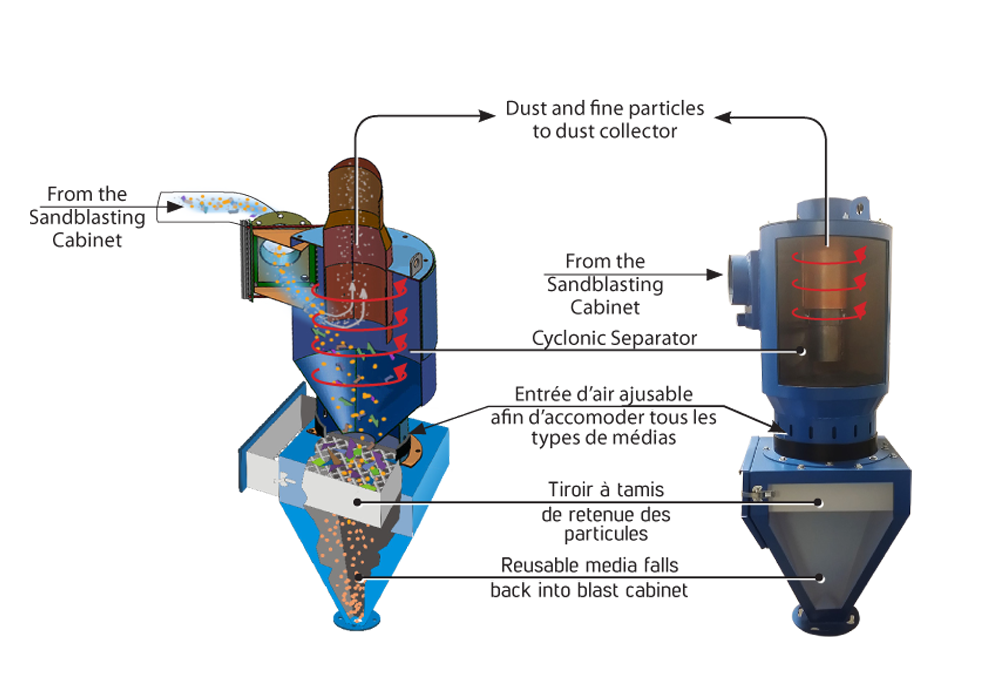
The four main blast equipment categories each have distinct media compatibility profiles. Using the wrong media in a system damages equipment, produces unpredictable results, and voids warranties. Match your media to your machine first — then optimise within the compatible range.
| Equipment Type | Wie es funktioniert | Compatible Media | Incompatible Media |
|---|---|---|---|
| Centrifugal Wheel Blast | Spinning impeller wheel throws media at high velocity — high throughput, automated | Steel grit, steel shot (exclusively) | Mineral media, organic media, glass beads — all damage the wheel impeller |
| Direct Pressure Blast | Pressurised vessel feeds media through nozzle — highest air-blast performance | Aluminum oxide, garnet, steel grit (limited), glass beads, plastic media, walnut shell | Corn cob (clogs), sodium bicarbonate (pressure pots only with moisture control) |
| Suction / Siphon Blast Cabinet | Venturi effect draws media from sump — lower pressure, best for precision work | Aluminum oxide, glass beads, plastic media, walnut shell, corn cob | Heavy steel abrasives (too dense for siphon action), very coarse media (<20 mesh) |
| Wet / Vapor Blast | Media mixed with water — eliminates airborne dust, gentler impact | Aluminum oxide, garnet, glass beads, crushed glass — any non-water-soluble, non-reactive media | Steel abrasives (rust contamination of slurry), sodium bicarbonate (dissolves), organic media (swells) |
A general rule: the minimum nozzle bore diameter should be at least 3× the maximum media particle diameter. Using media that is too coarse for your nozzle causes bridging, inconsistent flow, and pressure fluctuations that ruin surface profile uniformity. Check your nozzle manufacturer’s media size recommendations before ordering.
Calculate Total Cost of Use
Purchase price per pound is the least useful cost metric in abrasive media selection. The number that determines the real economics of your operation is cost per unit of surface area processed. This calculation integrates four variables that the per-pound price ignores entirely: media consumption rate, number of reuse cycles, disposal cost, and the productivity impact on blast rate.
📐 Cost Per Cycle Formula
| Example A — Garnet (single-use): | $0.90/kg ÷ 1 cycle × 1.2 kg/m² = $1.08 per m² |
| Example B — Aluminum Oxide (7 cycles): | $1.40/kg ÷ 7 cycles × 0.8 kg/m² = $0.16 per m² |
| Example C — Steel Grit (120 cycles): | $1.80/kg ÷ 120 cycles × 0.4 kg/m² = $0.006 per m² |
Note: Figures above are illustrative. Actual consumption rates vary by media type, operating pressure, nozzle size, and substrate condition. Request a project-specific cost model from our technical team.
Beyond media consumption, also factor in:
- Disposal cost: Spent media containing lead, chromium, or other RCRA-regulated metals from blasted coatings may require hazardous waste disposal at $100–$400+ per ton. Media that produces lower volumes of fines reduces this cost.
- Blast productivity: A harder, more angular media at the correct grit size can process a surface 30–50% faster than an undersized or under-aggressive media, directly reducing labour cost per square meter.
- Equipment wear: Harder, denser media causes faster nozzle wear (for air blast) or wheel/impeller wear (for wheel blast). Factor in nozzle replacement frequency when comparing high-hardness media options.
For a detailed per-cycle cost comparison of all major media types, see the Abrasive Media Comparison Chart.
Confirm Safety & Regulatory Compliance
The final filter is compliance. Even if a media type is technically optimal for your substrate, specification, equipment, and budget, it must also meet the regulatory requirements of your jurisdiction and worksite. There are three compliance dimensions to verify:
1. OSHA Crystalline Silica Standard
OSHA’s final rule on occupational exposure to crystalline silica (29 CFR 1910.1053 for general industry; 1926.1153 for construction) sets a PEL of 50 µg/m³ as an 8-hour TWA — making conventional silica sand blasting effectively non-compliant in most US workplace environments without extraordinary engineering controls. All abrasive media supplied by Jiangsu Henglihong Technology — aluminum oxide, glass beads, garnet, steel grit, steel shot, walnut shell, corn cob, and plastic media — are certified silica-free and produce no crystalline silica dust. For full OSHA compliance guidance, see our Abrasive Media Safety Guide.
2. Site-Specific and Client Requirements
Many industrial sites — refineries, power stations, food processing facilities, pharmaceutical plants — have their own approved media lists and prohibition lists independent of government regulation. Confirm with your site or client before ordering, especially for:
- Stainless steel surfaces (no iron-bearing media)
- Food-contact or pharmaceutical environments (FDA-approved media only)
- Near-water or environmentally sensitive locations (biodegradable or low-leachate media required)
- Enclosed or confined spaces (low-dust media such as garnet or wet blast required)
3. Waste Disposal Classification
Spent blast media is classified under RCRA as a solid waste, and may be elevated to hazardous waste if TCLP testing reveals concentrations of lead, chromium, cadmium, arsenic, or other regulated metals above threshold levels — which can occur when blasting old painted steel containing lead-based coatings. Before committing to a large-scale project on painted structural steel of unknown coating history, factor in the cost of hazardous waste characterisation and disposal. Garnet and glass beads typically produce the most environmentally clean spent media; steel abrasives in wheel-blast systems accumulate metallic fines that require periodic characterisation.
Quick-Pick Flowchart: Most Common Scenarios
If your project fits a standard scenario, use the flowchart below to reach a media recommendation in seconds. For non-standard applications or unusual substrate combinations, work through the full six-step framework above or contact our technical team directly.
⚡ Quick-Pick: Match your situation to a media recommendation
5 Most Common Abrasive Media Selection Mistakes
Even experienced operators fall into recurring selection errors. These are the five we see most frequently — and each one is entirely preventable.
Choosing media based on price per bag alone
Single-use media at $0.60/kg looks cheap. Aluminum oxide at $1.40/kg with 7 cycles costs $0.16/kg equivalent. The bag price is irrelevant without the recyclability denominator.
Using steel abrasives on stainless steel
Iron particles from steel grit or steel shot embed in the stainless surface, initiating corrosion at the contamination points. This failure mode is subtle, delayed, and very expensive to remediate.
Ignoring the coating specification’s profile range
Blasting to SSPC-SP10 cleanliness with the wrong grit size and producing a 0.8 mil profile when the coating requires 1.5–2.5 mil is a guaranteed adhesion failure — regardless of how clean the surface looks.
Running mineral media through a wheel blast machine
Wheel blast impellers and liners are engineered for the density and hardness range of steel abrasives. Loading them with garnet or aluminum oxide causes rapid, expensive wear and inconsistent blast patterns.
Reusing media across incompatible substrates
Media used on painted steel picks up lead, coating residue, and iron fines. Running that same media on stainless or aluminum introduces the very contaminants you are trying to remove. Keep substrate-specific media batches separate.
Storing media in humid conditions
Moisture causes mineral media to clump, organic media to mould, and steel media to rust. Contaminated media produces inconsistent results and can introduce moisture-related adhesion problems on the blasted surface.
Pre-Order Selection Checklist
Before placing your media order, confirm you can answer yes to every item on this list. If any item is unresolved, work through the relevant step above or contact our technical team before proceeding.
- I have identified my substrate material, thickness, and sensitivity level
- I know the required surface cleanliness grade (SSPC/ISO) for this project
- I have the coating manufacturer’s datasheet and confirmed the required profile range (in mils or µm)
- I have confirmed my blast equipment type and verified the media is compatible
- I have calculated cost per blast cycle — not just purchase price per pound
- I have verified the media is silica-free and OSHA-compliant for my work environment
- I have checked for any site-specific or client-specific media restrictions
- I have considered spent media disposal classification and cost
- I have checked storage conditions at the job site are appropriate for the media type
- I have confirmed grit size is appropriate for the required surface profile depth
Häufig gestellte Fragen
How do I know which abrasive media is right for my project?
Work through the six-step framework in this guide: identify your substrate, define the required surface outcome, check the governing specification, confirm equipment compatibility, calculate total cost of use, and verify regulatory compliance. In most cases, these six filters narrow the field to one or two clear choices. For edge cases, contact Jiangsu Henglihong Technology’s technical team — we provide free media selection consultation for all enquiries.
Can I use any abrasive media in my blast cabinet?
No. Suction blast cabinets work best with lighter media — aluminum oxide, glass beads, and plastic media — in the 40–220 mesh range. Heavy steel abrasives are too dense for siphon action and will jam the pickup tube. Direct pressure blast systems handle a wider range. Wheel blast machines are engineered exclusively for steel grit and steel shot. Using incompatible media in any system causes equipment damage and inconsistent results.
What happens if I use the wrong abrasive media?
The failure mode depends on the direction of the error. Too aggressive — warped panels, dimensional loss, iron contamination, destroyed composite fibres. Too soft — insufficient cleanliness grade, inadequate surface profile, coating adhesion failure within 6–18 months. Both are costly. The most expensive outcome is discovering the error after the coating system has been applied and has begun to delaminate.
Does grit size affect which media type I should choose?
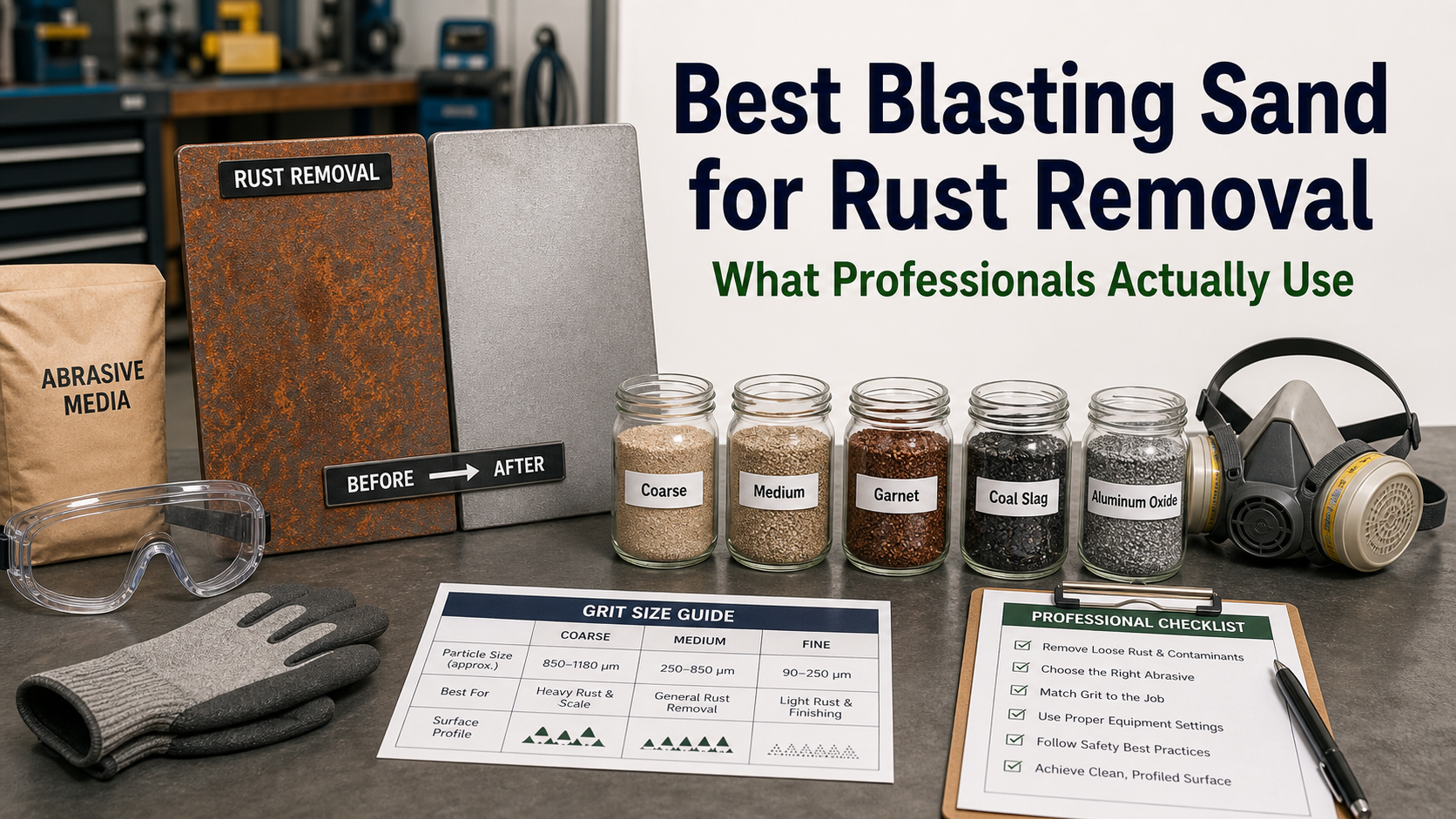
Grit size is a secondary variable you optimise after selecting the media type. Within any given media type, coarser grits produce deeper profiles and faster blast rates; finer grits produce shallower profiles and smoother finishes. Determine media type first (based on substrate and required outcome), then select grit size to hit the profile depth specified in your coating datasheet. A good starting point: for a 1.5–2.0 mil profile with aluminum oxide, use 60–80 grit; for 2.5–3.5 mil, use 36–46 grit.
How do I compare the cost of recyclable vs single-use media?
Use the cost-per-cycle formula: (price per kg ÷ number of reuse cycles) × consumption rate per m². A single-use media at $0.80/kg consuming 1.0 kg/m² costs $0.80/m². A recyclable media at $1.40/kg with 8 cycles consuming 0.7 kg/m² costs $0.12/m² — a 6.5× cost advantage. Over a large project, this difference is substantial. Request a project-specific cost model from our technical sales team if you need precise figures for your application.
Skip the Guesswork — Talk to Our Technical Team
Describe your substrate, coating spec, and equipment and we will recommend the exact media type, grit size, and quantity for your project — at no charge.
Get Free Media Selection Advice View Products & Pricing →Filter