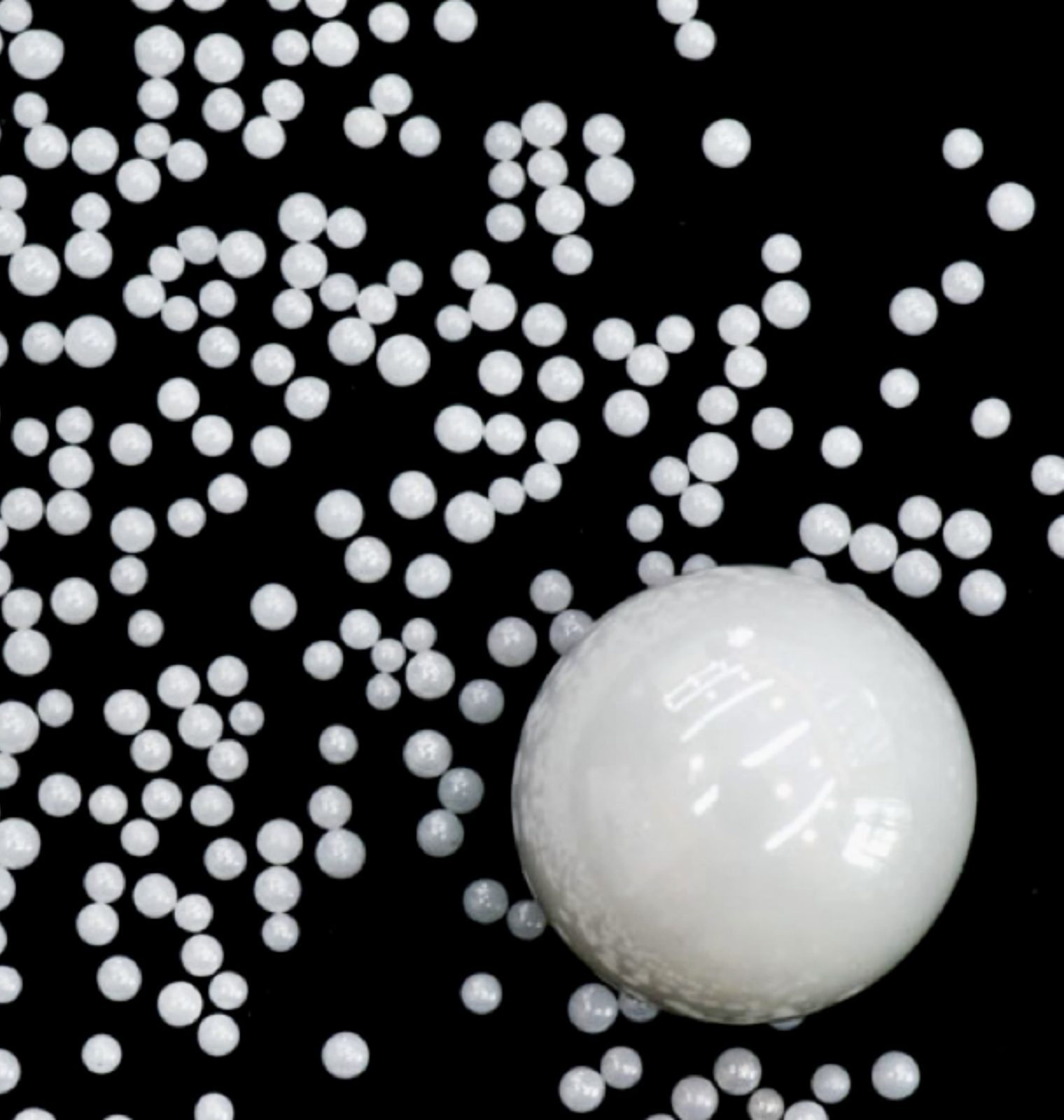
Steel Shot & Steel Grit Blasting Media: Angular vs Round for Surface Prep
A complete technical guide to steel shot and steel grit — comparing spherical shot vs angular grit, surface profile outcomes, hardness grades, reuse economics, and applications across shipbuilding, structural steel, and automotive manufacturing.
- Steel Shot vs Steel Grit: The Core Distinction
- How Steel Media Is Manufactured
- Physical Properties & Hardness Grades
- Size Standards (SAE & ISO)
- Surface Profiles Produced
- Reusability: The 200–300 Cycle Advantage
- Industry Applications
- Shot & Grit Blending
- Limitations & When Not to Use Steel Media
- Frequently Asked Questions
Steel Shot vs Steel Grit: The Core Distinction
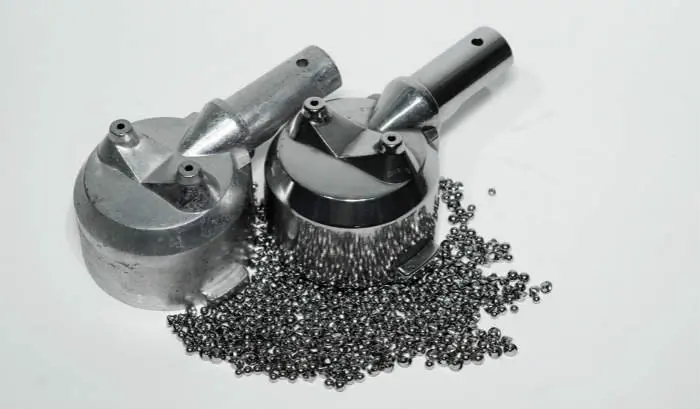
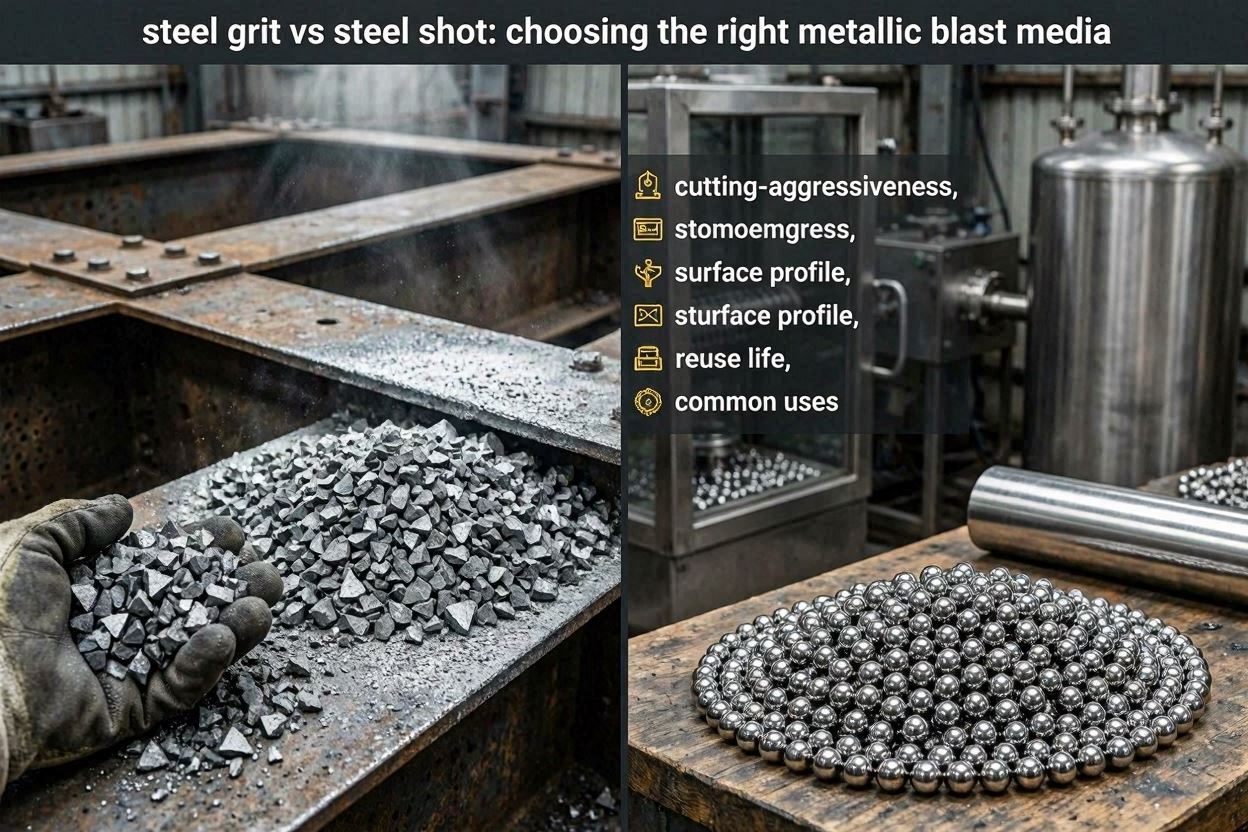
Steel shot and steel grit are both manufactured from steel and offer the same exceptional recyclability — 200 to 300 cycles under a proper reclaim system — but they produce fundamentally different surface outcomes due to their opposing particle shapes. Understanding this distinction is the foundation of effective steel media selection.
Steel Shot — Spherical
Round particles that impact and compress the surface without cutting into it. Each impact produces a shallow, rounded dimple. The cumulative effect of thousands of overlapping impacts is:
- A smooth, uniform, peened surface texture
- Compressive residual stress in the surface layer
- Improved fatigue resistance and stress corrosion cracking resistance
- No significant surface roughness anchor profile for coatings
Steel Grit — Angular
Irregular, angular particles produced by crushing and screening hardened steel shot. Each particle cuts into the surface, creating sharp peaks and valleys. The cumulative effect produces:
- A rough, angular anchor profile for coating adhesion
- Aggressive surface cleaning — removes mill scale, rust, and coatings efficiently
- Higher surface roughness (Ra and Rz) than shot
- Faster material removal per pass than spherical media
Many industrial operations use blends of shot and grit to achieve a combined outcome — the grit component cuts the profile while the shot component smooths the highest peaks, producing a surface that has both adequate roughness for coating adhesion and a surface cleanliness that exceeds what grit alone would achieve. This approach is particularly common in automated wheel blasting lines for structural steel and pipe fabrication.
For a broader treatment of how particle shape drives surface outcomes across all media types, see: Angular vs Round Blasting Media: Surface Profile & Finish Differences.
How Steel Shot and Steel Grit Are Manufactured
Steel shot is produced by atomization: molten steel is poured through a nozzle while high-pressure water or air jets break the stream into droplets. Surface tension causes these droplets to solidify into near-perfect spheres as they cool. The shot is then heat-treated to achieve the required hardness range, screened to size, and subjected to quality inspection for roundness and surface defects.
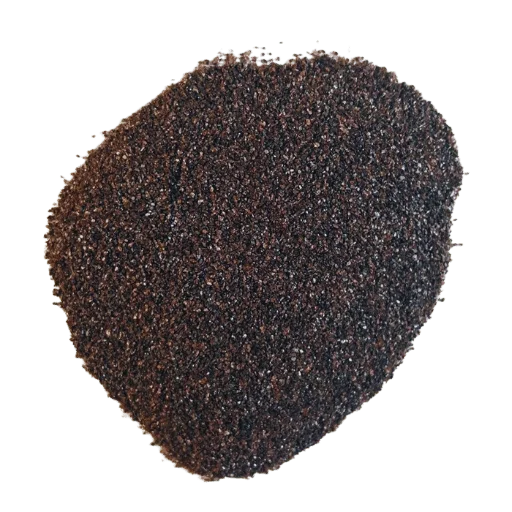
Steel grit is manufactured by taking hardened steel shot and crushing it between hardened steel rollers or in impact mills. The crushing process fractures the spheres into irregular angular fragments. These fragments are then screened to size and may receive additional hardening heat treatment to achieve the higher hardness grades required for aggressive surface profiling.
Jiangsu Henglihong Technology manufactures both steel shot and steel grit under ISO 9001-certified quality systems, with hardness verification, size distribution testing, and surface defect inspection carried out on each production batch.
Physical Properties & Hardness Grades
| Property | 钢丸 | 钢砂 |
|---|---|---|
| 材料 | High carbon cast steel | High carbon cast steel (crushed shot) |
| Shape | Spherical | Angular, irregular |
| Hardness range | 40–51 HRC | 54–65 HRC |
| True density | 7.4–7.8 g/cm³ | 7.4–7.8 g/cm³ |
| Bulk density | 4.5–5.0 g/cm³ | 3.8–4.5 g/cm³ |
| Reuse cycles | 200–300× | 200–300× |
| Surface profile produced | Smooth, peened dimples | Angular peaks and valleys |
| Primary applicable standards | SAE J827, ISO 11124-3 | SAE J1993, ISO 11124-2 |
Steel Grit Hardness Grades
Steel grit is classified into three hardness grades, each producing a distinct surface profile and wearing differently over service life:
- GP (General Purpose, ~54–60 HRC): The softest grit grade. Less aggressive cutting, longer media life. Suitable for general coating preparation where a moderate anchor profile (25–75 µm) is required.
- GL (Hard, ~60–63 HRC): Intermediate grade. Produces deeper profiles and faster cutting than GP. The most widely used grade for shipbuilding, bridge preparation, and structural steel coating work requiring profiles up to 100 µm.
- GH (Extra Hard, ~63–65+ HRC): The hardest and most aggressive grade. Cuts the deepest anchor profiles and removes the most tenacious scale and corrosion fastest. Higher wear rate than softer grades — premium cost justified by throughput gains in high-volume operations.
Size Standards: SAE and ISO Classification
| Steel Shot (SAE) | Nominal Diameter (mm) | Steel Grit (SAE) | Nominal Diameter (mm) |
|---|---|---|---|
| S-110 | 0.30 | G-120 | 0.18 |
| S-170 | 0.43 | G-80 | 0.25 |
| S-230 | 0.60 | G-50 | 0.36 |
| S-280 | 0.71 | G-40 | 0.43 |
| S-330 | 0.86 | G-25 | 0.71 |
| S-390 | 1.00 | G-18 | 1.00 |
| S-460 | 1.18 | G-14 | 1.40 |
| S-550 | 1.40 | G-10 | 2.00 |
| S-660 | 1.70 | — | — |
| S-780 | 2.00 | — | — |
Larger shot and grit particles carry more kinetic energy at the same velocity, producing deeper peening effects and more aggressive surface profiling respectively. Smaller sizes produce finer, more uniform finishes with less aggressive material removal. Size selection is governed by the required surface profile specification and the available blasting equipment velocity range.
Surface Profiles Produced
The surface profiles achievable with steel media are governed by particle size, hardness, velocity, and the ratio of shot to grit in mixed operations. The following guidelines cover the most commonly specified applications:
| Media Type & Size | Typical Ra (µm) | Typical Rz (µm) | ISO 8501-1 Grade | Application |
|---|---|---|---|---|
| Steel shot S-230–S-330 | 1–3 | 5–15 | Sa 2.5 (with prior grit) | Shot peening, fatigue enhancement |
| Steel grit G-50–G-25 (GP) | 5–8 | 30–60 | Sa 2.5 | Standard coating prep, light steel work |
| Steel grit G-25–G-18 (GL) | 8–14 | 50–100 | Sa 2.5–Sa 3 | Shipbuilding, bridges, heavy coating systems |
| Steel grit G-14–G-10 (GH) | 12–20 | 75–150 | Sa 3 | Aggressive mill scale removal, heavy industrial |
| Shot/Grit blend (50/50) | 4–10 | 30–70 | Sa 2.5 | High-throughput structural steel, pipe mills |
Reusability: The 200–300 Cycle Economic Advantage
The most economically significant characteristic of steel blasting media is its extraordinary recyclability. Under a well-maintained closed-loop reclaim system, steel shot and steel grit can be reused 200 to 300 times before replacement is required — a figure that translates directly into the lowest per-cycle media cost available in the abrasive blasting industry.
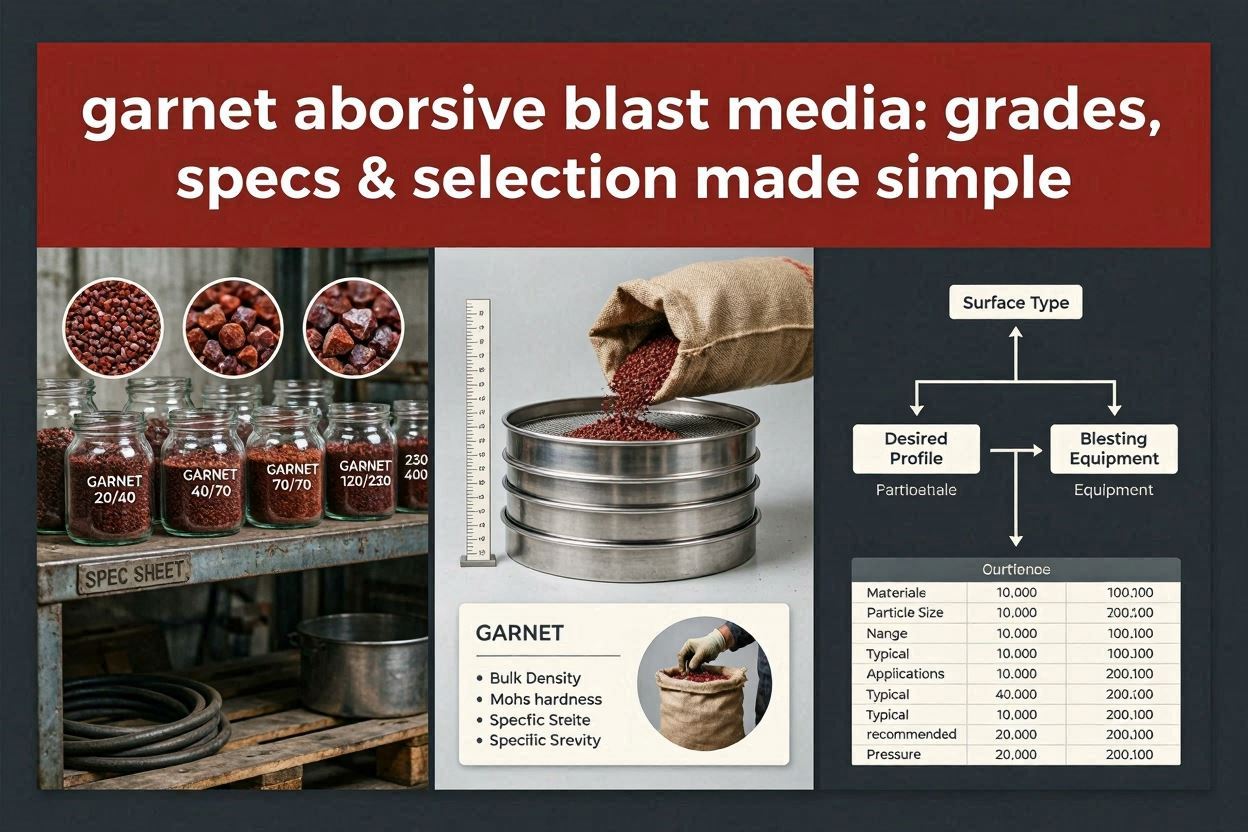
Steel grit at $1.50/kg × 250 reuse cycles = $0.006 per effective cycle. By comparison, garnet at $0.40/kg × 4 cycles = $0.10 per cycle. Single-use slag at $0.12/kg = $0.12 per cycle. Steel grit’s effective cost is 16× lower than garnet and 20× lower than single-use slag — even accounting for the higher capital cost of a steel media reclaim system, the economics are compelling for any operation running more than a few tons of work per month.
The key enabling technology for this recyclability is the closed-loop reclaim system: a bucket elevator to return spent media from the blast chamber, an air wash separator to remove fine particles and dust, and a screening system to verify particle size distribution. Without reclaim, steel media loses much of its economic advantage. For full reclaim system guidance, see: Abrasive Blasting Media Recycling & Reclaim Systems: Reduce Cost & Waste.
Industry Applications
Shipbuilding & Marine Steel Structures
Steel grit — primarily G-25 and G-18 grades — is the dominant blast media in shipyard surface preparation worldwide. Hull plates, frames, bulkheads, and structural members must be blasted to Sa 2.5 or Sa 3 cleanliness with a defined anchor profile before application of marine epoxy, antifouling, and corrosion-protection coating systems. The high throughput rates of automated wheel blasting lines in shipyards, combined with the economics of steel media’s recyclability, make the combination unbeatable for this application volume. For full guidance on marine applications, see: Blasting Media for Shipbuilding & Marine Steel Structures.
Structural Steel Fabrication & Bridge Construction
Fabricated steel sections — I-beams, columns, plates, and assemblies — are routinely wheel-blasted with steel grit or shot/grit blends to Sa 2.5 before shop-applied primer coating. The combination of high throughput (automated conveyor wheel blast lines can process hundreds of tons per hour) and low per-cycle media cost makes steel media the only economically rational choice at this scale.
汽车零部件制造
Steel shot is used extensively in automotive manufacturing for shot peening of fatigue-critical components: crankshafts, connecting rods, gears, springs, and suspension components. The compressive residual stress layer introduced by shot peening extends component fatigue life by 50–300% in laboratory testing, justifying the process cost for any high-cycle-load component. This process is governed by SAE AMS 2430 and related specifications defining Almen intensity and coverage percentage.
Pipe & Tube Mills
Seamless and welded steel pipe, including oil and gas transmission pipeline, is routinely blasted with steel grit in automated internal and external blast machines before application of FBE (fusion-bonded epoxy), three-layer polyethylene, or coal tar enamel corrosion protection systems. The anchor profile requirements for pipeline coating systems (typically 50–100 µm Rz) align well with steel grit G-25/G-18 performance.
Pressure Vessels & Industrial Equipment
Process vessels, heat exchangers, storage tanks, and industrial equipment require surface preparation before both internal and external coating application. Steel grit provides the combination of throughput, cost efficiency, and profile consistency required for large-vessel shop blasting operations.
Shot & Grit Blending: Getting the Best of Both
Mixed shot/grit operations — typically 30–70% grit with the balance shot, adjusted to the specific profile requirement — are common in high-production structural steel blasting lines. The grit component drives aggressive cleaning and profile creation; the shot component smooths the peak-to-valley ratio and improves surface cleanliness uniformity. The optimal blend ratio for a given operation is determined empirically by profiling test panels and adjusting until the required Ra, Rz, and ISO 8501-1 cleanliness grade are consistently achieved.
Limitations & When Not to Use Steel Media
Steel shot and grit must never be used on stainless steel, aluminum, copper, or other non-ferrous metals. The steel particles embed in the substrate surface, introducing ferrous contamination that: (1) destroys the passivation layer of stainless steel, initiating corrosion; (2) causes rust staining visible after short-term exposure; (3) compromises anodizing or chromate conversion coating processes on aluminum. Use 玻璃珠 or white aluminum oxide for non-ferrous substrates.
Additional situations where steel media is not appropriate:
- Thin or delicate substrates where the high-energy impact of dense steel particles would cause distortion or damage.
- Portable/open-site blasting where media recovery is impractical. Steel media’s economic advantage depends entirely on reclaim; without it, per-use costs become unfavorable compared to mineral alternatives.
- Applications requiring zero surface profile (e.g., cleaning precision molds or optical surfaces) where even the peening dimples from steel shot are unacceptable.
Source Steel Shot & Steel Grit from Jiangsu Henglihong Technology
We supply steel shot (S-110 through S-780) and steel grit (G-10 through G-120) in GP, GL, and GH hardness grades, with full SAE/ISO compliance documentation and batch hardness certificates. Available globally in 25 kg bags and 1,000 kg bulk jumbo bags.
Request a Quote or SampleFrequently Asked Questions
过滤器