Silicon Carbide Abrasive Blasting Media: Complete Buyer’s Guide
Everything industrial buyers, surface-prep engineers, and procurement teams need to know — from material science and grit selection to application-specific recommendations and sourcing from verified manufacturers.
SECTION 01What Is Silicon Carbide Abrasive Blasting Media?
Silicon carbide (SiC) abrasive blasting media is a synthetic crystalline ceramic abrasive manufactured from silica sand and carbon at extremely high temperatures. Commercially known under trade names such as Carborundum, it ranks among the hardest industrial minerals in existence — second only to diamond and cubic boron nitride on the Mohs scale. When used as a blasting medium, it propels sharp, angular particles at high velocity toward a target surface to clean, etch, profile, or deburr that surface with exceptional speed and precision.
In practical terms, silicon carbide blasting media is the abrasive of choice when other media simply cannot cut fast enough, hard enough, or cleanly enough. Its angular fracture morphology creates a surface profile that promotes outstanding mechanical adhesion for coatings, while its thermal stability makes it suitable for applications where heat generation during blasting would compromise other abrasives.
Industry definition: Silicon carbide abrasive blasting media is a manufactured, inorganic crystalline abrasive with a Mohs hardness of 9.0–9.5, produced via the Acheson process, and applied in dry or wet abrasive blasting systems for aggressive surface preparation, cleaning, etching, and precision cutting of hard substrates.
For procurement teams evaluating abrasive media for the first time, it helps to understand what silicon carbide blasting media is not: it is not natural sand (which is prohibited in most industrial environments due to silicosis risk), not a soft media like baking soda or plastic bead, and not a metallic abrasive like steel shot or cut wire. It occupies the premium end of the synthetic mineral abrasive category, positioned above aluminum oxide in hardness and below diamond in cost-effectiveness.
SECTION 02How Silicon Carbide Is Manufactured
Understanding the production process of silicon carbide abrasives is essential for buyers who need to specify purity levels, color grades, and structural consistency. The vast majority of industrial silicon carbide is produced through the Acheson Process, an energy-intensive electrochemical synthesis method developed in the late 19th century that remains the dominant production route to this day.
The Acheson Process
In the Acheson process, a mixture of high-purity silica sand (SiO₂) and petroleum coke (carbon source) is packed around a graphite core electrode within a large electric furnace. Electrical current — typically in the range of 100,000 to 500,000 amperes — is passed through the graphite core, generating temperatures between 1,700°C and 2,500°C (3,100°F to 4,500°F). At these extreme temperatures, the reaction proceeds as follows:
Synthesis reaction: SiO₂ + 3C → SiC + 2CO↑
Silica reacts with carbon to produce silicon carbide crystals and gaseous carbon monoxide, which vents from the furnace.
The resulting crystalline mass is then crushed, milled, and classified into precise particle size fractions using mechanical screening and air classification. The color, purity, and crystal structure of the final product are determined by the raw material quality, furnace temperature, and duration of the synthesis cycle.
From Crystal to Blast Media
Raw Crystal Formation
Silicon carbide crystals grow around the furnace core over 36–72 hours of sustained high-temperature synthesis. The innermost layers form green SiC (higher purity, ~99.5% SiC), while outer layers form black SiC (~97–98% SiC) due to lower temperatures and minor impurities.
Crushing & Milling
The cooled crystal mass is mechanically crushed using jaw crushers and roll mills. The resulting angular fragments — called macro grit — are then further reduced to target particle sizes through additional milling stages.
Classification & Screening
Particles are screened through vibrating sieves and air classifiers to achieve tight particle size distributions conforming to FEPA, ANSI, or JIS standards. This step determines the grit number of the final product.
Washing & Dedusting
Classified grit is washed to remove surface contaminants (free silica, carbon residue, metallic impurities) and treated to remove fine dust particles. Magnetic separation may be employed to remove any ferrous contamination.
Quality Control & Packaging
Final product undergoes chemical analysis (SiC content, Fe₂O₃ levels, free carbon, free SiO₂), physical testing (bulk density, particle shape index), and packaging in moisture-resistant containers — typically 25 kg bags, 50 kg bags, or 1-tonne bulk super sacks.
China produces over 80% of the world’s silicon carbide, with major production centers in Gansu, Ningxia, Qinghai, and Xinjiang provinces. 江蘇恒隆科技有限公司 sources directly from verified upstream SiC smelters, applying additional downstream processing and quality control to meet the specific purity and sizing requirements of industrial blasting applications.
SECTION 03Key Technical Properties of Silicon Carbide Blast Media
The technical superiority of silicon carbide blasting media over most competing abrasives stems from a combination of physical and chemical properties that are difficult to replicate in any single alternative material. The following properties collectively explain why SiC is the preferred abrasive in demanding precision and high-hardness applications.
| Property | Silicon Carbide (SiC) | Aluminum Oxide (Al₂O₃) | スチールグリット | ガーネット |
|---|---|---|---|---|
| モース硬度 | 9.0 – 9.5 | 8.0 – 9.0 | 7.0 – 8.0 | 6.5 – 7.5 |
| Crystal Structure | Hexagonal / Cubic | Trigonal (Corundum) | BCC Iron (Martensite) | Cubic / Tetragonal |
| 粒子形状 | Sharp angular | Sub-angular | Angular / Round | Sub-angular |
| 密度 (g/cm³) | 3.20 – 3.22 | 3.94 – 3.99 | 7.4 – 7.8 | 3.9 – 4.3 |
| Thermal Conductivity | 120–490 W/m·K | 30 W/m·K | ~50 W/m·K | ~6 W/m·K |
| Thermal Stability | Up to 1600°C | Up to 1000°C | Up to 400°C | Up to 450°C |
| Friability | Medium-High | Medium | 低い | Medium |
| リサイクル性 | 3–5 cycles | 5–10 cycles | 100+ cycles | 2–4 cycles |
| 化学的不活性 | 素晴らしい | Very Good | Poor (rusts) | グッド |
| Relative Cost (per ton) | Medium-High | Medium | Low-Medium | Low-Medium |
Why Hardness Matters in Blasting
In abrasive blasting, hardness determines how effectively the media can penetrate and disrupt the target surface. An abrasive that is significantly harder than the substrate removes material faster and creates a more defined surface profile. Silicon carbide’s Mohs 9.5 hardness means it can effectively blast hardened steel (Mohs ~8), ceramics, stone, and reinforced composites — substrates that would rapidly wear down softer abrasives like garnet or glass bead without achieving the required surface cleanliness or profile depth.
The Role of Angular Particle Shape
Silicon carbide grit is characterized by its sharp, angular fracture surfaces. Unlike rounded media (glass bead, steel shot) which peens and compresses the surface, angular SiC cuts into the substrate with a shearing action. This produces a rougher, more irregular surface anchor profile — typically measured as Ra (arithmetic mean roughness) or Rz (mean maximum peak-to-valley height) — which is precisely what high-performance coating systems require for maximum adhesion. Epoxy, zinc-rich primers, thermal spray coatings, and ceramic coatings all benefit from the aggressive profile that silicon carbide creates.
Thermal Properties: Underrated Advantages
Silicon carbide’s exceptionally high thermal conductivity (120–490 W/m·K, depending on crystal orientation and purity) and low thermal expansion coefficient make it one of the few abrasives that can be used at elevated substrate temperatures without structural degradation. This property is particularly valuable in aerospace component preparation, semiconductor wafer processing, and kiln furniture blasting — applications where substrate temperature during processing may be elevated.
SECTION 04Types of Silicon Carbide Blast Media: Black vs. Green
Two primary commercial grades of silicon carbide are available for abrasive blasting: Black Silicon Carbide (BSiC) そして Green Silicon Carbide (GSiC). Both are produced via the Acheson process, but they differ significantly in purity, crystallographic perfection, and intended applications. Choosing the correct type has a direct impact on blasting performance, substrate contamination risk, and total cost of ownership.
⬛ Black Silicon Carbide
- SiC purity: 97–98.5%
- Lower production cost
- Suitable for ferrous metal, stone, concrete prep
- Wider commercial availability
- Good for general industrial blasting
- Available in full macro and micro grit range
- Minor iron/aluminum impurities present
- Less suitable for precision semiconductor work
- Slightly lower friability → coarser breakdown products
🟢 Green Silicon Carbide
- SiC purity: 99.0–99.8%
- Sharper crystallographic edges
- Ideal for semiconductor, optics, precision ceramics
- Lower iron contamination risk
- Better for hard, brittle material processing
- Higher thermal conductivity than black grade
- 25–40% higher cost than black SiC
- Fewer large-volume suppliers globally
- Overkill for general metal surface prep
Buyer guidance: For the majority of industrial surface preparation applications — steel fabrication, marine maintenance, heavy equipment refurbishment, and anti-slip surface coating — Black SiC delivers equivalent blasting performance at lower cost. Green SiC is specifically recommended when substrate contamination from trace metallic impurities would be problematic, such as in semiconductor wafer dicing blade preparation, precision optical component finishing, or aerospace-grade composite surface conditioning.
For a detailed technical comparison of these two grades, including specific purity standards and application decision trees, see our dedicated guide: Black vs. Green Silicon Carbide Explained
SECTION 05Grit Sizes, Mesh Numbers & Surface Profiles
Grit size is the single most critical specification decision in abrasive blasting. It governs the surface profile (roughness) produced on the substrate, the cutting speed, the dust generation, and the finish quality. Silicon carbide blasting media is available in an exceptionally wide range of grit sizes — from coarse #10 mesh (approximately 2,000 µm particle diameter) to ultra-fine #1200 mesh (approximately 6 µm) — making it one of the most versatile abrasives across the entire blasting and polishing spectrum.
Grit size standards differ by region and industry: FEPA (Federation of European Producers of Abrasives) standards are dominant in Europe and Asia, while ANSI (American National Standards Institute) standards are used in North America. JIS (Japanese Industrial Standards) grades are common in Japan and South Korea. All three use different mesh numbering conventions for the same physical particle size ranges.
Grit Selection Quick Reference
Understanding Surface Profile Depth
Coarser grits produce deeper surface profiles with higher Ra values, which increases the mechanical bonding area for coatings but also requires more coating material to achieve full coverage. Finer grits produce shallower profiles with lower Ra values, which is preferable for precision applications where dimensional tolerances must be maintained, or where a smooth base finish is required for thin-film coatings.
| Grit (FEPA) | Approx. Particle Size (µm) | Typical Ra (µm) | Primary Application | Blasting Speed |
|---|---|---|---|---|
| #24 | 850–710 | 10–18 | Heavy descaling, structural steel | Very Fast |
| #60 | 355–250 | 5–10 | Mill scale, general metal prep | Fast |
| #100 | 180–150 | 3–5 | Coating prep, paint stripping | 中程度 |
| #180 | 106–90 | 1.5–3 | Glass etching, fine ceramic prep | 中程度 |
| #320 | 46–40 | 0.5–1.5 | Lapping, precision substrate prep | Slow |
| #600 | 23–18 | 0.1–0.5 | Optical polishing, wafer prep | Very Slow |
For a comprehensive reference with downloadable grit selection charts, read our full guide: Silicon Carbide Grit Size Chart & Selection Guide
SECTION 06Top Industrial Applications
Silicon carbide abrasive blasting media serves an extraordinarily broad range of industrial applications, spanning from heavy infrastructure maintenance to high-precision semiconductor manufacturing. The unifying factor across all these applications is the need for a fast-cutting, chemically inert, thermally stable abrasive that can process substrates too hard or too demanding for conventional media.
Application Deep Dive: Glass Etching
Among the precision applications for silicon carbide blasting media, glass etching stands out for its sensitivity to grit selection and blasting parameters. SiC’s sharp angular particles create a uniformly frosted or deeply carved surface on glass by micro-fracturing the surface layer — a mechanism fundamentally different from chemical etching. The depth and texture of the etch is controlled through grit size, nozzle pressure, stand-off distance, and dwell time. For detailed glass etching guidance, including recommended grit sizes and technique, see: SiC Blasting for Glass Etching
Application Deep Dive: Aerospace Surface Preparation
Aerospace applications impose the most stringent requirements of any industry on abrasive blasting media. Substrates include titanium alloys (Ti-6Al-4V), nickel superalloys (Inconel, Hastelloy), carbon fiber reinforced polymers (CFRP), and advanced ceramics. Silicon carbide’s combination of high hardness, chemical purity, and thermal stability makes it one of the few abrasives approved for direct use on these substrates under aerospace quality management systems. For standards, specifications, and MIL-SPEC compliance requirements, see: SiC for Aerospace Surface Prep: Standards & Specs
Application Deep Dive: Steel Rust Removal
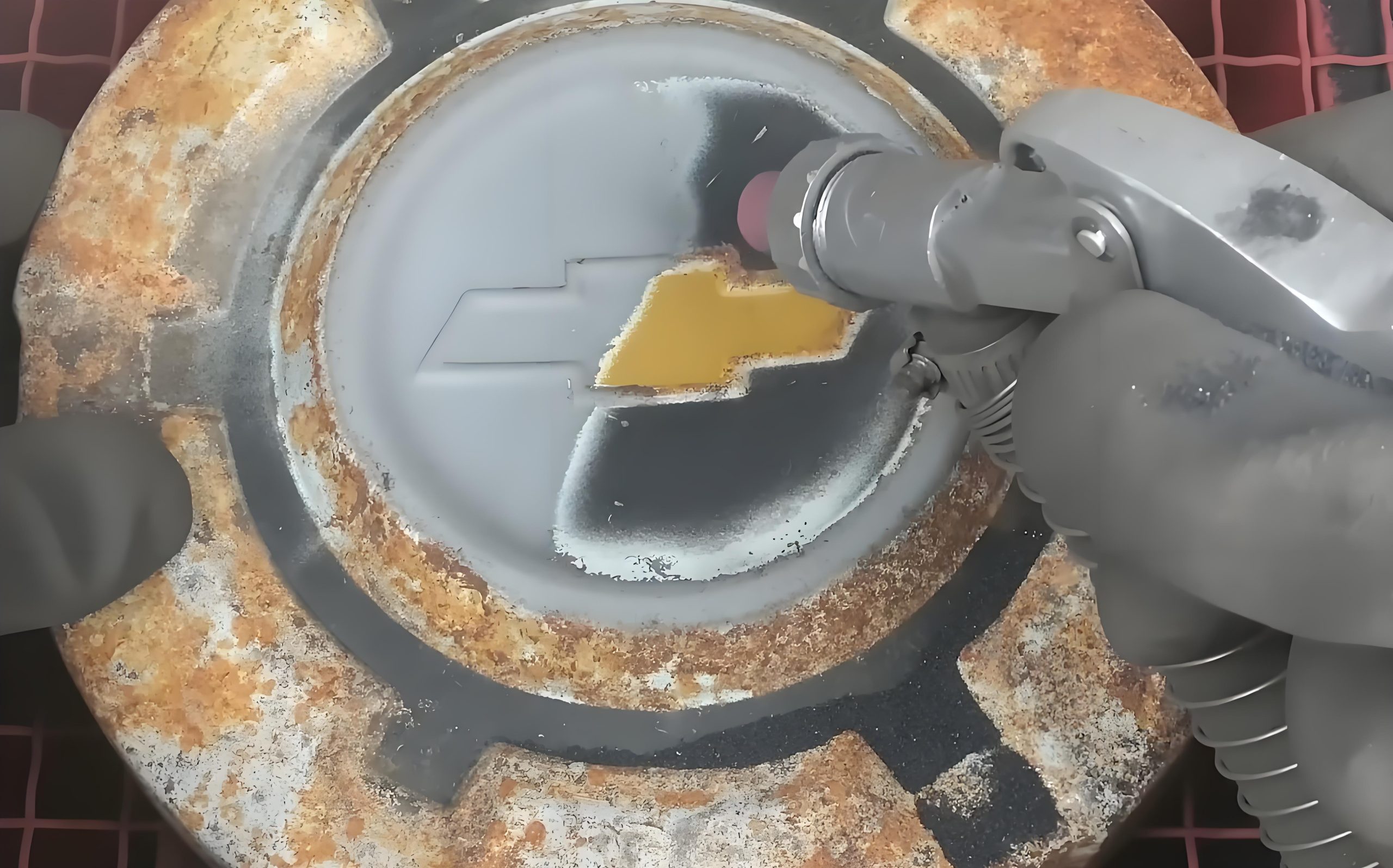
For heavy industrial rust removal and mill scale cleaning on carbon and alloy steels, silicon carbide’s hardness and angular shape enable it to achieve Sa 2.5 to Sa 3 cleanliness grades (per ISO 8501-1) faster than any other dry abrasive. Its chemical inertness also means no flash rusting from media residue — a common problem with metallic abrasives on wet or humid job sites. Explore the full process parameters for steel surface profiling: SiC Sandblasting for Rust Removal on Steel
Application Deep Dive: Ceramics & Composites
Advanced ceramics and composite materials represent one of the fastest-growing application areas for SiC blasting media, driven by the expansion of electric vehicle battery systems, 5G infrastructure ceramics, and aerospace structural composites. Silicon carbide media is uniquely suited to these substrates because it can process them without embedding ferrous or reactive contamination — critical for surfaces that will subsequently receive precision coatings or be used in clean-room manufacturing environments. Learn more: SiC Blasting for Ceramics & Composites
SECTION 07Silicon Carbide vs. Aluminum Oxide: Full Comparison
The most common and commercially significant comparison in industrial abrasive blasting is between silicon carbide and aluminum oxide (Al₂O₃, also called corundum or alox). Both are synthetic mineral abrasives, both are available in a wide grit range, and both are recyclable — yet they differ substantially in hardness, cutting action, optimal substrate compatibility, and total cost profile. Understanding these differences is essential for making the correct procurement decision for any given blasting operation.
| Comparison Factor | Silicon Carbide (SiC) | Aluminum Oxide (Al₂O₃) | Advantage |
|---|---|---|---|
| Hardness (Mohs) | 9.0 – 9.5 | 8.0 – 9.0 | SiC |
| Cutting Speed | 2–3× faster | Baseline | SiC |
| Surface Profile | Rougher, more aggressive | Moderate, more controlled | Context-dependent |
| リサイクル性 | 3–5 cycles | 5–10 cycles | Al₂O₃ |
| Best on Hard Substrates | ✓ Ceramics, glass, stone | Less effective | SiC |
| Best on Steel / Metals | グッド | ✓ More cost-effective | Al₂O₃ |
| Safe on Soft Metals (Al, Cu) | ❌ Too aggressive | ✓ Feasible with care | Al₂O₃ |
| Material Cost per Ton | Higher | Lower | Al₂O₃ |
| Cost per Hour of Blasting | Lower (faster cycle) | Higher (slower cycle) | SiC |
| 化学的不活性 | 素晴らしい | Very Good | SiC |
| Thermal Stability | Up to 1600°C | Up to 1000°C | SiC |
Rule of thumb: Choose silicon carbide when the substrate is harder than Mohs 7, when blasting cycle time is a critical cost driver, or when the application demands high purity and chemical inertness. Choose aluminum oxide when the substrate is steel or soft metal, when higher recyclability is a priority, or when a more controlled (less aggressive) surface profile is required.
For a complete deep-dive comparison with application-specific decision trees: SiC vs. Aluminum Oxide: Full 2026 Comparison
SECTION 08Silicon Carbide vs. Other Blast Media
While the SiC vs. aluminum oxide comparison is the most common, procurement teams often need to evaluate silicon carbide against a broader set of alternatives, particularly when projects involve specific surface finish requirements, environmental disposal constraints, or substrate sensitivities.
Silicon Carbide vs. Garnet
Garnet is a natural mineral abrasive with moderate hardness (Mohs 6.5–7.5) that is widely used for waterjet cutting and general-purpose blasting. It is significantly softer than SiC, resulting in slower material removal on hard substrates and a shallower surface profile. Garnet’s key advantages are its lower price point and its natural origin (important for some environmental certifications). However, for substrates harder than Mohs 7, garnet becomes rapidly ineffective and the cost advantage disappears due to much higher media consumption per unit area blasted. For detailed scenarios and cost modeling comparing these two media: SiC vs. Garnet: Which Is Better for Metal Prep?
Silicon Carbide vs. Glass Bead
Glass bead is a spherical abrasive used primarily for surface peening, cosmetic finishing, and light cleaning where surface finish smoothness is the priority. Its round morphology means it compresses rather than cuts the surface — the exact opposite of SiC’s cutting action. Glass bead is appropriate for stainless steel finishing, aluminum deburring, and creating matte satin finishes. It is categorically unsuitable for aggressive rust removal, deep surface profiling, or blasting of substrates harder than Mohs 6. SiC and glass bead therefore serve almost entirely different application profiles and are rarely direct substitutes for one another. Compare them in context: SiC vs. Glass Bead: Cut vs. Finish
Silicon Carbide vs. Steel Shot / Steel Grit
Metallic abrasives — steel shot (spherical) and steel grit (angular) — are the workhorse media for high-volume blasting of carbon steel in controlled environments. Their extreme recyclability (100+ cycles) makes them cost-effective in automated wheelabrator and barrel blasting systems. However, steel media introduces iron contamination on blasted surfaces, corrodes rapidly in humid environments, and cannot be used on non-ferrous metals, composites, or ceramics without causing contamination or damage. In environments where cleanliness, purity, or substrate compatibility is critical, silicon carbide is the superior alternative despite its higher media cost per ton.
When NOT to Choose Silicon Carbide
Understanding the limitations of SiC is as important as understanding its strengths. Our dedicated guide covers the five most common situations where silicon carbide is the wrong choice and recommends appropriate alternatives: When NOT to Use SiC Blasting Media
SECTION 09How to Choose the Right Silicon Carbide Grade
Specifying the correct silicon carbide blasting media grade requires answering four fundamental questions about the application. Work through the following decision framework before placing a procurement order or submitting a request for quote.
Step 1: Identify Your Substrate
The substrate material determines the hardness, fragility, and contamination sensitivity requirements of the abrasive. Map your substrate to one of the following categories:
| Substrate Type | Hardness Range | Recommended SiC Type | Grit Range |
|---|---|---|---|
| Carbon / Alloy Steel | Mohs 7–8 | Black SiC | #24–80 |
| Stainless Steel / Titanium | Mohs 7–8.5 | Black or Green SiC | #60–120 |
| Ceramics / Alumina | Mohs 8–9 | Green SiC preferred | #80–220 |
| Glass / Borosilicate | Mohs 6–7 | Black SiC | #80–240 |
| Stone / Granite | Mohs 6–8 | Black SiC | #24–100 |
| Silicon Wafers / Compound Semiconductors | Mohs 7–9.5 | Green SiC (high purity) | #320–1200 |
| CFRP / Fiberglass Composites | Variable | Black or Green SiC | #120–320 |
| Concrete / Masonry | Mohs 6–7 | Black SiC | #16–36 |
Soft metal warning: Do not use silicon carbide on aluminum, copper, brass, or zinc substrates unless specifically required. SiC’s high hardness and angular shape will embed particles in these soft metal surfaces, causing contamination and surface damage. Use glass bead or plastic media for soft non-ferrous metals.
Step 2: Define the Required Surface Profile
Determine the target Ra (roughness average) or Rz (mean roughness depth) value specified by your coating system manufacturer, quality standard, or engineering drawing. Work backward from this requirement to select the appropriate grit size using the grit-to-profile correlation table in Section 5 above.
Step 3: Assess Recycling Requirements
If your operation uses a recovery and recycling system (blast cabinet, sweep blast recovery, cyclone separator), consider how many reuse cycles are acceptable before the grit is replaced. Higher-purity green SiC maintains its sharp edges for slightly more reuse cycles than standard black SiC due to its more perfect crystal structure. For a full economic analysis of SiC recyclability: SiC Recyclability & Cost Analysis
Step 4: Confirm Applicable Standards
Many industries impose mandatory abrasive media standards. Confirm whether your application falls under any of the following:
- ISO 11124 / ISO 11126 — Specifications for metallic and non-metallic blast cleaning abrasives
- SSPC-AB 1 — Mineral and Slag Abrasives
- MIL-A-22262 — Military specification for abrasive blast cleaning media
- FEPA Standard 42-1:2006 — Grain sizes of abrasives
- ANSI B74.12 / B74.18 — American National Standards for abrasive grains
- JIS R6001 — Japanese Industrial Standard for abrasive grains
Jiangsu Henglihong Technology Co., Ltd. supplies silicon carbide blasting media conforming to FEPA, ANSI, and JIS sizing standards, with full chemical composition certificates (SiC content, Fe₂O₃, free carbon, free SiO₂) available on request for every production lot.
SECTION 10Recyclability & Total Cost of Ownership
One of the most common misconceptions about silicon carbide blasting media is that its higher unit cost per ton makes it inherently more expensive than alternatives. When viewed through the lens of total cost of ownership (TCO) — which accounts for blasting speed, media consumption rate, labor time, and recycling efficiency — SiC frequently proves more cost-effective than lower-priced abrasives for the right applications.
Factors That Determine Recyclability
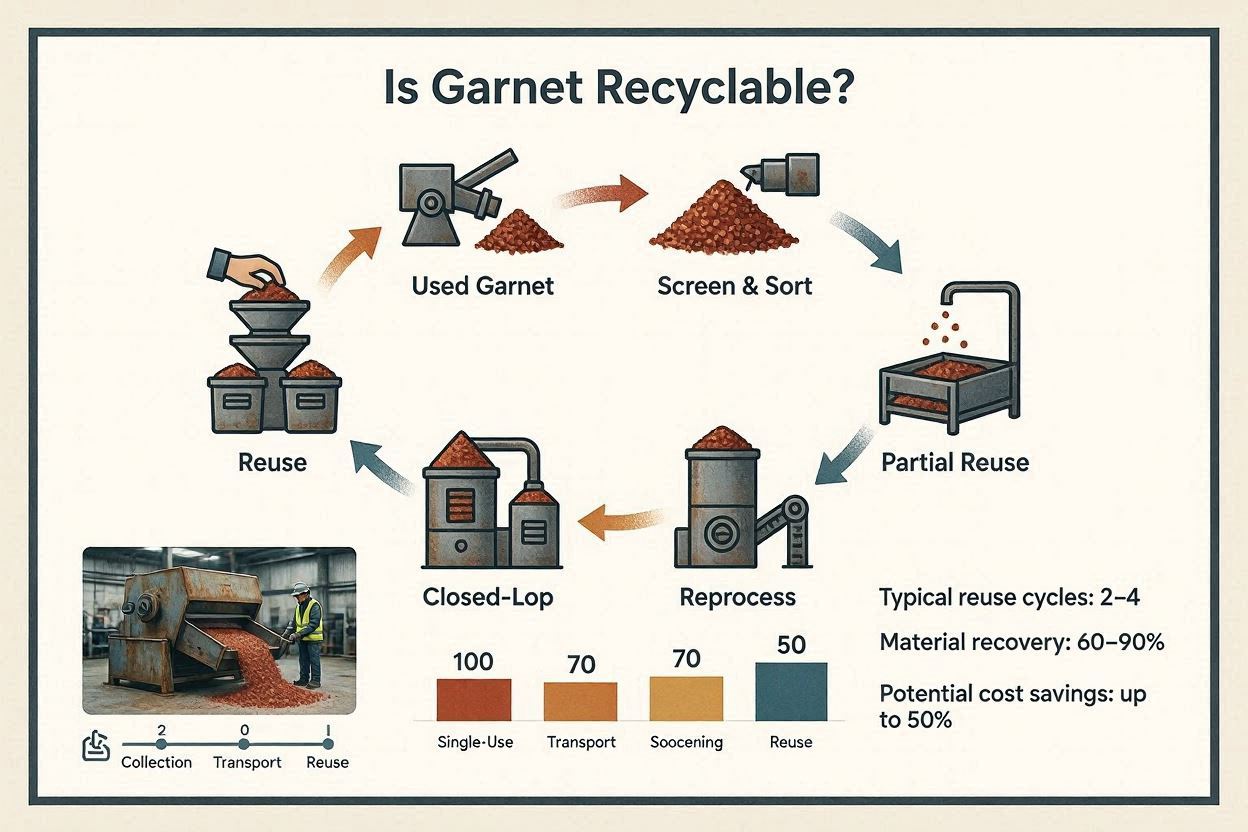
Silicon carbide is a medium-recyclability abrasive. Its angular particles fracture on impact — a phenomenon called friability — creating smaller particle fragments and fines. This friable behavior is actually responsible for SiC’s aggressive cutting action (each fracture exposes a fresh sharp edge), but it does reduce the number of effective reuse cycles. Under typical blasting cabinet conditions, silicon carbide can be effectively recycled 3–5 times with a media classifier before the particle size distribution shifts too far toward fines to maintain blasting efficiency.
| Cost Factor | 炭化ケイ素 | 酸化アルミニウム | ガーネット | スチールグリット |
|---|---|---|---|---|
| Media Cost ($/ton) | $$$ Higher | $$ Medium | $ Lower | $ Lowest |
| Reuse Cycles | 3–5 | 5–10 | 2–4 | 100+ |
| Effective Cost per Cycle | Medium | Medium-Low | Medium | 非常に低い |
| Blasting Speed (relative) | 200–300% | 100% (baseline) | 70–80% | 80–100% |
| Labor Cost per m² Blasted | Lowest | Medium | Medium-High | Low-Medium |
| Disposal Cost | Low (chemically inert) | 低い | 非常に低い | Medium (may rust) |
TCO insight: On a project blasting hardened steel components at scale, the 2–3× speed advantage of silicon carbide translates directly into 50–65% reduction in labor hours per unit area. When labor represents 60–70% of total blasting cost (the industry average for contracted surface preparation), SiC’s higher media cost is often fully offset by labor savings within the first 200 m² of blasted surface area.
For a full economic model with downloadable calculation templates, including break-even analysis comparing SiC to aluminum oxide on different project scales: SiC Reuse Cycles & Cost Analysis →
SECTION 11Blasting Process Overview
Effective use of silicon carbide abrasive blasting media requires proper setup and parameter control across the blasting system. The following overview covers the essential process variables for both direct pressure and suction (siphon) blast systems.
Direct Pressure vs. Suction Blasting
Silicon carbide blasting media can be used in both direct pressure and suction blast systems. Direct pressure systems deliver media to the nozzle at full pot pressure (typically 4–8 bar / 60–120 PSI), producing significantly higher impact velocity and faster material removal rates. Suction systems draw media from a hopper using venturi action and are slower but cheaper to operate. For heavy-duty industrial surface preparation where production rate is critical, direct pressure systems maximize SiC’s inherent speed advantage. For precision etching applications (glass, ceramics), suction systems offer finer control over media flow rate.
Key Process Parameters
| パラメータ | 推奨範囲 | Effect on Surface |
|---|---|---|
| Air Pressure (PSI) | 40–100 PSI (2.8–6.9 bar) | Higher pressure → deeper profile, faster cycle |
| Nozzle Standoff Distance | 150–400 mm (6–16 in) | Closer → more aggressive; farther → softer impact |
| ブラストアングル | 45°–90° to surface | 90° → maximum cutting; 45° → reduced profile, less embedding |
| Nozzle Diameter (Venturi) | 6–14 mm bore | Larger nozzle → higher production rate, more media flow |
| Media Flow Rate | Application-dependent | Consistent flow essential for uniform profile |
| Air Dryness | Dew point < –40°C at nozzle | Moisture causes media clumping and surface flash rusting |
Pro tip on nozzle wear: Silicon carbide’s extreme hardness (Mohs 9.5) means it is also highly abrasive to blast nozzles. For sustained SiC blasting operations, use tungsten carbide or boron carbide nozzle liners — do not use cheap ceramic or hardened steel nozzles, which will wear out within hours. Tungsten carbide nozzles provide 300–500 hours of service life with SiC media, while boron carbide (Mohs ~9.5) offers 750–1,500 hours and is the preferred choice for high-volume production environments.
Media Recovery and Recycling
To maximize silicon carbide reuse cycles, a media recovery system with mechanical classification is strongly recommended. A vibrating screen or cyclone separator removes oversized aggregate and fine dust from recovered media, retaining the productive mid-range particle size fraction for immediate reuse. Top up with 15–20% fresh SiC by weight per cycle to maintain consistent grit distribution and cutting performance.
SECTION 12Safety & Handling Requirements
Silicon carbide abrasive blasting media, while significantly safer than silica sand (it does not cause silicosis at standard exposure levels), still demands strict adherence to occupational health and safety protocols during use, storage, and disposal. The following guidelines apply to all commercial blasting operations using SiC media.
Regulatory note: While silicon carbide itself is not classified as a respirable crystalline silica hazard, the blasting operation generates fine dust from both the SiC media breakdown and the substrate being blasted. Dust from blasting painted surfaces (especially lead-based paints), rust, or hazardous coatings must be assessed independently for applicable occupational exposure limits and disposal regulations under local and national regulations (OSHA, EPA, HSE, etc.).
Silicon carbide blasting media hardness also poses equipment wear considerations. Never use SiC media in blasting equipment rated only for soft media (plastic bead, baking soda, glass bead systems). SiC will rapidly destroy the nozzle, media valve, pot liner, and blast hose in under-specified equipment. Always confirm equipment compatibility with the media manufacturer or equipment supplier before first use.
SECTION 13Sourcing & Procurement Guide
For international buyers — particularly those sourcing silicon carbide blasting media from China — the procurement process involves more considerations than a domestic purchase from a regional distributor. Quality consistency, purity certification, logistics planning, and minimum order quantities all require careful evaluation before committing to a supplier relationship.
Why China Is the Dominant Source
China’s dominance in global silicon carbide production is structural rather than merely price-driven. The country possesses the world’s largest proven reserves of high-purity silica sand and petroleum coke — the two primary raw materials for SiC synthesis — concentrated in regions with low-cost electricity essential for the energy-intensive Acheson process furnaces. This combination of raw material availability, energy infrastructure, and accumulated manufacturing expertise gives Chinese SiC producers a fundamental cost and scale advantage over competing production centers in Europe, North America, or Southeast Asia.
Key Specifications to Verify Before Ordering
| Specification | What to Verify | Typical Value (Black SiC) |
|---|---|---|
| SiC Content (%) | Chemical analysis certificate | ≥ 97.0% |
| Free SiO₂ (%) | XRF or wet chemistry report | ≤ 0.3% |
| Fe₂O₃ (%) | Chemical analysis certificate | ≤ 0.3% |
| Free Carbon (%) | Combustion analysis | ≤ 0.3% |
| 含水率 | Loss on drying at 110°C | ≤ 0.5% |
| Grit Size Distribution | Sieve analysis report (D10, D50, D90) | Per FEPA / ANSI / JIS |
| Bulk Density (g/cm³) | Physical test report | 1.20 – 1.60 |
| Magnetic Content | Davis tube or magnetic separation test | ≤ 0.1% |
Minimum Order Quantities and Packaging
Typical MOQs from Chinese SiC manufacturers for export orders range from 1 metric ton (for small buyers purchasing bag goods) to 20–25 metric tons per container load (for buyers sourcing in bulk super sacks or loose container loads). Jiangsu Henglihong Technology Co., Ltd. accommodates both small trial orders and full container shipments, with packaging options including:
- 25 kg multi-layer paper bags (moisture-resistant inner liner)
- 50 kg double-seam woven polypropylene bags
- 500 kg or 1,000 kg flexible intermediate bulk containers (FIBCs / super sacks)
- Bulk container (loose load) for very large volume orders
Logistics and Lead Times
Standard ocean freight lead times from Jiangsu / Shanghai ports to major destination ports are typically 15–22 days to Europe (Rotterdam, Hamburg, Antwerp), 18–28 days to the US East Coast (New York, Savannah), 12–18 days to the US West Coast (Los Angeles, Long Beach), and 8–14 days to Southeast Asian ports. Air freight is available for urgent trial sample shipments (typically 2–5 kg samples for quality evaluation) at cost.
For a comprehensive sourcing checklist, supplier evaluation framework, and detailed guidance on purchasing silicon carbide blasting media from China, read our procurement guide: How to Buy SiC Blasting Media from China →
Why Work With Henglihong?
Jiangsu Henglihong Technology Co., Ltd. has specialized in abrasive media manufacturing and export for industrial buyers worldwide. Our competitive advantages for international procurement include factory-direct pricing without intermediary markups, full batch-level chemical and physical QC documentation, flexible packaging and labeling to buyer requirements, multi-grit inventory for one-stop consolidated shipment, and dedicated export operations with experience in LC, TT, and other payment structures preferred by international buyers.
SECTION 14よくある質問
Silicon carbide abrasive blasting media has a Mohs hardness of 9.0 to 9.5, making it the hardest commercially available blasting abrasive. For comparison, diamond rates 10, aluminum oxide rates 8.0–9.0, and garnet rates 6.5–7.5 on the Mohs scale. This near-diamond hardness is what enables SiC to blast substrates that would rapidly consume softer abrasives.
Yes, silicon carbide is a partially recyclable abrasive. Under typical enclosed blasting cabinet conditions with media recovery and classification, SiC can typically be reused 3–5 times before the particle size distribution degrades below acceptable limits. Each use cycle produces some fines through friable fracture; these must be removed by the classifier before reuse. Adding 15–20% fresh media per cycle helps maintain consistent grit performance.
For glass etching, grit size selection depends on the desired finish depth and texture. For bold, deep etching (stage carving, 3D relief): use #80–120 grit. For standard frosted etching (signage, decorative panels): use #120–180 grit. For fine detail work or subtle satin frost effects: use #220–320 grit. Lower grit numbers produce coarser, deeper etching; higher numbers produce finer, shallower textures. Always start with lower air pressure (40–60 PSI) and increase incrementally for glass etching.
Yes. Silicon carbide (SiC) is a chemically distinct compound from silicon dioxide (SiO₂, crystalline silica). SiC does not contain free crystalline silica — the agent responsible for silicosis. However, quality control is important: reputable SiC manufacturers specify and certify free SiO₂ content (typically ≤ 0.3% for blasting grade). Always request a chemical composition certificate from your supplier to confirm free SiO₂ levels, particularly for applications subject to occupational health regulation.
All three are particle size classification standards for abrasive grains, but they use different sieve sequences and sizing conventions. FEPA (European standard, now also adopted in China and most of Asia for export products) and ANSI (North American standard) are broadly similar for macro grits (P12–P220) but diverge significantly in micro grit ranges. JIS standards (Japan) use different median particle size targets. When ordering from a Chinese manufacturer for North American use, specify ANSI standards explicitly; for European use, specify FEPA. Henglihong can supply to all three standards — specify your requirement at time of order.
Operating pressure depends on the substrate and application. For heavy industrial descaling and rust removal on steel: 60–100 PSI (4.1–6.9 bar). For general surface preparation and paint stripping: 50–80 PSI (3.4–5.5 bar). For glass etching and precision work: 30–60 PSI (2.1–4.1 bar). Always start at the lower end of the recommended pressure range and increase only as needed. Higher pressures accelerate media consumption and nozzle wear while increasing dust generation and operator fatigue.
Silicon carbide is generally not recommended for blasting aluminum. SiC’s high hardness (Mohs 9.5) and angular shape are too aggressive for soft aluminum substrates (Mohs ~2.5–3.0), causing excessive material removal, surface waviness, and SiC particle embedding in the aluminum surface — a form of contamination that can cause adhesion problems with subsequent coatings and create galvanic corrosion risk. For aluminum surface preparation, use glass bead (shot peening / satin finish), aluminum oxide at low pressure, or plastic blast media instead.
MOQ varies by supplier and packaging type. At Jiangsu Henglihong Technology Co., Ltd., trial sample orders (for quality evaluation) can be arranged in small quantities. Commercial production orders typically start from 1 metric ton for bagged goods. Full container load orders (20-foot FCL: approximately 18–20 MT; 40-foot FCL: approximately 22–25 MT in bags) offer the most competitive unit pricing. Contact our team directly for current pricing and MOQ confirmation for your specific grit size and grade.
SECTION 15Related Topics & In-Depth Guides
This pillar guide provides a comprehensive overview of silicon carbide abrasive blasting media. For deeper coverage of specific topics, each cluster article below explores a particular aspect of the subject in greater technical detail, with specific grit recommendations, case studies, and application parameters.
Product & Properties
Comparison Guides
Application Guides
Procurement
Ready to Source Silicon Carbide Blasting Media?
Get factory-direct pricing, full chemical certification, and flexible packaging from Jiangsu Henglihong Technology Co., Ltd. — an experienced SiC abrasive manufacturer serving industrial buyers worldwide.
Contact Us for a Quote →フィルター