What Pressure Should You Use for Plastic Media Blasting?
Blast pressure is the single most consequential parameter in plastic media blasting — the variable that most directly controls whether you remove the coating and protect the substrate, or remove the coating and damage the substrate, or fail to remove the coating at all. Every other process variable — standoff distance, nozzle angle, media mesh size, media type — operates within the constraints that pressure sets. Get the pressure right and the rest of the process has margin for normal variation. Get it wrong and no amount of technique compensates.
Yet pressure is also the parameter most commonly set by guesswork. Operators arriving at a new blast operation frequently ask a colleague what pressure they run, dial in that number without understanding why, and proceed. When results are inconsistent — too slow, leaving coating, or producing substrate damage — pressure adjustment is often the first thing tried, again by trial and error, rather than by the systematic logic that connects substrate type, media specification, coating hardness, and the physical mechanism of selective coating removal.
This guide eliminates the guesswork. It covers the physics that connect pressure to blast performance, the correct pressure ranges for every major application and substrate type, the variables that interact with pressure and must be considered together, how to measure pressure correctly (not all measurement points give the same number), how to qualify a new pressure setting properly, and what the specific symptoms of under-pressure and over-pressure look like so you can diagnose them before they become quality problems. For the broader setup context, see: Plastic Media Blasting: Step-by-Step Setup Guide.For a broader overview of the full plastic media category, see: What Is Plastic Media? The Complete Guide.
Why Pressure Matters: The Physics of Blast Impact
Blast pressure determines the velocity at which media particles leave the nozzle and strike the substrate surface. Velocity is the input; kinetic energy is what matters for coating removal. The kinetic energy of each particle impact scales with the square of velocity — doubling the blast velocity quadruples the impact energy per particle, not merely doubles it. This nonlinear relationship is why pressure changes have outsized effects on blast aggressiveness: a 20% increase in pressure can increase impact energy by 40–50%, pushing a safe process into over-blast territory without any obvious visible indication at the control point.
The mechanism of selective coating removal by plastic media — what makes it possible to remove paint from aluminum without damaging the aluminum underneath — depends on maintaining impact energy within a window bounded by two physical thresholds. The lower bound is the adhesion strength of the coating to the substrate: impact energy must exceed the coating’s bond strength to fracture and remove it. The upper bound is the yield strength (or fatigue limit, for repeated impacts) of the substrate material: impact energy must stay below the level that causes plastic deformation, micro-cracking, or surface erosion of the substrate itself.
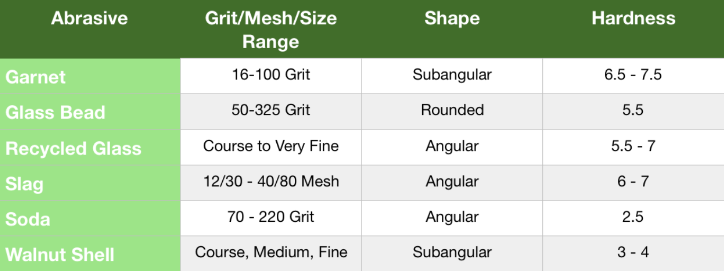
Plastic media’s fundamental advantage over mineral abrasives is that this window is wider. Mineral abrasives (silica sand, aluminum oxide) have Mohs hardness 6–9 — harder than most substrate materials, which means the lower threshold for substrate damage is near the lower threshold for coating removal. The working window is narrow, and process control is difficult. Plastic media at Mohs 2.5–4.0 is harder than most organic coatings but softer than most metallic substrates — the coating removal threshold and the substrate damage threshold are far apart, creating a wide working window where pressure can vary considerably without catastrophic results in either direction.
Where to Measure Pressure (and Where Not To)
One of the most consistently underestimated sources of process error in blast operations is measuring pressure at the wrong point in the system and assuming that number reflects what is actually happening at the substrate. There are three common measurement points in a blast system, and they give three different readings — only one of which is the operationally correct value.
The Hose Drop Problem
Pressure drop across a blast hose at high blast flow rates is typically 5–15 PSI depending on hose length, inside diameter, and flow velocity. A 50-foot hose at 3/8-inch nozzle flow rates loses approximately 8–12 PSI between the pot regulator and the nozzle inlet. If you set the pot regulator to 40 PSI, the nozzle may be receiving only 28–32 PSI — 20–30% below the intended operating pressure. This is not an edge case; it is the normal operating condition of most blast setups that do not have a nozzle inlet gauge installed.
The fix is simple and inexpensive: install a tee fitting and low-range pressure gauge (0–60 PSI range, not the standard 0–200 PSI gauge, which reads poorly at the low end of plastic media operating pressures) at the nozzle inlet, 6–12 inches upstream of the nozzle entry. All pressure specifications in this guide are referenced to this measurement point. When qualifying a new process or verifying an established one, always confirm pressure at the nozzle inlet gauge under active blast conditions — not at the pot regulator and not with the blast trigger released.
The Three Pressure Zones
Across all plastic media applications, nozzle inlet pressure operates in one of three functional zones. Understanding which zone each application falls into provides an immediate framework for setting starting parameters before qualification:
Master Pressure Reference: All Applications
| Application | Type de média | Mesh Size | Pressure Range (Nozzle Inlet) | Starting Point | Notes |
|---|---|---|---|---|---|
| CFRP / composite structure (aerospace) | Type V Acrylic | Mesh 30–40 | 20–35 PSI | 20 PSI | Never exceed 40 PSI on CFRP. Fiber damage is irreversible and may not be visible — requires NDI verification at qualification. |
| Aluminum aircraft skin (0.020–0.063″ thick) | Urée de type II | Mesh 30–40 | 20–35 PSI | 20 PSI | Almen strip testing required at qualification per most aerospace process specs. Document Almen intensity vs. pressure curve. |
| Aluminum aircraft structure (thicker, >0.063″) | Urée de type II | Mesh 20–30 | 25–40 PSI | 25 PSI | More latitude than thin skin; still requires Almen testing for fatigue-sensitive structures. |
| Automotive body panel (20–24 gauge steel) | Urée de type II | Mesh 20–30 | 25–40 PSI | 28 PSI | Panel distortion (oil-canning) risk above 40 PSI on 22–24 gauge. Run palm check after each panel at a new pressure. |
| Automotive body panel (16–18 gauge steel) | Urée de type II | Mesh 20–30 | 30–50 PSI | 30 PSI | Heavier gauge allows higher pressure. Rocker panels and structural sections: treat as chassis (see below). |
| Automotive chassis / frame (heavy steel) | Type II or III | Mesh 16–20 | 45–65 PSI | 45 PSI | Structural steel tolerates aggressive parameters. Check for pre-existing cracks before blasting — blasting can open hairline cracks. |
| Aerospace engine nacelle / cowl (composite) | Type V Acrylic | Mesh 30–50 | 15–30 PSI | 15 PSI | Complex geometry — adjust standoff to 10–14 inches for curved surfaces. Type V mandatory; Type II too aggressive for thin composite skins. |
| Injection mold cleaning (P20 / H13 tool steel) | Type V Acrylic | Mesh 50–80 | 12–25 PSI | 12 PSI | Measure Ra before first blast and monitor every 5 cycles. If Ra creeps upward, reduce pressure immediately. See mold cleaning guide. |
| Die casting die cleaning (H13, cooled to <150°F) | Type V Acrylic | Mesh 40–60 | 20–30 PSI | 20 PSI | Verify die temperature with IR thermometer before blasting. Above 150°F surface temp: media softens, embeds, contaminates die surface. |
| Electronics deflashing (IC packages, connectors) | Type V Acrylic | Mesh 60–80 | 8–20 PSI | 8 PSI | Fine-pitch IC packages (QFP, LQFP): do not exceed 15 PSI. Lead deformation is permanent. Automated fixturing required above 1,000 pcs/day. |
| Pre-anodize aluminum finishing | Type V Acrylic | Mesh 50–80 | 12–20 PSI | 12 PSI | This is tumbling media territory (vibratory) for most pre-anodize work; blast prep used for complex geometry or large parts. Keep iron contamination to zero. |
| Marine / industrial thick coating removal (steel) | Type II or III | Mesh 12–20 | 45–65 PSI | 45 PSI | Thick coatings may require multiple passes even at maximum pressure. Consider Type III melamine for rubberized coatings that resist Type II. |
| Beryllium copper (mold inserts, connectors) | Type V Acrylic | Mesh 60–80 | 10–18 PSI | 10 PSI | ⚠️ Full beryllium PPE protocol required. BeCu softer than steel (RB 96–100). Establish Ra baseline before first blast. Review with safety officer. |
| Titanium aerospace structure | Type II or III | Mesh 20–30 | 30–50 PSI | 30 PSI | Titanium is hard (HRC 30–36) but fatigue-sensitive. Almen strip testing required at qualification. Do not use parameters derived from steel work without separate testing. |
Substrate-by-Substrate Pressure Guide
Variables That Interact With Pressure
Pressure does not operate in isolation. Five other variables directly modify the effective impact energy delivered to the substrate at a given nozzle pressure. Understanding these interactions allows you to deliberately adjust the total process energy without touching the pressure dial — and explains why two operations running at “the same pressure” can produce radically different results.
How Mesh Size Changes Your Effective Pressure
Mesh size and pressure are partially interchangeable in terms of their effect on coating removal — both ultimately determine impact energy. A coarser mesh at lower pressure can deliver equivalent strip performance to a finer mesh at higher pressure. This interchangeability is a useful tool when you are constrained at one end: if you cannot increase pressure beyond a safe maximum, switching to a coarser mesh is the way to increase strip rate without increasing pressure.
| Scenario | Original Parameters | Adjusted Parameters | Net Effect |
|---|---|---|---|
| Stripping slowly — can’t increase pressure (substrate limit) | Mesh 30, 30 PSI | Mesh 20, 30 PSI | Strip rate increases ~30–40%; same substrate impact per particle, more kinetic energy per larger particle. Monitor surface profile. |
| Substrate damage occurring — can’t reduce pressure more (strip floor) | Mesh 20, 35 PSI | Mesh 30, 35 PSI | Energy per impact reduced ~20–25%; same strip rate potential over more passes; substrate impact stress per event reduced. |
| Need finer surface finish after stripping | Mesh 20, 40 PSI (rough result) | Mesh 30–40, 30–35 PSI | Finer surface profile; longer strip time but cleaner substrate texture; better adhesion profile for thin-film coatings. |
| Precision surface finishing (mold, pre-plate) | Mesh 40, 20 PSI | Mesh 60–80, 12–18 PSI | Minimum possible impact energy; preserves surface finish; accepts significantly longer cycle time for quality-critical applications. |
The practical limit on this interchangeability is at the coarse end: very coarse media (Mesh 12–16) at low pressure can still cause mechanical damage through sheer particle mass even at low velocity. And at the fine end, very fine media at any practical pressure cannot generate enough impact energy to remove tenacious coatings. The mesh-pressure design space has real boundaries; the interchangeability works within the center of the envelope, not at the extremes.
Standoff Distance and Angle as Pressure Modifiers
Standoff distance and impingement angle are the two geometrical parameters that modify effective blast energy delivery independent of the pressure dial. They give the operator real-time control over local process intensity — the ability to increase or decrease energy delivery in specific areas without stopping to adjust the system.
Standoff Distance
A media particle leaving the nozzle at full velocity immediately begins decelerating due to air resistance. The kinetic energy available at impact is the launch energy minus the deceleration loss. This loss is proportional to distance — a particle at 6 inches from the nozzle has lost relatively little energy; the same particle at 14 inches has lost significantly more. The practical effect:
| Standoff Distance | Relative Impact Energy vs. 10″ Reference | Blast Pattern Width | Best Use Case |
|---|---|---|---|
| 4–6 inches | ~120–130% of reference | Very narrow, concentrated | Spot-treating stubborn contamination; deep recesses; requires very controlled nozzle movement |
| 6–8 inches | ~110–120% of reference | Narrow-to-moderate | Detail work, corners, edges; higher strip rate applications where control is prioritized |
| 8–10 inches | Reference (100%) | Modéré | Default for most applications; good balance of strip rate and pattern uniformity |
| 10–12 inches | ~85–90% of reference | Moderate-to-wide | Sensitive substrates needing reduced effective energy; thin aluminum; composite skins |
| 12–16 inches | ~70–80% of reference | Wide, diffuse | Maximum substrate protection; pre-anodize cleaning passes; very thin-wall parts |
Impingement Angle
At 90° (perpendicular), all of the particle’s kinetic energy is directed normal to the surface — maximum energy transfer into the substrate-coating interface. As the angle decreases toward oblique, the normal component of energy decreases (less substrate impact) while the tangential component increases (more cutting/shearing action along the surface). For most coating removal applications, 75–85° provides the best combination of strip efficiency and substrate protection. For mold cleaning and surface finishing where the goal is removing surface contamination with minimum substrate impact, 60–75° is preferred. Never blast perpendicular to polished surfaces — the pure normal impact at 90° is most likely to alter Ra on precision surfaces.
Signs You Are Running Too Low
Under-pressure operation is safer than over-pressure, but it is still a problem — it wastes time, wastes media, and produces incomplete results that require re-work. Recognize these indicators before concluding that the media is wrong or the substrate is too difficult:
| Symptom | What It Looks Like | Diagnosis Confirmation |
|---|---|---|
| Coating peeling rather than fracturing | Paint lifts at edges and peels in large sheets rather than fragmenting under impact — the blast stream is undercutting the coating at low-adhesion zones rather than fracturing it comprehensively | Increase pressure 5 PSI: if the mode shifts from peeling to fracturing/powdering, you were under-pressure |
| Uneven coverage requiring many passes | Some areas clear after 2–3 passes; other areas of the same substrate with the same coating require 8–10 passes to clear — indicating marginal impact energy that only removes coating where adhesion happens to be lowest | Test strip at 5 PSI higher on a hidden area — if coverage uniformity improves, under-pressure confirmed |
| Media bouncing visibly off coating surface | At very low pressure, media impact is visible as particles ricocheting off the surface without cutting into the coating — the coating is not responding to the blast at all | Definitive visual confirmation of under-pressure; increase by 5–8 PSI and re-evaluate |
| Burnishing / polishing instead of removing | Soft coatings (e.g., flexible topcoats, some specialty primers) respond to very low blast pressure by polishing smooth rather than fragmenting — surface appears shinier and more uniform rather than being removed | Check surface with white rag — if rag picks up coating color, coating is still present but compressed rather than removed |
| Strip rate decreases progressively through a session | First 10 minutes of blast session produces good removal; removal rate drops noticeably over the session even though nothing changes — indicates media wear combined with marginal starting pressure, so as media degrades slightly the process falls below the effective strip threshold | Check nozzle bore (worn nozzle reduces effective velocity); run sieve check on media from pot |
Signs You Are Running Too High
Over-pressure is the more dangerous failure mode — the substrate damage it causes is often irreversible and may not be immediately apparent under normal inspection conditions. These are the early warning indicators that pressure has exceeded the substrate’s damage threshold:
| Symptom | What It Looks Like | Severity | Action |
|---|---|---|---|
| Thin steel panel warping | Panel surface shows oil-can distortion detectable by palm sweep; visible waves or buckles in light reflection; straightedge reveals departure from flatness | 🔴 Critical | Stop immediately. Reduce pressure 10+ PSI. Re-qualify. Warped panels require metal straightening — expensive rework. |
| Substrate surface appears frosted / hazy after strip | Bare metal surface after coating removal shows a frosted, micro-roughened appearance more aggressive than expected for the media mesh size — indicates micro-erosion of the substrate surface, not just coating removal | 🔴 High | Measure Ra; if above the substrate specification maximum, reduce pressure 5 PSI and re-qualify on test area. |
| Aluminum surface discoloration (darkening) | Blasted aluminum shows uneven grey-to-dark discoloration in some areas that does not respond to compressed air blowoff — indicates surface smearing or mechanical working of the aluminum surface layer | 🔴 High | Reduce pressure immediately. This condition may compromise anodize adhesion. Clean with appropriate acid etch before proceeding to coating. |
| CFRP surface shows fiber texture / weave | After blast, the surface reveals the fiber weave pattern of the composite — epoxy matrix has been eroded exposing the reinforcing fibers. Even slight exposure indicates the resin/fiber bond integrity is compromised. | 🔴 Critical | Stop immediately. Do not proceed. Notify engineering — NDI required to assess depth of fiber exposure. May require repair/rework of the composite structure. |
| Media embedding visible on substrate (white specks) | White particles visible on the bare metal surface after blowing off — media fragments embedded in the substrate surface rather than fracturing cleanly and bouncing off | 🟡 Medium | Reduce pressure. Reduce to more oblique angle (60–70°). Embedded media compromises coating adhesion and may cause coating failure in service. |
| Surface profile exceeds specification maximum | Testex replica tape or profilometer measurement shows surface roughness above the specified maximum Rz or Ra — excessive peak-to-valley depth for the intended coating system | 🟡 Medium | Reduce pressure and/or increase mesh fineness. A profile too deep for the coating system creates coating thickness deficiency at peak crowns and premature corrosion initiation. |
How to Qualify a New Pressure Setting
Any time you are using a new pressure setting — new application, new substrate, new media type, or new operator — the setting must be qualified against the specific substrate and coating combination before committing to production work. Qualification is not a lengthy or expensive process, but it is non-negotiable for any substrate where damage cannot be reversed.
Establish the Target Parameters Range
Using the Master Reference Table (Section 4) and the substrate guide (Section 5), identify the applicable pressure range for your substrate and media type. Note both the minimum (lower bound of strip effectiveness) and maximum (upper bound for substrate protection). Your qualification will find the optimum starting point within this range.
Prepare the Qualification Test Panel
Use a representative sample of the actual substrate material and coating system — same alloy/grade, same coating type and thickness, same adhesion profile as production parts. A 6 × 12 inch panel is sufficient for qualification. Mark three equal sections of the panel for testing at three different pressures.
Blast the Lower-Bound Section First
Set the nozzle inlet pressure to the lower bound of the applicable range (verified with the inline nozzle gauge under active blast conditions). Blast a 4 × 4 inch area of Section 1 at standardized nozzle technique: 8–10 inch standoff, 75–80° angle, consistent overlapping passes. Record time to achieve complete coating removal. Inspect for substrate damage indicators. Measure Ra and surface profile.
Step Up to the Mid-Range Section
Increase pressure to the midpoint of the range (or to the upper bound if the lower-bound test produced no coating removal). Blast Section 2 with identical technique. Record strip time, inspect for substrate damage, measure Ra. Compare strip rate improvement against any substrate condition change vs. Section 1.
Select the Qualified Operating Pressure
The qualified operating pressure is the lowest pressure from the qualification test that achieves complete coating removal in an acceptable cycle time without any substrate damage indicators. If both the lower-bound and mid-range tests produce clean, damage-free results, use the lower-bound pressure — it provides maximum safety margin. If the lower-bound test produced incomplete removal, use the mid-range pressure. Document the qualified pressure, media type, mesh size, standoff, and angle as the process specification.
Run the Production Verification Blast
Blast the first production part or first production section at the qualified parameters with full inspection at the end. Verify that production results match the qualification test panel. Document the first-article inspection results and retain with the process specification. Re-qualify if any of the three defining variables change: substrate material/grade, coating type/thickness, or media specification.
Pressure Drift: Why Your Setting Changes Without Touching the Dial
One of the most frustrating and least understood phenomena in blast operations is the degradation of process performance over time at a “fixed” pressure setting. The operator has not changed anything — the pot regulator reads the same number as on the qualification date — but strip rate has dropped, or surface results are inconsistent. The cause is almost always pressure drift: the actual nozzle inlet pressure has changed even though the control point reading has not. The four most common causes:
Nozzle wear: As the nozzle bore grows from wear, more air passes through the nozzle at the same inlet pressure — but at lower velocity because the larger bore produces lower pressure drop and therefore lower exit velocity per unit of airflow. A nozzle worn 1/16 inch oversize can reduce particle velocity by 15–25% at the same pot regulator setting. The gauge reads the same; the substrate receives significantly less energy. Measure nozzle bore regularly and replace at the specified maximum wear limit.
Hose degradation: Blast hoses develop interior wear and internal collapse over time. A hose with reduced interior diameter increases pressure drop along its length, delivering less pressure to the nozzle inlet at the same pot regulator setting. Replace blast hoses annually in production operations or whenever kinking, exterior cracking, or reduced flexibility is observed.
Compressor capacity loss: Compressor output degrades over time due to worn cylinder seals, dirty air filters, and dryer system inefficiency. A compressor that initially delivered 100 CFM at 90 PSI may deliver only 80 CFM after two years of operation without maintenance — reducing available nozzle pressure at the same flow demand. Check compressor output quarterly with a CFM meter at the outlet.
Media size degradation: As media degrades through multiple reclaim cycles to a smaller average particle size, the pressure required to achieve the same strip rate increases — finer particles carry less kinetic energy at the same velocity. A process qualified with fresh Mesh 20 media operating at 35 PSI may require 40–42 PSI with the same media after 4 reclaim cycles to achieve the same strip rate. The media condition has effectively reduced the process energy below the minimum effective level, making it appear to the operator that “the pressure setting isn’t working anymore.”
Pressure Troubleshooting Guide
Process was working well; strip rate has declined without any parameter changes
Before adjusting any parameter, measure the nozzle bore with a pin gauge. If the bore is at or past the replacement limit, replace the nozzle and re-test before any other changes. If the nozzle is in-spec, verify actual FAD from the compressor and run a sieve analysis on the working media. These three checks cover 90% of unexplained strip rate decline cases. Only if all three check out as in-specification should you investigate hose condition, media moisture, or reconsider the process parameters themselves.
Compressor pressure drops and recovers cyclically during blast operation
Cyclic pressure drop during blasting (the pressure falls when the trigger is pulled and recovers when released) is the unmistakable signature of an undersized compressor. The compressor cannot sustain the FAD demanded by the nozzle, causing pressure to collapse until the compressor catches up. The only permanent fix is to match the compressor FAD to the nozzle CFM requirement — either by reducing the nozzle bore (if a smaller nozzle is acceptable for the application) or by upgrading the compressor. A larger receiver tank provides a buffer for short-duration demand spikes but does not solve the fundamental undersizing problem for sustained blast operations.
Nozzle pressure gauge reads correctly but blast stream looks weak / lacks impact
Nozzle pressure can be correct while blast performance is poor if the media-to-air ratio in the blast stream is too low. The pressure pushes air effectively but with insufficient media to carry impact energy to the surface. Check the media flow rate by briefly diverting the blast stream into a bucket — normal media flow should produce a visible, densely loaded stream. If the stream appears mostly air with sparse media, the metering valve may be partially closed or the pot media level may be too low. Refill if needed, and inspect and clean the metering valve orifice if flow remains low after refilling.
Substrate shows damage at the pressure that was previously safe — same substrate, same parameters
The most overlooked source of substrate damage “at previously safe parameters” is a material change in the substrate. Aluminum alloy 6061-T4 and 6061-T6 have different yield strengths and respond differently to the same blast parameters — as do different gauges of the nominally same specification steel. Verify that the current production material matches the qualification coupon in alloy, temper, and gauge. If the material specification has changed, the process qualification must be repeated — parameters from one material specification do not automatically transfer to another, even within the same alloy family.
Questions fréquemment posées
Why do aerospace specifications give such a narrow pressure range (e.g., 20–35 PSI) while automotive operators seem to use much higher pressures?
The pressure range difference reflects the different consequences of substrate damage in each application. Aerospace aluminum structures are fatigue-critical — cyclic stress from flight loads means that even microscopic surface damage (micro-cracks, surface cold work, residual stress introduction) can initiate fatigue failures that progress over thousands of flight cycles and result in structural failure. The narrow aerospace pressure range is set to keep blast intensity below the threshold at which surface fatigue life is measurably reduced, which is verified through Almen strip testing and sometimes through coupon fatigue testing at qualification. Automotive panels, by contrast, are not fatigue-critical in the same way — a dented or even slightly warped body panel is a cosmetic and dimensional problem, not a safety-of-flight issue. Automotive operators can tolerate a wider operating window because the consequences of minor substrate over-blast are rework, not structural failure. The higher pressures sometimes used in automotive blast work would be completely unacceptable on aerospace aluminum — not because the aluminum is necessarily thinner (structural frames can be quite thick) but because the fatigue consequence is categorically different.
Can I use the same pressure for all media mesh sizes, or does changing mesh require a pressure adjustment?
Changing mesh size requires re-evaluating pressure — they are not independent. A pressure setting that produces acceptable strip rate and surface profile with Mesh 20 media will typically produce over-aggressive results with the same pressure at Mesh 12 (larger, heavier particles carry more kinetic energy per particle) and under-effective results with the same pressure at Mesh 40 (smaller, lighter particles carry less kinetic energy per particle). When switching mesh size, use the new mesh size’s applicable pressure range from the reference tables in this article rather than the pressure that was working for the previous mesh. In general, switching to a coarser mesh should be accompanied by a pressure reduction of 5–10 PSI from the current setting; switching to a finer mesh may require a pressure increase of 5–10 PSI to maintain equivalent strip rate. Always qualify the new mesh-pressure combination on a test area before committing to production.
Is there a simple field test to tell if my blast pressure is in the correct range before I do formal qualification?
Yes — the split test. Find a small, hidden area of the substrate with coating present. Blast a 2-inch square at your proposed starting pressure for 30 seconds with consistent technique, then inspect. A correct pressure produces a clean, uniformly stripped area with a consistently matte bare substrate surface — the coating should be completely removed, the bare surface should look uniform in texture, and there should be no gloss spots (remaining coating) or discoloration (substrate over-blast). If the coating is not completely removed, increase pressure by 5 PSI and repeat on an adjacent 2-inch area. If the substrate shows any discoloration, unusual texture, or visible roughness beyond what the media mesh would be expected to produce, reduce pressure by 5 PSI and repeat. The split test does not replace formal qualification with measurements — but it gets you to the right order of magnitude in 5 minutes before investing in detailed qualification work on a large test panel.
What is the maximum safe pressure for plastic media blasting on carbon fiber composite?
For carbon fiber reinforced polymer (CFRP) structures, the broadly accepted maximum nozzle inlet pressure for plastic media blasting is 40 PSI using Type V acrylic media at Mesh 30–40. Most established aerospace process specifications for composite depainting set working ranges of 20–35 PSI, with 40 PSI as an absolute upper limit that should not be approached without specific process qualification data demonstrating acceptable results on that exact composite layup and resin system. Above 40 PSI, the risk of eroding the epoxy matrix to expose carbon fibers becomes significant — and any fiber exposure represents structural damage to the composite that may not be visible under normal white-light inspection. Fiber exposure requires NDI (non-destructive inspection) to characterize, and potentially requires repair or replacement of the affected structure. If 40 PSI with Type V acrylic is insufficient to remove a particularly tenacious coating from CFRP, the correct response is not to increase blast pressure but to investigate chemical softening (application of a compatible paint stripper to the coating before blasting) or laser ablation for that specific coating type rather than exceeding the pressure limit for the substrate.
My automotive customer specifies “media blast per MIL-P-85891A” without giving a specific pressure. What pressure should I use?
MIL-P-85891A is a media specification standard — it defines the properties the plastic blast media must meet (hardness, density, moisture content, pH, particle size distribution) but does not specify blast operating parameters. When a customer references MIL-P-85891A without additional process parameters, they are specifying the media type and quality standard, not the operating conditions. For automotive panel stripping, the applicable pressure depends on the panel gauge and coating system — use the substrate-specific ranges from this article as your starting point (25–40 PSI for 18-gauge steel panels, 25–35 PSI for aluminum panels) and qualify the specific pressure for the customer’s substrate and coating combination. If the customer has additional requirements for surface profile (Rz or Ra specification) or substrate condition after stripping (e.g., no distortion, specific cleanliness standard), request that specification before beginning qualification work — it is much easier to qualify to a defined acceptance criterion than to work backward from a complaint that the surface is not what the customer expected.
Filtres