Abrasive & Media Materials – Complete Guide to Industrial Surface Treatment Media
Primary keyword: abrasive media — Secondary keywords: abrasive media types, industrial abrasive media
Introduction to Abrasive Media
Industrial surface treatment uses mechanical action to remove burrs, oxides, residues, or to impart a specific surface texture. That mechanical action is delivered by abrasive media — engineered particles or shapes that are tumbled, blasted, or vibrated against a part. Good abrasive media selection reduces rework, increases throughput, and improves final part performance (fatigue life, paint adhesion, etc.).
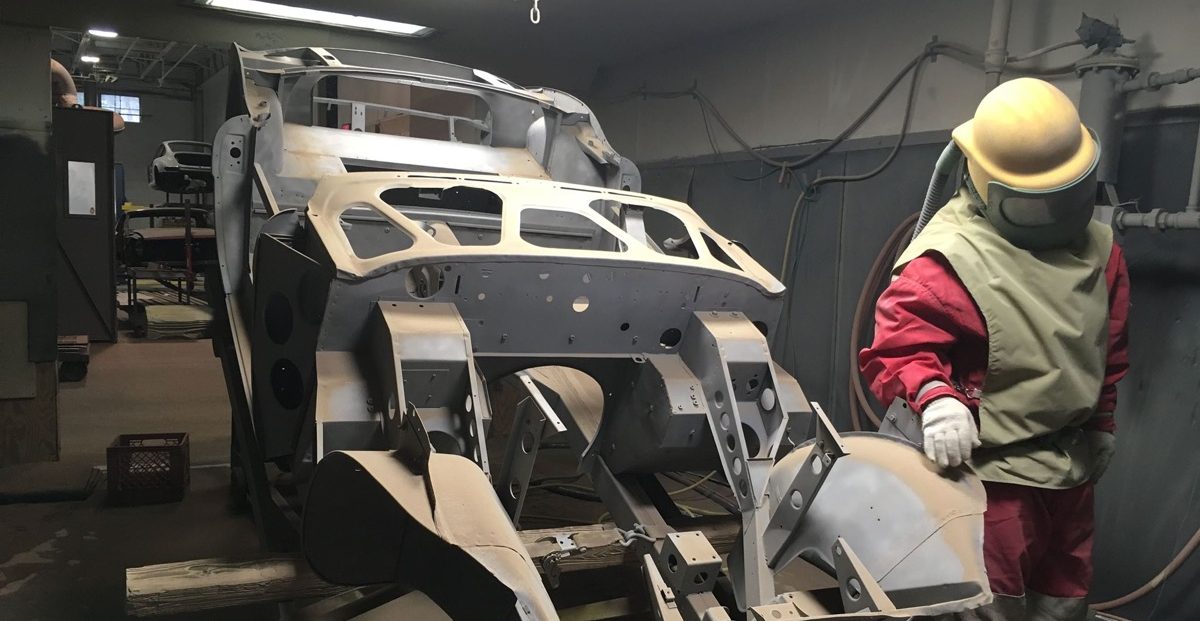
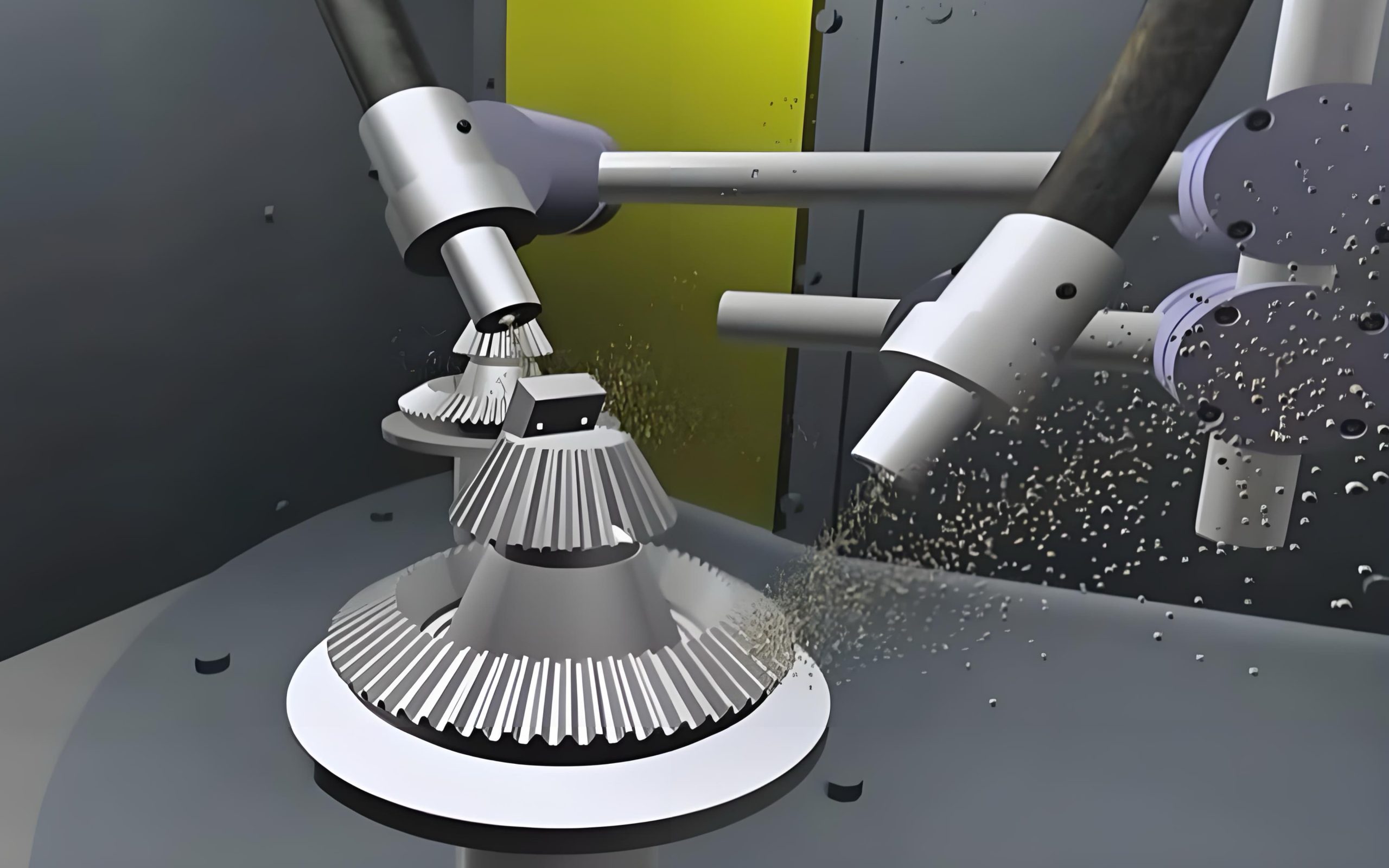
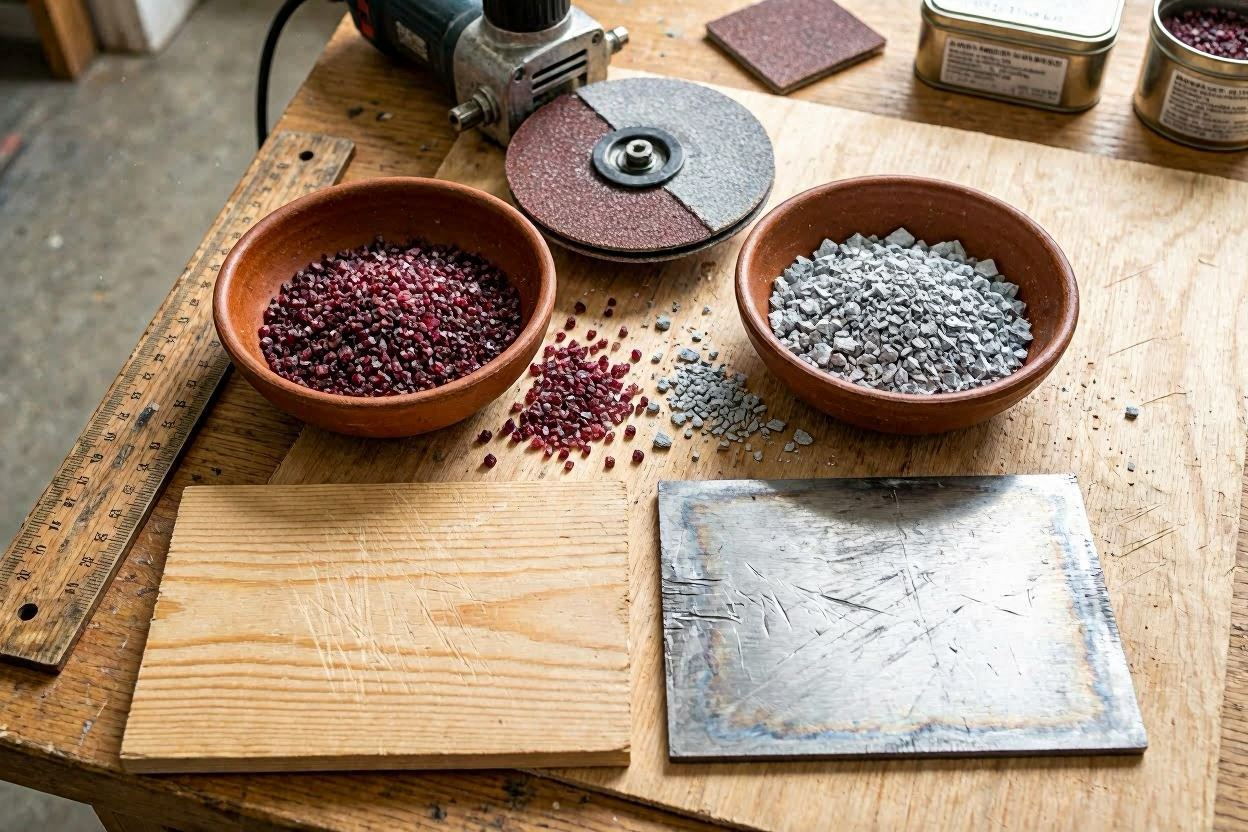
Common processes using abrasive media include: vibratory finishing, tumbling, shot peening (with metallic media), and abrasive blasting. Each process and media type interacts differently with the substrate. For example, high-hardness media remove material quickly but risk dimensional change; softer media preserve geometry but may require longer cycles.
Below we overview the four major media families — Supports en céramique, Perles en zircone, Oxyde d'aluminiumet Supports en plastique — and provide selection guidance and real-world tips.
Key Types of Abrasive Media
This section gives a high-level technical snapshot of the four major abrasive media types used in industry. Each subsection links to a cluster page with product-level details and spec sheets.
Supports en céramique
Overview: Manufactured from advanced ceramic formulations (typically sintered clay/ceramic bodies with controlled hardness). Ceramic media are engineered for aggressive cutting, high wear resistance and consistent shape retention.
Typical properties: High hardness (variable by grade), good fracture resistance, long life in tumbling/vibratory applications; available in shapes such as cones, cylinders, triangles and spheres.
Read the full Ceramic Media product guide →
Perles en zircone
Overview: Zirconia (zirconium dioxide) beads are dense, very hard, and have excellent wear life. They are often used where tight tolerances and aggressive cutting are required without contamination.
Typical properties: Very high hardness, excellent durability, consistent roundness (when beads), low contamination risk for critical components.
Read the full Zirconia Beads product guide →
Oxyde d'aluminium
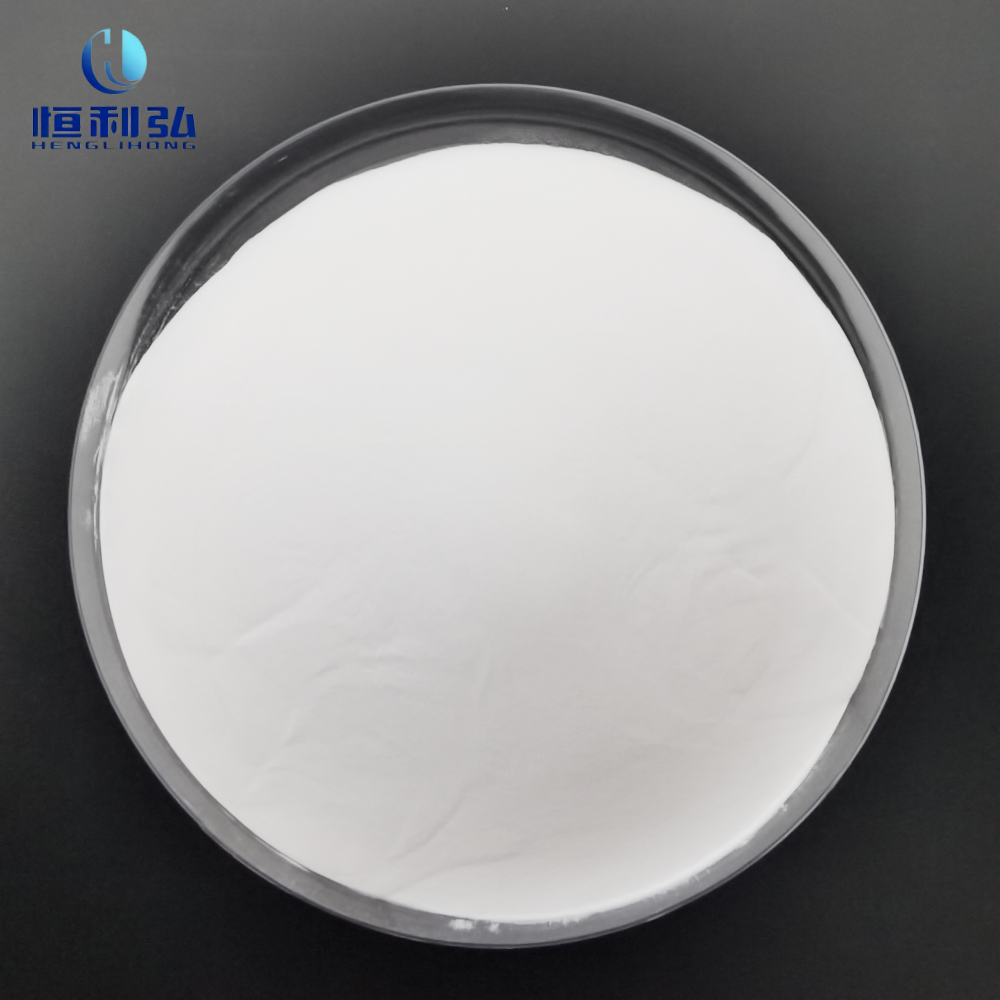
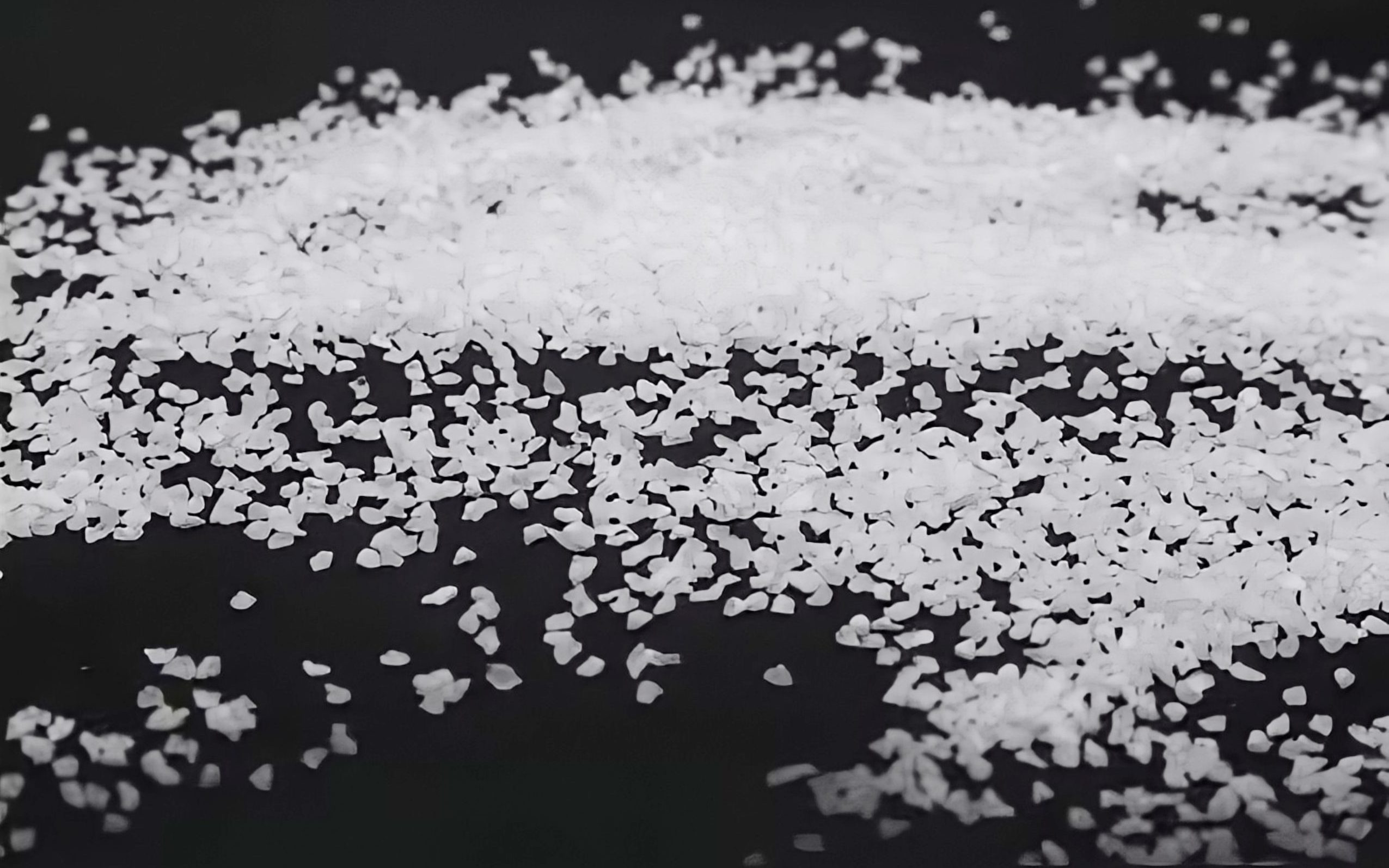
Overview: Aluminum oxide (Al₂O₃) is a synthetic abrasive widely used in blasting and some tumbling operations. It is an angular abrasive and is valued for rapid stock removal.
Typical properties: High cutting ability, angular shapes for sharp cutting, good for heavy rust/scale removal and aggressive cleaning.
Read the full Aluminum Oxide product guide →
Supports en plastique
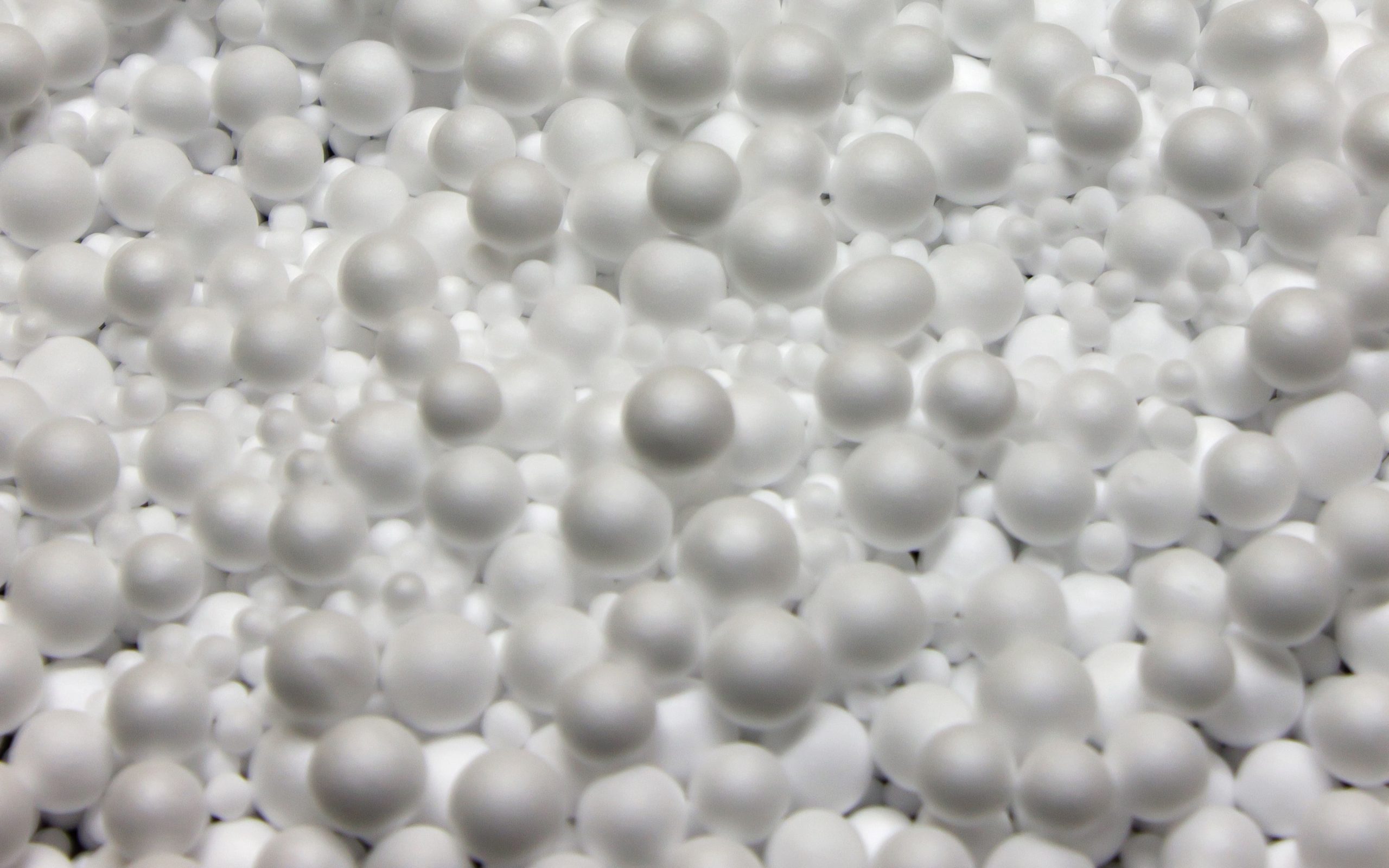
Overview: Engineered polymer-based media designed for light finishing, polishing, and precision deburring where minimal material removal is required.
Typical properties: Softer than mineral media, available in shapes that gently polish and deburr; excellent for delicate parts or when surface integrity and dimensional control are critical.
Quick Comparison Table
Use this table as a quick reference when deciding which family to investigate first. For detailed specs and part numbers, see the cluster pages linked above.
| Type de média | Hardness (approx.) | Best For | Typical Life | Rapport coût-efficacité |
|---|---|---|---|---|
| Supports en céramique | Medium–High | Deburring, finishing, fast stock removal with shape retention | Long | Modéré |
| Perles en zircone | Haut | Precision finishing, tight tolerance components | Very long | Lower (higher upfront cost, longer life) |
| Oxyde d'aluminium | Haut | Abrasive blasting, heavy rust/scale removal | Short–Moderate | High (low unit cost, more consumption) |
| Supports en plastique | Low–Medium | Polishing, delicate deburring, cosmetic finishing | Short–Moderate | High (good for finishing where rework is expensive) |
Note: “Typical Life” depends on process (vibratory vs tumbling vs blast), media shape, and part geometry.
Applications Across Industries
Abrasive media are used across automotive, aerospace, electronics, precision manufacturing, medical devices, and more. Below are common pairings and reasons for selection.
Automobile
Applications: deburring castings and machined parts, preparing surfaces for plating/painting, polishing small components (e.g., valve bodies).
Common media choices: ceramic media for castings; plastic media for delicate stamped components; zirconia for precision engine parts.
Aérospatiale
Applications: fatigue-critical part finishing, edge smoothing, burr removal prior to heat treatment or coating.
Common media choices: zirconia beads (tight-tolerance finishing), specialty ceramic grades that meet aerospace cleanliness standards.
Electronics & Precision Manufacturing
Applications: polishing contacts, removing burrs from connectors, cosmetic finishing without damaging plated surfaces.
Common media choices: plastic media (non-conductive and gentle), ultra-clean zirconia beads for contamination-sensitive parts.
For full industry case studies and photographs, see our Applications industrielles page which collects real-world examples and performance data.
How to Choose the Right Abrasive Media — Practical Step-by-Step Guide
Choosing media is a decision tree. Below is an experience-based, step-by-step checklist that engineers use on the shop floor.
- Define the objective: Do you need deburring, surface cleaning, matte finishing, or high-gloss polishing? Example: remove 0.1–0.2 mm burr vs. achieve Ra < 0.8 μm.
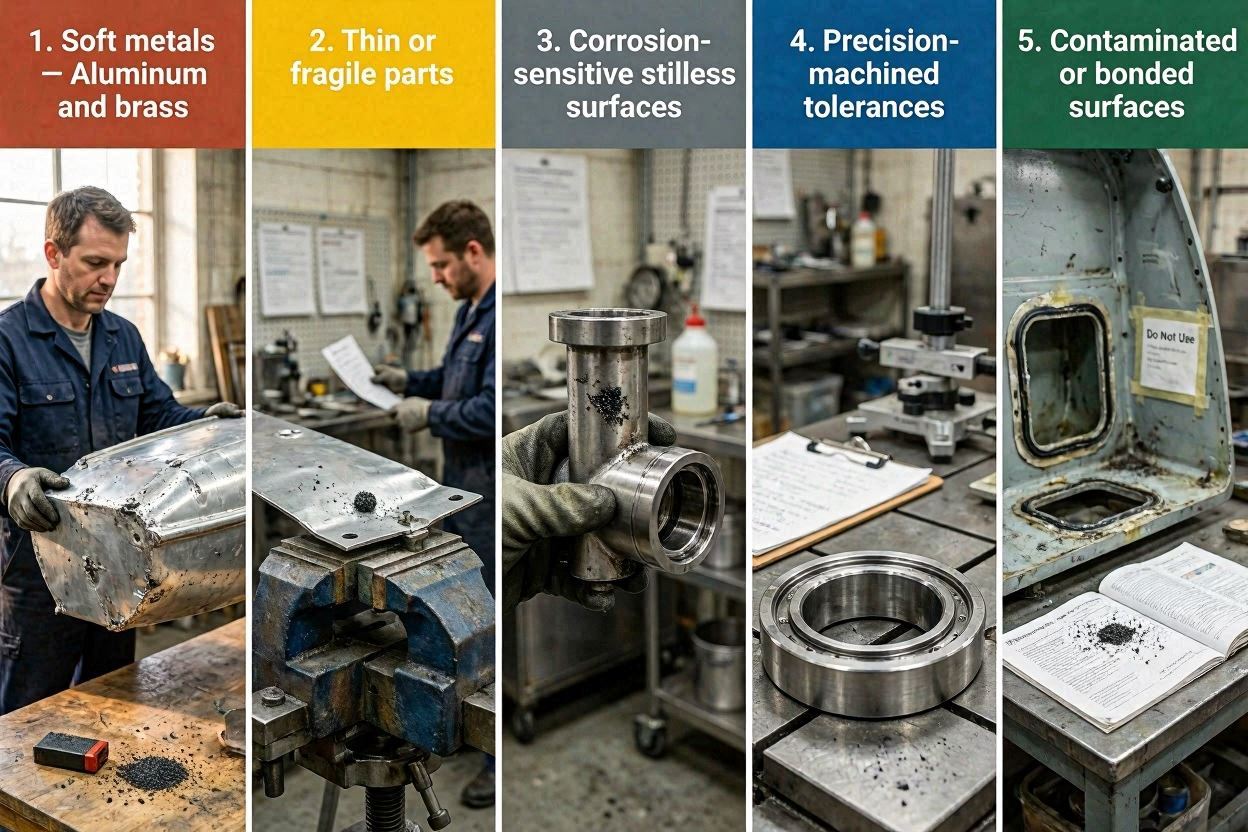
- Identify substrate material: Steel, aluminum, brass, plastic, or plated surfaces? Softer substrates need gentler media.
- Assess tolerances & geometry: Thin-walled or precision bore parts restrict media aggressiveness and size.
- Decide acceptable cycle time: Faster material removal favors ceramic or aluminum oxide; cosmetics favor plastic media with longer cycles.
- Estimate operating cost: Factor media life, media consumption, disposal/recycling, and downtime for media change.
- Trial & measure: Run a pilot batch with target media; measure burr removal, dimensional change, surface roughness and cycle time.
- Refine: If surface is too aggressive, switch to softer grade or smaller grit; if too slow, increase hardness or change shape to angular cutting forms.
Practical tip from field engineers: always log batch parameters (media type, size, machine RPM, cycle time, water/compound used). This builds a repeatable knowledge base.
Selection Examples
- Thick cast iron brake components: Ceramic media or aluminum oxide for fast stock removal.
- Plated connectors: Plastic media to avoid surface damage and preserve plating.
- High-precision aerospace bushings: Zirconia beads for uniform, low-contamination finishing.
If you’d like professional help selecting media for a specific part, Contact Us for Professional Advice.
Case Figures — Before & After Examples (Illustrative)
Frequently Asked Questions (FAQ)
Q: What is the most durable abrasive media?
A: Zirconia beads and high-grade ceramic media have the longest life under similar conditions. Zirconia is often the most durable (and most costly) per unit, but offers better lifecycle cost in high-throughput precision operations.
Q: Which media is best for removing rust from heavy castings?
A: Aluminum oxide or a coarse ceramic grade—aluminum oxide’s angular grains cut quickly, making it excellent for aggressive rust/scale removal.
Q: Can abrasive media contaminate parts?
A: Yes. Media contamination (introducing foreign particles or residues) is a concern for aerospace and medical parts. Use inert, low-residue media (e.g., pre-washed zirconia) and implement post-process cleaning.
Q: How often should I replace media?
A: Replace when performance degrades (longer cycle times to achieve same finish), when media shape fractures excessively, or when contamination accumulates. Track media life by run-hours or parts processed.
Q: Are there environmental or disposal concerns?
A: Yes. Some mineral media and used compounds can be hazardous. Check local disposal regulations. Many plants recycle or screen media to extend life and to reduce waste.
Filtres