Pumps for Abrasive Media: 20 Most Common Questions Answered
This FAQ compiles and answers the 20 questions most frequently asked by engineers, maintenance managers, and procurement specialists working with abrasive media pump systems. Questions cover pump type selection, materials, operating parameters, maintenance, wear rate estimation, and total cost of ownership. For detailed treatment of any topic, links throughout this page connect to dedicated in-depth guides in our abrasive pump resource library.
For the complete pump selection framework, start with: Pumps for Abrasive Media: The Complete Selection & Buying Guide.
There is no single best pump type for all abrasive slurry applications — the correct choice depends on flow rate, particle size, particle hardness, solids concentration, and viscosity. As a general framework: centrifugal slurry pumps are the standard choice for high-volume applications (mining, dredging, large process slurry) where flow exceeds 20–50 m³/h. AODD pumps are most practical for portable and medium-scale applications requiring self-priming and compressed-air operation. Peristaltic pumps excel with very hard or highly corrosive abrasive media where zero metal contact is required. Progressive cavity pumps are best for viscous abrasive media requiring smooth, metered flow. For a detailed comparison, see: Peristaltic vs. AODD vs. Progressive Cavity Pumps for Abrasive Media.
Standard centrifugal pumps — designed for clean, non-abrasive fluids — are not suitable for abrasive media and will fail rapidly when exposed to solid particles. The thin-walled components, tight impeller-to-casing clearances, and standard mechanical seals cannot withstand abrasive attack for any meaningful service duration. Purpose-built centrifugal slurry pumps are required for sustained abrasive service. These differ fundamentally from standard centrifugal pumps: they feature thick replaceable liners (high-chrome alloy or rubber), large impeller clearances specifically designed to pass solid particles, heavy-duty shaft seals, and oversized bearings rated for the additional loads from heavy slurry. Substituting a standard centrifugal pump for a slurry pump to save initial cost will almost always produce higher total costs within months from premature failure and replacement.
Choose positive displacement (PD) over centrifugal when any of the following apply: flow rate is below approximately 20–50 m³/h (where PD pumps are cost-competitive); fluid viscosity exceeds 200–500 cP (centrifugal efficiency degrades sharply above this); precise flow metering or constant flow at variable pressure is required; the application requires self-priming and dry-run safety; particles are very hard (Mohs 8+) where centrifugal wear rates become prohibitive; or there is no reliable electrical power supply (AODD pumps run on compressed air only). At high flow rates, centrifugal slurry pumps are typically the only practical and economical choice, despite higher wear management requirements. See: Centrifugal vs. Positive Displacement Pumps for Abrasive Media.
In almost all cases, no. Gear pumps depend on extremely tight internal clearances (5–50 microns) for their volumetric efficiency. Abrasive particles — even relatively fine ones — rapidly score these tight clearances, opening gaps that eliminate hydraulic efficiency within hours of exposure. The gear teeth, casing bore, and shaft seals are all destroyed in sequence by abrasive particle ingestion. The narrow exceptions where gear pumps may be acceptable with mildly abrasive fluids (sub-10 micron soft particles at very low concentration, or highly lubricious abrasive compounds in thick oil) are very specific and must be verified with the pump manufacturer before use. For typical abrasive slurry applications, specify AODD, peristaltic, progressive cavity, or centrifugal slurry pumps instead. See: Are Gear Pumps Suitable for Abrasive Liquids?
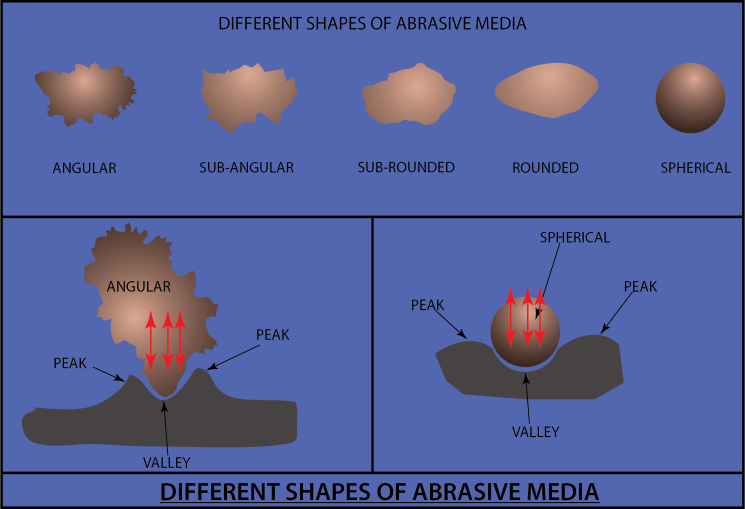
Neither is universally “better” — the correct choice depends entirely on the particle characteristics. Rubber resists abrasion through elastic deformation: particles deform the surface and are ejected without removing material. This works well for fine, rounded particles at moderate velocity and hardness below approximately Mohs 6.5. High-chrome alloy resists abrasion through hardness (600–800 HB): the pump material is harder than the particle and resists cutting and gouging. This is required for coarse, angular, or hard particles above Mohs 6.5–7. Particle shape is critical: angular particles cut through rubber at hardness values where rubber would perform adequately against rounded particles. Many experienced engineers specify rubber for fine-particle zones and high-chrome for high-velocity impact zones in the same pump installation. See: Pump Materials for Abrasive Media: Chrome vs. Rubber vs. Ceramic vs. Polyurethane.
For particles above Mohs 8 — alumina (Mohs 9), silicon carbide (Mohs 9–9.5), and similar ultra-hard abrasives — the practical material options narrow significantly. High-chrome white iron (Cr27/Cr28) at 600–800 HB provides the best general-purpose wear resistance at this hardness level and remains the standard choice for coarse, high-velocity abrasive applications. Alumina or silicon carbide ceramic components (Mohs 9+) provide superior hardness and chemical resistance for fine, low-velocity, low-impact applications — particularly in precision chemical and semiconductor slurry pumping. Natural rubber and polyurethane are not suitable above Mohs 7 and should not be specified for alumina, SiC, or similarly hard abrasives. For peristaltic pumps handling very hard fine abrasives, reinforced EPDM or natural rubber hoses remain viable because the abrasive contacts only the hose interior at low velocity.
The most common causes of accelerated, unexpected wear in abrasive pump installations are: (1) Excessive impeller tip speed — wear rate scales with velocity to the 2nd–3rd power; operating above the material wear limit is the most common root cause of premature failure. (2) Particle hardness exceeding the pump material capability — rubber used with particles above Mohs 7, or standard alloys against very hard minerals. (3) Operating far from best efficiency point — off-BEP operation creates internal recirculation zones with high local velocities. (4) Excessive impeller clearance from deferred maintenance — worn clearances accelerate wear in a positive feedback loop. (5) Inconsistent abrasive media quality — oversize particles or batch-to-batch hardness variation cause unexpected wear spikes. (6) Air ingestion at the suction line creating cavitation damage. Diagnose by examining the wear pattern on failed components — see: How Abrasive Particles Damage Pumps.
Critical transport velocity (CTV) is the minimum fluid velocity in a pipeline below which solid particles begin to settle and progressively block the line. It is the lower boundary on pump operating speed — the pump must always maintain pipeline velocity above CTV in all sections, including horizontal runs and during startup. CTV depends on particle density, particle size, pipe diameter, and slurry concentration; for most mineral slurries in 50–150 mm pipelines, CTV falls between 1.5 and 3.5 m/s. In pump selection, CTV sets the minimum flow rate at which the pump must operate, which in turn sets the minimum impeller speed when a VFD is installed. Always design the system so minimum pump output maintains pipeline velocity at 110–115% of CTV to provide a safety margin for wear-related performance decline. Falling below CTV — even briefly — can initiate progressive settling that results in complete pipeline blockage.
d50 (median particle size) is the particle diameter below which 50% of the particles by mass fall. It characterizes the typical or average particle and is the primary input for wear rate estimation and liner material selection. d95 (95th-percentile size) is the particle diameter below which 95% of particles fall — it characterizes the largest particles present in meaningful quantity. For pump selection, d95 governs the minimum clear passage requirement: all pump internal passages, impeller clearances, and port openings must exceed d95 to prevent particle bridging and impeller jamming. Specifying only d50 and ignoring d95 is one of the most common pump selection errors — the 5% of particles above d95 are responsible for a disproportionate share of valve seat damage, clearance blockage, and impact wear events. Always obtain and specify both values. See: How to Select a Pump for Abrasive Media: 8 Critical Parameters.
The practical threshold is approximately Mohs 6.5–7, but particle shape significantly modifies this number. For rounded particles (steel shot, glass beads), rubber performs acceptably up to approximately Mohs 6.5–7 — the elastic deformation mechanism ejects rounded particles without being cut. For angular particles (crushed steel grit, garnet, angular sand), the cutting edges penetrate rubber surfaces at much lower hardness values — effectively reducing the viable Mohs threshold to approximately Mohs 5.5–6 for highly angular media. As a practical rule: if your particles are above Mohs 6.5 and angular, specify high-chrome alloy liners, not rubber. If particles are above Mohs 7 regardless of shape, rubber is generally not appropriate and high-chrome or ceramic is required. When near the threshold, request wear life data from the pump manufacturer for your specific media type rather than relying on general guidance.
Solids concentration affects pump selection in three ways. First, hydraulic performance: centrifugal pump head and efficiency must be derated for slurry compared to water — typically reducing head by 5–15% at 20% w/w and significantly more at higher concentrations. Second, wear rate: wear increases sub-linearly with concentration — doubling concentration from 15% to 30% w/w typically increases wear rate by approximately 50–80% (not 100%), but at very high concentrations above 50% w/w, particle interference reduces per-particle energy and wear rate per unit concentration begins to plateau. Third, pump type suitability: above 40–45% w/w, centrifugal slurry pump performance becomes difficult to manage and progressive cavity or specialist high-density centrifugal designs are preferable. Always specify both the normal operating concentration AND the maximum credible upset concentration, and verify pump selection at both conditions.
Flow rate specification for abrasive slurry has two boundaries. The upper boundary is the maximum process demand flow rate — determined by your mass balance and production rate requirements. Convert from mass flow (tonnes/hour) to volumetric flow (m³/h) using slurry density: ρ_slurry = 1 / (Cw/ρ_solids + (1−Cw)/ρ_water). The lower boundary is the minimum flow required to maintain pipeline velocity above critical transport velocity in all pipeline sections. Calculate minimum pipe cross-sectional area from your chosen pipe diameter, then: Q_min = CTV × π × (D/2)² × 3,600 m³/h. Your pump must be capable of delivering maximum process demand flow while maintaining — at minimum operating conditions — the minimum flow above CTV. Where process demand varies significantly, a VFD with minimum speed interlock at the CTV-corresponding speed is the recommended implementation.
Progressive cavity pumps handle abrasive slurry with moderate effectiveness, but they have specific limitations. The stator elastomer and rotor surface both wear in direct contact with abrasive particles throughout the pumping cycle. For moderately abrasive slurries (Mohs 5–6.5, fine to medium particle size, 10–40% concentration), stator wear intervals of 1,000–4,000 hours are achievable with appropriate stator material selection. For highly abrasive media (Mohs 7+, angular particles), stator wear rate increases dramatically and stator replacement intervals can fall to weeks rather than months — making PC pumps economically unviable compared to peristaltic alternatives. PC pumps are most appropriate for abrasive applications where their primary advantage — smooth pulsation-free flow for viscous media or precision metering — justifies the wear management cost. They should not be selected for highly abrasive service simply because they are a familiar positive displacement design. See: Peristaltic vs. AODD vs. Progressive Cavity Pumps for Abrasive Media.
Viscosity has a dramatic effect on pump type suitability. Centrifugal pumps deliver decreasing hydraulic efficiency as viscosity rises — at 200 cP, a centrifugal pump may be running at 70% of its rated water efficiency; at 500 cP, as low as 50%. Above approximately 500 cP, centrifugal pumps are generally not economical for abrasive slurry service. Positive displacement pumps are largely insensitive to viscosity for volumetric efficiency — progressive cavity pumps in particular maintain constant output per revolution regardless of viscosity, which is their primary advantage for viscous abrasive applications. For thixotropic slurries (those that thin under shear) — common in bentonite mud, ceramic glaze, and some mineral slurries — measure viscosity at the actual shear rate the pump will impose, not at rest. A fluid that appears far too viscous for centrifugal pumping may be quite pumpable under the shear conditions of the operating pump. Measure dynamic viscosity at operating shear rate before ruling out any pump type on viscosity grounds.
A tiered maintenance schedule is recommended, with frequency matched to the severity of the application. Daily: operator walk-around including flow and pressure checks, suction strainer cleaning, abnormal noise or vibration check, external seal leak inspection, end-of-shift flush with clean water. Weekly: vibration amplitude measurement, motor current at constant flow, AODD check valve and seat inspection, peristaltic hose condition check. Monthly: impeller-to-liner clearance measurement and adjustment, mechanical seal face inspection, bearing lubrication, shaft runout measurement. Quarterly: wet-end teardown, liner thickness measurement at multiple points, impeller vane thickness measurement, full pump curve performance verification, bearing inspection. Adjust frequencies based on your actual liner replacement intervals — if liners are replaced every 3 months, increase inspection frequency to monthly. See the complete guide: Abrasive Media Pump Maintenance Guide.
Yes — VFDs are among the highest-return investments available in abrasive pump management, delivering benefits on two fronts simultaneously. Energy savings: pump power scales with speed cubed — a 20% speed reduction reduces energy consumption by approximately 49%. For a 7.5 kW pump running 2,000 hours per year, this represents roughly $450/year in energy savings at typical industrial electricity rates. Wear rate reduction: wear rate scales with particle velocity to the 2nd–3rd power — the same 20% speed reduction that saves 49% of energy also reduces wear rate by approximately 40–50%, roughly doubling liner service intervals. In applications with variable process demand, VFDs allow continuous operation at the minimum adequate speed rather than throttling a fixed-speed pump. VFD payback periods of 12–24 months are typical in medium-duty continuous abrasive pump applications. The minimum speed interlock must be set at the speed corresponding to critical transport velocity ×1.1 to prevent inadvertent pipeline settling. See: Optimal RPM & Flow Rate for Abrasive Media Pumps.
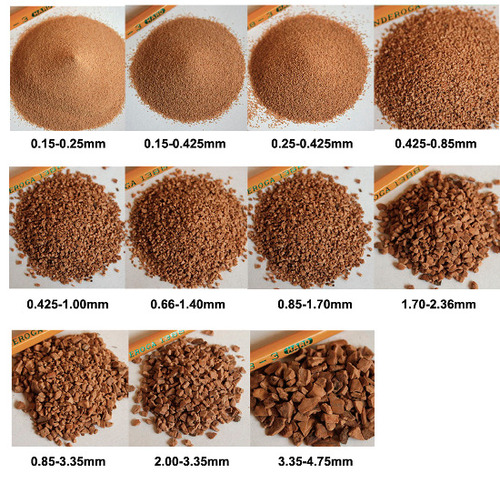
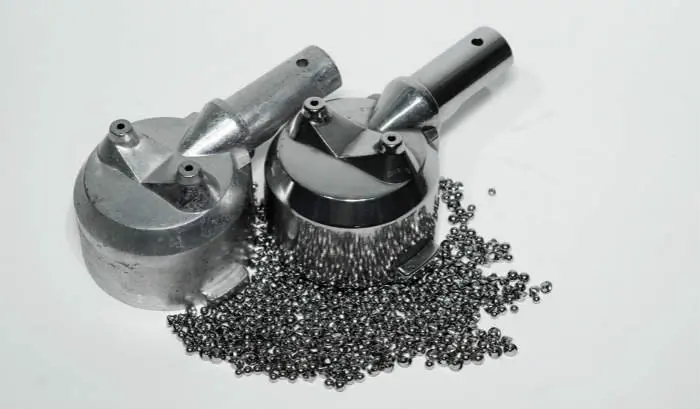
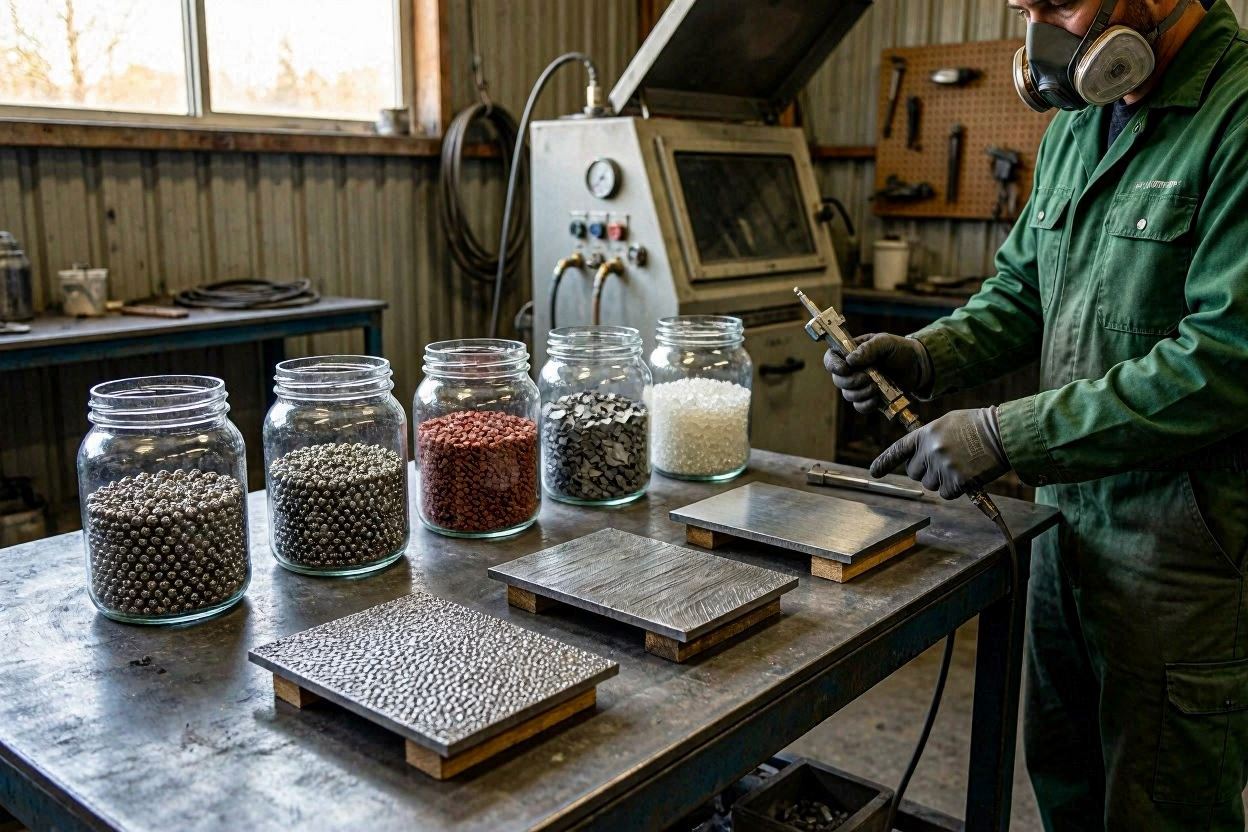
Abrasive media quality has a direct, quantifiable impact on pump wear rates, maintenance frequency, and process consistency. Four quality attributes matter most: (1) Particle size distribution consistency — media with tight, certified size distribution produces predictable wear rates; poorly graded media with wide distribution introduces oversize particles that cause disproportionate impact wear at valve seats and clearance zones, unpredictably shortening service life. (2) Hardness uniformity — media manufactured to tight hardness specifications (HRC range for steel, Mohs range for mineral media) produces batch-to-batch wear consistency; hardness variation creates unpredictable wear rate spikes. (3) Particle shape integrity — certified spherical media (steel shot to SAE J827) maintains its shape factor throughout a delivery; media with inconsistent sphericity behaves like angular abrasive in the pump. (4) Contamination control — dust fractions and mixed-hardness batches create unpredictable pump behavior. Sourcing from manufacturers who provide certified analysis documentation on every batch is the most effective single measure for improving pump wear predictability.
For dual corrosive and abrasive service, peristaltic pumps with chemical-resistant hose material (EPDM, natural rubber, PTFE-lined) are frequently the best solution at flow rates up to approximately 15–20 m³/h. The abrasive-corrosive slurry contacts only the hose interior — no metal components are exposed to either attack mechanism — and the hose material can be independently selected for both chemical and abrasive resistance. For higher flow rates, rubber-lined centrifugal pumps with EPDM or natural rubber liners provide adequate corrosion resistance for mild-to-moderate acid or alkali conditions while the rubber handles fine abrasive particles. For strongly acidic or oxidizing conditions with abrasive content, PVDF-body AODD pumps with ceramic check valves address both requirements. Avoid stainless steel in any application combining abrasive particles with acidic or chloride-containing carriers — the passive film that provides corrosion resistance is continuously stripped by abrasive wear, creating severe erosion-corrosion. See: Pumps for Corrosive AND Abrasive Media.
Wear rate estimation requires knowledge of six key variables: particle velocity (impeller tip speed), particle hardness (Mohs), particle size (d50 and d95), particle shape (rounded vs angular), solids concentration, and carrier fluid chemistry. The most rigorous approach is the Miller Number test (ASTM G75) — a standardized laboratory test that measures the abrasivity of your specific slurry against a standard reference material, producing a single number that accounts for all particle and fluid variables simultaneously. Where laboratory testing is impractical, relative wear factors can be applied to field wear rate data from similar reference installations. As a first estimate: obtain liner life data from your pump manufacturer for the closest available reference slurry, then apply correction factors for differences in particle hardness, speed, concentration, and shape. Validate the estimate against physical liner thickness measurements at the first quarterly inspection and recalibrate. See: How to Estimate Pump Wear Rate for Abrasive Slurry.
Total cost of ownership (TCO) is the sum of all costs associated with a pump over a defined analysis period — typically five years — including initial purchase price, installation, energy consumption, planned maintenance (liner, seal, and bearing replacements), unplanned downtime costs (lost production during unexpected failures), spare parts inventory carrying cost, and end-of-life disposal. TCO matters because in continuous-service abrasive pump applications, the initial purchase price typically represents only 10–20% of five-year total cost. Energy consumption and maintenance together account for 60–75%. A pump that costs 40% more at purchase but runs 15% more efficiently and requires liner changes half as frequently will almost always deliver lower five-year TCO than the cheapest alternative — often by a factor of 2–3×. Making pump procurement decisions based on purchase price alone is the most common and most expensive systematic error in abrasive media pump management. Build a five-year TCO model before any purchase decision. See: Total Cost of Ownership for Abrasive Media Pumps.
Certified Abrasive Media — The Foundation of Reliable Pump Performance
The accuracy of every pump selection model, wear rate prediction, and maintenance schedule in this FAQ depends on consistent, certified abrasive media inputs. Jiangsu Henglihong Technology Co., Ltd. manufactures steel shot, steel grit, stainless steel shot, glass beads, and aluminum cut wire shot to SAE and ISO standards — with certified particle size distribution and hardness documentation on every shipment, giving your pump systems the predictable media properties they need.
Request Product Specifications & Quotation →Filtros