Jiangsu Henglihong Technology Co., Ltd.
Sandblasting Grit Size Chart: Mesh Size, Surface Profile & Application Guide
The definitive grit size reference for industrial abrasive blasting — covering FEPA, US Mesh, and ISO standards, particle size ranges, anchor profile depth data (Ra/Rz) for major media types, and a full application-to-grit selection matrix across all major substrates and coating systems.
Understanding Grit Size & Mesh: The Fundamentals
Grit size — also called mesh size or mesh number — describes the physical diameter of individual abrasive particles. The term “mesh” refers to the number of openings per linear inch in a standardized testing sieve screen. An abrasive particle that passes through a sieve with 36 openings per inch but is retained on a sieve with 46 openings per inch is designated “36/46 grit” or “F36” in the FEPA system.
The counterintuitive rule: higher mesh number = smaller particle. A sieve with 220 openings per inch has much smaller openings than one with 24 openings per inch, so F220 grit is a very fine abrasive while F24 is quite coarse. This inverse relationship confuses many buyers encountering grit specifications for the first time — once understood, it clarifies every grit chart and specification document.
Higher grit number → smaller particles → smoother, finer finish → less aggressive material removal.
Lower grit number → larger particles → rougher profile → more aggressive material removal.
This relationship is consistent across all blasting abrasive specifications regardless of the media type.
This page is the companion grit-size reference to Henglihong’s complete blasting media resource hub. For the complete media-type overview and selection framework, see our complete guide to sandblasting material.
Grit Size Standards: FEPA, US Mesh & ISO
Three primary grit sizing systems are used in international abrasive trade. Understanding the relationship between them is essential for correct specification when sourcing from different regions or comparing competing quotations.
Federation of European Producers of Abrasives standard. F-series (F12–F220) for macro blasting grits. P-series (P40–P2500) for coated abrasives. Most widely used in international industrial specifications. The reference standard for aluminum oxide and silicon carbide.
American National Standards Institute designation — the most common system in North American specifications. Mesh number = openings per linear inch. Not directly interchangeable with FEPA numbers — always check particle size (µm) when comparing.
International standards for metallic and non-metallic blasting abrasives respectively. Define allowable particle size distributions and tolerances. Referenced in SSPC, NACE, and ISO surface preparation specifications.
Society of Automotive Engineers standard for steel shot and steel grit — uses S-series (shot) and G-series (grit) with nominal diameter in fractions of an inch. Common in automotive and structural steel blasting specifications.
FEPA F-grade (macro grits, for blasting and bonded abrasives) and FEPA P-grade (for coated abrasives like sandpaper) use different sieving methodologies and produce different particle size distributions at nominally equivalent numbers. Always specify F-grade aluminum oxide or silicon carbide for blasting applications. Specifying P-grade by mistake will result in incorrect surface profiles and poor process repeatability.
Master Grit Size Chart — All Major Blasting Media
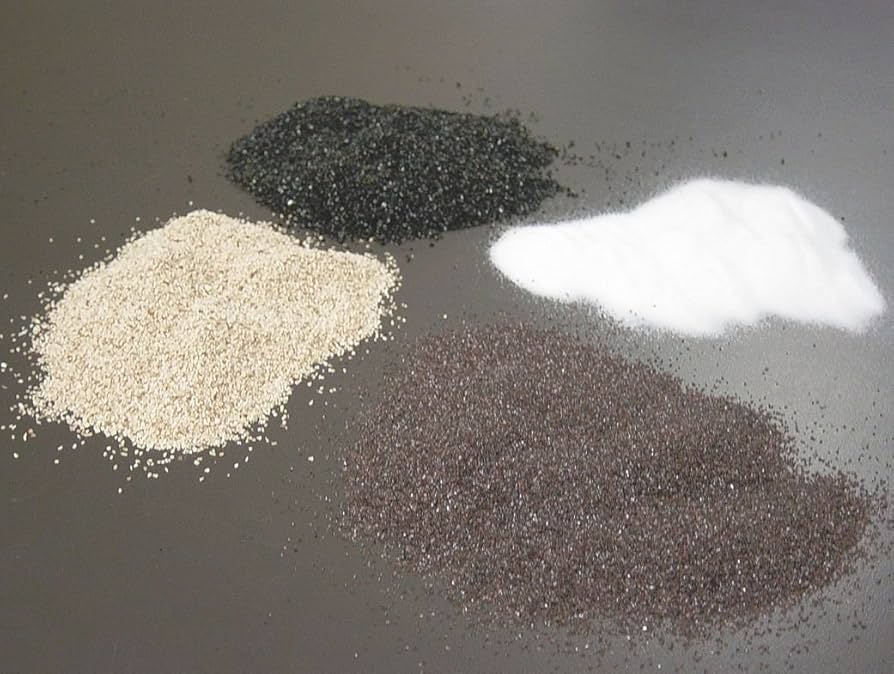
The chart below maps FEPA F-series grit numbers to US mesh equivalents and particle diameter ranges. These size ranges apply to aluminum oxide and silicon carbide. Steel abrasives (SAE designations) and garnet (G-series) use different but comparable size systems — see the dedicated media pages for those specifications.
| FEPA Grit | US Mesh ~ | Particle Diameter (µm) | Particle Diameter (mm) | Classification | Profile Aggression |
|---|---|---|---|---|---|
| F12 | #12 | 1,700–2,360 | 1.70–2.36 | Very Coarse | |
| F16 | #16 | 1,180–1,700 | 1.18–1.70 | Very Coarse | |
| F20 | #20 | 850–1,180 | 0.85–1.18 | Coarse | |
| F24 | #24 | 710–850 | 0.71–0.85 | Coarse | |
| F30 | #30 | 600–710 | 0.60–0.71 | Coarse | |
| F36 | #36 | 500–600 | 0.50–0.60 | Medium-Coarse | |
| F46 | #46 | 355-500 | 0.355–0.50 | Medium-Coarse | |
| F54 | #54 | 300–355 | 0.30–0.355 | Medium | |
| F60 | #60 | 250-300 | 0.25–0.30 | Medium | |
| F80 | #80 | 180-250 | 0.18–0.25 | Medium-Fine | |
| F100 | #100 | 150–180 | 0.150–0.18 | Fine | |
| F120 | #120 | 106-150 | 0.106–0.15 | Fine | |
| F150 | #150 | 75–106 | 0.075–0.106 | Fine | |
| F180 | #180 | 63–75 | 0.063–0.075 | Very Fine | |
| F220 | #220 | 45–63 | 0.045–0.063 | Very Fine |
Surface Profile (Ra/Rz): What They Mean and Why They Matter
Surface profile — also called surface roughness or anchor profile — is the three-dimensional texture created on a substrate surface by abrasive blasting. It is the single most important surface characteristic for determining coating adhesion quality in industrial protective coating systems.
Ra (Average Roughness)
Ra is the arithmetic mean of the absolute deviations of the surface profile from the mean line, measured in micrometers (µm) or microinches (µin). It is the most commonly specified surface roughness parameter in coating specifications and ISO/SSPC surface preparation standards. A higher Ra value means a rougher, more deeply profiled surface.
Rz (Ten-Point Mean Roughness)
Rz is the average vertical distance between the five highest peaks and five lowest valleys in the measurement sample length. It better captures the extreme peaks and valleys of an angular abrasive profile — values typically run 5–7 times higher than Ra on the same surface. Some coating manufacturers specify Rz rather than Ra because it better represents the “worst case” peaks that could puncture thin coating films or remain exposed above the coating surface.
Practical Measurement
Surface profile is measured using a surface profilometer (contact or optical), a Testex Press-O-Film replica tape (for field measurement), or a Surtronic/Mitutoyo portable roughness gauge. Always measure actual profile on test panels before proceeding to production blasting — the profile values in grit charts are representative guidelines, not guaranteed results. Variables including blast pressure, nozzle-to-surface distance, blast angle, media condition, and substrate hardness all affect the actual profile produced.
Surface Profile Data by Media Type & Grit
The table below provides representative Ra and Rz values achievable on carbon steel (approximately 200 HB hardness) at standard production blast parameters (80–90 PSI, perpendicular angle, 6–8 inch standoff distance). Actual values will vary with operating conditions.
| Tipo de medio | Grit / Size | Ra (µm) | Rz (µm) | SSPC Profile Grade | Typical Coating Suitability |
|---|---|---|---|---|---|
| Aluminum Oxide (Angular) | F16–F24 | 50–75 | 100–150 | Very Rough | Heavy-duty epoxy, thermal spray base coat |
| F36–F46 | 25–50 | 60–100 | Rough | Zinc-rich primer, high-build epoxy, FBE | |
| F60–F80 | 12–25 | 30–60 | Medium | Industrial primers, powder coatings | |
| F100–F150 | 5–12 | 12–30 | Fine | Thin-film coatings, automotive primer | |
| Steel Grit (Angular) | G25 / GH | 30–50 | 80–130 | Rough | Heavy protective coatings, offshore |
| G40 / GL | 18–32 | 50–90 | Medium | Industrial epoxy, FBE pipeline | |
| G80 / GP | 10–20 | 25–55 | Medium-Fine | General industrial coatings | |
| Steel Shot (Round) | S-550–S-660 | 8–15 | 25–55 | Fine-Medium | Shop primers, structural steel cleaning |
| S-230–S-330 | 3–8 | 10–25 | Fine | Peening, thin primers, light coatings | |
| Glass Beads (Round) | Size 16–25 | 1–5 | 5–15 | Smooth | Peening only — not for coated systems |
| Size 35–60 | 0.5–2 | 2–8 | Very Smooth | Polishing, peening, aesthetic finish | |
| Garnet (Angular) | G16–G25 | 25–45 | 60–100 | Medium-Rough | Industrial coatings, marine antifouling |
| G50–G80 | 10–22 | 25–55 | Medium | General industrial primers |
Coating System Anchor Profile Requirements
Every protective coating system has a specified anchor profile requirement published in its technical data sheet (TDS). Matching the blasting grit to the coating specification is mandatory — a surface that is too smooth will not provide adequate mechanical adhesion, while a surface that is too rough may result in peaks protruding above the coating film, creating corrosion initiation points.
| Coating System | Typical DFT (µm) | Required Profile Ra (µm) | Required Profile Rz (µm) | Recommended Media & Grit |
|---|---|---|---|---|
| Inorganic zinc silicate | 50–75 | 40–75 | 75–150 | Al₂O₃ F24–F36 or Garnet G16–G25 |
| Zinc-rich epoxy primer | 50–100 | 30–65 | 60–120 | Al₂O₃ F30–F46 or Steel Grit G40 |
| High-build epoxy | 125–500 | 20–50 | 45-90 | Al₂O₃ F36–F60 or Steel Grit G40–G80 |
| FBE (Fusion-Bonded Epoxy) | 300–500 | 40–75 | 80–150 | Steel Grit G25–G40 or Al₂O₃ F24–F36 |
| Polyurea / Polyurethane | 500–2,000 | 25–60 | 60–120 | Al₂O₃ F36–F60 |
| Powder coating | 60–150 | 8–25 | 20–50 | Al₂O₃ F60–F100 or Glass Bead size 35 |
| Thin-film architectural coating | 25–75 | 5–15 | 12–35 | Al₂O₃ F80–F120 |
| Thermal spray (HVOF) | 100–500 | 40–80 | 80–160 | Al₂O₃ F16–F30 or SiC F24–F46 |
The anchor profile ranges in the table above are representative guidelines. Always consult the actual Technical Data Sheet for the specific coating product you are applying — the manufacturer’s requirements are the binding specification. Coating warranty claims can be voided by surface preparation that does not comply with the TDS specification.
Application-to-Grit Selection Matrix
Use this matrix to quickly identify which grit size ranges are appropriate for common blasting applications across the main substrate categories. ● = recommended, ◆ = conditional/with caution, ○ = not recommended.
| Aplicación | F12–F24 (Very Coarse) | F30–F60 (Coarse-Med) | F60–F120 (Med-Fine) | F120–F220 (Fine) |
|---|---|---|---|---|
| Tight mill scale removal (structural steel) | ✓ | ✓ | ◆ | × |
| Heavy rust removal (pitted steel) | ✓ | ✓ | ◆ | × |
| Light rust & paint removal (mild steel) | ◆ | ✓ | ✓ | ◆ |
| Weld cleaning (carbon steel) | ◆ | ✓ | ✓ | × |
| Stainless steel finishing | × | ◆ | ✓ | ✓ |
| Aluminum surface prep | × | ◆ | ✓ | ✓ |
| Concrete floor profiling | ◆ | ✓ | ✓ | × |
| Glass etching & frosting | × | ◆ | ✓ | ✓ |
| Automotive paint stripping | × | ◆ | ✓ | ◆ |
| Shot peening (aerospace/auto) | × | ◆ | ✓ | ✓ |
| Precision deburring of hardened parts | × | × | ◆ | ✓ |
For the full step-by-step selection methodology, including how to use the coating TDS to determine grit specification, see our dedicated guide: how to choose sandblasting material: step-by-step selection guide.
Blast Pressure & Grit Interaction
Grit size alone does not determine the surface profile produced — blast pressure is an equally important variable. The same grit size at different pressures can produce significantly different Ra values, and the interaction between grit size and pressure determines both the surface finish quality and the media consumption rate.
General Pressure Guidelines by Media Type
| Tipo de medio | Recommended Pressure Range (PSI) | Effect of Higher Pressure | Effect of Lower Pressure |
|---|---|---|---|
| Aluminum Oxide (coarse F16–F46) | 80–110 PSI | Deeper profile, faster cleaning, more fines | Shallower profile, slower cleaning |
| Aluminum Oxide (fine F60–F220) | 60–90 PSI | Risk of particle fracture, uneven profile | Consistent fine finish |
| Steel Shot / Steel Grit | 50–100 PSI | Deeper profile, higher media stress | Lighter profile, less media wear |
| Cuentas de vidrio | 40–80 PSI | Bead fracture, sharp fragments, damage risk | Gentler cleaning, longer media life |
| Garnet (coarse G16–G30) | 70–100 PSI | Faster cleaning, more dust | Slower cleaning, less dust |
| Walnut Shell / Corn Cob | 20–50 PSI | Rapid fracture, excessive dust, poor results | Gentle, effective cleaning |
| Carburo de silicio | 70–100 PSI | Aggressive material removal, high dust | Controlled cutting on hard materials |
Preguntas frecuentes
Request a Quote
Know your grit size? Tell us the media type, FEPA grade, quantity, and packaging format — we’ll respond with competitive pricing within 24 hours.
Get a Free Quote →Talk to a Technical Advisor
Have a coating specification and not sure which grit size to select? Our surface preparation engineers will match your spec to the right media grade.
Contact Our Team →Filtros