Zirconia Beads – High-Density Media for Precision Grinding and Finishing
Primary keywords: cuentas de circonio, zirconia grinding media. This page covers their material properties, types, applications, performance comparisons, selection guide, and FAQs.
What are Zirconia Beads?
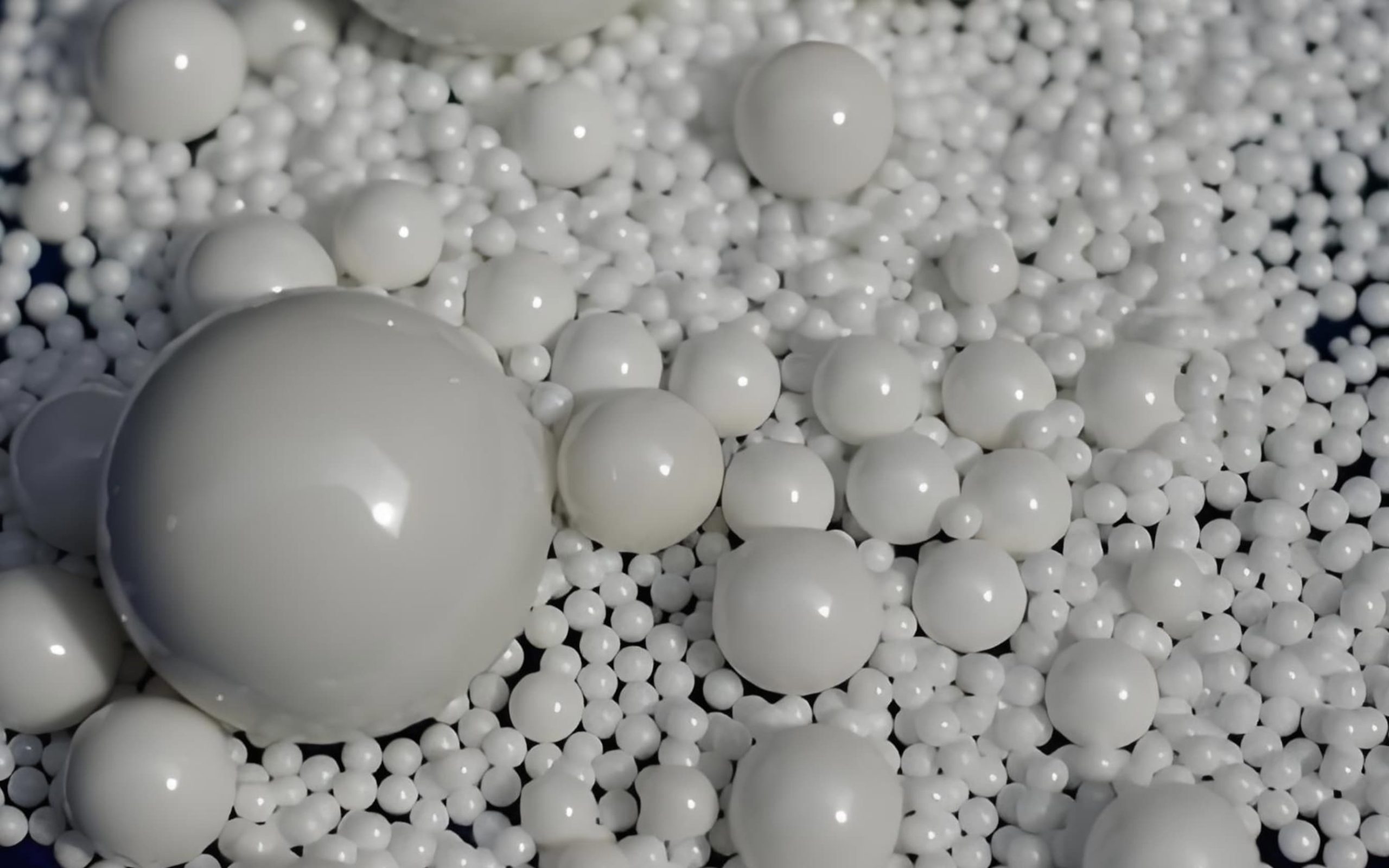
Definición: Zirconia beads (also called zirconium oxide beads or zirconia grinding media) are spherical or cylindrical beads produced from stabilized zirconium dioxide. Their very high density (5.5–6.1 g/cm³) makes them ideal for high-energy grinding and dispersing applications.
Manufacturing: Raw zirconia powder is blended with stabilizers such as yttria or ceria, then formed into beads via molding or granulation, followed by sintering at >1400°C. This yields beads with extremely low porosity and very high fracture toughness.

Close-up of stabilized zirconia beads used in industrial grinding mills.
Types of Zirconia Beads
There are several grades of zirconia beads depending on stabilizer type and intended use:
- Yttria-stabilized zirconia (YSZ): Most common. Excellent toughness, wear resistance, and density. Preferred for high-energy milling.
- Ceria-stabilized zirconia (CSZ): Slightly lower density, improved resistance to thermal shock. Used in some specialized milling processes.
- Partially stabilized zirconia (PSZ): Balanced cost vs performance, suitable for medium-energy grinding.
For most industrial users, YSZ zirconia beads are the go-to choice due to their superior balance of performance and durability.
Key Properties & Specifications
- Densidad: 5.5–6.1 g/cm³ (about 2–3× heavier than ceramic media).
- Dureza: ~1200 HV (Vickers), enabling extreme wear resistance.
- Roundness: >95% sphericity ensures uniform contact and reduced dead zones in mills.
- Contamination level: Ultra-low wear reduces contamination, critical for pharmaceuticals, electronics, and high-purity chemicals.
- Thermal stability: Stable up to 1000°C continuous, making them resistant to heat build-up in milling.

Industrial Applications
Paints, Inks & Coatings
Zirconia beads are widely used in horizontal and vertical mills to grind pigments and disperse particles for high-quality paints and inks. Their high density ensures rapid particle size reduction.
Pharmaceuticals
Used in wet milling of APIs (Active Pharmaceutical Ingredients). Zirconia minimizes contamination and maintains particle purity.
Electronics & Advanced Materials
Essential in dispersing nano-materials such as lithium battery materials, ceramic powders, and electronic pastes. Uniform bead roundness ensures stable nano-scale particle distribution.
Mining & Minerals
Applied in fine grinding of minerals, zirconia media last longer than steel shot or ceramic beads, reducing downtime and maintenance.

Industrial bead mill using zirconia beads for high-efficiency pigment dispersion.
Zirconia vs Ceramic vs Alumina Media
When deciding which media to use, compare these factors:
| Property | Cuentas de circonio | Medios cerámicos | Óxido de aluminio |
|---|---|---|---|
| Densidad | 5.5–6.1 g/cm³ | 2.2–2.8 g/cm³ | ~3.9 g/cm³ |
| Durabilidad | Very high | Medium | Medium-high |
| Contamination Risk | Very low | Medium | Higher (friable) |
| Best For | High-energy, high-purity grinding | Deburring, vibratory finishing | General blasting, aggressive cut |
See our Media Comparison Guide for a detailed breakdown.
How to Select Zirconia Beads
- Define process: milling, grinding, dispersing, or finishing? Clarify desired particle size reduction (e.g., <200 nm).
- Match mill type: High-energy horizontal mills require YSZ zirconia; low-energy vertical mills may allow PSZ.
- Bead size: Smaller beads (0.1–1.0 mm) for nano-dispersion; larger beads (1–6 mm) for coarse grinding.
- Purity requirement: For pharma/food/electronics, choose medical/food-grade certified zirconia with COA (Certificate of Analysis).
- Lifecycle cost: Calculate not only purchase price but also replacement intervals, downtime, and contamination impact.
Tip: Start pilot trials with 0.3–0.6 mm YSZ beads for nanoparticle dispersions in high-energy mills, then optimize size distribution.
Sample Product Specification Table
| Product Code | Material | Tamaño (mm) | Densidad (g/cm³) | Hardness (HV) | Aplicaciones |
|---|---|---|---|---|---|
| ZB-101 | YSZ | 0.3–0.5 | 6.0 | 1200 | Nano-dispersion in pharma |
| ZB-202 | YSZ | 1.0–2.0 | 5.9 | 1200 | Pigments and paints |
| ZB-305 | CSZ | 2.0–3.0 | 5.7 | 1100 | Mineral grinding |
Frequently Asked Questions (FAQ)
Q: How long do zirconia beads last compared to ceramic?
A: In high-energy mills, zirconia beads often last 3–5× longer than ceramic media, making them more cost-effective over time.
Q: Do zirconia beads cause contamination?
A: Very little. Wear rates are extremely low, making them safe for high-purity applications like pharma or electronics.
Q: Can zirconia beads be reused?
A: Yes, they can be washed and sieved to remove fines. However, once beads fracture or lose roundness, they should be replaced.
Q: What bead size is best for nanoparticle dispersion?
A: 0.1–0.6 mm YSZ zirconia beads are commonly used for achieving particle sizes below 200 nm.
Filtros