Silicon Carbide Sandblasting for Rust Removal & Surface Profiling on Steel
A practical guide to using SiC blast media for structural steel rust removal — ISO 8501-1 and SSPC cleanliness grades, grit selection by corrosion level, pressure settings, and realistic production rates for heavy industrial steel preparation.
SECTION 01Why Silicon Carbide for Steel Rust Removal?
Rust removal and mill scale cleaning on structural steel is one of the highest-volume abrasive blasting applications worldwide — bridges, storage tanks, offshore platforms, ships, pipelines, and heavy equipment all require periodic or pre-coating surface preparation to remove corrosion products and achieve a clean, properly profiled substrate for new coating systems. Silicon carbide’s combination of extreme hardness (Mohs 9.0–9.5), aggressive angular cutting action, and chemical inertness makes it one of the fastest and most effective abrasives for this work.
Three properties specifically benefit steel rust removal: first, SiC’s hardness differential against rusted/scaled steel (Mohs ~4–5 for rust, ~7–8 for the base steel) allows it to remove corrosion products and mill scale rapidly without excessive media consumption. Second, SiC’s chemical inertness means no flash-rust-promoting residue is left on the cleaned surface — unlike some metallic abrasives that can leave reactive iron particles behind. Third, SiC’s deep, aggressive anchor profile provides excellent mechanical adhesion for the heavy-duty coating systems (epoxy, zinc-rich primers, polyurethane) typically specified for structural steel protection.
For a full overview of SiC properties, see: Complete Buyer’s Guide to SiC Abrasive Blasting Media.
SECTION 02ISO 8501-1 Initial Rust Grades (A–D)
Before specifying blast parameters, the initial condition of the steel must be classified according to ISO 8501-1, which defines four standard rust grades describing the condition of uncoated or previously coated steel prior to blast cleaning. This classification determines both the expected media consumption and the production rate that can be achieved.
| Rust Grade | Beschreibung | Surface Condition | Relative Media Consumption |
|---|---|---|---|
| Grade A | Mill scale, no rust | Steel surface largely covered with adherent mill scale, little or no rust | Lowest |
| Grade B | Mill scale + rust beginning | Steel surface has begun to rust and mill scale has begun to flake | Low-Medium |
| Grade C | Mill scale rusted away | Mill scale rusted away or can be scraped off; slight pitting visible | Medium-High |
| Grade D | Heavy pitting | Mill scale rusted away with general pitting visible to normal vision | Highest |
Grade D steel — heavily pitted, long-term exposed steel — requires significantly more media and time per unit area than Grade A or B steel, regardless of abrasive choice. Always assess and document the rust grade of the steel before estimating project duration and media quantity requirements.
SECTION 03Target Cleanliness Grades: Sa 1 / Sa 2 / Sa 2.5 / Sa 3
ISO 8501-1 also defines the target cleanliness grades achievable by abrasive (dry) blast cleaning, designated with the prefix “Sa.” The required grade is specified by the coating manufacturer or the project’s corrosion protection specification (e.g., ISO 12944, NORSOK M-501, SSPC-PA standards) and directly determines blasting time, media consumption, and achievable coating system warranty.
| Grade | SSPC Equivalent | Beschreibung | Typical Use Case |
|---|---|---|---|
| Sa 1 | SP 7 (Brush-Off) | Light blast — loose mill scale, rust, and foreign matter removed | Maintenance touch-up; thin film coatings |
| Sa 2 | SP 6 (Commercial) | Thorough blast — most mill scale, rust, and foreign matter removed; slight staining permitted | General industrial coatings; budget-sensitive maintenance |
| Sa 2.5 | SP 10 (Near-White) | Very thorough blast — only slight stains/shadows remain from rust or scale | Most structural steel, marine, offshore — industry standard for heavy-duty coatings |
| Sa 3 | SP 5 (White Metal) | Blast to visually clean steel — uniform metallic color, no visible residue | Critical immersion service, high-performance lining systems, nuclear/offshore critical assets |
Industry standard: Sa 2.5 (near-white metal) is the most commonly specified cleanliness grade for structural steel receiving epoxy or zinc-rich primer systems, balancing thorough surface preparation with practical production rates. Sa 3 (white metal) is reserved for the most demanding immersion or critical-service applications due to the significantly higher time and media cost required.
SECTION 04Grit Selection by Rust Grade and Target Cleanliness
| Initial Condition | Target Cleanliness | Recommended SiC Grit | Expected Profile (Ra) |
|---|---|---|---|
| Grade A/B (mill scale, light rust) | Sa 2.5 | F36–F60 | 8–13 µm |
| Grade C (scale gone, slight pitting) | Sa 2.5 | F24–F46 | 10–16 µm |
| Grade D (heavy pitting) | Sa 2.5–Sa 3 | F16–F36 | 12–20 µm |
| Any grade | Sa 2 (commercial) | F46–F80 | 5–10 µm |
| Any grade | Sa 3 (white metal) | F16–F36 (multi-pass) | 12–20 µm |
| Previously coated steel (recoat) | Sa 2.5 | F36–F60 | 8–13 µm |
Coarser grits (F16–F36) cut faster through heavy rust and pitting but produce deeper profiles — verify the resulting Ra against the coating manufacturer’s maximum profile specification before committing to production. If the coating system specifies a maximum Ra (common for thin-film systems), a coarser grit that exceeds this limit will create profile peaks that protrude through the coating, creating early corrosion initiation points. For the complete grit-to-profile reference: SiC Grit Size Chart
SECTION 05Process Parameters for Steel Rust Removal
| Parameter | Light Rust (Grade A/B) | Heavy Rust/Pitting (Grade C/D) |
|---|---|---|
| Air Pressure | 60–80 PSI | 80–100 PSI |
| Nozzle Standoff | 200–300 mm | 150–250 mm |
| Nozzle Angle | 75–90° | 80–90° |
| Nozzle Bore | 8–10 mm | 10–14 mm |
| Compressor CFM | 90–125 CFM | 125–185 CFM |
| Grit Size | F46–F60 | F16–F36 |
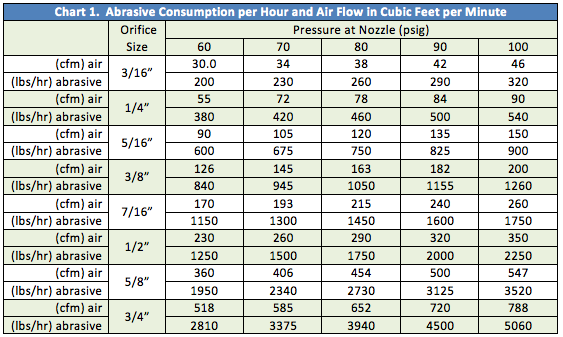
Compressor sizing matters: Undersized compressors are the most common cause of poor blasting production rates. A 10 mm nozzle at 90 PSI requires approximately 125 CFM of compressed air — running this nozzle on a compressor rated for only 90 CFM will cause pressure drops at the nozzle tip, dramatically reducing particle impact velocity and cutting efficiency. Always size the compressor to the nozzle, not the other way around.
SECTION 06Production Rates and Project Planning
Realistic production rate estimation is essential for project bidding and scheduling. The following rates are based on direct-pressure blasting with SiC at the parameters above, achieving Sa 2.5 cleanliness on open structural steel (unobstructed flat or gently curved surfaces — congested areas with bolts, stiffeners, and tight corners reduce these rates by 30–50%).
| Steel Condition | SiC Production Rate (Sa 2.5) | Comparable Garnet Rate | Comparable Al₂O₃ Rate |
|---|---|---|---|
| Grade A/B (mill scale) | 12–16 m²/hr | 4–6 m²/hr | 7–10 m²/hr |
| Grade C (light pitting) | 9–12 m²/hr | 3–4 m²/hr | 5–7 m²/hr |
| Grade D (heavy pitting) | 6–9 m²/hr | 2–3 m²/hr | 3–5 m²/hr |
| Recoat / previously painted | 10–14 m²/hr | 4–5 m²/hr | 6–9 m²/hr |
For a detailed cost comparison showing how SiC’s production rate advantage translates into labor savings against garnet specifically, see: SiC vs. Garnet for Metal Prep. For the full total cost of ownership model including media reuse: SiC Recyclability & Cost Analysis.
SECTION 07Anchor Profile Requirements for Common Coating Systems
| Coating System | Typical Ra Required (µm) | Recommended SiC Grit | Notes |
|---|---|---|---|
| Inorganic zinc silicate primer | 10–15 | F16–F36 | High-build primer benefits from deep anchor |
| Zinc-rich epoxy primer | 8–12 | F36–F46 | Standard offshore/marine primer system |
| High-build epoxy (general) | 5–10 | F46–F60 | Most common structural steel coating |
| Polyurethane / polysiloxane topcoat systems | 3–8 (basecoat profile carries through) | F46–F80 | Profile set by primer coat, not topcoat directly |
| Thermal spray aluminum/zinc (TSA/TSZ) | 12–20 | F16–F24 | Very deep profile required for metallization bond |
| Thin-film coatings (<100 µm DFT) | 2–5 | F80–F120 | Coarser grit risks profile peaks exceeding DFT |
The 1/3 rule: A common rule of thumb is that the peak-to-valley profile depth (Rz) should not exceed approximately one-third of the coating’s dry film thickness (DFT). Exceeding this ratio risks profile peaks protruding through the coating film, creating localized thin spots and premature corrosion initiation points — even if the average coating thickness meets specification.
SECTION 08Flash Rust Prevention After Blasting
Flash rust — the rapid re-oxidation of freshly blasted steel surfaces, particularly in humid environments — is one of the most common issues affecting blast-cleaned steel awaiting coating application. Freshly blasted steel has an extremely high surface energy and reactivity; without protection, visible flash rusting can occur within 1–4 hours in humid conditions (relative humidity above 70–80%).
Silicon carbide itself does not promote flash rust — unlike some metallic abrasives (steel grit, steel shot) that can leave trace iron particles embedded in the surface, which act as corrosion initiation sites. SiC’s chemical inertness means the blasted surface reactivity is determined purely by the steel substrate and ambient conditions, not by abrasive residue.
Flash Rust Mitigation Practices
- Coat blasted steel within the manufacturer-specified recoat window — typically as soon as practical, and always within the same shift for high-humidity environments
- Monitor ambient relative humidity and dew point continuously; do not blast if steel temperature is within 3°C of dew point (condensation risk)
- For unavoidable delays, use a “holding primer” or temporary corrosion inhibitor compatible with the final coating system
- In coastal/marine environments, consider scheduling blasting for lower-humidity periods (typically mid-day in many climates) rather than early morning
- If flash rust does occur before coating, light re-blasting (sweep blast) at lower pressure can typically restore the surface to specification without full re-blasting
SECTION 09Equipment Recommendations
Given SiC’s hardness, equipment selection for steel rust removal projects should account for accelerated wear of standard components. Refer to the full equipment wear guidance in the SiC Hardness guide for nozzle material recommendations. For high-volume steel rust removal specifically:
- Boron carbide nozzles for sustained high-pressure operation (750–1,500 hour service life)
- Heavy-wall blast hose (12 mm+ wall thickness) rated for the operating pressure
- Compressor sized to nozzle bore — undersized compressors are the leading cause of poor production rates
- Dust collection / containment systems for enclosed blasting (required for lead paint removal on older structures)
- Media recovery and classification system if recycling SiC across multiple work areas
SECTION 10FAQ
SECTION 11Related Guides
Bulk SiC for Structural Steel Projects
Jiangsu Henglihong Technology Co., Ltd. supplies Black Silicon Carbide in F16–F80 grit — ideal for structural steel rust removal and surface profiling. Factory-direct pricing, full chemical certification, bulk packaging for large projects.
Request a Quote →Filter