Black Beauty Blasting Media for Ship Hull Cleaning: Application Guide
Dry-dock blasting protocols, antifouling coating prep requirements, and NACE/SSPC compliance guidance for marine contractors and shipyard surface preparation engineers.
1. Why Abrasive Blasting Is the Standard for Hull Cleaning
Ship hull steel operates in one of the most demanding corrosion environments known to engineering — continuously immersed in chloride-laden seawater, subject to mechanical erosion from water flow, barnacle attachment, and periodic dry-docking stress. Hull coatings must adhere under these conditions for two to five years between dry-docking intervals, which demands surface preparation of the highest quality.
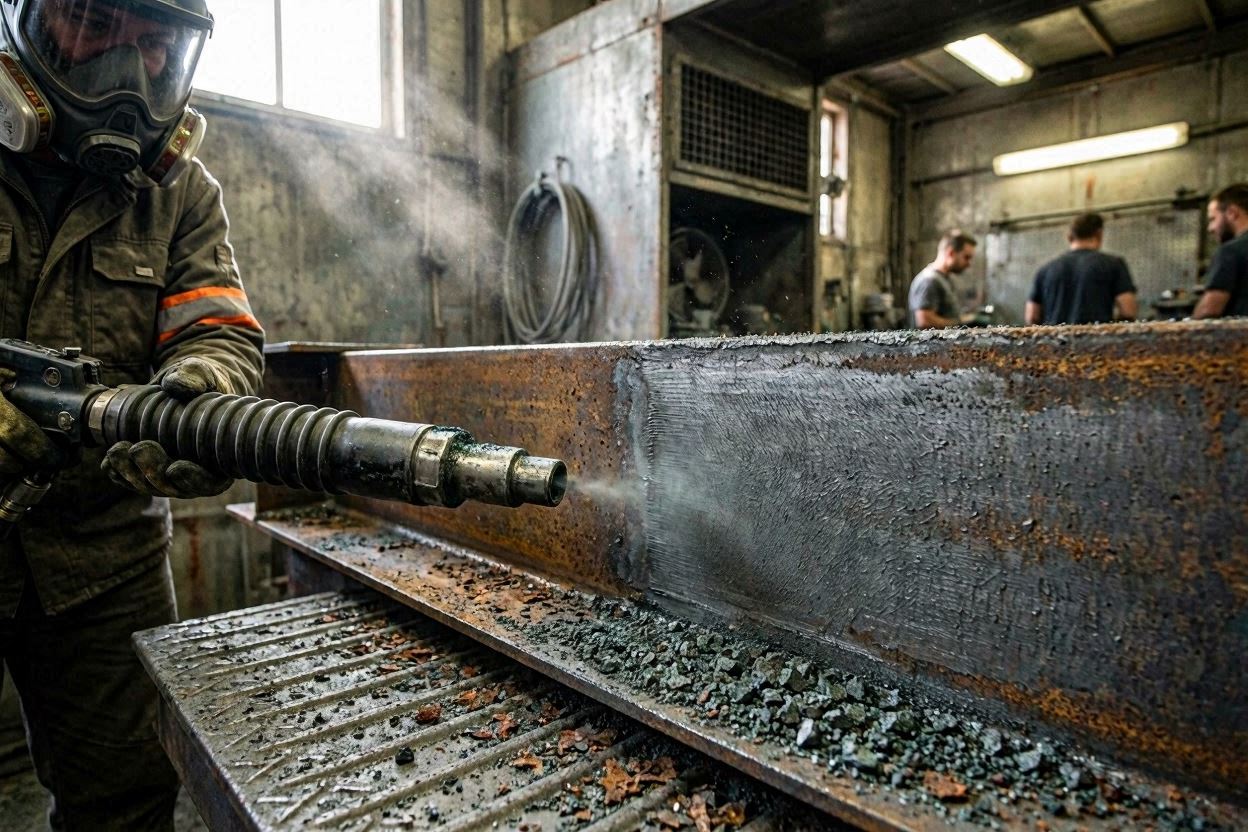
Abrasive blasting achieves what no other surface preparation method can: complete removal of old antifouling coatings, corrosion products, and mill scale while simultaneously creating the angular mechanical anchor profile that high-build epoxy tie-coats and antifouling topcoats require for adhesion in continuous seawater immersion service.
High-pressure water jetting (HPWJ) is used increasingly for maintenance blasting between full dry-docks, but it cannot create a new anchor profile on bare steel — making abrasive blasting the required method for any hull section where the substrate has been exposed to bare metal or where the anchor profile has been degraded by erosion or pitting.
For the full overview of Black Beauty’s properties and applications: Black Beauty Abrasive Blasting Media: The Complete Buyer’s Guide.
2. Why Coal Slag Is Used in Shipyards
Coal slag abrasive — both Black Beauty-branded and specification-equivalent products — has been a shipyard standard for decades, for several practical reasons:
- Volume economics: A Panamax-class cargo vessel has approximately 25,000–40,000 m² (270,000–430,000 ft²) of hull surface requiring blasting. At typical media consumption rates of 0.5–0.8 lb/ft², a full hull blast requires 60–160 tons of abrasive. At $150–220/ton, coal slag is the lowest-cost SSPC-compliant option at these volumes.
- Single-use practicality: Shipyards typically operate in contained dry-dock environments where spent media must be collected and disposed of regardless of media type. Coal slag’s single-use economics — lower purchase price offset by simple disposal — are often better than the reclaim system investment required to justify garnet or aluminum oxide.
- Profile adequacy: Coarse-grade coal slag (8/16 mesh) reliably achieves the 4.0–6.0 Mil anchor profiles required by major antifouling coating manufacturers and IMO PSPC (International Maritime Organization Performance Standard for Protective Coatings) for ballast tanks and hull immersion zones.
- Speed of supply: Coal slag is available in super-sack and bulk tanker delivery from multiple regional suppliers in all major port cities globally, ensuring uninterrupted supply during tight dry-docking schedules.
3. Grade Selection for Marine Applications
| Hull Zone | Typical Corrosion Condition | Recommended Grade | Target Profile (Mil) | SSPC-SP Target |
|---|---|---|---|---|
| Underwater hull plating (external) | Grade C–D; old antifouling + marine growth | Coarse (8/16) | 4.0–6.0 | SP 10 or SP 5 |
| Boot top / waterline zone | Grade C; alternating wet/dry; heavy pitting | Coarse (8/16) or Medium (12/40) | 3.5–5.5 | SP 10 |
| Topsides / freeboard | Grade B–C; old topcoat, light to moderate rust | Medium (12/40) | 3.0–4.8 | SP 10 |
| Ballast tank interior | Grade C–D; severe pitting; old coating | Coarse (8/16) | 4.5–6.0+ | SP 5 (IMO PSPC requires Sa 2.5) |
| Superstructure / deck | Grade B; salt-contaminated; chalked topcoat | Fine (20/40) or Medium (12/40) | 2.5–4.0 | SP 10 |
| Chain locker / void spaces | Grade C–D; isolated | Medium (12/40) or Coarse (8/16) | 3.0–5.0 | SP 10 or SP 5 |
4. SSPC and NACE Standards for Hull Preparation
Ship hull blasting is governed by two parallel standard systems — SSPC (Society for Protective Coatings, U.S.-centric) and NACE International (now merged into AMPP — Association for Materials Protection and Performance). Both are referenced in international shipbuilding and ship repair contracts.
| Standard | SSPC Designation | NACE/ISO Equivalent | Beschreibung | Marine Use |
|---|---|---|---|---|
| Near-White Blast | SSPC-SP 10 | NACE No. 2 / ISO Sa 2.5 | 95%+ area free of visible contamination | Hull plating, topsides, most shipyard work |
| White Metal Blast | SSPC-SP 5 | NACE No. 1 / ISO Sa 3 | 100% free of all visible contamination | Ballast tanks (IMO PSPC), critical immersion zones |
| Commercial Blast | SSPC-SP 6 | NACE No. 3 / ISO Sa 2 | 2/3 area free of visible residue | Topside maintenance with less critical coatings |
NACE SP0108 (Corrosion Control of Offshore Structures by Protective Coatings) and NACE SP0188 (Holiday Testing) are frequently referenced alongside SSPC surface preparation standards in offshore vessel and platform maintenance specifications.
5. Dry-Dock Blasting Protocol
- Pre-blast assessment and planning. Survey the hull for coating condition, pitting depth, and weld bead geometry before media selection. Identify any watertight penetrations, sea chests, or zinc anodes that require masking or removal. Confirm media grade and volume requirements with the coating applicator’s technical representative.
- Containment setup. Erect containment sheeting around the dry dock or vessel to prevent spent media and dust from escaping the work area. Comply with port authority environmental regulations — many ports prohibit uncontained dry abrasive blasting within their boundaries.
- Equipment staging. Position pressure blast pots at dock-level supply points with hose runs sized for nozzle pressure delivery. For large vessels, multiple blast crews operating simultaneously with 2–4 nozzles maximize schedule efficiency. Compressors: minimum 375 CFM per Coarse-grade nozzle at 100–110 psi.
- Surface degreasing (if required). If the hull shows oil, bilge fluid, or heavy grease contamination — common at the waterline and boot top — degrease with a compatible marine degreaser and freshwater rinse before blasting. Blasting over oily contamination embeds the contaminant into the steel profile and causes catastrophic coating adhesion failure.
- Blasting sequence. Work from top to bottom: topsides and superstructure first, then boot top, then underwater body. This prevents re-contamination of lower blasted zones by spent media and runoff from higher sections. Maintain nozzle-to-surface distance of 12–18 inches for Coarse grade; adjust for local pitting geometry.
- Surface cleanliness and profile verification. After blasting each zone, inspect with SSPC-VIS 1 comparator under adequate lighting before moving to the next section. Measure anchor profile using Testex Press-O-Film tape at minimum 3 locations per 500 m² of blasted surface.
- Soluble salt testing. Test blasted surfaces for soluble salt contamination using Bresle patch sampling (ISO 8502-6) or equivalent. IMO PSPC limits soluble salt to 50 mg/m² NaCl equivalent on ballast tank surfaces before coating application. Freshwater wash may be required if salt levels exceed threshold.
- Coating application window. Apply the first coat of the approved coating system within the coating manufacturer’s flash rust window — typically within 4 hours on clean steel at <50% relative humidity. In humid tropical dry-dock environments, this window may compress to 1–2 hours.
6. Antifouling and Coating System Compatibility
Black Beauty Coarse grade (8/16 mesh) creates the 4.0–6.0 Mil anchor profile required by most hull coating systems used in marine service. Compatibility with common hull coating systems:
| Coating System Type | Required Profile (Mil) | Black Beauty Grade | Notes |
|---|---|---|---|
| Epoxy tie-coat + self-polishing antifouling (SPA) | 3.5–5.0 | Coarse (8/16) | Standard hull system for cargo vessels; dominant system in commercial shipping |
| High-build epoxy + ablative antifouling | 3.0–5.0 | Medium (12/40) or Coarse | Common on tankers and bulk carriers |
| Zinc silicate primer + epoxy + antifouling | 3.0–4.5 | Medium (12/40) | Three-coat system; zinc primer requires controlled profile — avoid over-profiling |
| IMO PSPC ballast tank coating | 30–75 μm (≈1.2–3.0 Mil) | Medium (12/40) or Fine (20/40) | PSPC minimum profile is actually relatively shallow — avoid Coarse grade unless tank condition is Grade D |
| Epoxy coal tar (immersion zones) | 3.5–5.5 | Coarse (8/16) | Thick-film coal tar system requires deep anchor for adequate adhesion |
7. Chloride Contamination and Salt Testing
Chloride contamination is the primary cause of premature coating failure in marine environments. Soluble chloride salts — present in seawater spray, marine atmospheric deposits, and residual sea growth — are hygroscopic and osmotically active under coating films, causing blistering and delamination even when the coating appears visually intact.
Two sources of chloride contamination must be managed in hull blasting operations:
- Substrate contamination: Chloride salts deposited on the hull during service accumulate in corrosion pits and cannot be fully removed by blasting alone. Post-blast Bresle patch testing is mandatory to confirm salt levels are within coating specification limits before application.
- Media-introduced chloride: Coal slag abrasive from certain sources may have elevated chloride content — particularly slag derived from coal burned in coastal plants where seawater cooling is used. For sensitive marine applications, request the supplier’s water extract conductivity test results (SSPC AB 1 limit: 1,000 μS/cm) and verify chloride content is acceptable for the coating system specified.
8. Spent Media Management in Dry Dock
Dry-dock blasting on a large commercial vessel generates 30–160 tons of spent abrasive media, depending on vessel size, coating condition, and surface area. Management requirements:
- Collect spent media from dock floor using mechanical scrapers, vacuum trucks, or dedicated blast room floor sweep systems
- Characterize the spent media waste — test for heavy metals if the vessel’s previous coating contained lead-based antifouling (common on older vessels pre-2001)
- TCLP-passing coal slag spent media that has not contacted hazardous coatings qualifies as non-hazardous solid waste in most jurisdictions
- Coordinate disposal with the port or shipyard’s approved waste management contractor — do not mix spent blast media with other shipyard waste streams without characterization
- Retain disposal manifests and waste characterization documentation for the vessel’s maintenance records
9. When to Consider an Alternative Abrasive
Black Beauty coal slag is adequate for most commercial ship hull and superstructure blasting applications. Consider an alternative when:
- Enclosed interior spaces (tanks, chain lockers, cofferdams): Garnet’s significantly lower dust generation reduces ventilation burden and worker exposure in enclosed volumes — particularly important in confined spaces where SAR air hose management is already complex
- IMO PSPC ballast tank work with strict salt limits: Some garnet grades offer verifiably lower chloride content than coal slag — useful when post-blast salt testing consistently shows elevated levels from coal slag media
- Very hard stainless or duplex steel hull components: Aluminum oxide is needed for profiling harder alloy steel components that coal slag cannot adequately scratch at Mohs 6–7
Full comparison guides: Black Beauty vs. Garnet · Black Beauty vs. Copper Slag
Return to overview: Complete Buyer’s Guide · Related: Safety & Compliance · Structural Steel Bridges
Filter