Aluminum Oxide Blast Media: The Complete Buyer’s Guide
Everything engineers, procurement managers, and surface-finishing specialists need to know — from grit selection and application science to product types, safety, and supplier qualification.
Table of Contents
- What Is Aluminum Oxide Blast Media?
- Three Main Types: Brown, White & Sintered
- Key Physical & Chemical Properties
- Grit Size Selection Guide
- Industrial Applications & Use Cases
- Aluminum Oxide vs Other Blast Media
- Reusability & Cost Efficiency
- Health, Safety & Environmental Compliance
- How to Evaluate a Supplier
- よくある質問
- Get a Custom Quote
1. What Is Aluminum Oxide Blast Media?
Aluminum oxide blast media — also called alumina abrasive, corundum grit, or aluminum oxide blasting abrasive — is a synthetic mineral abrasive produced by fusing or sintering high-purity bauxite ore at temperatures exceeding 2,000 °C. The result is an extremely hard, chemically inert, angular-shaped grain that removes surface contaminants, creates anchor profiles, and delivers a precisely controlled surface finish on metal, glass, ceramic, stone, and composite substrates.
Since its commercial introduction in the early twentieth century, aluminum oxide has become the world’s most widely used industrial abrasive for blasting, grinding, lapping, and surface preparation — and for good reason. With a Mohs hardness of 9 (diamond is 10), it cuts faster and lasts longer than most competing media. Its angular morphology — unlike the round silica sand it largely replaced — creates sharp, consistent anchor teeth that dramatically improve coating adhesion.
Aluminum oxide blast media is produced and graded to multiple international standards — including FEPA (Federation of European Producers of Abrasives), ANSI B74.12, and ISO 6344 — ensuring consistent particle size distribution regardless of the country of origin. At 江蘇恒隆科技有限公司, every batch undergoes full sieve analysis, chemical assay, and bulk-density testing before shipment.
2. Three Main Types: Brown, White & Sintered
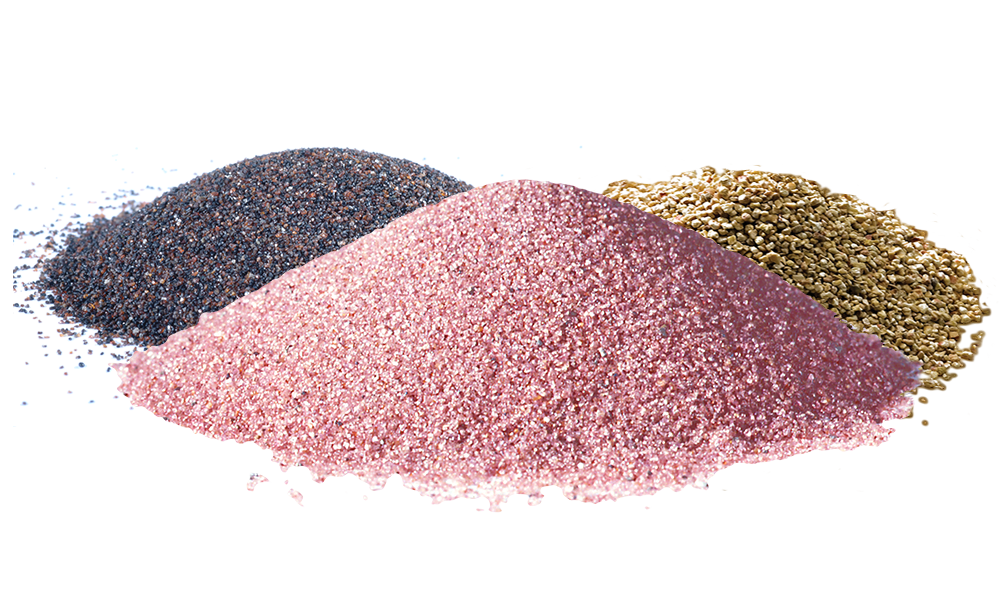
Not all aluminum oxide blast media is the same. Feedstock chemistry, fusion temperature, and post-processing determine three distinct commercial grades — each optimized for different performance and cost profiles. Understanding the differences lets you match the right material to your application without overpaying or under-specifying.
For a detailed side-by-side breakdown, see our dedicated guide on Sintered vs Brown Fused vs White Aluminum Oxide.
- Al₂O₃ content: 94–97%
- TiO₂ content: 1.5–3.8% (toughening agent)
- Color: dark brown to reddish-brown
- Toughness: highest of the three grades
- Cost: most economical
- Best for: heavy-duty steel descaling, rust removal, general surface prep
- Reusability: 4–8 cycles in closed-loop systems
- Al₂O₃ content: ≥ 99.5%
- Virtually iron-free (<0.05% Fe₂O₃)
- Color: pure white
- Toughness: more friable than brown grade
- Cost: 30–60% premium over BFAO
- Best for: stainless steel, aerospace alloys, medical implants, glass etching
- No iron contamination risk
- Al₂O₃ content: ≥ 99%
- Spherical or near-spherical morphology
- Exceptionally high crush strength
- Cost: premium tier
- Best for: aerospace shot peening, automated blast cabinets, ultra-long service life
- Reusability: up to 20+ cycles
To make the right choice for your specific substrate, explore our in-depth article: Brown vs White Aluminum Oxide: Which Should You Use?
3. Key Physical & Chemical Properties
Understanding the material science behind aluminum oxide helps you predict performance, troubleshoot problems, and write tight procurement specifications. The table below summarizes the most decision-relevant parameters across all three grades.
| Property | Brown Fused (BFAO) | White Fused (WFAO) | Sintered | Test Standard |
|---|---|---|---|---|
| Al₂O₃ Purity | 94–97% | ≥ 99.5% | ≥ 99% | XRF / Wet Chemistry |
| モース硬度 | 8.9–9.0 | 9.0 | 9.0–9.2 | ASTM E18 |
| かさ密度 | 1.75–1.95 g/cm³ | 1.60–1.80 g/cm³ | 1.80–2.00 g/cm³ | ISO 8130-4 |
| True (Specific) Density | 3.90–3.95 g/cm³ | 3.93–3.97 g/cm³ | 3.94–3.98 g/cm³ | ASTM B923 |
| Grain Morphology | Angular / blocky | Angular / sharp | Spheroidal / rounded | SEM / Image Analysis |
| Free Iron (Fe₂O₃) | 0.2–1.5% | < 0.05% | < 0.10% | XRF |
| 融点 | ~2,040 °C | ~2,050 °C | ~2,050 °C | — |
| Silica (SiO₂) | 0.5–2.0% | < 0.1% | < 0.1% | XRF |
| 含水率 | < 0.3% | < 0.1% | < 0.1% | ISO 6344-3 |
Angular Grain Shape: Why Morphology Matters
The sharp, angular shape of brown and white fused aluminum oxide is not incidental — it is the mechanism that delivers the anchor profile that makes coatings stick. Each grain acts as a micro-chisel, fracturing and gouging the substrate surface. As grains fracture through multiple passes, they expose fresh cutting edges, maintaining aggressive cutting action far longer than rounded media such as steel shot or glass beads. Sintered oxide’s more spheroidal shape sacrifices some aggression for dramatically extended service life, making it the preferred choice in automated blast cabinets where consistent performance over thousands of cycles matters more than raw cutting speed.
4. Grit Size Selection Guide
Grit size — expressed as a mesh number under FEPA or ANSI standards — is the single most important specification decision after product grade. Too coarse and you waste media, create excessive surface roughness, and risk substrate distortion. Too fine and you fail to achieve the anchor profile depth required by your coating system. The rule of thumb used by most specification engineers: choose a grit that produces an anchor profile roughly one-third the thickness of the topcoat DFT (dry film thickness).
For a full engineering-level reference including mil profile tables, see our dedicated article: Aluminum Oxide Grit Size Chart & Selection Guide.
| FEPA Grit | ANSI Mesh | Particle Size (µm) | Anchor Profile | Typical Application |
|---|---|---|---|---|
| F12 | #12 | 1,700–2,000 | 100–130 µm | Heavy mill scale removal, large structural steel |
| F16 | #16 | 1,180–1,700 | 80–110 µm | Heavy rust and scale, ship hulls, bridges |
| F24 | #24 | 710–1,180 | 60–85 µm | General steel fabrication, pipe coating |
| F36 | #36 | 500-710 | 40–65 µm | Near-white blast cleaning, moderate coatings |
| F46 / F54 | #46 / #54 | 355-500 | 30–50 µm | Automotive, general industrial coatings |
| F60 / F80 | #60 / #80 | 212–355 | 20–35 µm | Precision cleaning, thin-film coatings, dental labs |
| F120 | #120 | 106-150 | 12–20 µm | Glass etching, frosting, surface texturing |
| F220 | #220 | 63–75 | 6–12 µm | Fine glass work, ceramic, electronics |
| F320–F1200 | #320+ | 8–40 | < 6 µm | Lapping, polishing, optical components |
Operating Pressure & Distance Recommendations
Grit size works in tandem with blasting pressure and nozzle-to-work distance. Increasing pressure increases profile depth but also increases media breakdown rate and compressor energy cost. A practical starting framework for cabinet blasting:
- Light cleaning / glass work: 20–40 PSI (1.4–2.8 bar), 6–8 inch (15–20 cm) standoff
- General steel preparation: 60–80 PSI (4.1–5.5 bar), 8–12 inch (20–30 cm) standoff
- Heavy descaling: 80–100 PSI (5.5–6.9 bar), 10–14 inch (25–35 cm) standoff
Always consult your blast equipment manufacturer and coating specification before finalizing parameters.
5. Industrial Applications & Use Cases
Aluminum oxide blast media is trusted across a remarkably diverse range of industries — from oil & gas infrastructure to precision optics — precisely because its properties can be tuned by grade and grit to suit nearly any surface-finishing challenge.
Steel Surface Preparation
This is the highest-volume application globally. Aluminum oxide effectively removes mill scale, rust, old paint, weld splatter, and other contaminants from carbon and alloy steels to achieve SSPC-SP 5, SP 6, SP 10, and SP 11 cleanliness levels. Brown fused aluminum oxide in the F16–F36 range is the workhorse specification for bridge, pipeline, and structural steel coating projects. For more detail on choosing the right media for metal surfaces, read our guide: How to Choose Aluminum Oxide Blast Media for Steel Surfaces.
Aerospace & Defense
Aerospace specifications demand near-zero contamination tolerances. White fused and sintered aluminum oxide are used for stripping aircraft coatings, shot-peening turbine blades to induce compressive residual stress, and preparing aluminum and titanium airframe components for bonding and thermal spray processes. MIL-A-22262 and AMS 2431 are among the governing standards in this sector. Our dedicated application page covers this in detail: Aluminum Oxide for Aerospace & Medical Applications.
Medical & Dental
Orthopedic implants — hip cups, dental abutments, bone screws — require a precisely textured surface to promote osseointegration. White fused aluminum oxide at F120–F220 grit is specified for this purpose because it is chemically inert, produces a reproducible surface texture, and leaves no metallic contamination that could trigger a biological response. Dental labs use micro-blasting with fine-grit aluminum oxide for porcelain bonding preparation and intraoral appliance adjustment.
Glass Etching & Frosting
Aluminum oxide cuts glass cleanly and predictably. Fine-grit white oxide (F120–F320) is favored for artistic glass etching, architectural frosting, and functional texturing of optical filters because it creates a uniform matte finish free from the heavy lines left by coarser media. Read our complete application guide: Aluminum Oxide for Glass Etching & Frosting.
Anti-Slip Floor Coatings
Finely graded aluminum oxide (F46–F80) is widely incorporated as an anti-slip aggregate in epoxy floor coatings, polyurethane decking systems, and industrial walkway paints. Unlike quartz sand, aluminum oxide does not degrade under foot traffic and retains its sharp texture far longer — maintaining slip resistance well beyond typical maintenance cycles. Learn more about this specialized use: Aluminum Oxide Anti-Slip Additive for Floor Coatings.
6. Aluminum Oxide vs Other Blast Media
Selecting a blast media requires balancing performance, cost-per-cycle, substrate sensitivity, and environmental compliance. Aluminum oxide competes with several other abrasive types — each with genuine strengths in specific niches. The comparison below will help you make an evidence-based decision. For the full head-to-head analysis, see: Aluminum Oxide vs Garnet Blast Media: Full Comparison.
| メディア・タイプ | Hardness (Mohs) | Recyclable? | Iron Contamination | Profile Depth | Dust Level | Relative Cost | Best For |
|---|---|---|---|---|---|---|---|
| 酸化アルミニウム | 9.0 | Yes (4–20×) | None / Trace | 高い | Low–Med | $$ | Universal surface prep |
| ガーネット | 7.5–8.5 | Limited (1–3×) | なし | Medium | 低い | $$ | Water jetting, stainless |
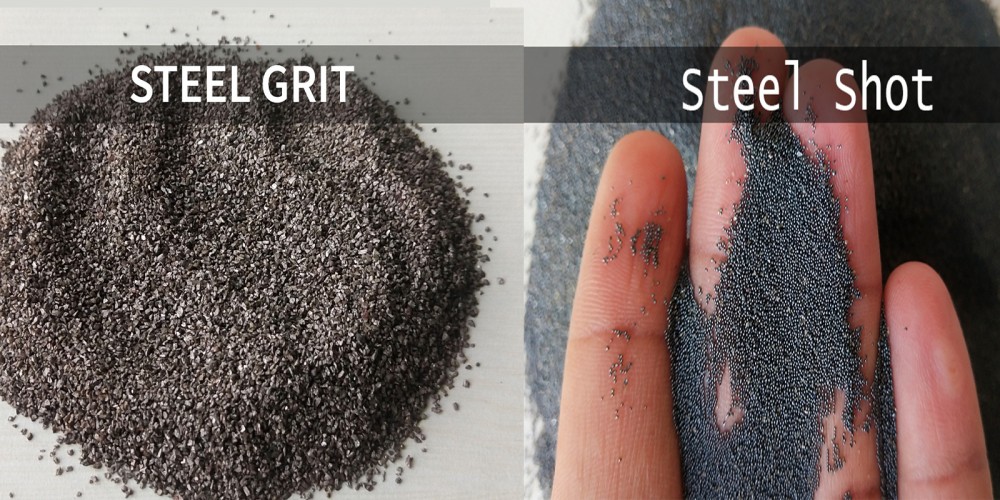
| スチールグリット | 7–8 | Yes (100–200×) | 高い | Very high | 低い | $ | Carbon steel, shipyards |
| 炭化ケイ素 | 9.5 | Limited (2–5×) | なし | Very high | 高い | $$$ | Hardened alloys, ceramics |
| ガラスビーズ | 5.5–6.5 | Moderate (3–5×) | なし | Very low | 低い | $$ | Peening, cosmetic finish |
| Crushed Glass | 5.5–6.0 | No | なし | Low–Med | 高い | $ | General cleaning |
| 珪砂 | 7.0 | No | なし | Medium | Very High | $ | Banned/restricted in many markets |
| Coal Slag | 7.0–7.5 | No | Trace | Medium | 高い | $ | Open blasting (legacy) |
When to Choose Aluminum Oxide Over Garnet
Garnet is an excellent media for applications requiring low dust generation and minimal iron risk on stainless steel — but aluminum oxide’s superior hardness means it cuts faster per pound, especially on harder alloys. In closed-loop blast cabinet systems where media is reclaimed and reused, aluminum oxide’s durability delivers a meaningfully lower cost per square meter treated over a full production run. For applications where both are candidates, the deciding factor is usually recycle rate: if your system supports multiple cycles, aluminum oxide wins on total cost of ownership.
Why Silica Sand Is Being Replaced
Crystalline silica is a Group 1 carcinogen under IARC classification. Silica sand blasting is outright banned in the UK, EU, and Australia, and heavily regulated by OSHA in the United States. Aluminum oxide — particularly white grade — is one of the safest replacement options, generating far less respirable dust at equivalent grit sizes, and the dust it does produce is classified as a nuisance dust (not a carcinogen) when silica content is below threshold. This regulatory tailwind continues to drive global aluminum oxide demand growth well into the 2020s.
7. Reusability & Cost Efficiency
One of the most frequently asked questions we receive: Is aluminum oxide blast media reusable? The short answer is yes — and this reusability is a critical driver of its total cost of ownership advantage over single-use media like coal slag or crushed glass. Our full analysis is available at: Is Aluminum Oxide Blast Media Reusable? How Many Times?
How Many Cycles Can You Expect?
| Grade | Typical Recycle Cycles | Key Limiting Factor | Recovery Method |
|---|---|---|---|
| Brown Fused (angular) | 4–8 cycles | Grain fracturing, particle size reduction | Air wash separator / classifier |
| White Fused (angular) | 5–10 cycles | Purity degradation from substrate pickup | Air wash separator |
| Sintered (spheroidal) | 15–25+ cycles | Gradual rounding, profile depth reduction | Cyclone + screen classifier |
Cycle counts depend heavily on blast pressure, nozzle geometry, substrate hardness, and recovery system efficiency. A well-maintained reclaim system with a properly set air wash separator can extend service life by 30–50% compared to systems without classification. The key performance indicator to track is anchor profile depth per square meter: when profile depth drops below specification, it is time to add fresh media or replace the charge.
Total Cost of Ownership (TCO) Calculation Example
Assume a mid-sized fabrication shop processing 500 m² of steel plate per week at a target anchor profile of 50–70 µm (SSPC-SP 10 Near-White):
- Single-use coal slag: ~2.5 kg/m² × 500 m² = 1,250 kg/week disposal + purchase cost
- Brown fused aluminum oxide (6-cycle average): ~2.5 kg/m² ÷ 6 = 0.42 kg net consumption/m² × 500 = 210 kg/week purchase + minimal disposal
- Net saving: 60–70% reduction in weekly media cost, plus reduced disposal fees and improved consistency
8. Health, Safety & Environmental Compliance
Respiratory Protection
While aluminum oxide dust is not classified as a carcinogen (unlike crystalline silica), inhalation of fine alumina particles over extended periods may cause pulmonary irritation. Operators should wear NIOSH-approved P100 respirators or powered air-purifying respirators (PAPRs) during blasting operations and media handling. Always operate blast cabinets with functional dust collectors and ensure air changes meet the ventilation requirements of your local occupational health authority.
Silica Content Compliance
High-quality aluminum oxide blast media — particularly white and sintered grades — contains less than 0.1% SiO₂, well below the threshold that triggers crystalline silica hazard classification. Brown fused oxide from reputable manufacturers typically contains 0.5–2.0% total silica, of which the crystalline fraction is negligible. Always request a Safety Data Sheet (SDS) from your supplier and verify the SiO₂ content and crystalline silica fraction before committing to a specification.
Relevant Standards & Certifications
- REACH (EU): Aluminum oxide is listed on the REACH candidate substance list for its potential effects at high cumulative exposures. Compliant SDS documentation is required for EU imports.
- RoHS: Aluminum oxide abrasive itself is RoHS-compliant; confirm this for media used in electronics manufacturing.
- ISO 9001:2015: Quality management certification for manufacturer process control — a baseline requirement for aerospace and medical supply chains.
- FEPA Quality Label: Voluntary certification confirming grit size distribution meets FEPA F-grits or P-grits standards.
- AMS 2431 / MIL-A-22262: Governing specs for aerospace abrasive blasting media.
Waste Disposal
Spent aluminum oxide media is generally classified as non-hazardous solid waste in most jurisdictions, provided it is not contaminated with heavy metals from the blasted substrate (e.g., chromium from legacy coatings or lead-based paint). Always test spent media before disposal if the substrate history is unknown. Many blasting contractors arrange for spent media to be recycled into refractory products, abrasive grinding wheels, or road surfacing aggregate — a value-recovery pathway that reduces disposal costs.
9. How to Evaluate an Aluminum Oxide Blast Media Supplier
The global aluminum oxide abrasive market is served by hundreds of manufacturers, but quality consistency varies significantly. Here is the due-diligence framework used by professional procurement teams in aerospace, heavy industry, and coatings contracting.
For bulk and wholesale procurement inquiries, visit our dedicated page: Bulk Aluminum Oxide Blast Media – Wholesale Pricing & RFQ.
10-Point Supplier Checklist
- Certificate of Analysis (CoA) per batch: Every shipment should carry a lot-specific CoA showing Al₂O₃ purity, SiO₂, Fe₂O₃, bulk density, and particle size distribution.
- Sieve analysis data: Request D10/D50/D90 values and compare against FEPA or ANSI tolerance tables. Narrow distributions produce consistent anchor profiles.
- ISO 9001:2015 certification: Confirms documented quality management system; baseline for industrial buyers.
- Moisture content specification: High moisture causes clumping in feed hoppers and inconsistent media flow. Specify ≤ 0.3% for brown and ≤ 0.1% for white/sintered grades.
- Packaging integrity: 25 kg PP woven bags with inner PE liner, or 1,000 kg super sacks with moisture barrier, are standard. Inspect for damage on receipt.
- Lead time & minimum order quantity (MOQ): Understand the supplier’s production schedule and whether they hold inventory for spot orders.
- Third-party test reports: For critical applications, commission independent verification from an accredited laboratory (e.g., SGS, Bureau Veritas, Intertek).
- Silica SDS compliance: Confirm crystalline silica content and ensure the SDS is compliant with your country’s chemical hazard regulations.
- Iron contamination declaration: Essential for stainless steel, aerospace, medical, and food-contact applications.
- References and application case studies: Reputable suppliers can provide documented references from clients in your industry segment.
Why Work With Jiangsu Henglihong Technology?
Jiangsu Henglihong Technology Co., Ltd. is a China-based manufacturer and global exporter of brown fused, white fused, and sintered aluminum oxide abrasives. Our manufacturing complex in Jiangsu Province operates under ISO 9001:2015 quality management, with in-house XRF analysis, laser particle size analysis, and automated sieve stations on every production line. We supply industrial customers across North America, Europe, the Middle East, Southeast Asia, and Australasia with consistent, documented quality — and we provide full CoA documentation on every shipment.
10. Frequently Asked Questions
They are the same compound. Aluminum oxide (Al₂O₃) is the chemical name; alumina is the common industrial name. Corundum is the naturally occurring mineral form. In the abrasive industry, “brown fused alumina” and “brown fused aluminum oxide” are interchangeable terms describing the same product.
Yes — but only white fused or sintered grades should be used on stainless steel. Brown fused aluminum oxide contains trace iron (Fe₂O₃) that can embed in the passive layer of stainless steel and initiate corrosion. White fused aluminum oxide (≥ 99.5% Al₂O₃, < 0.05% Fe₂O₃) is the industry-standard choice for stainless, duplex, and super-duplex steels.
For moderate surface rust and light mill scale, F36–F46 brown fused aluminum oxide is the most cost-effective starting point. For heavy mill scale or pitted surfaces requiring a coarser anchor profile (60–100 µm) per coating system requirements, F16–F24 delivers faster cycle times. Always verify the minimum anchor profile depth specified by your coating manufacturer’s data sheet.
Both perform well in wet (vapor) blasting systems. Garnet is widely used for wet blasting on sensitive substrates because its lower hardness produces slightly less aggressive cutting — beneficial for thin-walled components and non-ferrous alloys. Aluminum oxide cuts faster on harder substrates and has better recyclability in closed-loop wet blast machines. For a full comparison, see our article on Aluminum Oxide vs Garnet Blast Media.
Yes, with proper ventilation and respiratory protection. Aluminum oxide is not classified as a carcinogen, unlike crystalline silica. Operate blast cabinets with functional dust collectors, ensure adequate air exchange, and wear a P100-rated respirator or PAPR. White and sintered grades with < 0.1% SiO₂ produce the lowest respirable hazard profile of any industrial abrasive alternative to silica sand.
Standard packaging from Jiangsu Henglihong Technology includes 25 kg PP woven bags with inner PE moisture barrier and 1,000 kg / 1,200 kg bulk super sacks (FIBC). Custom pallet configurations and private-label packaging are available for OEM and distributor accounts. Minimum order quantities for export start at one full container load (typically 20–25 MT). Contact us to discuss your specific volume and delivery requirements.
With correct grit selection and adequate blast pressure, aluminum oxide can achieve any SSPC or ISO 8501-1 cleanliness grade, including: SSPC-SP 5 / ISO Sa 3 (White Metal Blast — complete removal of all visible contamination), SSPC-SP 10 / ISO Sa 2½ (Near-White Blast), SSPC-SP 6 / ISO Sa 2 (Commercial Blast), and SSPC-SP 7 / ISO Sa 1 (Brush-Off Blast). For high-performance protective coatings on critical infrastructure, SSPC-SP 10 or SP 5 is typically specified.
Store in a cool, dry, covered area away from moisture. Aluminum oxide is hygroscopic at very fine grit sizes — absorbed moisture causes clumping in blast machine feed systems. Keep bags sealed until point of use. For long-term storage (> 6 months), store on pallets off the ground in a climate-controlled warehouse with relative humidity below 60%. White and sintered grades are especially sensitive to moisture due to their higher surface area per unit weight.
Ready to Source Aluminum Oxide Blast Media?
Jiangsu Henglihong Technology Co., Ltd. supplies brown fused, white fused, and sintered aluminum oxide abrasives to industrial customers worldwide. Every order includes full Certificate of Analysis documentation and is backed by our ISO 9001:2015 quality management system.
Explore More Resources
Deepen your knowledge with these related guides from the Henglihong editorial library:
- Aluminum Oxide Grit Size Chart & Selection Guide
- Brown vs White Aluminum Oxide: Which Should You Use?
- Sintered vs Brown Fused vs White Aluminum Oxide: What’s the Difference?
- Aluminum Oxide vs Garnet Blast Media: Full Comparison
- How to Choose Aluminum Oxide Blast Media for Steel Surfaces
- Aluminum Oxide for Glass Etching & Frosting
- Is Aluminum Oxide Blast Media Reusable? How Many Times?
- Aluminum Oxide Blast Media for Aerospace & Medical
- Bulk Aluminum Oxide Blast Media – Wholesale Pricing & RFQ
- Aluminum Oxide Anti-Slip Additive for Floor Coatings
フィルター