Aluminum Oxide Anti-Slip Additive for Floor Coatings
The complete technical guide to aluminum oxide as a functional anti-slip aggregate in epoxy, polyurethane, MMA, and deck coating systems — covering why it outperforms quartz sand, how to select the right grit and dosage, application methods, and compliance with international slip-resistance standards.
- Why Aluminum Oxide Outperforms Quartz Sand for Anti-Slip
- Application Environments & Use Cases
- Grade and Grit Selection for Floor Coatings
- Compatibility with Coating Systems
- Dosage Rates and Surface Coverage
- Application Methods: Broadcast, Premix & Topcoat
- Slip-Resistance Standards and Test Methods
- Durability, Maintenance, and Service Life
- Troubleshooting Common Anti-Slip Coating Problems
- よくある質問
1. Why Aluminum Oxide Outperforms Quartz Sand for Anti-Slip
Quartz sand has been the traditional aggregate for anti-slip floor coatings for decades — it is cheap, readily available, and provides an immediate improvement in friction coefficient when incorporated into a coating. But in any environment where service life, slip-resistance retention under traffic, and coating integrity are important, aluminum oxide is the demonstrably superior choice. The performance gap between the two materials becomes decisive in heavy-traffic or chemically aggressive environments.
The fundamental reason is hardness. Quartz sand registers Mohs 7.0. Aluminum oxide registers Mohs 9.0 — more than 30% harder on the Mohs scale, and approximately four times harder in Vickers microhardness terms. Under the sustained foot and wheel traffic of an industrial floor, quartz sand particles gradually polish smooth — losing the sharp angular texture that generates friction. Aluminum oxide particles retain their angular cutting edges under the same loading conditions, maintaining the friction coefficient that was designed into the floor at the time of installation.
A secondary advantage is chemical inertness. Aluminum oxide (Al₂O₃) is chemically stable across the entire pH range encountered in industrial environments — from strong acids (pH 1) to concentrated alkalis (pH 14). Quartz (SiO₂) dissolves slowly in concentrated sodium hydroxide and other strong alkalis — a failure mode that can undermine the aggregate texture of a floor coating in chemical processing or food manufacturing environments where alkaline cleaners are used routinely.
This guide covers aluminum oxide as a functional aggregate in applied coating systems — incorporated into the coating during manufacture or application. For aluminum oxide used as a blast abrasive to prepare the concrete or steel substrate before coating application, see our steel surface preparation guide: How to Choose Aluminum Oxide Blast Media for Steel Surfaces. For the full product background, see: Aluminum Oxide Blast Media: The Complete Buyer’s Guide.
2. Application Environments & Use Cases
Aluminum oxide anti-slip aggregate is specified across a wide range of environments where the combination of durable slip resistance, chemical resistance, and long service life justifies its premium over cheaper quartz-based alternatives.
3. Grade and Grit Selection for Floor Coatings
Two independent decisions must be made simultaneously: which grade (brown or white), and which grit size. The grade decision is primarily about color and chemical environment; the grit decision is about the slip-resistance class required and the coating system thickness.
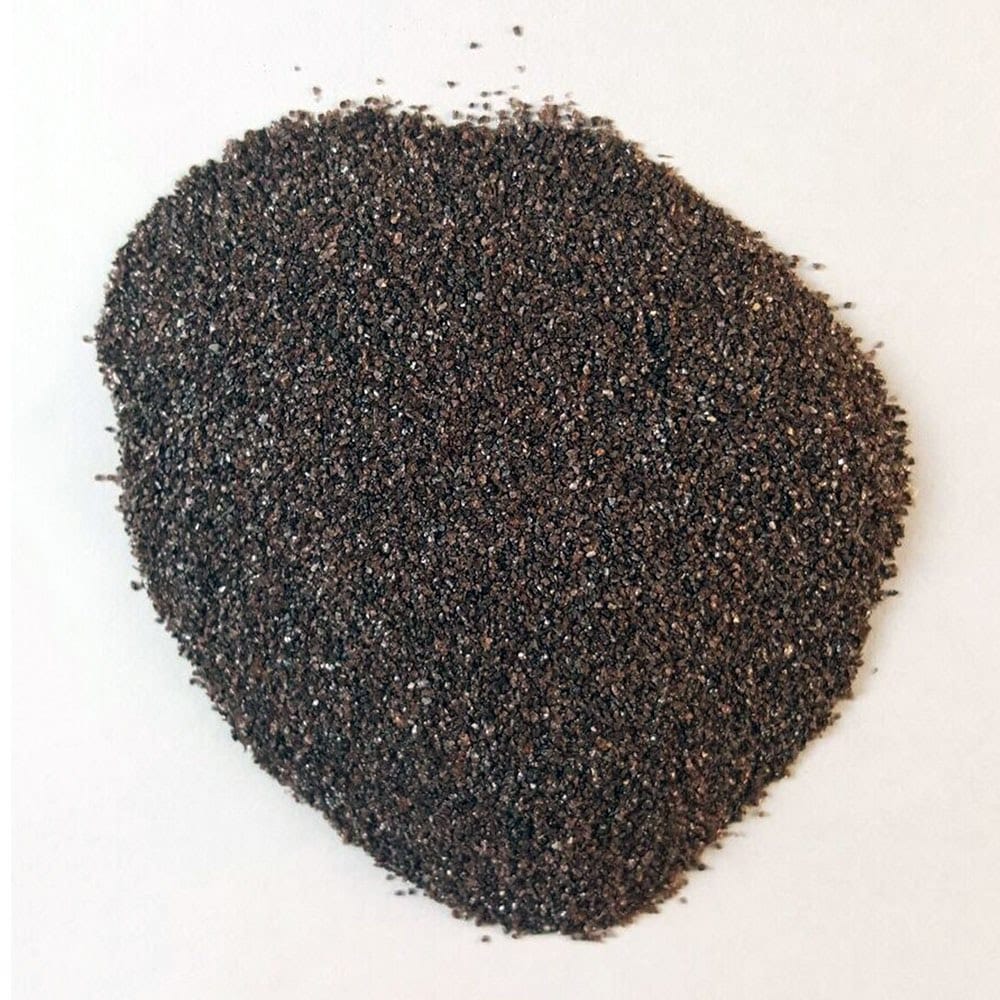
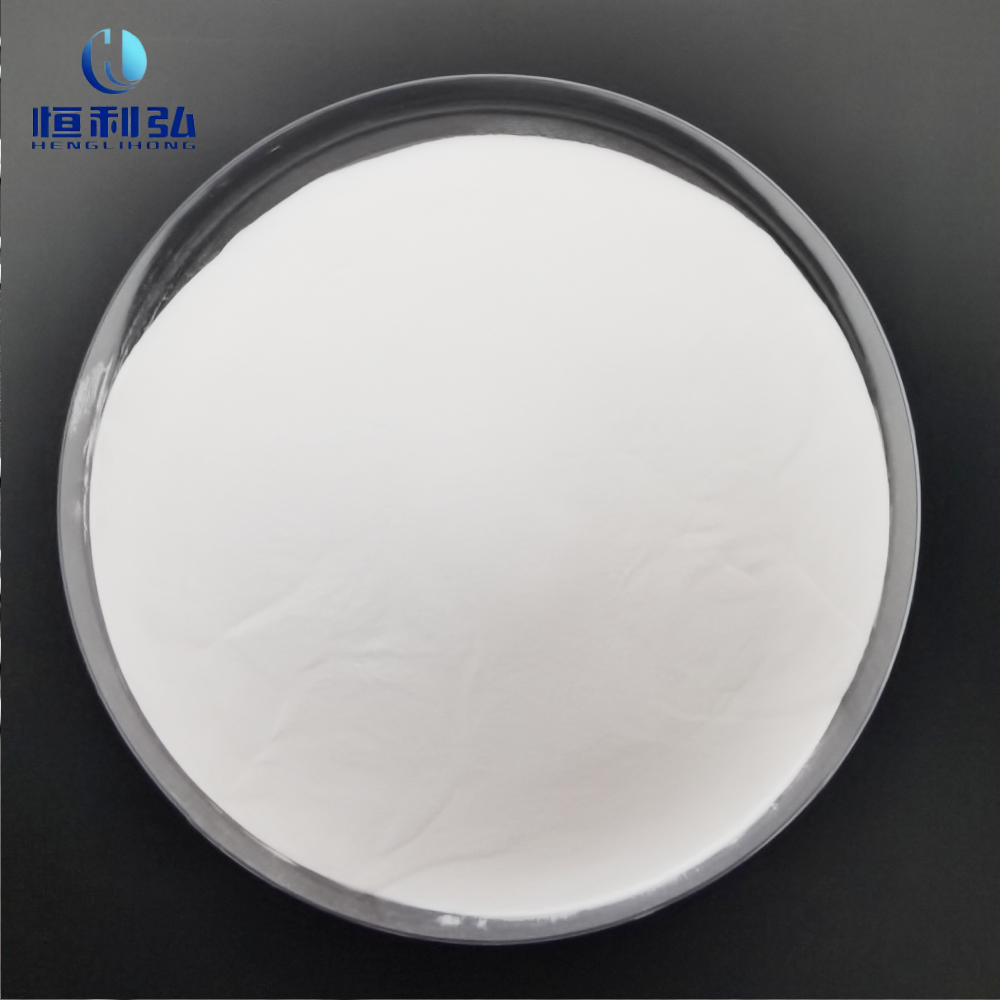
Grade Decision: Brown vs White for Floor Coatings
| Selection Criterion | Brown Fused Recommended | White Fused Recommended |
|---|---|---|
| Coating color | Dark coatings, grey, charcoal, tile-red — brown aggregate is invisible | Light grey, cream, white, off-white — brown aggregate creates visible dark speckling |
| Chemical environment | General industrial, automotive, warehousing — no aggressive alkalis | Food processing, pharmaceutical, marine, chemical — alkaline cleaners, acids, biocides |
| Regulatory environment | General industrial and commercial — no specific purity requirements | Food contact adjacent, pharmaceutical GMP, cleanroom — requires documented chemical inertness |
| Unit cost priority | Cost-sensitive projects where aesthetics are secondary | Premium projects where long-term appearance and compliance are valued |
Grit Selection: Matching Grit to Slip-Resistance Requirement
Grit size determines the peak-to-valley texture height of the cured coating surface, which directly governs the achieved slip-resistance class under the applicable test standard. The relationship is: finer grit → smoother texture → lower R class (less aggressive but aesthetically cleaner); coarser grit → rougher texture → higher R class (more aggressive slip resistance). The coating system’s wet film thickness and final build also interact with aggregate size — the aggregate must protrude sufficiently above the cured coating surface to function as an effective anti-slip texture.
| FEPA Grit | Particle D50 (µm) | Achievable DIN R Class | OSHA Coefficient (wet) | Typical Coating System | Best Application |
|---|---|---|---|---|---|
| F24–F36 | 600–850 µm | R13 | > 0.80 | Thick-build epoxy (> 1.5 mm DFT) | Heavy ramps, forklift areas, industrial loading bays |
| F46 | ~425 µm | R12–R13 | 0.70–0.85 | Standard epoxy (0.5–1.5 mm DFT) | Industrial workshops, vehicle ramps, wet process areas |
| F54–F60 | 300–355 µm | R11–R12 | 0.60–0.75 | Epoxy, polyurethane, MMA (0.3–1.0 mm DFT) | Food processing, commercial kitchens, stairways — most widely specified range |
| F70–F80 | 212–250 µm | R10–R11 | 0.50–0.65 | Thin epoxy, polyurethane (0.2–0.5 mm DFT) | Commercial and retail floors, pharmaceutical, office washrooms |
| F100–F120 | 125–150 µm | R10 | 0.45–0.55 | Thin-coat systems, varnish, sealer coatings | Light-duty commercial, decorative resin floors, car showrooms |
4. Compatibility with Coating Systems
Aluminum oxide is chemically inert and thermally stable, making it compatible with all standard industrial floor coating chemistries. However, practical compatibility considerations — specifically related to aggregate particle size and coating viscosity at the time of application — vary between coating types and application methods.
| Coating System | Al₂O₃ Grade | Recommended Grit | Application Method | Key Compatibility Notes |
|---|---|---|---|---|
| Solvent-free epoxy (self-levelling) | Brown or White | F46–F60 | Broadcast after notch trowel application | Standard self-levelling epoxy has sufficient flow to encapsulate F46–F60 aggregate broadcast at 0.3–0.6 kg/m². Avoid premix above 5% w/w — aggregate settlement in pail before application. |
| Epoxy mortar / screed | ブラウン | F24–F46 | Factory premix (6–15% w/w) | Heavy-body mortar systems are formulated with aggregate; additional broadcast not typically needed. Coarser grit contributes both strength and anti-slip texture. Consult formulator for aggregate loading limits. |
| Water-based epoxy | Brown or White | F60–F80 | Broadcast or premix (3–5% w/w) | Lower viscosity than solvent-free — fine grit (F60–F80) avoids excessive particle settlement during application. White grade preferred for light-colored water-based systems. |
| Polyurethane (PU) floor coating | Brown or White | F54–F80 | Broadcast onto wet coat or premix (2–5% w/w) | PU systems cure faster than epoxy — broadcast must be completed within the open time. Moisture-cure PU systems in humid environments: white grade avoids any iron-induced discoloration during cure. |
| PMMA / MMA floor system | Brown or White | F46–F60 | Broadcast onto wet topcoat; sealed with clear MMA | MMA has very short open time (typically 10–20 min) — require prepared aggregate and experienced applicator. Sealed MMA systems: aggregate broadcast into the base coat, then sealed with clear MMA topcoat for durable encapsulation. |
| Polyurethane deck coating (marine) | ホワイト | F46–F60 | Broadcast between coats or topcoat sealing | Marine deck systems face UV, salt, and thermal cycling — white fused Al₂O₃ is UV-stable and does not discolor under prolonged UV exposure; brown grade may show subtle discoloration in UV-exposed pale deck coatings over time. |
| Decorative flake / chip resin floor | ホワイト | F80–F100 | Sealer coat with fine Al₂O₃ premixed | Decorative systems prioritize appearance — fine-grit white aggregate in the clear sealer topcoat adds functional slip resistance without compromising the visible flake pattern beneath. Typical loading: 3–5% w/w in clear polyurethane sealer. |
5. Dosage Rates and Surface Coverage
Dosage rate — the mass of aluminum oxide applied per square meter of floor surface — directly controls the density of anti-slip texture and therefore the achieved slip-resistance class. Under-dosing produces an irregular, patchy texture that fails to achieve the specified R class. Over-dosing creates an excessively rough surface that is difficult to clean, traps contamination, and may exceed the encapsulation capacity of the coating system.
6. Application Methods: Broadcast, Premix & Topcoat Sealing
Three distinct application techniques are used to incorporate aluminum oxide into floor coating systems. The optimal method depends on the coating chemistry, the required slip-resistance class, and the aesthetic requirements of the finished floor.
7. Slip-Resistance Standards and Test Methods
Specifying “anti-slip” without reference to a measurable standard and a quantified test result is legally and commercially inadequate for any commercial or industrial floor installation. The following standards and test methods are the most commonly referenced internationally for floor coating slip resistance compliance.
8. Durability, Maintenance, and Service Life
The durability advantage of aluminum oxide over quartz sand anti-slip aggregate is most visible in high-traffic and chemically demanding environments — precisely the environments where the cost of floor replacement is highest and the disruption to operations most severe.
Service Life Comparison
In a food processing environment with daily hot alkaline wash-down and moderate foot traffic (approximately 500 pedestrian passes per day), field data from coatings contractors consistently shows:
- Quartz sand aggregate: Slip resistance typically degrades below specification (R class drops by one grade) within 18–30 months of installation. Surface becomes visibly smooth; R class confirmed low by pendulum test.
- Aluminum oxide aggregate (F46–F60): Slip resistance remains within specified R class for 5–8 years under the same conditions. Surface texture visually retained; pendulum test confirms continued compliance.
Cleaning and Maintenance
Aluminum oxide anti-slip floors are cleaned using the same methods as any industrial floor coating — scrubber-dryer machines, mop-and-bucket, or high-pressure hot-water systems. The aggregate texture’s chemical inertness means it is unaffected by the alkaline detergents, sanitizers, acidic descalers, and solvent-based degreasers used in industrial and food-processing maintenance programs. Key maintenance practices to extend service life:
- Use a brush-type scrubber head rather than a smooth pad — brush heads clean into the texture valleys without polishing the aggregate peaks
- Avoid abrasive pad burnishing — while this is sometimes used to restore gloss to smooth coating surfaces, it will accelerate wear of anti-slip aggregate tips
- Inspect the floor annually with a pendulum test (EN 13036-4) to confirm slip resistance compliance; renew the topcoat sealer with fresh Al₂O₃ loading when PTV falls below threshold
- Repair isolated damage (impact craters, chemical attack spots) with color-matched repair compound incorporating matching grit size to maintain consistent slip resistance across the floor area
Topcoat Renewal Without Full Floor Replacement
One of the practical advantages of the topcoat sealing application method (Method C above) is that slip resistance can be restored at end of service life by abrading the worn sealer coat, applying a fresh clear topcoat containing Al₂O₃ aggregate at the original specification, without disturbing the decorative base coat or stripping the entire floor system. This renewal is approximately 30–50% of the cost of a complete re-coating, making aluminum oxide anti-slip systems more economical over multi-cycle service life than single-use aggregate alternatives.
9. Troubleshooting Common Anti-Slip Coating Problems
| Problem | Most Likely Cause | Corrective Action |
|---|---|---|
| Floor fails pendulum or ramp test at completion inspection | Grit too fine for R class required; dosage too low; aggregate buried under over-applied topcoat; incorrect application timing (broadcast too late — coating too cured) | Abrade sealer, apply fresh topcoat with coarser grit or higher dosage; validate with test panel before full re-application; review application timing protocol |
| Aggregate particles pulling out under traffic | Aggregate too coarse relative to coating build (under-encapsulated); broadcast too late — coating already too cured when aggregate applied; substrate contamination preventing bond | Switch to finer grit; review broadcast timing relative to coating open time; ensure substrate is clean and dry before application; use double-broadcast method for heavy-duty areas |
| Visible brown speckling in light-colored coating | Brown fused aluminum oxide used in a light-colored or white coating system | Replace with white fused aluminum oxide — brown aggregate is visually incompatible with all light-colored coating systems. This cannot be remedied after application. |
| Uneven texture — patchy slip resistance | Non-uniform broadcast application (hand-spreading without consistent technique); aggregate clumping from moisture absorption; coating surface not uniformly tacky across the floor area | Use a mechanical aggregate spreader for areas > 50 m²; verify media moisture content ≤ 0.3%; ensure uniform coating thickness before broadcast using notch trowel gauge |
| Slip resistance degrades rapidly within 12 months | Grit too fine for the traffic type; burnishing from inappropriate cleaning equipment (smooth pad); aggregate quantity insufficient (under-dosed); quartz sand used instead of aluminum oxide | Confirm media grade (brown or white Al₂O₃, not quartz); switch to coarser grit or higher dosage; replace smooth cleaning pads with brush heads; re-test after maintenance protocol change |
| Aggregate causes excessive dirt retention / difficulty cleaning | Grit too coarse for the hygiene requirements of the environment; dosage excessive; sealer topcoat too thin — aggregate peaks exposed with insufficient lateral bonding | Step to finer grit; reduce dosage; apply additional sealer topcoat to partially bury aggregate tips to approximately 50% height; evaluate whether R class achieved still meets specification after adjustment |
10. Frequently Asked Questions
In blast abrasive applications, aluminum oxide particles are propelled at high velocity to remove surface contamination and create an anchor profile — the particles impact the surface and are then collected, classified, and reused or disposed of. In anti-slip floor coating applications, aluminum oxide particles are permanently incorporated into the cured coating system as a functional aggregate. The same material — same grade, similar grit range — serves both purposes, but in the anti-slip context it is the permanent exposure of the particles above the coating surface that creates friction, rather than their impact velocity. The product specification requirements are similar: consistent FEPA particle size distribution, low moisture content, and white grade for light-colored coatings — but the application technique is completely different.
Yes — aluminum oxide is UV-stable and does not degrade, discolor, or lose hardness under UV exposure or freeze-thaw cycling. It is widely used in outdoor polyurethane deck coatings, marine deck systems, external ramp coatings, and bridge walkway systems. For outdoor applications, the primary specification consideration is the coating chemistry rather than the aggregate — solvent-free polyurethane topcoats with alumina aggregate offer better outdoor UV stability than epoxy (which chalks under UV), while MMA (methyl methacrylate) systems are preferred for environments with extreme freeze-thaw cycling, such as car park decks in cold climates. White fused aluminum oxide is preferred for pale-colored outdoor coatings, as it does not discolor under prolonged UV exposure in the way that some brown-grade material may in very light coating systems.
The quantity depends on the application method and required R class. As a working estimate for the most common scenarios: for a standard broadcast application targeting R11 (F54–F60 grit at 0.4 kg/m²), you need 400 kg per 1,000 m². For R12 heavy industrial (F46 at 0.7 kg/m²), you need 700 kg per 1,000 m². For a topcoat premix application at R10 (F80 at 5% w/w in a 200 g/m² topcoat application rate), you need approximately 10 kg per 1,000 m². Always add 10–15% to your calculated quantity to allow for uneven spreading, wastage, and trial panel testing before committing to a final order quantity. Contact HLH with your floor area, grit specification, and application method for a project-specific quantity recommendation.
The visual impact of aluminum oxide aggregate on a finished floor depends on the grit size, application method, and coating system. Fine grit white fused Al₂O₃ (F80–F120) at low dosage (0.1–0.2 kg/m²) incorporated into a clear sealer topcoat is virtually invisible in the cured floor — the surface appears slightly textured under raking light but does not affect the decorative scheme visible through the coating. Coarser grit (F36–F60) broadcast at higher dosage creates a more visibly textured surface — the aggregate tips are apparent and cast fine shadows under directional lighting. Brown grade in a light-colored coating creates visible brown speckling that compromises the aesthetic entirely. For any decorative floor where appearance is important, specify fine-grit white fused aluminum oxide in the topcoat sealer and validate the visual result on a 0.5 m² sample panel in the same coating before proceeding to full installation.
White fused aluminum oxide (Al₂O₃ ≥ 99.5%, Fe₂O₃ < 0.05%, SiO₂ < 0.1%) is chemically inert, non-toxic, and does not leach harmful substances under the pH conditions and cleaning regimes used in food processing environments. It is not listed as a food additive or food contact material because it is permanently bonded in the cured floor coating rather than being in contact with food directly — but its chemical properties make it compatible with the hygiene requirements of food manufacturing facilities regulated under EU Regulation 852/2004, FDA 21 CFR Part 110 (cGMP), or equivalent national food safety regulations. White grade must be specified (not brown) for food processing facilities, both for chemical purity and to ensure any aggregate that is eventually dislodged under extreme wear is not iron-contaminating in a food-contact zone. Consult your specific facility’s hygiene manager and the coating manufacturer’s technical data sheet to confirm compliance with your site’s food safety plan.
Yes. Jiangsu Henglihong Technology supplies both brown and white fused aluminum oxide in the F36–F120 grit range specifically for floor coating anti-slip applications, in 25 kg bags and 1,000 kg FIBC bulk bags. The material is the same FEPA-graded product used for blasting applications — it is the grit size and grade that matter, not a separate product line. For coating manufacturers requiring factory-incorporated aggregate, we can supply in the fine-grit range (F60–F120) with tight moisture specification (≤ 0.15%) to ensure compatibility with moisture-sensitive coating chemistries. Request a technical data sheet and Certificate of Analysis sample from our sales team to confirm the product meets your formulation requirements before placing a production order. See our bulk ordering page for pricing and MOQ information: Bulk Aluminum Oxide Blast Media – Wholesale Pricing & RFQ.
Source Anti-Slip Grade Aluminum Oxide from HLH
Jiangsu Henglihong Technology supplies brown and white fused aluminum oxide in the full anti-slip grit range — F36 through F120 — with tight FEPA particle size tolerances, low moisture content, and full Certificate of Analysis documentation on every shipment.
Related Resources
Complete your knowledge with these guides from the Henglihong resource library:
- Aluminum Oxide Blast Media: The Complete Buyer’s Guide
- Aluminum Oxide Grit Size Chart & Selection Guide
- Brown vs White Aluminum Oxide: Which Should You Use?
- Aluminum Oxide vs Garnet Blast Media: Full Comparison
- How to Choose Aluminum Oxide Blast Media for Steel Surfaces
- Is Aluminum Oxide Blast Media Reusable? How Many Times?
- Aluminum Oxide Blast Media for Aerospace & Medical
- Aluminum Oxide for Glass Etching & Frosting
- Bulk Aluminum Oxide Blast Media – Wholesale Pricing & RFQ
フィルター