Sintered vs Brown Fused vs White Aluminum Oxide: What’s the Difference?
A clear, technical explanation of the three main types of aluminum oxide abrasive — how they are made, how their properties differ, and which type is the right choice for your specific application.
- Quick Answer: Three Types at a Glance
- How Each Type Is Made
- Full Properties Comparison
- Grain Morphology: The Hidden Performance Driver
- Cutting Speed, Profile Depth & Recyclability
- Cost Comparison & Total Cost of Ownership
- Which Type Should You Choose? 10 Application Scenarios
- Commercial Availability & Market Reality
- よくある質問
1. Quick Answer: Three Types at a Glance
Brown fused: most economical, toughest, best for heavy-duty carbon steel work.
White fused: highest purity, iron-free, required for stainless steel, aerospace, medical, and glass.
Sintered: longest service life, spheroidal shape, premium price — specialist choice for high-cycle automated blast systems.
This guide provides the full technical comparison to help engineers, procurement managers, and blast shop operators make an informed specification decision. For the complete product background covering industrial applications and selection criteria, see our main resource: Aluminum Oxide Blast Media: The Complete Buyer’s Guide.
2. How Each Type Is Made
The manufacturing process is not a technical curiosity — it is the primary determinant of every downstream performance difference between the three types. Understanding the production route explains why each type has the properties it has.
Process: Bauxite is loaded into a large electric arc furnace and heated to approximately 2,000–2,050 °C. The alumina melts and is reduced; most volatile impurities are driven off. The TiO₂ and a portion of the iron dissolve into the melt. The furnace is tapped and the molten material solidifies into large “pigs” or is air-quenched. The cooled material is crushed, sized, and classified to FEPA F-grits tolerances.
Key result: TiO₂ (1.5–3.8%) is retained in solid solution in the corundum crystal lattice — it acts as a toughening agent, making brown fused the most impact-resistant grade.
Process: The purified alumina powder is loaded into an electric arc furnace and fused at approximately 2,050 °C. Because the feedstock is already highly purified, the resulting melt is essentially pure aluminum oxide. Solidification, crushing, and classification follow the same route as brown fused. The absence of TiO₂ makes the grain slightly more friable (less tough) than brown grade, but the hardness is marginally higher.
Key result: Near-zero Fe₂O₃ (<0.05%) and negligible SiO₂ (<0.1%) — the purity essential for contamination-sensitive applications.
Process: Alumina powder is mixed with binders, wet-formed or spray-dried into granules of controlled shape and size, then fired in a kiln at 1,400–1,700 °C — below the melting point, so the particles sinter (bond by solid-state diffusion) rather than fuse. This produces a fully dense, fine-crystalline ceramic grain with a controlled spheroidal or near-spheroidal morphology. No crushing step is needed — the grain shape is formed directly.
Key result: Spheroidal grain shape with exceptionally high crush strength — significantly higher than either fused grade. This shape and strength combination enables 15–25+ recycle cycles in closed-loop blast cabinets.
3. Full Properties Comparison
| Property | Brown Fused (BFAO) | White Fused (WFAO) | Sintered (SinterBlast) | Test Standard |
|---|---|---|---|---|
| Al₂O₃ Purity | 94–97% | ≥ 99.5% | ≥ 99% | XRF / Wet Chemistry |
| TiO₂ | 1.5–3.8% | < 0.05% | < 0.2% | XRF |
| Fe₂O₃ (Free Iron) | 0.2–1.5% | < 0.05% | < 0.10% | XRF |
| SiO₂ | 0.5–2.0% | < 0.10% | < 0.15% | XRF |
| モース硬度 | 8.9–9.0 | 9.0 | 9.0–9.2 | ASTM E18 |
| Vickers Microhardness | 1,800–2,000 HV | 2,000–2,200 HV | 2,000–2,400 HV | ASTM E384 |
| 真の密度 | 3.90–3.95 g/cm³ | 3.93–3.97 g/cm³ | 3.94–3.98 g/cm³ | ASTM B923 |
| Grain Morphology | Angular / blocky | Angular / sharp-edged | Spheroidal / rounded | SEM / Image Analysis |
| Crush Strength | グッド | Good–High | Exceptional | Single-particle crush test |
| Grain Toughness | Highest of fused grades | Moderate (more friable) | Highest overall | Impact fracture test |
| Recyclability (closed loop) | 4–8 cycles | 5–10 cycles | 15–25+ cycles | Production trial |
| カラー | Dark brown / reddish-brown | Pure white | White to light grey | Visual |
| Anchor Profile Depth | 高い | 高い | Lower (spheroidal shape) | ISO 8503 / ASTM D4417 |
| Dust Generation | Low–Moderate | 低い | 非常に低い | Operational measurement |
| Unit Cost (relative) | 1× (baseline) | 1.3–1.6× | 3–6× | Market pricing |
| Cost per m² (optimized system) | 低い | Low–Moderate | Low (over full service life) | TCO calculation |
4. Grain Morphology: The Hidden Performance Driver
Of all the differences between the three types, grain shape is the one that most directly determines which application each type is suited for — yet it is the property most frequently overlooked in procurement specifications that focus exclusively on chemistry and particle size.
Angular Grains (Brown and White Fused)
Both fused grades produce angular grains when crushed from the solidified melt. Angular grains have sharp edges and flat cleavage surfaces that function as micro-cutting tools on impact. Each grain impacts the substrate, fractures the surface zone, and removes material rapidly. As the grain itself fractures through successive impact cycles, it exposes fresh sub-grain cutting edges — maintaining cutting aggression over multiple recycle cycles. This progressive self-sharpening behavior is why fused aluminum oxide consistently produces the deep, aggressive anchor profiles that high-performance protective coating systems require.
The difference between brown and white fused angular grains is subtle: white fused grains, being more friable (due to the absence of TiO₂ toughening), fracture into slightly sharper sub-fragments on impact — which is why white grade is preferred for precision applications where micro-cutting sharpness matters more than longevity, such as dental ceramic bonding preparation. Brown fused grains are blockier and resist fracture better — which is why they outlast white grade in heavy-duty steel descaling where impact resistance is the limiting factor.
Spheroidal Grains (Sintered)
Sintered aluminum oxide grains are formed by spray-drying or controlled granulation before sintering — producing a rounded, near-spherical shape. Spheroidal grains do not cut in the same way as angular grains. Instead of fracturing and gouging the substrate surface, they primarily deform it through repeated compressive impacts — a mechanism closer to shot peening than abrasive cutting. This has two important consequences:
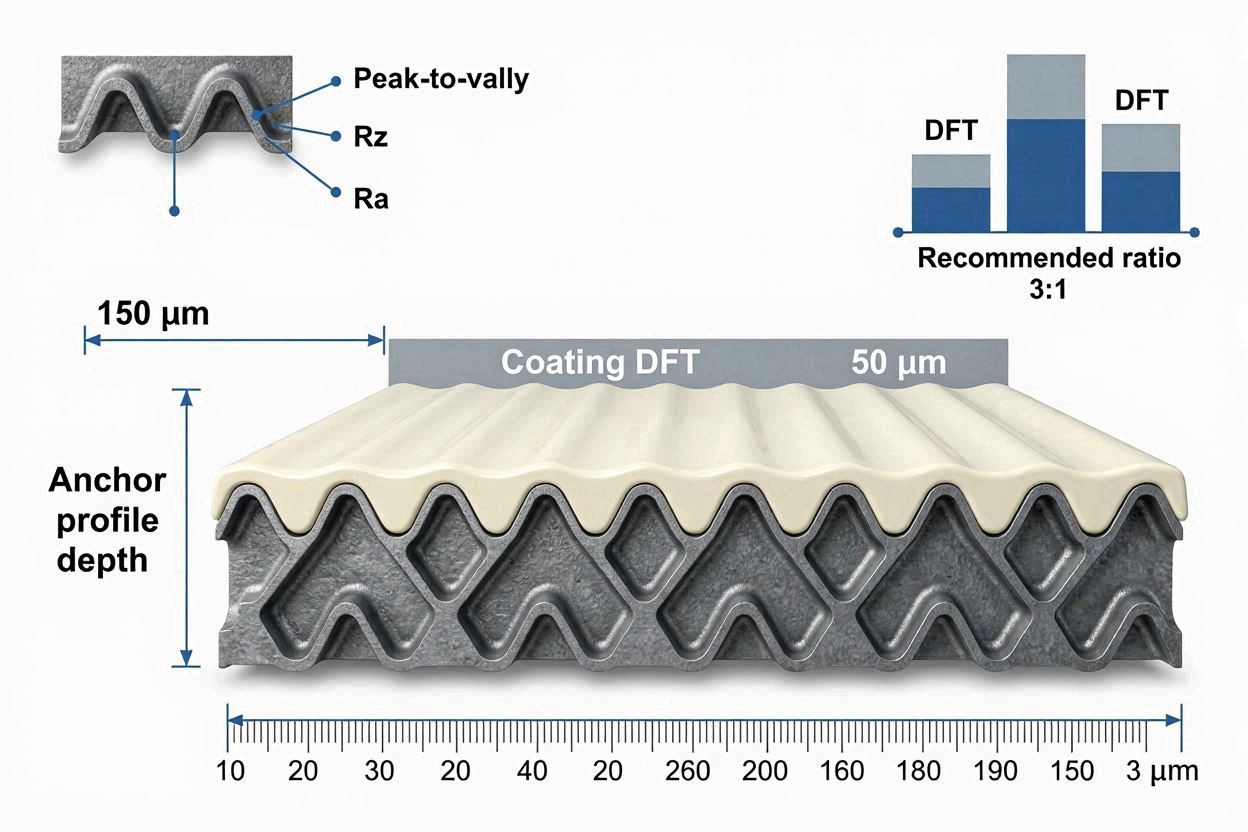
- Anchor profile depth is shallower at equivalent grit size and blast pressure than angular fused grades. A sintered aluminum oxide F36-equivalent produces significantly less Rz than brown or white fused F36. For applications requiring deep anchor profiles (>50 µm), sintered grade often requires a coarser nominal size than a fused equivalent to achieve the same profile depth.
- Recyclability is dramatically higher. Because spheroidal grains do not fracture on impact — they deform the substrate rather than fracturing themselves — each grain survives many more impact cycles before reaching end-of-life. This is the primary value proposition of sintered aluminum oxide: 15–25+ recycle cycles versus 4–10 for fused grades.
5. Cutting Speed, Profile Depth & Recyclability
The three types occupy distinct positions on the performance spectrum — no single type dominates across all three criteria simultaneously. The right choice depends on which performance dimension is most critical for your specific production environment.
Cutting Speed on Hard Steel (Comparative)
The key insight from these comparisons: sintered aluminum oxide does not outperform the fused grades on cutting speed or profile depth — it trades those performance dimensions for exceptional media longevity. Its value proposition is entirely in the recycle economy of high-volume, long-running automated blast systems where equipment uptime and media change-out frequency are the dominant operational cost drivers. For a detailed treatment of recyclability economics across all three types, see our guide: Is Aluminum Oxide Blast Media Reusable? How Many Times?
6. Cost Comparison & Total Cost of Ownership
Unit price comparisons between the three types are frequently misleading without a TCO framework. Sintered aluminum oxide is 3–6× the unit price of brown fused — but the comparison is irrelevant without accounting for the number of square meters treated per kilogram of media consumed over its service life.
| Cost Factor | Brown Fused | ホワイト・フューズド | Sintered |
|---|---|---|---|
| Unit purchase price (relative) | 1× (baseline) | 1.3–1.6× | 3–6× |
| Recycle cycles (closed loop) | 4–8 | 5–10 | 15–25+ |
| Net kg consumed per m² (F36-equiv.) | ~0.42 kg (6 cycles) | ~0.33 kg (7.5 cycles) | ~0.13 kg (20 cycles) |
| Relative cost per m² treated | 低い | Low–Moderate | Low–Moderate (in optimized system) |
| Dust generation / disposal cost | Moderate volume | Lower volume | Lowest volume |
| Typical break-even vs brown fused | Baseline | Justified by contamination requirement | Typically >500 m²/week continuous operation |
7. Which Type Should You Choose? 10 Application Scenarios
8. Commercial Availability & Market Reality
Understanding the commercial landscape for each type prevents specification decisions that look sound on paper but face practical sourcing problems in production.
Brown Fused Aluminum Oxide — Globally Abundant
Brown fused aluminum oxide is produced in very large volumes by manufacturers in China, India, Russia, and several other countries. It is available in all FEPA grit sizes from F12 through F220, from multiple competing suppliers, with short lead times. It is the commodity baseline of the industrial abrasive market. Competition among suppliers is vigorous, which keeps pricing competitive. The primary procurement risk is quality consistency — not availability.
White Fused Aluminum Oxide — Widely Available, Premium Positioned
White fused aluminum oxide is produced in large volumes by manufacturers in China (the largest producer globally), and to a lesser extent in Germany, Japan, and other countries. It is available in all FEPA grit sizes from F36 through F1200, with reliable supply chains established for aerospace and medical applications. Unit prices are 30–60% higher than brown grade, reflecting the more expensive Bayer-process alumina feedstock. For contamination-sensitive applications, it is non-substitutable — the only alternative with equivalent purity is silicon carbide, which is more expensive and less available in the fine grit range.
Sintered Aluminum Oxide — Specialist, Limited Sourcing
Sintered aluminum oxide abrasive (sometimes marketed under brand names such as “SinterBlast,” “Treibacher SinterKorund,” or similar) is produced by a smaller number of specialist manufacturers. It is not universally available from commodity abrasive suppliers, and availability in the full grit range is more limited than fused grades. Lead times can be longer and minimum order quantities may be higher. For buyers considering sintered aluminum oxide, supplier qualification should include confirming consistent availability across the production volumes required — some buyers have switched back to high-cycle white fused aluminum oxide after encountering sourcing difficulties with sintered grade at scale.
Jiangsu Henglihong Technology manufactures and exports brown fused and white fused aluminum oxide across the full commercial grit range — the two grades that cover over 95% of industrial blast abrasive applications globally. For a detailed product specification and current pricing, see our product landing page: Buy Aluminum Oxide Blast Media – All Grit Sizes In Stock.
9. Frequently Asked Questions
No — “better” depends entirely on the application. Sintered aluminum oxide has one decisive advantage: exceptional recyclability (15–25+ cycles) that significantly reduces media consumption and change-out frequency in high-volume automated blast systems. In every other performance dimension, sintered grade is either equal to or inferior to the fused grades: its cutting speed on hard substrates is lower, its anchor profile depth at equivalent grit size is shallower (due to the spheroidal grain shape), and its unit cost is 3–6× higher. For most blast cabinet operations that do not run continuously at very high throughput, brown or white fused aluminum oxide delivers lower total cost of ownership than sintered grade. Sintered aluminum oxide is not a universal upgrade — it is a specialist product for a specific operational context.
Yes, but you need to validate the switch before committing to full production. Because sintered grade has a spheroidal grain shape and produces a shallower anchor profile than angular fused grades at the same nominal grit size and blast pressure, simply swapping from F36 brown fused to F36 sintered will likely produce a shallower profile than your coating specification requires. You will typically need to specify a coarser sintered grit (for example, an equivalent to F24 or even F20 in sintered form) to achieve the same Rz as F36 brown fused. Run a trial blast on representative test panels, measure the anchor profile with ISO 8503 replica tape, and confirm specification compliance before making the switch in production. Also verify that your reclaim classifier is set correctly for the different bulk density of sintered grade — the air wash separation velocity will need adjustment.
The sintering process is more capital-intensive and energy-intensive than electric arc fusion for equivalent production volumes, and requires tighter process controls to achieve consistent spheroidal morphology and density. The green forming step (spray-drying or granulation), kiln firing at precisely controlled temperatures, and quality screening of the finished spheroidal particles all add manufacturing steps that are absent from the simpler fusion-and-crush process used for fused grades. Additionally, sintered aluminum oxide is produced in lower global volumes than fused grades, which means less economies of scale in production. The 3–6× unit price premium is a genuine reflection of higher manufacturing cost — not an arbitrary market positioning.
Sintered aluminum oxide generates the least dust — because its high crush strength means grains fracture far less on each impact cycle, producing proportionally fewer fine particles per pass. Brown fused generates more dust than white fused at equivalent conditions, because brown grade fractures more readily than white (despite being tougher by impact resistance — the distinction is that brown fractures more productively along cleavage planes while white tends to fragment). In a practical dust management context, all three types require functioning dust collection systems for enclosed blast work, and all three qualify as nuisance particulates (not carcinogens) when silica content is within specification. The dust advantage of sintered grade is most relevant for very-high-throughput operations where cumulative dust volume and filter replacement frequency are significant operational costs.
Several specialty variants exist beyond the three main types, though they serve niche markets rather than mainstream blasting applications. Pink fused aluminum oxide incorporates a small amount of chromium oxide (Cr₂O₃), giving it a pink color and marginally higher hardness than white fused — used in some precision grinding applications. Black silicon carbide そして green silicon carbide are harder than aluminum oxide (Mohs 9.5) but are not aluminum oxides. Tabular alumina is a very-high-temperature calcined form used primarily in refractory applications rather than blast abrasive. Sol-gel aluminum oxide (used in some premium coated abrasive products) has a microcrystalline structure that enables self-sharpening during grinding — but it is not used as a blast media. For essentially all industrial blast abrasive applications, the choice remains among the three types covered in this article.
Jiangsu Henglihong Technology Co., Ltd. manufactures and exports brown fused and white fused aluminum oxide across the full commercial grit range (F12–F220 brown; F46–F1200 white), with ISO 9001:2015 quality management and lot-specific Certificate of Analysis documentation on every shipment. We supply industrial buyers, distributors, and OEM coating manufacturers in North America, Europe, the Middle East, Southeast Asia, and Australasia. For pricing, minimum order quantities, and a formal quotation, see our product page: Buy Aluminum Oxide Blast Media – All Grit Sizes In Stock or contact us directly at hlh-js.com/contact.
Brown Fused & White Fused Al₂O₃ — Ready to Ship
Jiangsu Henglihong Technology supplies the two most widely used aluminum oxide grades across the full FEPA grit range, with ISO 9001:2015 quality management and full CoA documentation on every export shipment.
Related Resources
Continue with these in-depth guides from the Henglihong resource library:
- Aluminum Oxide Blast Media: The Complete Buyer’s Guide
- Brown vs White Aluminum Oxide: Which Should You Use?
- Aluminum Oxide Grit Size Chart & Selection Guide
- Aluminum Oxide vs Garnet Blast Media: Full Comparison
- How to Choose Aluminum Oxide Blast Media for Steel Surfaces
- Is Aluminum Oxide Blast Media Reusable? How Many Times?
- Aluminum Oxide Blast Media for Aerospace & Medical
- Aluminum Oxide for Glass Etching & Frosting
- Bulk Aluminum Oxide Blast Media – Wholesale Pricing & RFQ
- Aluminum Oxide Anti-Slip Additive for Floor Coatings
フィルター