Peristaltic vs. AODD vs. Progressive Cavity Pumps for Abrasive Media: Which Is Right for You?
When handling abrasive media, the pump type decision often comes down to three candidates that together cover the vast majority of non-centrifugal abrasive applications: peristaltic (hose) pumps, air-operated double diaphragm (AODD) pumps, and progressive cavity pumps. Each handles abrasive media through a fundamentally different mechanism, and each excels in specific scenarios while performing poorly in others. Most comparison content online advocates for one type because it is the author’s product—this guide provides a genuinely neutral engineering comparison.
For a broader overview including centrifugal slurry pumps and gear pumps, see our complete resource: Pumps for Abrasive Media: The Complete Selection & Buying Guide.
1. Why These Three Pump Types Dominate Non-Centrifugal Abrasive Applications
Centrifugal slurry pumps handle the highest-volume abrasive applications—mining tailings, dredging, large-scale process slurry—but they require priming, cannot run dry, and experience significant efficiency and wear penalties at moderate-to-high viscosity. For the large number of industrial abrasive applications that fall outside the centrifugal pump’s optimal range—medium concentration, variable or batch-mode flow, fine particles, higher viscosity, or smaller scale—these three positive-displacement pump types cover almost all scenarios.
The fundamental difference between them is where wear occurs and how the abrasive particle is isolated from pump components:
- Peristaltic: Abrasive contacts only the hose interior. Zero metal contact. Wear item is the hose only.
- AODD: Abrasive contacts diaphragms, check valve balls and seats, and manifold passages. Multiple wear items.
- Progressive cavity: Abrasive contacts rotor surface and stator bore continuously throughout the pumping cycle. Wear distributed across the entire rotor-stator interface.
2. Peristaltic (Hose) Pumps for Abrasive Media
A peristaltic pump moves fluid by mechanically squeezing a flexible hose with rotating rollers or shoes mounted on a rotor. Each squeeze creates a sealed plug of fluid that is pushed forward as the rotor turns. The key design characteristic is that the pumped fluid only ever contacts the inside surface of the flexible hose—never the pump casing, rotor, or any metal component. This single-contact-surface design makes peristaltic pumps uniquely suited to fluids that would rapidly destroy metal pump components, including highly abrasive slurries, corrosive fluids, and shear-sensitive materials.
✓ Advantages for Abrasive Media
- Abrasive contacts hose only — maximum component protection
- Self-priming to 9 m suction lift
- Fully reversible (back-flush capability)
- Safe to run dry indefinitely without damage
- Single wear item (hose) — lowest maintenance complexity
- Hose replacement in 15–20 minutes; no tools required on some designs
- Handles very fine, very hard particles with excellent service life
- Gentle, low-shear pumping — preserves fragile particle structures
✗ Limitations for Abrasive Media
- Lower maximum flow rate than centrifugal or large AODD pumps
- Maximum operating pressure typically limited to 4–6 bar
- Maximum particle size limited by hose internal diameter
- Pulsating flow output (2 pulses per revolution) — may require dampener for precision metering
- Hose replacement frequency increases sharply with particle hardness above Mohs 7
- Higher capital cost per flow unit than AODD at equivalent scale
Best applications: Fine abrasives (d50 below 500 micron), highly corrosive abrasive slurries, very hard particles (Mohs 8+) at moderate concentration, laboratory or pilot-scale abrasive handling, applications requiring zero metal contamination of the fluid stream.
3. Air-Operated Double Diaphragm (AODD) Pumps for Abrasive Media
AODD pumps use compressed air to alternately flex two diaphragms connected by a common shaft. As one diaphragm is pushed outward by air pressure, it displaces fluid through the discharge check valve; simultaneously, the opposite diaphragm is pulled inward, drawing fluid through the suction check valve. The cycle then reverses. The result is a reciprocating positive-displacement action that is self-priming, handles solids up to the check valve port diameter, and requires no electricity.
In abrasive service, the diaphragms flex rather than slide against abrasive particles, making them more wear-resistant than elastomeric seals in continuous rubbing contact. The primary wear points in AODD pumps handling abrasive media are the ball check valves and seats, where particles become trapped at the sealing interface on each stroke.
✓ Advantages for Abrasive Media
- No electricity required — uses compressed air already at most blasting facilities
- Self-priming to 7–8 m suction lift
- Dry-run safe without damage
- Adjustable output by varying air supply pressure
- Handles particle sizes up to check valve port diameter (up to 75 mm on large pumps)
- Lower capital cost than peristaltic at equivalent scale
- Wide range of body and wetted-parts materials
- Simple maintenance; widely understood in most maintenance teams
✗ Limitations for Abrasive Media
- Ball check valves wear from particle entrapment at seat — primary failure mode
- High pulsation output — pulse dampener recommended for most process applications
- Multiple wear items (diaphragms, ball valves, seats, manifold) vs. peristaltic’s single hose
- Compressed air consumption can be significant in high-pressure, high-flow applications
- Less suitable for very fine (<50 micron) hard abrasives where check valve precision is affected
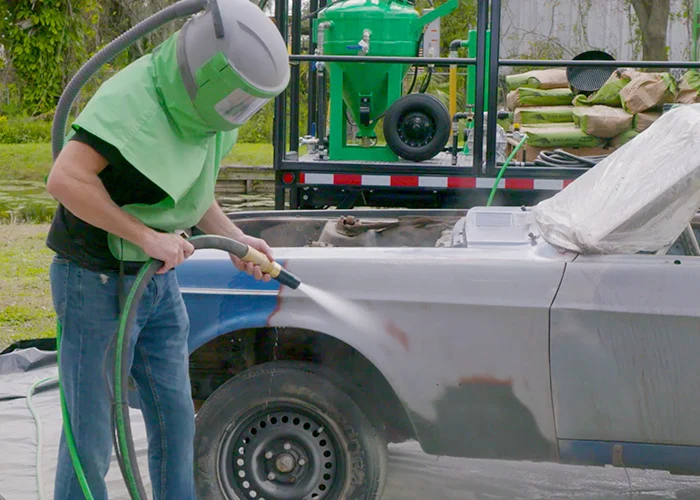
Best applications: Wet abrasive blasting systems, slurry transfer, lime milk, ceramic glaze, process slurry at moderate concentration and particle size, any application where no electrical power is available at the pump location.
4. Progressive Cavity (PC) Pumps for Abrasive Media
A progressive cavity pump consists of a helical metal rotor rotating eccentrically inside a double-helix elastomeric stator. As the rotor turns, sealed cavities form at the suction end and progress continuously from inlet to outlet, delivering smooth, pulsation-free flow at low fluid velocity. The low velocity through the pumping element is the key advantage for abrasive media: since erosion rate scales approximately with the cube of velocity, the inherently low-velocity flow path produces substantially lower erosion rates than centrifugal or high-speed pumps at equivalent flow.
✓ Advantages for Abrasive Media
- Smooth, pulsation-free flow — ideal for precision metering and dosing
- Low fluid velocity through pumping element → lower erosion rate
- Handles high-viscosity abrasive slurries where centrifugal pumps fail
- Self-priming
- High pressure capability (up to 24 bar on multi-stage designs)
- Constant volumetric flow rate regardless of discharge pressure (positive displacement)
- Handles high solids concentrations (up to 60% w/w)
✗ Limitations for Abrasive Media
- Stator wear is the dominant failure mode — must be replaced periodically
- Cannot run dry — even brief dry running destroys the stator rapidly
- Rotor wear is cumulative and affects volumetric efficiency over time
- Particle size limited to approximately 30% of pump cavity dimension
- Higher capital cost than AODD at equivalent flow
- Requires coupling and gear reducer — more mechanical complexity than AODD
Best applications: Viscous abrasive slurries (above 200 cP), precision metering of abrasive compounds, sludge dewatering and biogas digestate, underground slurry return (high-pressure capability), food processing slurries requiring gentle handling and no pulsation.
5. Head-to-Head Comparison Table
| Attribute | Peristaltic | AODD | Progressive Cavity |
|---|---|---|---|
| Abrasion resistance | ★★★★★ | ★★★★☆ | ★★★☆☆ |
| Max solids content | 40% w/w | 25% w/w | 60% w/w |
| Particle size limit | Up to hose ID | Up to port size | ~30% of cavity |
| Handles hard particles (Mohs 8+) | ✓ Best | ✓ Good | ✗ Poor |
| Viscous slurry (>500 cP) | Limited | Poor | ✓ Best |
| Self-priming | ✓ | ✓ | ✓ |
| Dry-run safe | ✓ | ✓ | ✗ |
| Flow character | Pulsating | High pulsation | Smooth |
| Max pressure | 4–6 bar | 6–8 bar | Up to 24 bar |
| Needs electricity | Yes (motor) | No (air only) | Yes (motor) |
| Wear item count | 1 (hose) | 3–4 (valves, diaphragms) | 2 (rotor, stator) |
| Typical capital cost | Medium-High | Low-Medium | Medium-High |
| Pulsation dampener needed | Often | Usually | No |
6. Scenario-Based Selection Guide
- Wet abrasive blasting with steel shot or glass beads, portable installation: AODD pump. Self-priming, no electrical power required, handles particle sizes well, adjustable output by air pressure. For very fine or very hard blast media, upgrade to peristaltic.
- Pumping alumina or silicon carbide slurry (Mohs 9) at any concentration: Peristaltic pump. Only hose contacts the media; high-chrome or rubber components of AODD or PC pumps will wear rapidly. Choose a reinforced natural rubber or EPDM hose appropriate for media concentration and particle size.
- Metered dosing of abrasive ceramic glaze compound into a production process: Progressive cavity pump. Pulsation-free flow ensures consistent glaze application; positive displacement provides accurate volume per stroke. Specify a stator hardened for abrasive service and monitor rotor-stator clearance regularly.
- Abrasive pharmaceutical or food-grade slurry requiring no contamination from pump components: Peristaltic pump with FDA-compliant hose material. Zero metal contact with the product. Hose replacement is the only maintenance task.
- Mining tailings or ore concentrate slurry at high volume (above 50 m³/h): None of these three — centrifugal slurry pump is the correct choice at this scale. See our guide: Centrifugal vs. Positive Displacement Pumps for Abrasive Media.
よくある質問
The Right Media Makes the Difference
Whichever pump type you select, the consistency of your abrasive media determines how predictably your pump wears. Jiangsu Henglihong Technology Co., Ltd. manufactures certified steel shot, steel grit, glass beads, and stainless steel shot with tight particle size distribution and controlled hardness — giving your pump the consistent, predictable media it needs to perform reliably.
Request Media Specifications →フィルター