Ceramic Tumbling Media
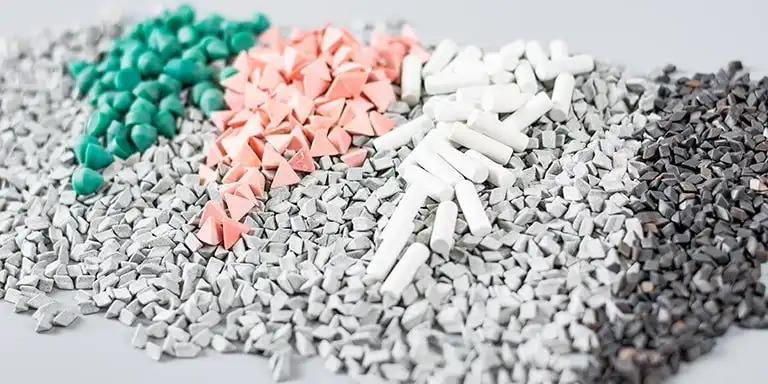
What Is Ceramic Tumbling Media
Ceramic tumbling media refers to sintered abrasive bodies manufactured primarily from alumina-based ceramic systems combined with inorganic bonding agents. Through controlled high-temperature firing, these materials are transformed into dense, mechanically stable media with predictable hardness, porosity, and wear behavior. The resulting ceramic structure enables consistent abrasive interaction with workpieces across extended finishing cycles.
In mass finishing equipment such as vibratory tumblers and rotary tumblers, ceramic tumbling media operates in conjunction with water and chemical compounds. The interaction between media and parts generates repeated contact events that remove burrs, flash, and surface irregularities while gradually refining surface roughness. Because ceramic media removes material through micro-cutting rather than plastic deformation, it allows precise control over edge radii and surface texture.
From a functional standpoint, ceramic tumbling media occupies a middle ground between plastic and steel media. It offers higher cutting aggressiveness and faster stock removal than plastic media, while avoiding the excessive burnishing forces and potential part deformation associated with steel media. This balance makes ceramic tumbling media suitable for aluminum alloys, stainless steel, zinc die castings, carbon steels, brass, copper, and mixed-material assemblies.
How Ceramic Tumbling Media Works in Mass Finishing Systems
The performance of ceramic tumbling media is governed by a combination of micro-cutting, abrasion, and controlled impact. During operation, vibratory or rotational motion induces relative movement between media and workpieces, producing rolling, sliding, and intermittent impact interactions. These interactions progressively modify the surface topography of the parts.
At the microscopic level, abrasive grains embedded within the ceramic matrix engage surface asperities and burr roots, generating localized shear forces that remove material through controlled cutting. Unlike burnishing-dominated processes, ceramic media does not primarily rely on plastic deformation, which allows predictable material removal and minimizes work hardening. This mechanism is critical for achieving repeatable surface finishes in precision manufacturing.
The overall finishing outcome is influenced by a system of interacting variables, including media geometry, media size, density, hardness, compound chemistry, water ratio, machine amplitude, and cycle time. Properly engineered ceramic tumbling media ensures that its intrinsic properties remain stable over time, allowing process parameters to be optimized and maintained.
- Impact forces fracture burrs and remove casting flash
- Sliding abrasion smooths surface irregularities
- Rolling motion promotes uniform edge radiusing
- Controlled porosity supports compound retention and debris evacuation
Types of Ceramic Tumbling Media by Shape and Geometry
Media geometry is one of the most critical design variables in ceramic tumbling media selection. Shape directly affects contact mechanics, cutting intensity, media flow behavior, and the risk of part lodging. A detailed shape reference can be found in the Ceramic Tumbling Media Shapes guide.
Angle Cut Ceramic Tumbling Media
Angle cut ceramic tumbling media features sharp edges and angular faces that concentrate contact pressure at discrete points. This geometry produces aggressive cutting action and high material removal rates, making it suitable for heavy deburring, flash removal, and rapid edge knockdown. Angle cut media is typically used in early-stage finishing operations where throughput is prioritized over surface refinement.
Due to its geometry, angle cut ceramic media presents an increased risk of lodging in small holes or narrow slots if improperly sized. Media dimension control and part geometry analysis are therefore essential when selecting this type.
Cylindrical Ceramic Tumbling Media
Cylindrical ceramic tumbling media provides a balanced interaction between cutting and smoothing. Rounded edges distribute contact forces more evenly, reducing localized stress and enabling controlled edge radiusing. Cylindrical media is widely used for general-purpose deburring, surface conditioning, and pre-polishing applications.
This geometry is often preferred for components with through-holes or internal features, as the risk of lodging is lower compared with angular media shapes.
Straight Cut and Custom Shape Ceramic Media
Straight cut and custom-shaped ceramic media are engineered for specialized applications involving complex geometries, thin walls, or sensitive features. These shapes are frequently developed to optimize media flow, contact orientation, and part separation behavior within the finishing chamber.
Ceramic Tumbling Media Size Selection and Lodging Prevention
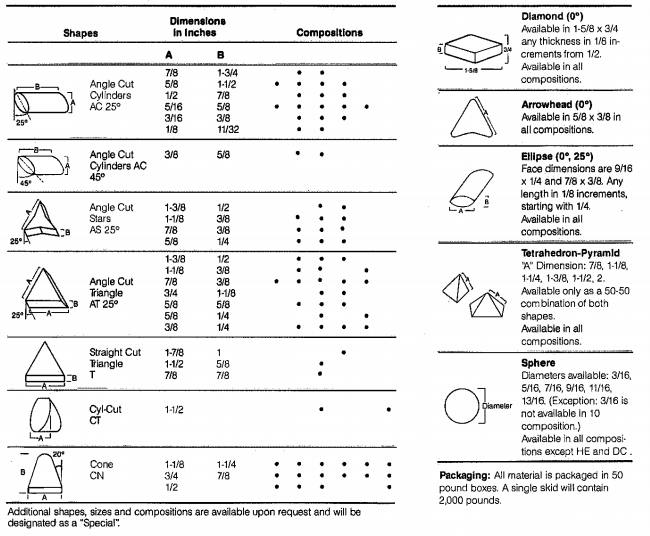
Media size selection is a critical factor in achieving efficient finishing while preventing part lodging or damage. Improperly sized ceramic tumbling media can become trapped in holes, slots, or cavities, leading to production downtime and scrap risk. A detailed dimensional reference is provided in the Ceramic Media Size Chart.
As a general engineering guideline, the minimum dimension of ceramic media should exceed the smallest opening in the workpiece by a sufficient safety margin. Conversely, excessively large media may reduce surface contact efficiency and increase cycle time.
Ceramic Tumbling Media Material Composition and Manufacturing
The performance characteristics of ceramic tumbling media are fundamentally determined by material formulation and manufacturing process control. Most industrial ceramic media is based on alumina (Al₂O₃) systems, often combined with silica and fluxing agents to regulate sintering behavior. Inorganic binders provide structural integrity and thermal stability.
Manufacturing involves raw material blending, shaping, and firing at temperatures typically above 1200°C. The sintering process creates a dense ceramic matrix with controlled micro-porosity. Post-firing classification ensures consistent size distribution and mechanical properties, which is essential for repeatable finishing performance.
Technical Parameters of Ceramic Tumbling Media
| パラメータ | Typical Range | Process Impact |
|---|---|---|
| かさ密度 | 2.3 – 2.6 g/cm³ | Determines cutting energy and contact force |
| 硬度 | Mohs 7 – 9 | Controls abrasive aggressiveness and wear rate |
| Porosity | Low to controlled micro-porosity | Affects compound retention and debris removal |
| メディアサイズ | 3 – 50 mm | Must match part geometry to prevent lodging |
| Cutting Rate | Medium to high | Influences cycle time and stock removal |
| Service Life | Thousands of cycles | Impacts total cost of ownership |
Applications of Ceramic Tumbling Media by Material
Ceramic tumbling media is used across a wide range of industries and materials where controlled finishing is required. Application-specific considerations such as hardness, ductility, and surface sensitivity must be accounted for during media selection.
- Aluminum components: deburring, edge radiusing, surface smoothing (see Ceramic Media for Aluminum)
- Stainless steel parts: burr removal and matte finishing
- Zinc die castings: flash removal and surface homogenization
- Carbon steel components: pre-finishing prior to coating
- CNC machined parts: tool mark reduction and surface conditioning
Ceramic Tumbling Media vs Plastic and Steel Media
Understanding the differences between ceramic, plastic, and steel tumbling media is essential for correct process selection. A more detailed comparison is available in the Ceramic vs Plastic Tumbling Media reference.
| メディア・タイプ | Primary Mechanism | Surface Result | Typical Use |
|---|---|---|---|
| セラミック・メディア | Micro-cutting and abrasion | Controlled, uniform | Deburring, edge radiusing, smoothing |
| プラスチック・メディア | Mild abrasion | Gentle, cosmetic | Light deburring, sensitive materials |
| Steel Media | Burnishing | High gloss | Surface densification and polishing |
How to Select Ceramic Tumbling Media: Engineering Decision Logic
Effective ceramic tumbling media selection requires a structured evaluation of part characteristics, process objectives, and equipment parameters. The following decision logic provides a practical framework for engineering selection.
- Identify base material and hardness
- Define initial surface condition and target Ra
- Analyze part geometry, holes, slots, and fragile features
- Select media shape based on cutting aggressiveness and safety
- Determine media size using geometry-based constraints
- Choose hardness and density to balance cutting rate and surface control
- Validate selection through pilot trials and surface measurements
Frequently Asked Questions About Ceramic Tumbling Media
Is ceramic tumbling media suitable for high-volume production?
Yes. Ceramic tumbling media is widely used in high-volume manufacturing due to its durability, consistent performance, and predictable wear behavior.
Can ceramic tumbling media be used on delicate parts?
When properly sized and selected, ceramic media can safely process delicate parts. Incorrect geometry or oversizing is the primary cause of part damage.
How does ceramic media affect total finishing cost?
Although ceramic tumbling media has a higher initial cost than plastic media, its longer service life and higher processing efficiency often result in lower total cost of ownership.
フィルター