The Ultimate Guide to Sandblasting Media: Types, Grit Sizes, and Applications
Welcome to your comprehensive guide on sandblasting media—sometimes called sandblast media or sandblaster media. Whether you are preparing steel for coating, cleaning a worn mold, or refining an automotive component, the right abrasive matters. In this guide, we’ll cover everything from the basics of what sandblasting media is, to how it works, to detailed specifications and applications, to how you choose the best media for your job. We’ll also link you to detailed deep-dives on specific materials so you can find the exact match for your surface-preparation task.
Table of Contents
- Introduction to Sandblasting Media
- How Sandblasting Media Works
- Major Types of Sandblasting Media
- Sandblasting Media Grit Sizes Explained
- Key Properties That Define Media Performance
- Comparing Different Sandblasting Media
- Choosing the Right Sandblasting Media for Your Application
- Соображения по охране окружающей среды и безопасности
- Common Problems and How to Solve Them
- Summary: Optimizing Your Sandblasting Process
1. Introduction to Sandblasting Media
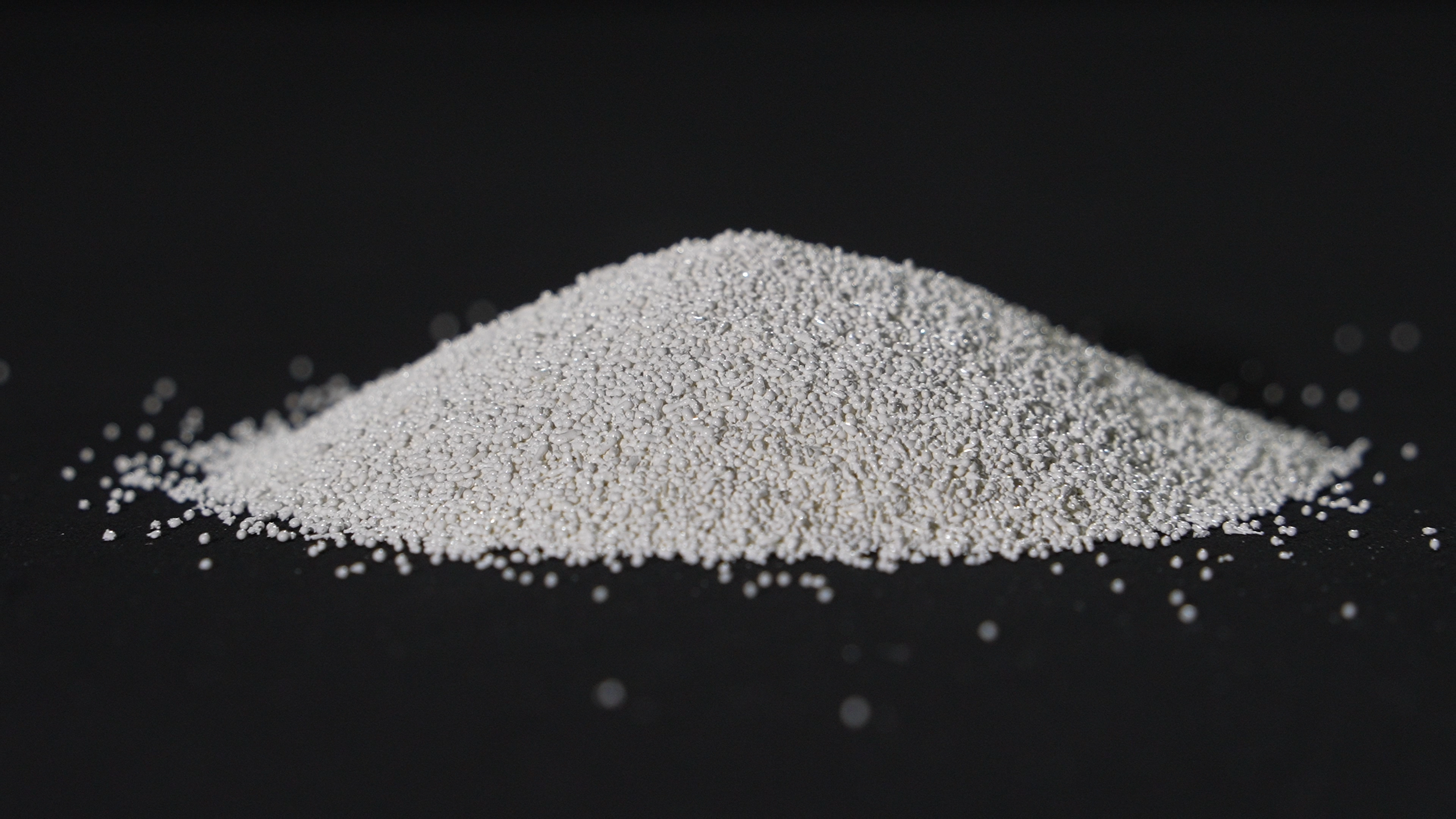
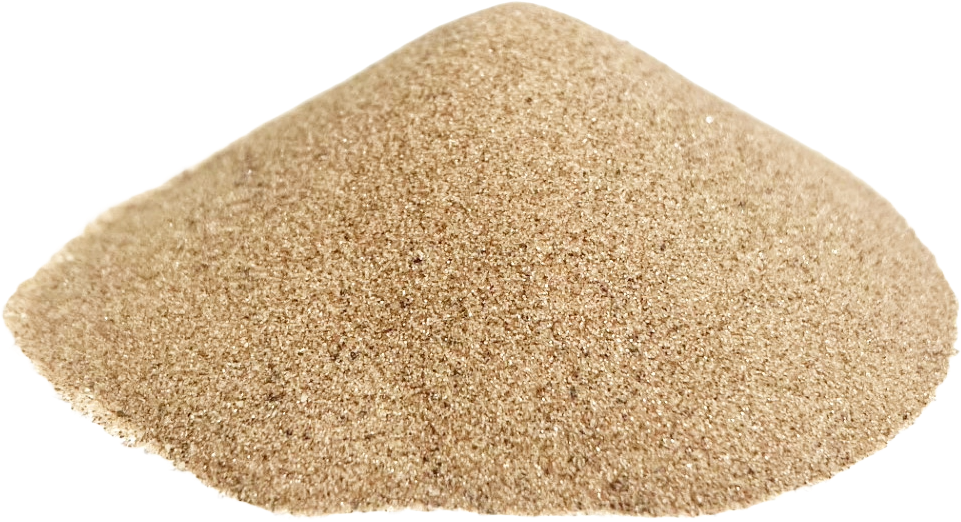
“Sandblasting media” is a term you’ll often see in surface-preparation and industrial-cleaning discussions. Essentially, it refers to the material used in the blasting process to clean, profile or finish a substrate. The term “sandblast media” is synonymous, and sometimes people also call it “sandblaster media.” Regardless of name, the function is the same: an abrasive particle propelled at a surface to achieve a targeted outcome.
Spray-or blast-cleaning has been around for decades, and the choice of media has grown far beyond natural silica sand (which is now largely avoided due to health risks). Modern sandblasting media are engineered for specific tasks: rust removal, paint stripping, surface roughening, glossing, polishing and more. Choosing the right one influences surface finish quality, coating adhesion, cycle time and overall cost.
In this guide we will build a strong foundation—explaining how media works, showing major types of media, covering grit-size concepts, exploring performance parameters, comparing media side-by-side, and giving actionable criteria for selection. We’ll also cover environmental and safety aspects, and common pitfalls in actual operations.
Finally, each major media type is explored in dedicated cluster pages—for example Aluminum Oxide Sandblasting Media, Garnet Sandblasting Media, Crushed Glass Sandblasting Media and so on. These detailed pages are linked at appropriate points throughout this article.
2. How Sandblasting Media Works
To appreciate why different media behave differently, you need to understand the physical mechanism behind sandblasting. At its core, blasting involves accelerating abrasive particles (media) under pressure or mechanical force so that they impact the target surface, transferring kinetic energy which removes material, creates a profile or smooths the surface.
The key variables in this process are:
- Particle velocity: Higher velocity increases impact energy. More impact energy can remove tougher coatings or scale.
- Particle mass / density: Heavier and denser particles carry more momentum at the same velocity.
- Particle hardness and shape: A sharp, angular particle will cut or scar more aggressively; a spherical or soft particle may roll or polish rather than cut.
- Surface properties: The substrate (steel, aluminum, plastic, wood) influences how the media interacts (cut, dent, polish, or abrade).
- Blast angle and stand-off distance: The angle at which particles hit and the distance they travel affect effectiveness and surface finish.
When the particles hit the surface, multiple phenomena can happen:
- **Cutting or scouring**: when angular or hard media interact with scale, rust or coatings.
- **Plastically deforming the substrate surface**: which is often the case in aggressive cleaning of heavy steel structures.
- **Surface profiling or peening**: creating a roughness (often expressed as Ra value) that helps coating adhesion or changes surface reflectivity.
- **Polishing or smoothing**: when spherical or very fine media are used at lower pressures for finishing purposes.
For example: when cleaning rust from a steel plate, you might use coarse, hard, angular media. But when you want a satin finish on a cast-aluminum part, you might choose a softer, finer, spherical media with lower kinetic energy. This is why the correct selection matters—what works for one substrate or finish may damage another.
As you explore the individual media types later (see section 3), pay attention to how those media behave in real-world applications, and how that aligns with the physics described above.
3. Major Types of Sandblasting Media
There is a wide variety of sandblasting media available today. Below we summarise the most commonly used types. Each type has its own strengths, weaknesses and ideal applications. For a deeper dive into each type, check the linked cluster pages.
3.1 Aluminum Oxide
Aluminum Oxide Sandblasting Media is a high-hardness abrasive (Mohs ≈ 9) known for aggressive material removal, long life when recycled, and excellent performance on steel and similar substrates. Because of its hardness and angular shape, it is widely used in heavy-duty surface preparation tasks.
3.2 Garnet
Garnet Sandblasting Media is a natural mineral abrasive, offering moderate hardness, low dust, and good environmental credentials. It is often used in waterjet cutting as well as dry-blast surface preparation of metal and concrete surfaces.
3.3 Crushed Glass
Crushed Glass Sandblasting Media is manufactured from recycled glass, making it eco-friendly while delivering effective cleaning for paint stripper and rust removal applications. Its angular shards aid cleaning yet can be gentler on the substrate compared to coal slag.
3.4 Plastic Media
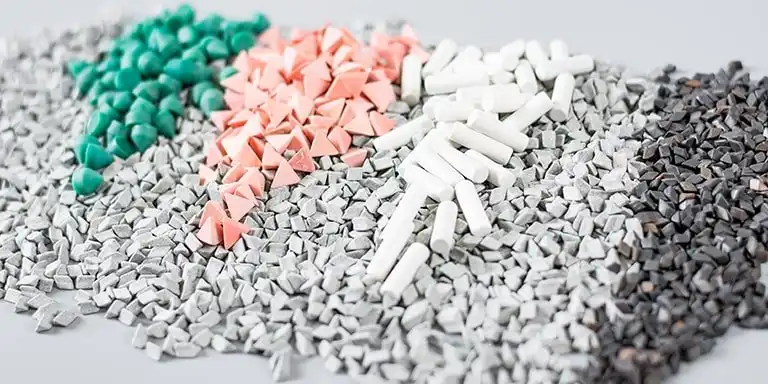
Plastic Sandblasting Media is lower hardness, engineered for precision cleaning in industries like aerospace and automotive where substrate damage must be minimized—e.g., removing coatings from delicate parts or lightweight aluminum components.
3.5 Walnut Shell
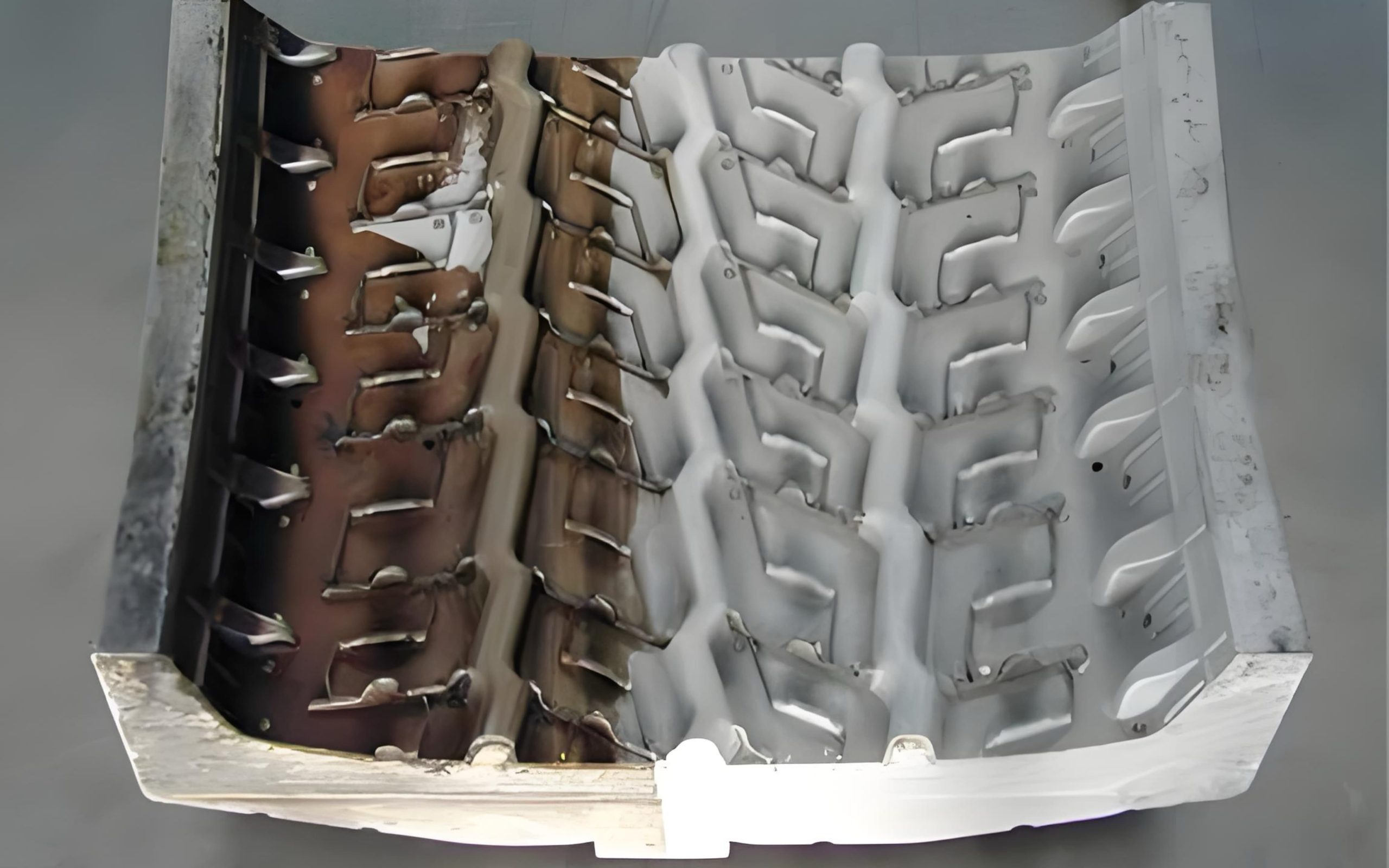
Walnut Shell Sandblasting Media is a biological, low-hardness media ideal for cleaning wood, soft metals, and certain mold surfaces. It is gentle yet effective, reducing risk of substrate damage while removing contaminants and old coatings.
3.6 Coal Slag
Coal Slag Sandblasting Media is a cost-effective abrasive often used in large, heavy-duty cleaning such as ship hulls, steel beams and structural overhaul. Although inexpensive, it may produce more dust and requires proper containment.
3.7 Black Beauty
Black Beauty Sandblasting Media is a coated coal slag derived media with enhanced durability and performance compared to untreated coal slag. It’s used when strong cleaning power is needed but you want improved consistency and less breakage.
3.8 Black Diamond
Black Diamond Sandblasting Media is a more wear-resistant alternative to conventional coal slag, often used in situations where cost is still important but performance and life-cycle cost need improvement.
3.9 Glass Bead
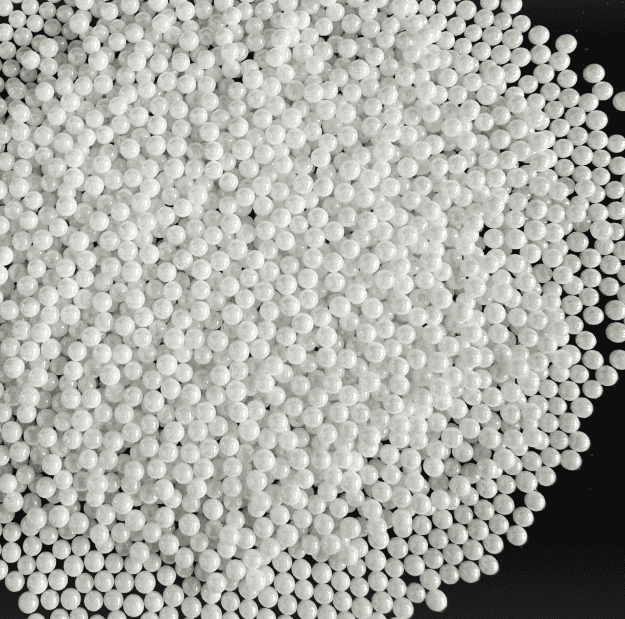
Glass Bead Sandblasting Media consists of spherical glass particles that are ideal when you want a smooth, satin or polished finish rather than a sharp profile. Common in finishing dies, aerospace components, and decorative work.
3.10 Specialty & Hybrid Media
In some applications, hybrid or specially engineered media are used—combinations of the above materials or media with added coatings to provide dual-function (e.g., cleaning plus peening). For a comprehensive comparison of “best media” for given tasks, see Best Sandblasting Media for Different Applications.
4. Sandblasting Media Grit Sizes Explained
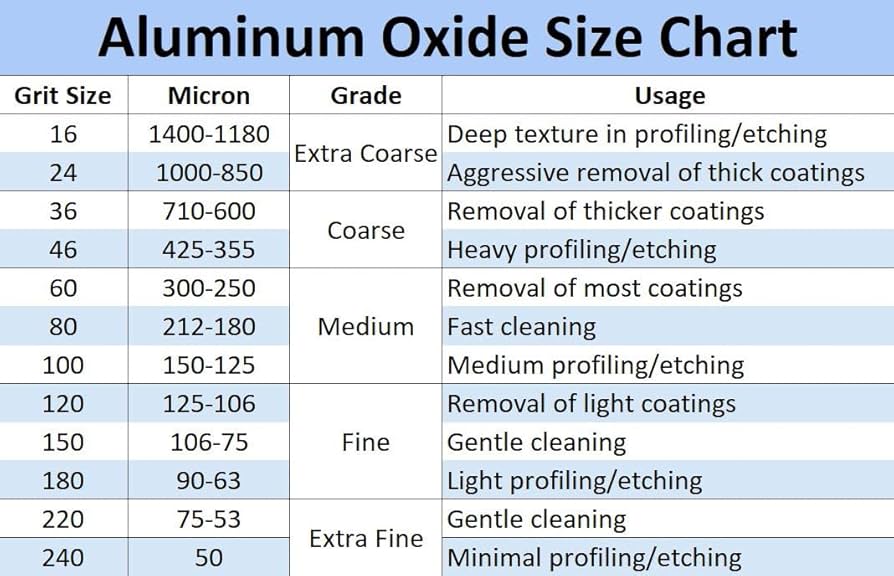
One of the most important (and sometimes overlooked) parameters is the grit size of the abrasive. Grit size determines the size of individual particles and can strongly influence surface finish, profile depth, and overall performance.
Here are some key concepts:
- Mesh size – Often the term “#40 mesh” or “#80 mesh” is used. This indicates how many openings there are per inch in a sieve used to classify the media.
- Particle diameter – Mesh size correlates roughly to particle diameter. For example, #40 might correspond to ~420 µm, while #120 may be ~125 µm (depending on media type).
- Coarse vs. medium vs. fine grit -
- Coarse: #16–#36 (large particles). Good for heavy rust removal or large bulk cleaning.
- Medium: #40–#80. Common choice for standard surface prep before painting.
- Fine: #100–#220 or finer. Used for finishing, polishing or light cleaning tasks.
Below is a table summarizing typical grit-size ranges and their applications:
| Mesh Size | Approx. Particle Diameter | Typical Application |
|---|---|---|
| #16–#24 | ~1000–710 µm | Heavy rust or scale removal on steel plates |
| #30–#40 | ~600–400 µm | Structural steel cleaning, ship hulls |
| #50–#80 | ~300–180 µm | General surface preparation for coating |
| #100–#220 | ~150–70 µm | Surface finishing, satin finish, delicate parts |
When selecting grit size, think of the desired surface outcome: deep profile for coating adhesion or gentle texturing for polish. Matching grit to media type and substrate is key. For example, a coarse aluminum-oxide grit could be overkill for soft aluminum sheet and may damage it; conversely, fine walnut-shell grit might be too mild for heavy industrial steel and simply extend cycle time without achieving the required profile.
For more help in selecting the best media for your application—including matching grit and media types—see the detailed guide on Best Sandblasting Media for Different Applications.
5. Key Properties That Define Media Performance
Beyond grit size, performance of blasting media is defined by a range of technical parameters. Below we break them down.
Твердость (шкала Мооса)
Hardness is a measure of how resistant the abrasive particle is to being scratched. On the Mohs scale, aluminum oxide is ~9, whereas walnut shell is much lower (around 2.5-3). A harder particle can cut faster but also risks damaging the substrate or wearing blast equipment more quickly.
Плотность (г/см³)
Density directly affects particle mass (for given size). Higher density means heavier mass at same volume and thus greater momentum. For example, steel media or some ceramics may outperform lighter materials like glass beads when targeting quickly removing heavy scale.
Shape (Angular vs. Spherical)
Shape influences how particles impact the surface. Angular particles (like crushed glass or coal slag) tend to cut or scar. Spherical particles (like glass beads) tend to roll or polish. Knowing desired finish determines shape choice.
Recyclability / Life Cycle
Some media can be reused multiple times (for example, certain grades of aluminum oxide or garnet), reducing cost per cycle. Others are single-use (coal slag) or degrade faster. Consider media life when calculating total cost of ownership.
Breakage Rate & Dust Generation
Media that breaks up easily will generate fine particles and dust, which can degrade visibility, contaminate workspace, and reduce effectiveness. Higher durability media may cost more but reduce dust, maintenance, and health risks.
Environmental & Health Impact
Media that generate less dust, have fewer hazardous constituents, or are easier to recycle will simplify compliance with health, safety and environmental standards. For example, natural garnet or recycled crushed glass often score high in these categories.
To see how these properties play out in actual materials, refer to the individual media pages such as Оксид алюминия, Plastic Sandblasting Media, и Walnut Shell Sandblasting Media.
6. Comparing Different Sandblasting Media
Here is a side-by-side comparison of typical media types to help you benchmark performance and cost. Note: values are approximate and vary by supplier and grade.
| Тип носителя | Hardness (Mohs) | Возможность вторичной переработки | Dust Generation | Cost Estimate | Ideal Substrates |
|---|---|---|---|---|---|
| Оксид алюминия | ~9 | Высокий | Low-Medium | Higher | Steel, cast iron, heavy duty removal |
| Гранат | ~6.5-7 | Medium | Низкий | Medium | Metal, concrete, waterjet backing |
| Crushed Glass | ~5-6 | Medium | Medium | Medium-Low | Paint stripping, rust removal, steel |
| Пластиковые носители | ~2.5-4 | Высокий | Очень низкий | Высокий | Aerospace components, soft metals |
| Walnut Shell | ~2.5-3 | Low-Medium | Низкий | Низкий | Wood, mold cleaning, soft surfaces |
| Coal Slag | ~6 | Низкий | Высокий | Низкий | Heavy structural steel, ship hulls |
| Black Beauty | ~6-7 | Low-Medium | Medium | Low-Medium | Steel cleaning with improved control |
| Black Diamond | ~6-7.5 | Low-Medium | Medium | Low-Medium | Structural cleanup with higher durability |
| Glass Bead | ~5-6 | Высокий | Очень низкий | Medium | Finishing, polishing, satin surfaces |
From this table you can draw a few conclusions:
If you need aggressive cleaning with high material removal, go for a high-hardness media like aluminum oxide. If you need finish or polish, glass beads or plastic media make more sense. If budget matters and substrate is robust (structural steel), coal slag or black beauty may be cost-effective—but you should plan for higher dust and maintenance. For environmentally sensitive jobs or softer parts, garnet, crushed glass or walnut shell may offer the best balance.
Remember: the best media is not always the hardest or cheapest—it’s the one that fits your substrate, your finish goal, your process cycle time and your budget. Use this comparison as a guide, and then dig deeper into each media’s specific page.
7. Choosing the Right Sandblasting Media for Your Application
Now that you understand how media works, what types exist, what sizes and properties matter, and how they compare, it’s time to make a decision for your specific project. Below is a step-by-step procedure you can follow:
- Identify the substrate: Is it steel, cast iron, aluminum, plastic, wood, composite? Each behaves differently when blasted.
- Define the surface condition: Are you removing heavy rust/scale, paint, oxide, or simply preparing for coating? Do you need a profile (roughness) or a smooth finish?
- Check equipment and environment: Blast pressure, stand-off distance, media flow rate, containment (indoors/outdoors), dust collection—these affect media choice and economy.
- Select the media family: Using your substrate and surface goal, pick media type (see section 3) that fits. Use the cluster pages for deeper insight.
- Select grit size: Use table in section 4 to pick coarse for heavy removal, medium for general prepping, fine for finishing or delicate parts.
- Verify recyclability and cost implications: If you recycle media, higher upfront cost may pay off via longevity. If single-use, low cost may be more important.
- Consider environmental/health factors: If indoor workspace, minimal dust or low hazard media matters—see section 8.
- Test and validate: Perform a small test: measure surface roughness (Ra), check coating adhesion, examine cycle time. Adjust media or grit size as needed.
Here is a quick reference conversion table (substrate vs recommended media):
| Substrate / Application | Recommended Media Type | Typical Grit Range / Notes |
|---|---|---|
| Steel with heavy rust/scale | Aluminum Oxide, Coal Slag | #16–#40, high hardness |
| General structural steel prep before painting | Garnet, Crushed Glass | #30–#80, moderate hardness, reusable |
| Cast aluminum part, moderate cleaning | Crushed Glass, Plastic Media | #50–#120, lower hardness to avoid substrate damage |
| Wood piece or mold cleaning | Walnut Shell | #80–#150, very low hardness, minimal substrate effect |
| Interior finishing, satin surface on metal | Glass Bead | #100–#220, spherical particles for smooth finish |
| Large steel blast job, budget constrained | Black Beauty, Black Diamond | #30–#60, lower cost, adequate performance |
Be sure to cross-reference your selected media with its dedicated cluster page—for example Garnet Sandblasting Media или Black Beauty Sandblasting Media—to check detailed specs, vendor grades and real-world case studies.
8. Environmental and Safety Considerations
Understanding and controlling environmental and safety factors is critical when choosing and using sandblasting media. Here are key considerations:
Dust and Airborne Particulates
Many blasting media generate fine dust, which can impair visibility, harm operators’ respiratory systems and contaminate adjacent areas. Media types with lower breakage and dust generation (like plastic media, glass beads, garnet) are preferable in indoor or contained environments. Always use proper dust-collection systems and follow local regulations (OSHA in the U.S.).
Substrate Contamination and Waste Handling
Spent media mixed with removed coatings, rust, paint or substrate fragments may classify as hazardous waste depending on material. Some media (like coal slag) may require special disposal. Choose a media that eases waste handling and recycling wherever possible—for example, natural garnet or recycled crushed glass.
Operator Health and Safety
Protective equipment (PPE) is non-optional: blast helmet, respirator certified for silica-free dust, hearing protection, gloves, and body protection. Also consider rebound hazards when blasting at odd angles or on complex shapes. Media that rebounds excessively or shatters easily can increase risk.
Воздействие на окружающую среду
Eco-friendly media are increasingly preferred. For example:
- Recycled crushed glass reduces landfill waste.
- Natural garnet mining has lower environmental impact than some coal-slag processing.
- Reusable media reduce consumption and waste generation.
If you are operating in regulated zones or inside enclosed facilities, choose media specifically rated for low dust and low hazard environments.
For in-depth environmental profiles of each media type, see pages like Crushed Glass Sandblasting Media и Walnut Shell Sandblasting Media.
9. Common Problems and How to Solve Them
Even with the correct media, many blasting jobs still encounter issues. Here are common problems and how to address them.
Blast Pressure Fluctuations
Problem: Pressure drops during operation, reducing cleaning power or altering profile depth.
Solution: Check hoses and fittings for leaks; ensure compressor capacity meets demand; use proper nozzle size; control media flow rate and maintain equipment.
Uneven Surface Roughness or Inconsistent Profile
Problem: Some areas of the substrate look rougher or smoother than intended, making coating adhesion unpredictable.
Solution: Check blast angle and stand-off distance; ensure consistent traverse speed; verify media size and shape remain within spec (media can degrade and round off); assess substrate geometry for shadow zones or under-cutting.
Media Clogging or Agglomeration
Problem: Media clumps or binds in the hopper or nozzle, reducing flow and potentially causing bursts of inconsistent blasting.
Solution: Ensure media is dry and free-flowing; use vibrators or agitation in hopper; verify no moisture ingress; consider switching to a more durable media if breakage rate is high.
Excessive Dust or Poor Visibility
Problem: Too much dust reduces visibility and may hamper productivity or worker safety.
Solution: Use lower-dust media (e.g., glass beads, plastic); improve dust collection equipment; maintain negative pressure in enclosure; schedule clean-up intervals; ensure media is being recycled properly if relevant.
Substrate Damage or Undesired Effects
Problem: The substrate shows gouging, deformation or excessive removal due to incorrect media choice.
Solution: Re-evaluate media hardness and grit size—select a gentler media like plastic or walnut shell instead of aggressive ones like aluminum oxide; reduce blast pressure; increase stand-off distance; consider a finishing media pass to smooth damage.
In many cases these problems stem from trying to use a “one size fits all” media rather than matching media to substrate and finish goal. Always refer back to media selection matrix in section 7 and consult the specific media type pages such as Coal Slag Sandblasting Media for procurement, handling and best-practice details.
10. Summary: Optimizing Your Sandblasting Process
To wrap up: selecting the right sandblasting media is a technical decision that blends substrate type, surface condition, equipment capability, environmental/safety requirements and budget. Here’s a recap of the key points:
- Understand your substrate and surface condition. Are you removing heavy rust or creating a satin finish?
- Explore media types. From high-hardness aluminum oxide to gentle walnut shell, there’s a fit for every job.
- Select the correct grit size. Coarse for heavy removal, medium for standard precoat, fine for finish or delicate surfaces.
- Compare key performance parameters. Hardness, density, shape, recyclability, dust, cost—all matter.
- Match media to operational constraints. Equipment, budget, dust control, environmental regulations all influence choice.
- Test and validate your process. Measure results, inspect substrate, assess coating adhesion, adjust as needed.
- Keep safety and environment front-of-mind. Use proper PPE, dust control, disposal or recycling practices.
By following the guidance in this ultimate guide, you’ll be able to make informed decisions about your sandblasting media selection, optimize surface-preparation efficiency, improve coating outcomes and control costs. Start with the right media, size it correctly, adjust your process—and you’ll see better results across your entire surface-treatment workflow.
Thank you for reading, and here’s to achieving clean, consistent, high-quality surfaces in your next blasting job.
Фильтры