Garnet Blast Media: Why Professionals Choose It for Surface Prep
Among the natural mineral abrasive media used in industrial blasting, almandine garnet occupies a position of exceptional reputation. Blasting contractors working on oil and gas pipelines, ship hull rehabilitation, offshore platforms, and bridge structures have converged on garnet as a benchmark media — not because it is the cheapest option per bag, or because it has the highest reuse cycle count, but because it consistently produces the combination of surface cleanliness, anchor profile quality, low dust, and near-zero free silica content that professional-grade coating contracts demand. When a coating inspector signs off on a blasted steel surface, garnet-blasted substrates consistently pass specification with fewer re-works and disputes than substrates prepared with lower-quality alternatives.
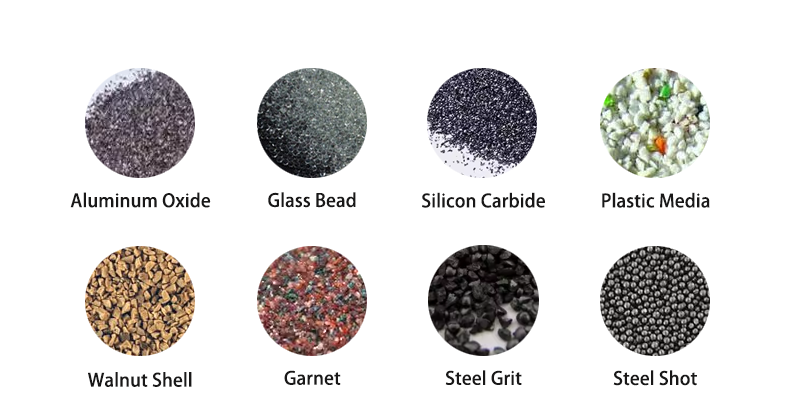
This guide covers the geology, physical properties, size options, performance advantages, and application scope of garnet blast media, along with a frank comparison with competing abrasives. For a full overview of all media types, see the Abrasive Media Supplies Buyer’s Guide.
What Is Garnet Blast Media?
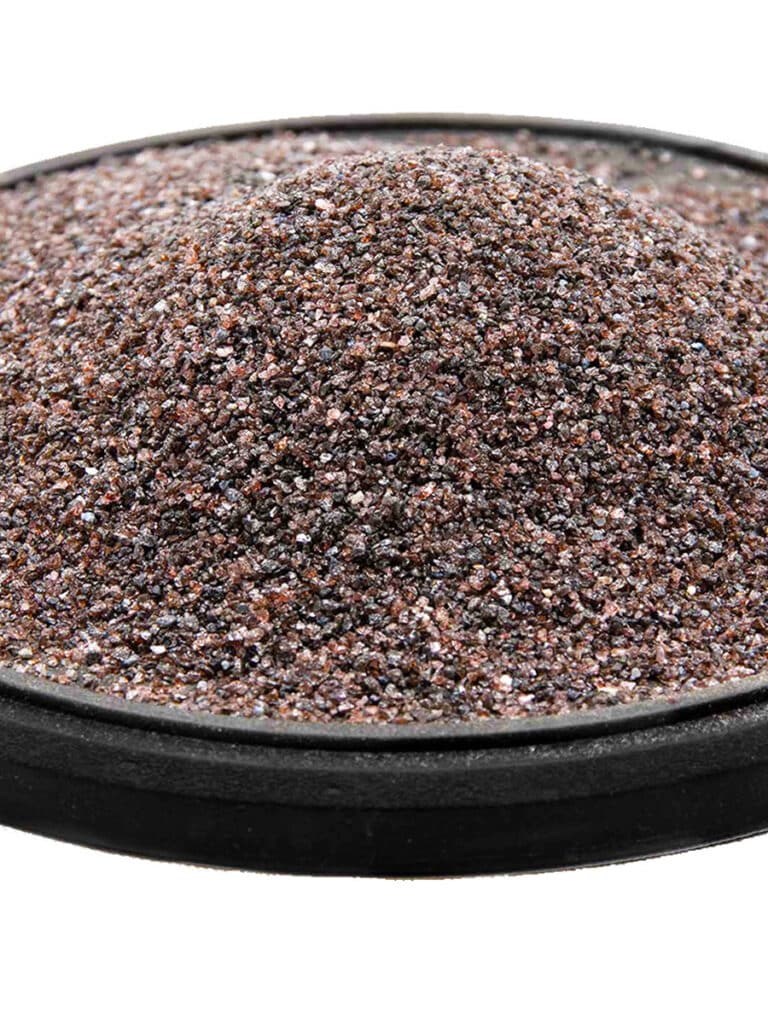
Garnet is a group of naturally occurring silicate minerals sharing a common crystal structure but varying in chemical composition. The commercially significant garnet for blasting is almandine garnet — an iron-aluminum silicate (Fe₃Al₂(SiO₄)₃) with a characteristic dark red to brownish-red color, mined primarily in India, Australia, South Africa, and the United States. Almandine garnet combines the hardness, density, toughness, and low free-silica content that make it suitable for professional industrial blasting to the stringent cleanliness and profile requirements of major coating specifications.
The garnet mineral is crushed, processed to remove clay and fine material, dried, and screened to produce the angular, sub-angular grit used in blasting. The natural crushing process produces a particle shape that is sub-angular to angular — presenting multiple cutting edges without the extreme angularity of some manufactured abrasives — which delivers a sharp, well-defined anchor profile on steel substrates without the tendency to produce an excessively jagged or directional texture.
Physical and Chemical Properties
| Property | Almandine Garnet |
|---|---|
| Mineral Type | Natural iron-aluminum silicate |
| Chemical Formula | Fe₃Al₂(SiO₄)₃ |
| Твердость по Моосу | 7.5–8.5 |
| Удельная плотность | 3.9–4.1 g/cm³ |
| Форма частиц | Sub-angular to angular |
| Free Silica (SiO₂) | <1% (non-crystalline silicate) |
| Цвет | Dark red to brownish-red |
| Reuse Cycles | 5–10 (limited recyclability) |
| Dust Generation | Low to moderate |
| Applicable Standards | ASTM D7256, ASTM B-7, SSPC-AB 1 |
The free silica content below 1% is one of garnet’s most commercially important properties from a regulatory standpoint. The silicate minerals in garnet (the silica is in a non-crystalline, chain-silicate crystal lattice rather than the free crystalline quartz form that causes silicosis) do not present the respirable crystalline silica hazard of quartz sand, making garnet compliant with OSHA’s 29 CFR 1926.1153 silica standard without requiring the supplemental engineering controls and medical surveillance that crystalline silica exposure would mandate. This compliance advantage is one of the primary reasons garnet displaced silica sand in professional blasting operations over the preceding decade.
Mesh Sizes and Surface Profiles
| Mesh Size | Particle Size Range | Typical Profile (Rz) | Cleanliness Achievable | Common Application |
|---|---|---|---|---|
| #12 / #20 | 850–1,700 µm | 80–120 µm | Sa 3 | Heavy scale, thick coating removal |
| #20 / #40 | 420–850 µm | 60–90 µm | Sa 2.5–Sa 3 | Structural steel, heavy industrial |
| #30 / #60 | 250–600 µm | 40–70 µm | Sa 2.5 | Pipeline, marine, bridge work (most common) |
| #80 | 150–210 µm | 25–45 µm | Sa 2–Sa 2.5 | Thin coating systems, aluminum structures |
| #120 | 100–150 µm | 15–25 µm | Sa 2 | Fine surface conditioning, stainless steel |
The #30/60 grade is by far the most widely used size for professional industrial blasting. At a median particle size of approximately 350 µm and with the typical blast pressure of 80–100 psi through a #6 or #7 nozzle, #30/60 garnet consistently delivers the 40–75 µm Rz profile required for the majority of industrial epoxy, polyurethane, and zinc-rich primer coating systems to both SSPC-SP 10 near-white and ISO Sa 2.5 cleanliness standards.
Why Professionals Choose Garnet
Low Dust Generation
Garnet generates significantly less airborne dust per unit of surface area blasted than copper slag or silica sand under comparable operating conditions. This is attributable to two factors: the higher specific gravity (3.9–4.1 g/cm³ vs 2.7 g/cm³ for silica) means that garnet particles carry more kinetic energy per unit of blast air volume, allowing lower air volumes to achieve equivalent cut rates — and therefore generating less dust-carrying air; and the toughness of almandine garnet limits the degree of particle fracture on impact, producing fewer fine particles per impact event than more friable abrasives. Lower dust translates to better visibility in enclosed blast areas, reduced filtration loading, lower worker health risk, and potentially reduced blast frequency requirements in regulatory environments.
Consistent Surface Profile
The sub-angular morphology and narrow hardness range of almandine garnet produce exceptionally consistent anchor profiles across a blasted surface. Coating inspectors frequently note the uniformity of garnet-blasted surfaces relative to copper slag or mixed-mineralogy abrasives, where hardness variation between individual particles can produce an irregular profile with high peak-to-valley variation. This consistency reduces the probability of coating failures at high spots (where thin coating over a peak can allow rust initiation) and at low valleys (where coating thickness may be excessive and prone to solvent entrapment).
OSHA-Compliant, Low Free Silica
With free crystalline silica below 1%, garnet satisfies the OSHA 29 CFR 1926.1153 table 1 engineering control requirements without additional medical surveillance requirements that would apply to operations using crystalline silica-containing abrasives. For contractors bidding on government, energy sector, or large industrial contracts, this compliance advantage eliminates a significant documentation and operational burden. For more on silica-free abrasive options, see: Silica-Free & Eco-Friendly Abrasive Blast Media: OSHA Compliant Options.
Recyclability: 5–10 Cycles
Garnet is not a high-reuse abrasive by the standards of metallic media — but in environments with dust-collector equipped blast rooms, 5–10 cycles of recirculation can be achieved with a properly calibrated separator and screen system. In open-blast field applications (pipeline, marine, infrastructure), garnet is typically used as a single-use media due to the impracticality of reclaiming spent media on-site. For applications where high recycle count is the primary economic driver, steel grit or aluminum oxide are more appropriate choices — see: Recyclable vs Single-Use Abrasive Media: Cost-Per-Cycle Analysis.
Key Industries and Applications
- Oil & gas pipelines: External pipeline coating systems (FBE, 3LPE, liquid epoxy) universally specify garnet-compatible surface profiles; garnet #30/60 is the default specification on most pipeline contractor procedures
- Shipbuilding and ship repair: Hull blasting to Sa 2.5 for antifouling and anticorrosion coating systems; garnet’s low dust is particularly valued in confined enclosed spaces on vessels
- Offshore platforms and subsea structures: Where coating failure means multi-million-dollar repair costs, garnet’s profile consistency and cleanliness compliance quality justify the higher cost over copper slag
- Bridges and infrastructure: Coating re-work on existing structures where dust and containment are regulated by environmental permit
- Industrial maintenance: Tank interior and exterior coating maintenance in petrochemical, water treatment, and power generation facilities
Garnet vs Copper Slag vs Steel Grit
| Factor | Гранат | Copper Slag | Стальная крошка |
|---|---|---|---|
| Hardness (Mohs) | 7.5–8.5 | 6-7 | 7–8 (54–65 HRC) |
| Free Silica | <1% | <1% | Нет |
| Dust Generation | Низкий | Высокий | Low-Moderate |
| Reuse Cycles | 5–10 | 1–2 | Up to 2,000 |
| Profile Consistency | Превосходно | Variable | Превосходно |
| Unit Cost | Medium | Низкий | Высокий |
| TCO (high volume) | Medium | High (disposal) | Lowest |
| Best Application | Field blast, pipe, marine | One-time large-area | Continuous production blast room |
Часто задаваемые вопросы
No. Garnet and silicon carbide are completely different minerals with different chemical compositions, hardness levels, and performance profiles. Garnet (almandine: Fe₃Al₂(SiO₄)₃) is a natural mineral with Mohs hardness 7.5–8.5. Silicon carbide (SiC) is a synthetic compound with Mohs hardness 9.5. Silicon carbide cuts harder substrates faster and is the choice for glass etching and stone carving; garnet is the preferred choice for industrial steel blasting where its combination of hardness, dust control, and low free silica content is most valuable. The two are not interchangeable in either direction.
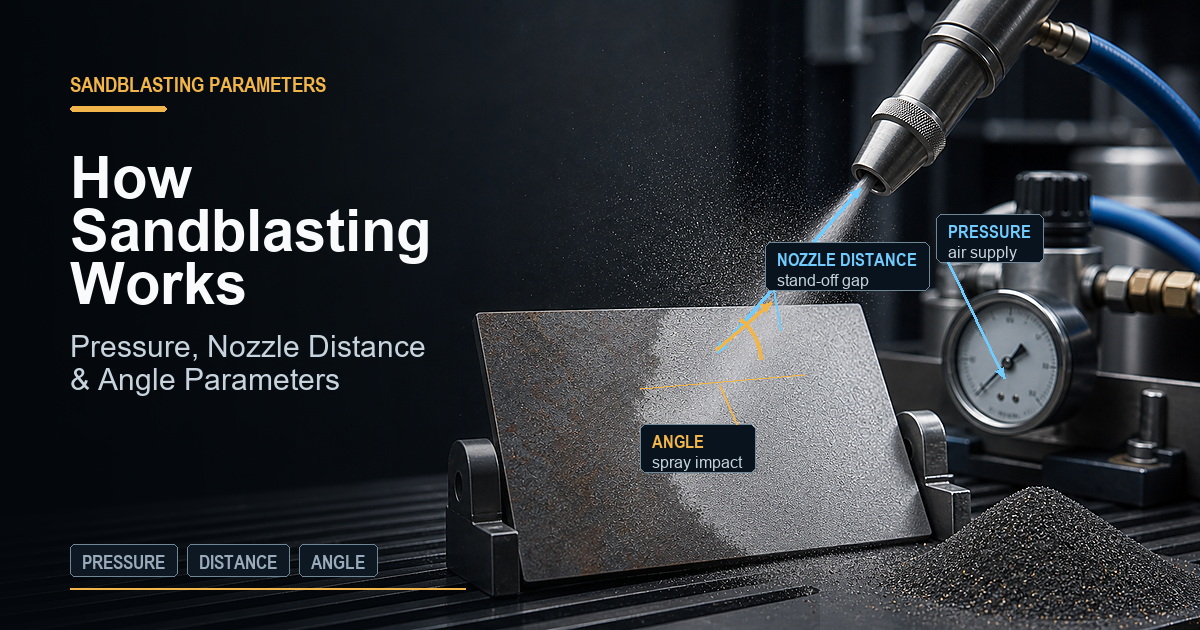
Consumption rates vary with blast pressure, nozzle size, stand-off distance, and initial surface condition. As a typical working estimate for professional-grade field blasting with #30/60 garnet on moderately corroded carbon steel to Sa 2.5: expect consumption of approximately 15–25 kg per square meter for single-use application. Heavily corroded steel or steel with intact millscale will consume more; lightly rusted or previously blast-cleaned steel will consume less. Your garnet supplier should be able to provide consumption guidance specific to the grade and nozzle configuration you are using.
Garnet can leave a light mineral dust on the blasted surface that should be blown off with clean dry compressed air or vacuum-cleaned before coating is applied. This residue is non-reactive and does not contaminate the steel in a way that affects coating adhesion — unlike chloride-containing abrasives (some slags) that can leave soluble salt contamination on the surface. However, any abrasive residue should be removed before coating application as a standard quality practice. Conductivity testing (Bresle patch method) on garnet-blasted surfaces routinely confirms very low soluble salt content, which is one of the reasons garnet is accepted without restriction in marine and offshore coating specifications that set strict limits on surface contamination.
Source Garnet Blast Media Direct from Henglihong
Almandine garnet in #20/40, #30/60, #80, and #120 mesh. ASTM B-7 compliant, low free silica (<1%), COA and SGS inspection per batch. Factory-direct export pricing.
Get a Free QuoteФильтры