Eco-Friendly Blasting Media: Low-Dust & Silica-Free Options
As silica regulations tighten globally and environmental permit conditions grow more demanding, the choice of blasting media has become a compliance decision as much as a technical one. This guide covers every silica-free and low-dust option available in March 2026 — with regulatory context, performance data, waste classification, and wet blasting as a dust-elimination strategy.
1. The Silica Problem — Why the Industry Had to Change
For most of the twentieth century, silica sand was the default blasting abrasive across virtually every industry — cheap, abundant, and effective. The health consequences of that choice are now well documented and irreversible for the workers exposed. Silicosis — an incurable, progressive, and potentially fatal fibrotic lung disease caused by inhaling respirable crystalline silica (RCS) dust — has disabled and killed generations of blasters, shotfirers, and surface preparation workers worldwide.
The mechanism is straightforward: when silica-containing abrasives fracture on impact with a hard surface, they generate ultrafine dust particles (respirable fraction: <10 µm diameter, with the most hazardous fraction below 4 µm). These particles penetrate deep into the alveolar spaces of the lungs where the body cannot clear them. The immune response causes progressive scarring of lung tissue over months to years, eventually leading to severely impaired lung function, increased susceptibility to tuberculosis, and elevated lung cancer risk.
The industrial response to this health crisis has been a global regulatory shift away from silica sand and toward silica-free alternatives. As of March 2026, the transition is effectively complete in all major industrial economies — the question is no longer whether to switch, but which silica-free alternative best fits each application’s technical and environmental requirements.
2. Regulatory Framework — OSHA, EU & Global Standards
The regulatory landscape governing silica in abrasive blasting is now comprehensive across most industrialized markets. The following table summarizes the key requirements that affect blasting media specification decisions as of March 2026.
| Jurisdiction | Key Regulation | RCS Exposure Limit | Silica Sand Status | Effective Since |
|---|---|---|---|---|
| European Union | Directive 2017/2398 (CMD); REACH Annex XVII | 0.1 mg/m³ (8h TWA) | ✗ Banned for professional blasting | 2020 (phased) |
| United Kingdom | EH40 Workplace Exposure Limits (4th ed.) | 0.1 mg/m³ (8h TWA) | ✗ Effectively prohibited | Post-Brexit parity with EU |
| United States (OSHA) | 29 CFR 1926.1153 (Construction); 1910.1053 (General Industry) | 50 µg/m³ PEL; 25 µg/m³ Action Level | △ Not banned but PEL unachievable with silica sand blasting | 2017 (enforcement) |
| Australia | Model WHS Regulations; Safe Work Australia | 0.05 mg/m³ (8h TWA) | ✗ Prohibited in all states and territories | Various (2020–2024) |
| Canada | Provincial OHS Regulations (various) | 0.025–0.1 mg/m³ (varies by province) | ✗ Prohibited in most provinces | Various |
| Middle East / GCC | National OHS standards (UAE, Saudi, Qatar) | Varies; typically 0.05–0.1 mg/m³ | △ Restricted; silica-free preferred on international projects | Project-specific |
For buyers and contractors operating internationally, the practical implication is clear: specifying only silica-free blasting media is the only defensible position across all jurisdictions. Even in markets where silica sand is not formally prohibited, the OSHA PEL of 50 µg/m³ is effectively impossible to achieve during open blasting with silica sand without extreme (and uneconomical) engineering controls. The liability exposure for non-compliance — both financial and reputational — makes silica-free specification the only rational default.
3. Silica-Free Mineral Abrasives — The Performance-Compliant Options
The good news for industrial operators is that the silica-free alternatives available in March 2026 are not compromises — they are mature, well-characterized industrial abrasives that in many cases outperform silica sand on key performance metrics including surface profile consistency, recyclability, and dust generation. The four principal silica-free mineral and manufactured abrasives are:
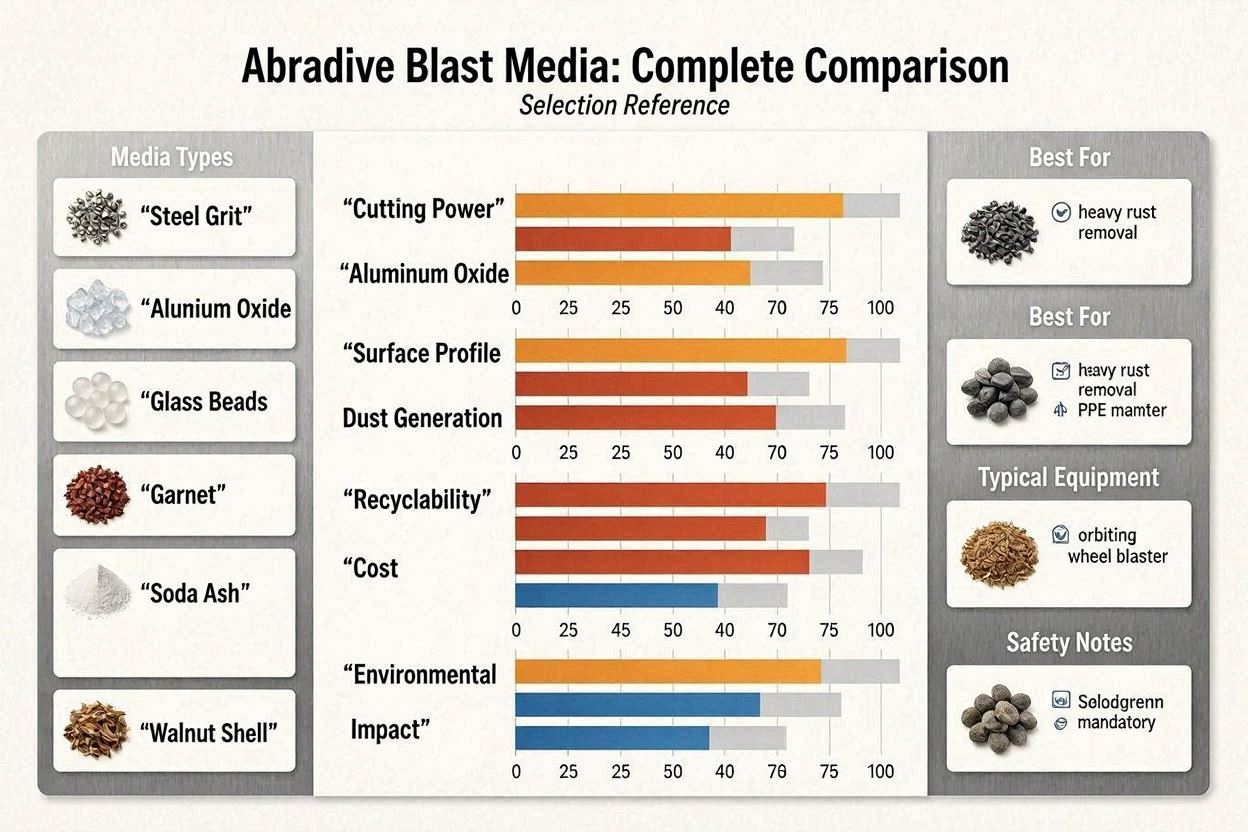
For a complete technical comparison of all four media types across hardness, profile, equipment compatibility, and cost, see the Blasting Media Comparison Chart. Individual in-depth guides are available for гранат, оксид алюминия, glass bead, и карбид кремния.
4. Low-Dust Blasting Media — Performance Comparison
Beyond the silica-free requirement, many blasting operations face dust generation constraints imposed by environmental permits, proximity to residential or commercial areas, location near food processing facilities, or the need to maintain visibility and air quality inside enclosed workspaces. Media selection significantly affects how much airborne dust is generated per m² of surface blasted.
Dust generation in blasting is driven by two factors: the friability of the abrasive (how readily it shatters into fine particles on impact) and the particle density (denser particles carry more energy but less surface area). Garnet leads the mineral abrasive category on low dust generation because its crystalline structure resists fracture more effectively than most alternatives — particles tend to remain intact through impact and rebound rather than shattering into fine clouds. Garnet blasting media typically generates 60–80% less airborne dust than copper slag or coal slag at equivalent blast conditions, a difference that is visible and measurable in air quality monitoring during blasting operations.
Оксид алюминия generates moderate dust compared to garnet — it is more friable and fractures more readily, producing more fines per blast cycle. However, in enclosed and recirculating blast cabinet or room systems, the dust is captured by the collection system rather than becoming a workplace or environmental exposure problem. The key is that the system must be properly designed and maintained — under-performing dust collectors and leaking blast rooms are a common source of silica and general dust exposure violations.
5. Organic & Biodegradable Media
Agricultural and organic blasting media — walnut shell, corn cob, peach pit grit, and similar natural materials — represent the gentlest and most environmentally benign end of the abrasive spectrum. Their defining environmental characteristics are full biodegradability, non-toxicity, and the absence of any classified hazardous components in the spent media (when blasted on uncontaminated surfaces).
Agricultural media are used in applications where minimal substrate aggression and maximum environmental safety are both required simultaneously:
- Oil field equipment cleaning — removal of hydrocarbon residues from valves, pumps, and pipeline components without substrate damage or additional chemical contamination of the spent media stream
- Engine component carbon removal — cleaning carbon deposits from cylinder heads, pistons, and carburetor components without dimensional damage or media embedment in precision surfaces
- Stone monument and heritage structure cleaning — removal of biological growth, soiling, and light surface coatings from limestone, sandstone, and marble without surface erosion
- Graffiti removal from masonry — selective removal of paint without damaging the porous stone or brick substrate underneath
- Food processing equipment cleaning — where any media residue must be completely non-toxic and the substrate cannot tolerate chemical treatments
The main limitation of organic media is their low hardness (Mohs 3–4) and inability to remove rust, mill scale, or hard coatings — they are surface cleaners, not surface preparation abrasives in the industrial coating preparation sense. For applications that combine delicate substrate requirements with light cleaning objectives, they represent the most environmentally responsible option available. For the broadest coverage of silica-free and low-impact options, see our complete guide to eco-friendly blasting media.
6. Metallic Abrasives — The Recyclability Argument
Steel grit and steel shot — while not typically positioned as “eco-friendly” in the traditional sense — make a compelling environmental case when evaluated on a lifecycle basis. Their dominant environmental advantage is exceptional recyclability: 500–2,000+ cycles in a well-maintained automated blast room, compared to 3–5 cycles for garnet and 1 cycle for copper or coal slag.
The lifecycle math is straightforward. A blast room processing 10,000 m² of structural steel per month using single-use copper slag generates approximately 8–10 tonnes of spent abrasive waste per month requiring disposal. The same volume processed with recycled steel grit in a properly maintained blast room with classifier generates perhaps 200–400 kg of fine waste per month — a waste reduction of 95% or more. Over a full year, this difference is measured in hundreds of tonnes of waste avoided.
Steel grit and steel shot are also silica-free — they contain no crystalline silica and generate metal dust rather than mineral dust. Metal dust presents its own inhalation health considerations (iron oxide fume in high concentrations), but it is not classified as a carcinogen in the same category as respirable crystalline silica. In enclosed automated blast rooms with proper extraction, metallic abrasive dust exposure is well manageable within occupational health limits.
7. Wet Blasting — Eliminating Dust at the Source
How Wet Blasting Controls Dust at the Point of Generation
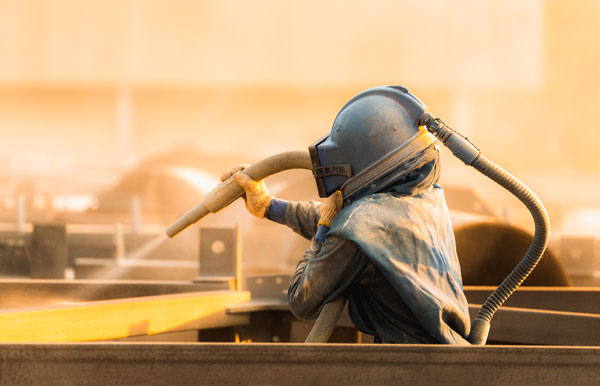
Wet blasting — also called dustless blasting, vapour blasting, or slurry blasting — mixes water with abrasive media before propelling the mixture at the target surface. The water envelopes each abrasive particle, and when the particle fractures on impact, the resulting fine dust particles are immediately captured by the surrounding water droplets and fall to the ground rather than becoming airborne. The result is near-complete elimination of airborne dust at the blasting point.
- Dust suppression efficiency: Studies have documented 85–95% reduction in airborne particulate compared to dry blasting with equivalent media and pressure settings
- Compatible media: Garnet and aluminum oxide work well in wet blast systems; glass bead is also compatible. Steel abrasives are not suitable — they rust rapidly in wet systems and generate contaminated water waste
- Surface cleanliness: The water also cleans soluble salts from the surface simultaneously with abrasive cleaning, reducing post-blast salt contamination — a significant benefit for corrosion-sensitive applications
- Flash rusting: Wet blasting leaves a wet surface that is more susceptible to flash rusting than dry blasting. Corrosion inhibitors added to the blast water, followed by rapid drying and immediate priming, are essential for steel substrates
- When to specify wet blasting: Urban sites, near food or pharmaceutical facilities, inside enclosed spaces with poor ventilation, on projects where environmental permit conditions prohibit visible dust emissions, or in jurisdictions where dry blasting with any media is restricted to enclosed blast rooms
8. Spent Media Waste Classification & Disposal
The environmental responsibility of a blasting operation does not end with media selection — the disposal of spent abrasive is an equally important environmental and regulatory obligation. Incorrect classification and disposal of spent blasting media is a significant source of environmental liability for blasting contractors and the clients who employ them.
✓ Generally Non-Hazardous Waste
- Garnet, aluminum oxide, glass bead, or silicon carbide used on clean, uncoated, or water-based coated carbon steel
- Steel grit or shot used on uncontaminated carbon steel with no hazardous coatings
- Organic media (walnut shell, corn cob) used on non-contaminated surfaces
- Any media used on surfaces with no lead, chromate, or other classified hazardous coating systems
- Recyclable media (aluminum oxide, steel grit) significantly reduces waste volume — less to classify and dispose of
⚠ Potentially Hazardous Waste — Requires Licensed Disposal
- Any media used on lead-painted surfaces — spent media is a lead-contaminated hazardous waste
- Media used on chromate-primed or hexavalent chromium-containing coating systems
- Media used on surfaces with cadmium, mercury, or other heavy metal coatings
- Copper slag used on surfaces with any hazardous coating — copper slag itself may also carry regulated heavy metal content depending on source
- Any media used on substrates with unknown coating history — treat as potentially hazardous until tested
Always perform a waste characterization assessment — ideally including chemical analysis of a representative spent media sample — before commencing any blasting project where the coating history is unknown or where the substrate may have been previously treated with lead-based or heavy metal-containing products. Engage a licensed waste contractor for disposal planning before blasting commences, not after the spent media has already been generated.
9. Frequently Asked Questions
Related Resources
Explore the full blasting media resource library from Jiangsu Henglihong Technology for further technical guidance and media-specific deep dives:
- Blasting Media: Complete Industry Guide — full overview of all media types and applications
- Types of Blasting Media: Complete Guide — technical data on every major abrasive type
- How to Choose the Right Blasting Media — step-by-step selection framework
- Garnet Blasting Media — the leading eco-friendly choice for open-air industrial blasting
- Aluminum Oxide Blast Media — silica-free mineral abrasive with outstanding recyclability
- Glass Bead Blasting Media — silica-free spherical media for stainless, aluminum, and decorative work
- Silicon Carbide Blast Media — silica-free, hardest commercial abrasive for glass and ceramics
- Steel Grit vs Steel Shot — metallic abrasives with 500+ cycle recyclability
- Plastic Blast Media for Aerospace & Automotive
- Blasting Media Safety Guide: Silica Risks & PPE — full OSHA/EU compliance and PPE guidance
- Blasting Media Comparison Chart — side-by-side data for all major abrasives
- Blasting Media Cost Guide & ROI Analysis — cost-per-m² benchmarks including waste disposal
- Industrial Surface Prep: Best Blasting Media for Metal
- Blasting Media for Automotive Restoration
Source Certified Silica-Free Blasting Media
Jiangsu Henglihong Technology supplies garnet, aluminum oxide, glass bead, silicon carbide, and other silica-free abrasives with certified free-silica analysis, full SDS documentation, and reliable export logistics to North America, Europe, the Middle East, and beyond.
Request a Quote or Compliance DocumentationФильтры