Blasting Media Grit Size Chart — Grit, Mesh, Microns and Inches Conversion
When a blasting spec sheet calls for “36 grit” aluminum oxide and your supplier quotes “40 mesh” garnet, are they the same thing? When a quality inspector measures a surface profile outside the specified range and traces it back to media size, which number on the bag should you have been checking? The answers to both questions are in this grit size conversion chart.
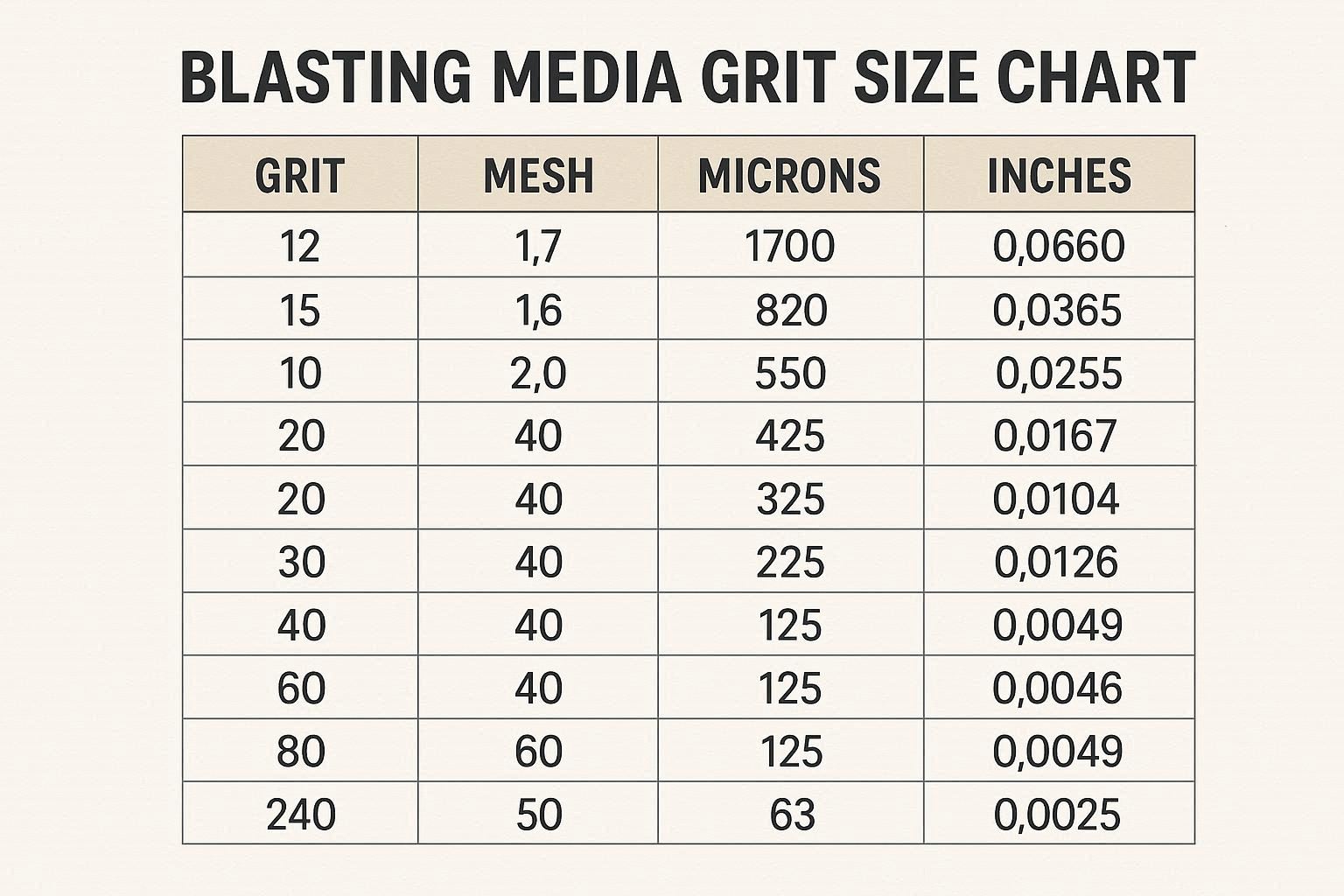
This page provides a complete, printable reference for converting between the four particle size measurement systems used in abrasive blasting: grit number, USS mesh equivalent, median diameter in microns (µm), and diameter in inches. It covers the full blasting range from coarse 12-grit down to 220-grit for mineral and synthetic abrasives (aluminum oxide, silicon carbide, garnet), extends into the FEPA P-grade micro-grit range for fine finishing work, and includes the separate SAE sizing system used for steel shot and steel grit.
Each size entry is paired with its typical surface profile depth range on structural carbon steel under standard pressure-blast conditions, allowing you to cross-reference media size against coating specification requirements in a single lookup. This chart is part of our complete abrasive blast media comparison and selection reference covering all major media types and parameters.
What Is Grit Size and Why Does It Matter?
Grit size is a standardized designation that describes the particle diameter of abrasive media. It is not a direct measurement of particle diameter — it is a classification number derived from the mesh size of the sieve screen used to sort the particles during manufacturing. Understanding this distinction is the key to reading any grit size chart correctly.
During abrasive production, particles are passed through a series of progressively finer wire mesh screens. A particle is assigned a grit number based on which screens it passes through (the upper sieve) and which screens it is retained on (the lower sieve). The mesh number is the number of wire openings per linear inch in the sieve screen. A coarse sieve has fewer, larger openings per inch — a low mesh number. A fine sieve has many small openings per inch — a high mesh number.
This creates the counterintuitive but fundamental rule of grit size charts: lower grit numbers mean coarser, larger particles; higher grit numbers mean finer, smaller particles. 12-grit aluminum oxide particles have a median diameter of approximately 1,680 µm (1.68 mm) — large enough to see clearly with the naked eye. 220-grit particles measure just 63 µm — visible as a fine powder. That is a size difference of more than 26 times between the two ends of the common blasting range.
Grit size matters in blasting because particle size is one of the two primary variables that determine surface profile depth (the other being blast pressure). A larger, heavier particle carries more kinetic energy per impact at a given velocity and creates a deeper, more jagged anchor profile on the substrate. A finer particle creates a shallower, smoother profile. Selecting the correct grit size is therefore inseparable from meeting the surface profile specification required by the coating system to be applied.
In industrial abrasive blasting, grit size designations follow one of three major standards: FEPA (Federation of European Producers of Abrasives, used in Europe, Asia, and most of the world), ANSI (American National Standards Institute, widely used in North America), or JIS (Japanese Industrial Standard, used in Japan). For the common blasting grit range (F12–F220), FEPA and ANSI designations are numerically identical, making cross-reference straightforward. Differences emerge in the fine and micro-grit ranges, which is addressed in the FEPA P-grade section below.
The Complete Grit Size Conversion Chart (F12 – F220)
The table below covers the full range of grit sizes used in industrial abrasive blasting. Highlighted rows (marked with ★) indicate the sizes most commonly specified in surface preparation work for industrial coating applications. Profile depth values reflect typical results for aluminum oxide on structural carbon steel at 90–100 psi (6.2–6.9 bar) pressure blast. Garnet of the same nominal grit will produce profiles approximately 15–20% shallower; silicon carbide will produce profiles 10–15% deeper.
How to use this table: Start with your required surface profile (from the coating TDS or project specification). Find the profile range in the rightmost column. The corresponding grit size in the same row is your starting specification for aluminum oxide or garnet. Then verify with a trial blast and profile gauge measurement before committing to the full job.
| Grit / F-Grade | USS Mesh Equiv. | Median Size (µm) | Approx. Size (inches) | Profile on Steel — AO (mils) | Typical Use |
|---|---|---|---|---|---|
| F12 | — | 1,680 | 0.066″ | 3.5 – 5.0 | Very aggressive profiling, thick mill scale |
| F16 ★ | 16 | 1,190 | 0.047″ | 3.0 – 4.5 | Heavy rust removal, deep anchor profiles, thermal spray prep |
| F20 ★ | 20 | 850 | 0.033″ | 2.5 – 4.0 | Structural steel, marine, pipeline — aggressive prep |
| F24 ★ | 25 | 710 | 0.028″ | 2.5 – 3.5 | Standard industrial surface prep, zinc-rich primer base |
| F30 | 30 | 590 | 0.023″ | 2.0 – 3.0 | General industrial primer prep |
| F36 ★ | 40 | 425 | 0.017″ | 2.0 – 3.0 | Epoxy primer surface prep — most common blasting grit |
| F46 | 45 | 355 | 0.014″ | 1.5 – 2.5 | Moderate profile, multi-coat systems |
| F54 | 50 | 297 | 0.012″ | 1.5 – 2.5 | Moderate profile, cabinets and automated lines |
| F60 ★ | 60 | 250 | 0.010″ | 1.5 – 2.0 | Light-duty coating prep, garnet equivalent for clean blast |
| F70 | 70 | 212 | 0.008″ | 1.0 – 2.0 | Fine profile work, stainless cabinet blasting |
| F80 ★ | 80 | 180 | 0.007″ | 1.0 – 1.8 | Fine surface prep, thin-film coatings, deburring |
| F90 | 90 | 150 | 0.006″ | 0.8 – 1.5 | Aluminum and soft metal prep, light deburring |
| F100 | 100 | 125 | 0.005″ | 0.5 – 1.2 | Fine finish blasting, pre-plating prep |
| F120 | 120 | 106 | 0.0042″ | 0.5 – 1.0 | Fine deburring, light cleaning, glass surface prep |
| F150 | 140 | 90 | 0.0035″ | 0.3 – 0.8 | Ultra-fine surface prep, optical component cleaning |
| F180 | 170 | 75 | 0.003″ | 0.2 – 0.6 | Precision finishing, micro-deburring |
| F220 | 230 | 63 | 0.0025″ | < 0.5 | Very fine finishing, cabinet-only applications |
★ Most commonly specified sizes in industrial surface preparation. Profile depths are for aluminum oxide (angular) on structural carbon steel at 90–100 psi pressure blast. Garnet: ~15–20% shallower. Silicon carbide: ~10–15% deeper. Profile values sourced from FEPA F-grade standard median diameters per ISO 8486-1:1996.
How to Read and Apply This Chart
The conversion chart above contains five data points per grit size, and knowing how to use each one correctly prevents misspecification errors that cause project failures.
Step 1 — Identify your profile requirement first
Always start with the surface profile requirement from the coating manufacturer’s Technical Data Sheet (TDS) or the project specification. The “Profile on Steel” column in the chart lets you work backwards: find the profile range your spec calls for, then read left to identify which grit size will deliver it. Never start from the grit number and work forward — that approach produces the profile the media happens to make, not the profile your coating system requires.
Step 2 — Verify the measurement unit your supplier is using
Media orders are placed in one of three ways: by grit number (F24), by mesh size (25 mesh), or by particle size range in microns (500–850 µm). All three describe the same material — but only if the supplier is using the same standard. A bag labeled “30 mesh” from a Chinese supplier quoting USS mesh will contain particles in the F30 size range (~590 µm median). The same label from a supplier quoting metric ISO sieve sizes may differ slightly. Use the µm column in this chart as the unambiguous common reference point when comparing offers from different suppliers.
Step 3 — Adjust for media type
The profile depth column is calibrated for aluminum oxide at 90–100 psi pressure blast. If you are using garnet of the same grit number, expect profiles running approximately 15–20% shallower due to garnet’s sub-angular (rather than full-angular) particle geometry. Silicon carbide at the same grit will run 10–15% deeper due to its greater hardness and sharper cutting edges. For garnet applications, consider stepping up one grit size to compensate — F30 garnet tends to produce similar profiles to F36 aluminum oxide.
Step 4 — Always perform a trial blast
The profile depth ranges in this chart represent typical results under standard conditions. Actual profiles vary with blast pressure, nozzle size and condition, standoff distance, blast angle, and the hardness and condition of the substrate. Before committing to a media specification for a large project, always perform a trial blast on representative substrate material, measure the resulting profile with a calibrated surface profile gauge per ASTM D4417 Method C (replica tape) or Method B (digital profilometer), and confirm that the result falls within the specified range.
Matching Profile Depth to Coating Requirements For a detailed chart showing which media type and grit size matches each major industrial coating system — including marine epoxy, zinc-rich primers, thermal spray, and floor coatings — see: Abrasive Blasting Surface Profile Chart — Anchor Pattern Depth Guide
Fine and Micro-Grit Designations: FEPA P-Grade (P240 – P2500)
The FEPA F-grade system used in the main conversion chart above covers grit sizes through F220 (approximately 63 µm). Abrasive particles finer than F220 are classified under a separate FEPA standard: the P-grade, defined in ISO 6344. P-grade designations run from P240 through P2500 and cover the micro-abrasive range used in precision polishing, lapping, ultra-fine finishing cabinet work, and some specialized semiconductor substrate processing applications.
The critical point for buyers and engineers: F220 and P220 are not the same particle size. The F-grade and P-grade standards use different sieve classification criteria. F220 has a slightly coarser median distribution than P220 — approximately 63 µm versus 58 µm. This difference is small but significant in ultra-precision applications where surface finish tolerance is tight. Always specify which standard applies when ordering in the 220+ range.
| FEPA P-Grade | Median Size (µm) | Tolerance (µm) | Approx. Inches | Типовые применения |
|---|---|---|---|---|
| P240 | 58.5 | ± 2.0 | 0.0023″ | Fine blast cabinet work, precision surface prep for thin-film coatings |
| P280 | 52.2 | ± 2.0 | 0.0021″ | Fine finishing cabinet blasting |
| P320 | 46.2 | ± 1.5 | 0.0018″ | Pre-plating surface preparation |
| P360 | 40.5 | ± 1.5 | 0.0016″ | Precision deburring, fine edge prep |
| P400 | 35.0 | ± 1.5 | 0.0014″ | Optical component cleaning, precision instrument prep |
| P500 | 30.2 | ± 1.5 | 0.0012″ | Ultra-fine deburring |
| P600 | 25.8 | ± 1.0 | 0.0010″ | Fine polishing prep |
| P800 | 21.8 | ± 1.0 | 0.0009″ | Lapping, precision surface refining |
| P1000 | 18.3 | ± 1.0 | 0.0007″ | Ultra-precision lapping |
| P1200 | 15.3 | ± 1.0 | 0.0006″ | Mirror surface preparation, gemstone lapping |
| P1500 | 12.6 | ± 0.5 | 0.0005″ | High-precision lapping, hard disk polishing |
| P2000 | 10.3 | ± 0.5 | 0.0004″ | Semiconductor substrate polishing |
| P2500 | 8.4 | ± 0.5 | 0.0003″ | Ultra-precision finishing, CMP pad conditioning |
In conventional abrasive blasting, P-grade micro-grit is rarely specified. These particle sizes are too fine to generate meaningful surface profiles under standard blast pressures and will produce excessive airborne dust with rapid media breakdown. Their primary role is in polishing compounds, lapping films, bonded abrasive wheels, and highly specialized ultra-fine blast cabinet operations — not general industrial surface preparation.
Steel Abrasive Sizing: SAE Shot and Grit Numbers
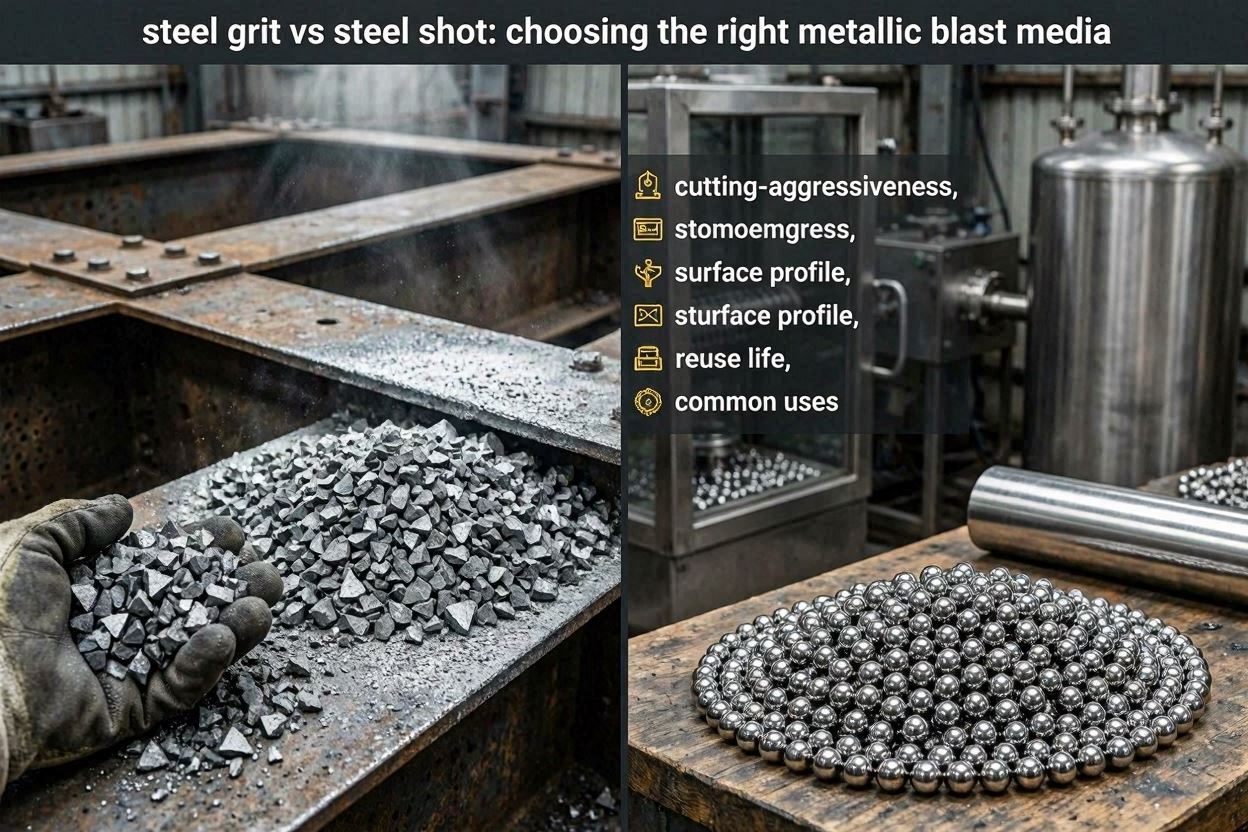
Steel shot and steel grit are classified under a completely separate sizing standard: SAE J444, developed and maintained by SAE International (originally the Society of Automotive Engineers). This standard uses two distinct number series — S-numbers for steel shot and G-numbers for steel grit — with different conventions from each other and from the FEPA mineral abrasive grit system.
The most important thing to understand about SAE sizing is the directional difference between S-numbers and G-numbers:
- S-numbers (shot): higher number = larger particle — S-70 is the smallest steel shot; S-780 is the largest.
- G-numbers (grit): higher number = smaller particle — G-120 is the finest steel grit; G-10 is the coarsest.
The G-number convention matches the FEPA mineral grit convention (lower = coarser, higher = finer). The S-number convention is opposite. This difference trips up experienced buyers who switch between shot and grit specifications — always double-check the direction when reading a steel abrasive spec sheet.
Steel Shot: SAE S-Number Reference
| S-Number | Size Range (mm) | Profile Depth (mils) |
|---|---|---|
| S-70 | 0.18 – 0.35 | 0.1 – 0.5 |
| S-110 | 0.25 – 0.50 | 0.3 – 0.8 |
| S-170 | 0.43 – 0.85 | 0.5 – 1.0 |
| S-230 | 0.60 – 1.18 | 0.7 – 1.5 |
| S-280 | 0.71 – 1.40 | 0.8 – 1.8 |
| S-330 | 0.85 – 1.68 | 1.0 – 2.0 |
| S-390 | 1.00 – 2.00 | 1.0 – 2.0 |
| S-460 | 1.18 – 2.36 | 1.2 – 2.2 |
| S-550 | 1.40 – 2.80 | 1.5 – 2.5 |
| S-660 | 1.70 – 3.35 | 1.5 – 2.5 |
| S-780 | 2.00 – 4.00 | 1.5 – 2.5 |
Profile depths for wheel-blast; round profile (peened surface). Hardness 40–51 HRC.
Steel Grit: SAE G-Number Reference
| G-Number | Nominal Size (mm) | Profile Depth (mils) |
|---|---|---|
| G-120 | 0.21 | 0.5 – 1.0 |
| G-80 | 0.29 | 0.8 – 1.5 |
| G-50 | 0.43 | 1.5 – 2.5 |
| G-40 | 0.58 | 2.0 – 3.0 |
| G-25 | 0.84 | 2.5 – 4.0 |
| G-18 | 1.18 | 3.0 – 4.5 |
| G-14 | 1.68 | 3.5 – 5.0 |
| G-12 | 2.00 | 4.0 – 5.5 |
| G-10 | 2.36 | 4.5 – 6.0 |
Profile depths for wheel-blast on structural steel; angular profile. Hardness 40–65 HRC (GL/GM/GH grades).
Important: Steel grit profile depths in the G-number table above assume GH (high hardness, 60–66 HRC) grade in a well-maintained wheel-blast system at standard turbine speed. GL (low hardness) grade of the same size will produce profiles 20–30% shallower. Mix ratios (blending G-sizes) also significantly affect the resulting profile distribution and should be tested at the operational mix before commitment.
How Grit Size Affects Surface Profile Depth
The relationship between grit size and surface profile depth is direct and consistent: as grit size increases (particles get coarser, grit number decreases), the surface profile depth increases proportionally. This relationship holds across all angular blast media types — aluminum oxide, steel grit, garnet, and silicon carbide — though the specific profile achieved at any given size varies between media types based on hardness and particle shape.
The physics behind this relationship is straightforward. A larger abrasive particle has greater mass. At the same blast velocity, greater mass means greater kinetic energy per particle (KE = ½mv²). That greater kinetic energy translates into deeper penetration on impact, creating higher peaks and deeper valleys in the substrate surface — a greater peak-to-valley height, which is what the profile gauge measures.
In practical terms, the grit size-to-profile relationship gives the blasting operator two levers to adjust surface profile:
- Change grit size: Moving from F36 to F24 aluminum oxide will roughly increase profile depth by 0.5–1.0 mils. This is a permanent change to media specification and requires confirming adequate stock and re-testing.
- Adjust blast pressure: Increasing blast pressure from 80 psi to 100 psi will increase profile depth by approximately 0.3–0.8 mils for the same media, by increasing particle velocity and therefore kinetic energy per impact. This is a faster, more flexible adjustment but has limits: above approximately 110–120 psi, profile depth gains plateau while media breakdown rate accelerates sharply, reducing cost efficiency.
In practice, most specification changes involve finding the right grit size first (for the right profile range), then fine-tuning with pressure adjustment within that range. The grit size chart functions as the primary reference for that first selection step.
Surface Profile Data by Media Type and Grit Size For complete surface profile depth tables with Rz, Ra, and Rmax data across all major media types, plus matching tables for industrial coating requirements, see: Abrasive Blasting Surface Profile Chart — Anchor Pattern Depth Guide
Quick Selection Guide: Grit Size by Application
The table below provides a fast-reference guide mapping common blasting applications to the recommended grit size range, expected surface profile, and the most appropriate media type for the job. For a full substrate-by-substrate selection matrix covering ten substrate types with media type recommendations, equipment considerations, and environmental compliance notes, see our dedicated abrasive blast media selection chart by material and application.
| Приложение | Recommended Grit (AO / Garnet) | Steel Abrasive Equiv. | Expected Profile (mils) |
|---|---|---|---|
| Heavy rust and mill scale removal — structural steel | F12 – F20 AO / Garnet 16–20 | G-18 – G-25 steel grit | 3.0 – 5.0 |
| Zinc-rich primer surface prep | F20 – F24 AO / Garnet 20–24 | G-25 – G-40 steel grit | 2.5 – 4.0 |
| Heavy-duty marine epoxy prep | F24 – F36 AO / Garnet 24–30 | G-25 – G-40 steel grit | 2.0 – 3.5 |
| Standard industrial epoxy primer | F36 – F46 AO / Garnet 30–36 | G-40 – G-50 steel grit | 1.5 – 3.0 |
| Light industrial primer (alkyd, acrylics) | F60 – F80 AO / Garnet 60 | G-50 steel grit | 1.0 – 2.0 |
| Stainless steel — bright satin finish | Glass beads 80 – 120 mesh | Steel shot S-110 – S-170 | 0.5 – 1.2 |
| Concrete floor — epoxy coating prep | F16 – F24 AO | N/A (mineral only) | CSP 3 – 5 |
| Glass artistic etching | Silicon carbide F60 – F120 | N/A | Visual depth only |
| Aluminum panels — paint stripping | Plastic grit 12 – 30 mesh | N/A | < 0.5 |
| Shot peening — fatigue improvement | N/A | Steel shot S-110 – S-330 | Peened (no profile target) |
| Fine deburring, pre-plating | F120 – F220 AO | G-80 – G-120 steel grit | 0.3 – 1.0 |
FEPA, ANSI, and JIS: Which Standard Governs Your Media?
When ordering abrasive media internationally, the grit size designation on the bag or data sheet may follow one of three major standards. For most common blasting grit sizes (F12 through F220), the numerical designations are identical between FEPA and ANSI, so this distinction rarely causes practical problems. However, understanding which standard your supplier is using ensures you can resolve any discrepancy in particle size tolerances, especially in critical surface preparation work.
FEPA (ISO 8486 / ISO 6344)
The global default for abrasive grain classification. FEPA F-grade (ISO 8486) covers the blasting and grinding range F4–F220. FEPA P-grade (ISO 6344) covers fine polishing P240–P2500. Used in Europe, China, most of Asia, Middle East, and by the majority of international suppliers. Jiangsu Henglihong products are graded to FEPA/ISO specifications.
ANSI (ANSI B74.12)
The North American standard for bonded and coated abrasives, maintained by the American National Standards Institute. ANSI grit numbers are numerically identical to FEPA F-grade for the common blasting range, making cross-reference straightforward. Differences emerge in particle size tolerances and distribution specifications, particularly at the coarse and fine extremes.
JIS (JIS R 6001)
The Japanese Industrial Standard for abrasive grain size. JIS designations align closely with FEPA for most sizes but use different tolerance criteria. Japanese-made media and Japanese industrial specifications will reference JIS grades. When substituting FEPA-graded media for JIS-specified media, confirm particle size tolerances with the supplier rather than relying on the numerical designation alone.
For steel abrasives, the applicable standard worldwide is SAE J444 for shot and grit classification, regardless of origin. ISO 11126 and ISO 11127 also provide international standards for metallic and non-metallic blasting abrasives respectively, and are increasingly referenced in international tender specifications for infrastructure and marine projects.
When writing purchase orders or project specifications, always state the standard explicitly — for example: “Aluminum oxide, brown fused, FEPA F36, per ISO 8486-1” — rather than relying on the grit number alone. This eliminates ambiguity and provides a clear reference for inspection and quality certification.
Часто задаваемые вопросы
FEPA F-grade (ISO 8486 Part 1) covers the coarser abrasive range from F12 through F220, used in blasting, grinding, and general surface preparation. FEPA P-grade (ISO 6344) covers fine and micro-grit abrasives from P240 through P2500, used in precision polishing, lapping, and ultra-fine finishing. Critically, F220 and P220 are not the same particle size — F220 has a slightly coarser distribution (approximately 63 µm median) than P220 (approximately 58 µm). In abrasive blasting applications, F-grade designations are standard. P-grade applies in applications such as fine waterjet abrasive flow, ultra-fine cabinet finishing work, or lapping compound production.
The grit number is derived from the mesh number — the number of wire openings per linear inch in the classification sieve screen. A coarse sieve has fewer, larger openings per inch, giving it a low mesh number. Particles sorted on a coarse (low-number) sieve are larger. A fine sieve has more, smaller openings per inch (high mesh number) and retains only smaller particles. So a lower grit number corresponds to a coarser, larger particle — and a higher grit number corresponds to a finer, smaller particle. This logic applies consistently to FEPA F-grade, ANSI, USS mesh, and JIS designations for mineral abrasives, though steel abrasive S-numbers follow the opposite convention (see the SAE sizing section above).
In practical pressure-blast operations, F180 to F220 (approximately 63–75 µm) is typically the finest mineral abrasive used, producing profiles below 0.5 mils on steel. Finer than F220, particles lose kinetic energy too rapidly due to their low mass, create excessive dustiness, and break down too quickly to be economically viable in pressure-blast systems. For applications requiring smooth surfaces with minimal profile, glass beads in the 120–325 mesh range are a more appropriate choice than very fine mineral abrasives — glass beads are spherical, generate less dust per pass, and achieve 20–30 reuse cycles. Micro-grit P-grade abrasives below P400 are limited to lapping, polishing, and ultra-fine precision cabinet operations.
For a quick approximation, dividing 15,000 by the mesh number gives a rough micron equivalent: 50 mesh ≈ 300 µm, 100 mesh ≈ 150 µm, 200 mesh ≈ 75 µm. More precisely, the opening size of each sieve is defined in ASTM E11 (US standard sieves) and ISO 3310 (metric sieves), which account for wire diameter variation at each mesh count. The conversion table in this article provides the FEPA-standard median particle diameter in µm for each F-grade grit number — these are the values you should use when comparing supplier offers in different measurement units or when writing unambiguous purchase specifications.
Steel shot and grit are classified under SAE J444, an independent standard developed specifically for metallic abrasives and using round-hole sieve screens rather than the square-opening sieves used for mineral abrasive classification. The two systems were developed by different industry bodies for different markets and were never harmonized. Additionally, shot S-numbers increase with larger particle size (S-70 smallest, S-780 largest), while grit G-numbers increase with smaller particle size (G-120 finest, G-10 coarsest) — a counterintuitive inconsistency even within the SAE system itself. When reviewing a spec sheet that mixes mineral and metallic media sizes, always verify each designation against the appropriate standard’s size table rather than assuming the same numerical relationship applies to both.
Need Abrasive Media in a Specific Grit Size?
Jiangsu Henglihong Technology supplies aluminum oxide, silicon carbide, glass beads, steel shot, and steel grit in the full range of FEPA F-grade and SAE sizes. All products are graded and certified to specification. Direct-source pricing with flexible MOQ for new customers.
Request a Quote ← Back to Complete Media ChartФильтры