Bead Blasting FDM 3D Printed Parts: Smoothing Layer Lines and Finishing Plastic Surfaces
Fused deposition modeling (FDM) is the world’s most widely adopted additive manufacturing process — and it produces some of the roughest as-built surfaces of any AM technology. Layer-by-layer extrusion leaves visible ridges at every layer boundary, creating surface roughness (Ra) values of 10–25 µm on vertical surfaces that exceed the requirements of most functional, aesthetic, or coating-prep applications. Bead blasting with fine glass beads is the fastest, most cost-effective, and most universally applicable method for reducing FDM surface roughness, normalising the visual appearance of layer lines, and preparing FDM parts for painting, dyeing, or functional deployment — across all common FDM thermoplastics from PLA to PEEK.
1. The FDM Surface Finish Challenge
Every FDM 3D printed part carries the signature of its build process: a series of stacked extruded beads, each 0.1–0.3 mm thick, that form the part layer by layer. On vertical and near-vertical surfaces, the boundary between each layer creates a visible ridge — the so-called stair-step effect — that is responsible for surface roughness values (Ra) typically between 10 µm and 25 µm. On horizontal top faces, where the extruded bead lies flat, Ra values are lower (5–12 µm) but still far above most engineering or aesthetic specifications.
The stair-step amplitude is directly proportional to the layer height: parts printed at 0.3 mm layer height have rougher surfaces than those printed at 0.1 mm layer height, all else being equal. On angled surfaces — overhangs printed without support — the stair-stepping becomes more pronounced as the effective layer height on the inclined face increases. Even at the finest commonly available layer heights (0.05 mm on high-precision FDM systems), the surface is still rougher than most industrial specifications without post-processing.
These surface conditions create tangible performance problems:
- Coating adhesion: As-built FDM surfaces have inconsistent surface energy and directional texture that promotes coating delamination at layer line interfaces.
- Aesthetic inconsistency: Different faces of the same part (top, side, overhang) have different Ra values, making uniform colour and sheen impossible without surface conditioning.
- Mechanical stress concentration: The notch geometry of FDM layer lines acts as a stress concentrator under cyclic loading, reducing fatigue resistance of loaded FDM parts.
- Dimensional inconsistency: Rough surfaces make dimensional measurement unreliable and create poor mating surfaces for pressed or bonded joints.
2. Why Bead Blasting Works on FDM Thermoplastics
Bead blasting propels spherical glass beads at the FDM surface under pneumatic pressure. Unlike angular abrasives (aluminum oxide grit), spherical beads do not cut the surface — they deform it. When a glass bead impacts the surface, it plastically deforms the local surface peak, flattening the ridge without creating new directional scratches. The cumulative effect of thousands of spherical impacts creates a uniformly deformed surface where the layer-line ridges are compressed and blended into the surrounding surface texture.
This produces several simultaneous benefits:
- Ra reduction: Layer line ridges (the dominant Ra contributor on FDM surfaces) are compressed and reduced, lowering Ra by 60–75% in a single blast cycle.
- Surface isotropy: The as-built FDM surface is highly directional — layer lines create texture that runs parallel to the build layers. Bead blasting creates an isotropic (non-directional) surface where Ra is uniform in all measurement directions. This is important for coating adhesion and for seal surfaces.
- Appearance uniformity: The matte surface created by blasting scatters light diffusely and consistently across all faces of the part, eliminating the visual variation between top, side, and overhang surfaces that is characteristic of as-built FDM parts.
- Improved coating adhesion: The uniform micro-texture created by blasting provides consistent mechanical anchor points for paint, primer, and adhesive across the entire surface, replacing the directional layer-line texture that causes preferential delamination at the layer interfaces.
Importantly, bead blasting does not require solvents, generates no hazardous waste (unlike acetone smoothing), works on all FDM thermoplastics, and can be completed in minutes rather than hours. It can be performed on parts with complex external geometry, including curved surfaces, bosses, ribs, and textured features — areas that manual sanding cannot access consistently.
Bead blasting FDM parts uses glass beads in peening mode — deforming surface peaks rather than cutting them. This is why low-to-moderate pressure (30–50 psi) is specified for plastics, and why angular abrasives like Al₂O₃ are not used on FDM thermoplastics. Angular media would aggressively cut the surface and risk part damage at the pressures required for effective smoothing.
3. Choosing Blasting Media for FDM Parts
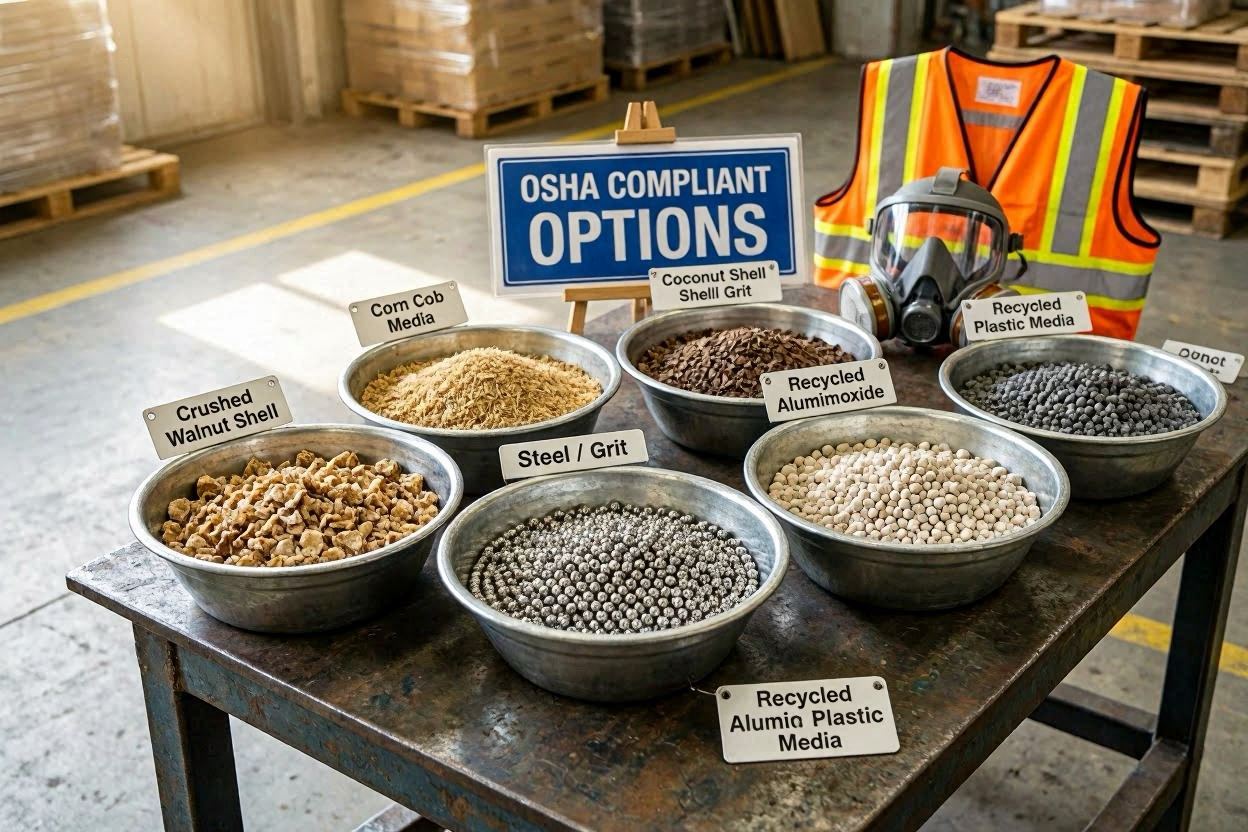
The three media types relevant to FDM post-processing are glass beads, plastic blasting media (PMB), and — in rare specialist cases — walnut shell or corn cob media. Angular abrasives (aluminum oxide, silicon carbide, steel grit) are not appropriate for FDM thermoplastics and should not be used.
Glass Beads (Primary Choice)
Glass beads are the standard blasting medium for FDM parts across all materials and applications. They are available in a range of mesh sizes — from coarse (80 mesh, ~177 µm) to very fine (325 mesh, ~44 µm). For FDM post-processing, the most useful range is 100–250 mesh (150–62 µm).
- 100–150 mesh (150–105 µm): Fastest Ra reduction; coarser surface after treatment; suitable for pre-painting (paint covers remaining texture); good for ABS and Nylon
- 150–200 mesh (105–75 µm): Best all-purpose choice for FDM; balances Ra reduction speed with final surface quality; suitable for ABS, PETG, Nylon, ASA, PC
- 200–250 mesh (75–62 µm): Finest glass bead option for FDM; produces lowest Ra (~2–4 µm); slower cycle time; for parts requiring the smoothest possible blast surface before coating or inspection
Plastic Blasting Media (PMB)
Plastic media (polyester or acrylic particles, hardness 2–4 Mohs) is the gentlest option. It is used primarily for FDM parts where even fine glass beads at minimum pressure risk surface damage: very thin walls (below 1.2 mm), large-area flat surfaces on flexible materials (TPU), or highly detailed miniature FDM prints. Plastic media produces very little Ra reduction (typically less than 15%) and is not recommended when surface conditioning is the primary objective. It is better suited to gentle cleaning and depowdering of polymer surfaces.
| メディア・タイプ | Mesh / Size | Hardness (Mohs) | Ra Reduction | Best FDM Materials | Risk |
|---|---|---|---|---|---|
| ガラスビーズ | 150–200 mesh | 6 | 60–75% | ABS, PETG, Nylon, ASA, PC, PLA | Low — if pressure matched to material |
| ガラスビーズ | 200–250 mesh | 6 | 50–65% | PLA, thin-wall parts, detailed features | Very low |
| プラスチックメディア | Various | 2–4 | <15% | TPU, TPE, very thin walls | Minimal |
| Al₂O₃ grit | Any | 9 | N/A | Not recommended for FDM | High — surface damage |
4. Material-Specific Blasting Recommendations
Different FDM thermoplastics respond differently to bead blasting depending on their hardness, brittleness, and thermal properties. The following recommendations apply to direct pressure blast cabinets; reduce pressure by approximately 15% for siphon/suction systems.
PLA (Polylactic Acid)
PLA is the most widely used FDM material and also the most brittle of the common FDM thermoplastics. Its relatively low impact resistance means that blast pressure must be kept conservative. Glass beads 150–200 mesh at 28–40 psi with a 12–14-inch standoff distance is the recommended starting point. PLA responds well to bead blasting (Ra improvement is good) but is more prone to cracking on thin walls. Do not blast PLA parts with walls below 1.8 mm at any standard pressure. Post-blast, PLA surfaces are ready for spray painting with primer and topcoat.
ABS (Acrylonitrile Butadiene Styrene)
ABS is the most forgiving FDM material for bead blasting. Its higher toughness and slightly higher surface hardness compared to PLA allow higher blast pressures (40–55 psi) with glass beads 120–200 mesh. ABS shows the best Ra improvement of any common FDM material under bead blasting conditions. An additional advantage: after bead blasting, ABS can be lightly wiped with an acetone-dampened cloth to achieve even lower Ra (1–3 µm) by flowing the surface at a micro-scale. This combined blast-then-acetone approach produces the smoothest FDM surface of any common post-processing method without specialised chemical smoothing equipment.
PETG (Polyethylene Terephthalate Glycol)
PETG performs similarly to ABS under bead blasting conditions: 35–50 psi, glass beads 150–200 mesh. It is slightly more prone to surface marking at high pressures than ABS due to its somewhat lower surface hardness. PETG parts are commonly blasted before painting or before bonding operations. Note that PETG can be hygroscopic; dry parts at 65°C for 2–4 hours before blasting if they have been stored in humid conditions.
Nylon (PA6, PA12, PA6-CF, PA12-CF)
Nylon is moderately tough and responds well to bead blasting at 35–50 psi with 150–200 mesh glass beads. Carbon-fibre-filled Nylon grades (PA6-CF, PA12-CF) have a harder surface due to exposed CF on the surface and can tolerate slightly higher pressures (45–55 psi). Nylon is hygroscopic; moisture absorbed during storage makes the surface softer and reduces blast effectiveness. Always dry Nylon FDM parts at 70–80°C for 2–4 hours before blasting.
TPU and TPE (Flexible Filaments)
Flexible elastomeric filaments present unique challenges. The elastic deformation of the surface under blast impact means that less energy is transferred to surface modification — most of the impact energy is returned elastically. Use minimum pressure (20–30 psi), very fine glass beads (200–250 mesh), and a large standoff (14–16 inches). Shore hardness matters: above 90A, blasting produces useful surface conditioning; below 80A, blasting has limited effect and may create surface marking. Manage expectations with flexible materials.
ASA (Acrylonitrile Styrene Acrylate)
ASA is ABS with better UV resistance; it responds identically to ABS under bead blasting (40–55 psi, 150–200 mesh). Its UV stability makes it particularly useful for outdoor FDM parts that will be painted: blast to prepare the surface, then apply UV-stable paint for long-term outdoor performance.
PC (Polycarbonate) and High-Performance Materials
Polycarbonate is a relatively hard, impact-resistant material that handles bead blasting very well at 40–55 psi with 120–200 mesh glass beads. High-performance materials such as PEEK (polyether ether ketone) and Ultem/PEI (polyetherimide) — used in aerospace, medical, and high-temperature applications — tolerate blasting at 45–60 psi. These materials are hard enough that the surface modification is very effective, and the resulting surface is ideal for pre-coating in industrial applications.
| FDM Material | Media | Pressure (psi) | Standoff (in) | Min Wall (mm) | Notes |
|---|---|---|---|---|---|
| PLA | Glass beads 150–200 mesh | 28–40 | 12–14 | 1.8 | Most brittle; test first |
| ABS | Glass beads 120–200 mesh | 40–55 | 10–14 | 1.5 | Best response; can follow with acetone wipe |
| PETG | Glass beads 150–200 mesh | 35–50 | 10–14 | 1.5 | Dry before blasting |
| Nylon PA6/12 | Glass beads 150–200 mesh | 35–50 | 10–14 | 1.5 | Dry at 70°C for 2h first |
| TPU/TPE | Glass beads 200–250 mesh | 20–30 | 14–16 | 2.0 | Limited improvement; manage expectations |
| ASA | Glass beads 120–200 mesh | 40–55 | 10–14 | 1.5 | Same as ABS; good for outdoor parts |
| PC / PEEK / PEI | Glass beads 120–200 mesh | 45–60 | 10–12 | 1.5 | Hard materials; good Ra improvement |
5. Process Parameters and Cabinet Setup
Suction vs. Pressure Blast Cabinets for FDM
For FDM thermoplastics, suction (siphon) blast cabinets are often preferred over direct pressure systems. Suction systems produce lower media velocity at equivalent air pressure, making them inherently gentler — important for materials like PLA and TPU. Direct pressure cabinets produce higher media velocity and are more suitable for ABS, Nylon, and high-performance FDM materials. If using a direct pressure system for FDM, reduce the working pressure by 10–15 psi compared to a suction system to achieve equivalent surface energy per impact.
Key Parameter Interactions
- Pressure × standoff: Increasing standoff distance at constant pressure has a similar effect to reducing pressure — it reduces the kinetic energy of the media at the surface. Use standoff adjustment as a fine-tuning tool once the general pressure range is validated.
- Media size × passes: Coarser media (100–150 mesh) removes surface peaks faster but leaves a coarser finish. Fine media (200–250 mesh) takes longer but produces the lowest achievable Ra. A two-stage approach (one pass with coarser media, one pass with finer media) is the most efficient way to achieve fine Ra from a rough FDM surface.
- Angle: For flat surfaces, 75–90° is most efficient. For thin walls and edges, drop to 45–60° to reduce local impact concentration. Never blast sharp outside edges at 90° — you will round them.
6. Step-by-Step Blasting Workflow for FDM Parts
- Inspect the as-built part. Check wall thickness at critical areas. Remove support structures mechanically if present. Note any features that should not be blasted (precision holes, text, fine details) for masking.
- Dry the part if necessary. Hygroscopic materials (Nylon, PC) should be dried at 65–80°C for 2–4 hours before blasting to ensure the surface is in its strongest state. Moisture weakens the surface and makes cracking more likely.
- Mask sensitive features. Use masking tape or rubber plugs to protect precision threads, bearing fits, and fine surface details that must retain their as-built geometry. Remove masking residue before blasting begins.
- Set up the blast cabinet. Load the correct glass bead size and set working pressure to the minimum for the material. Verify media condition (not over-broken or contaminated).
- Test on a coupon. For any new material or part geometry, blast a representative test piece at the planned parameters for 30 seconds before processing production parts. Inspect for damage, warping, or unexpected surface effects.
- Blast all surfaces with even coverage. Work systematically — one face at a time — moving the nozzle in overlapping parallel passes. Rotate the part to access all faces. Target 95–100% coverage on each surface zone. Maintain consistent standoff and angle throughout each pass.
- Blow off residual media. Use clean dry compressed air to remove all glass beads from the surface and any recesses. Inspect visually to confirm no bead accumulation in corners or channels.
- Inspect and measure. Visual check for uniform matte coverage; profilometer measurement of Ra if required by specification; dimensional check on critical features if tolerance is tight.
7. Expected Surface Roughness Improvements
The following Ra improvement data is based on typical FDM parts printed at 0.2 mm layer height, blasted in a pressure cabinet with glass beads at the recommended parameters for each material. All Ra values measured using a contact profilometer per ISO 4287 with cutoff wavelength λc = 0.8 mm.
| 素材 | Surface | As-Built Ra (µm) | After Blast Ra (µm) | Media Used | Improvement |
|---|---|---|---|---|---|
| ABS | Vertical | 18–24 | 3.5–7 | 150 mesh glass beads | ~70% |
| ABS | Horizontal top | 6–10 | 1.5–3.5 | 150 mesh glass beads | ~65% |
| PLA | Vertical | 15–22 | 4–8 | 150 mesh glass beads | ~65% |
| PETG | Vertical | 16–23 | 4–8 | 150 mesh glass beads | ~65% |
| Nylon PA12 | Vertical | 14–20 | 3–6 | 150 mesh glass beads | ~70% |
| PC | Vertical | 14–20 | 3–6.5 | 120 mesh glass beads | ~68% |
| ABS + acetone wipe | Vertical | 18–24 | 1–3 | 150 mesh + acetone | ~88% |
8. When Bead Blasting Is Not Enough
Bead blasting brings most FDM surfaces to Ra 3–8 µm reliably. For many functional, decorative, and pre-coating applications, this is sufficient. However, certain applications require smoother surfaces that bead blasting alone cannot achieve:
- Ra below 1.5 µm: For sealing surfaces, precision optical parts, or high-quality painting requiring a near-mirror finish, bead blasting should be followed by manual wet-sanding (400 → 800 → 1200 grit) or chemical smoothing (acetone for ABS; commercial smoothing systems for Nylon).
- Internal channels: Bead blasting cannot reach internal passages. For internal surface quality, design considerations (larger channel diameters, smooth internal geometry) and post-print chemical treatment are the only options.
- Dimensional accuracy on internal features: Blasting cannot access precision bores and inner diameters. Ream or tap post-print for accurate internal dimensions.
For the full comparison of blasting vs. alternative post-processing methods, see: Improving Ra and Rz on 3D Printed Parts: How Abrasive Blasting Reduces Surface Roughness and the pillar guide: Abrasive Blasting for 3D Printed Parts: The Complete Post-Processing and Surface Finishing Guide.
9. Quality Control After Blasting FDM Parts
- Visual uniformity: All surfaces should display a consistent uniform matte appearance. Any shiny patches indicate insufficient coverage — re-blast those areas.
- Ra measurement: If your specification calls for a target Ra range, measure with a contact profilometer at representative locations. For most FDM applications, visual inspection is sufficient; profilometer measurement is reserved for parts with specified surface finish tolerances.
- Dimensional check: For tight-tolerance fits, verify critical dimensions after blasting. Glass bead blasting at standard FDM parameters removes a negligible amount of material (typically less than 0.02 mm per pass), but for fits with ±0.05 mm or tighter tolerances, verify this is within your acceptable range.
- Media residue: Blow off the part thoroughly and inspect under good lighting for any glass bead accumulation in recesses, threaded holes, or snap-fit features. Media left in an assembly will cause wear and noise in service.
For more related content on surface finishing polymer 3D printed parts, see: Abrasive Blasting SLS and MJF Nylon 3D Printed Parts.
よくある質問
What blast pressure is safe for PLA 3D printed parts?
For PLA, keep blast pressure between 28 and 40 psi with fine glass beads (150–200 mesh). PLA is the most brittle common FDM material and can crack under sustained high-pressure impact, especially on walls below 2 mm. Always start at 28 psi on a test coupon and increase cautiously. Use a standoff distance of 12–14 inches and keep the nozzle moving continuously to prevent localised heat buildup from repeated impact on the same spot.
Can bead blasting remove FDM layer lines completely?
Bead blasting significantly reduces the visibility and mechanical effect of FDM layer lines but does not eliminate them entirely. A single pass of glass bead blasting (150–200 mesh, 35–50 psi) typically reduces Ra from 15–25 µm to 3–8 µm — a 60–75% roughness reduction. The surface goes from having distinct visible ridges to a uniform matte texture that reads as smooth under most lighting conditions. If your requirement is Ra below 1.5 µm with layer lines truly gone, follow bead blasting with chemical vapour smoothing (for ABS), vibratory media finishing, or manual wet-sanding with 400–800 grit.
How long does it take to bead blast a typical FDM part?
A simple rectangular FDM part (approximately 100 × 80 × 50 mm) typically requires 4–8 minutes of blasting for complete uniform coverage, including repositioning to access all faces. Complex geometries with undercuts, recesses, or internal features require longer cycles and may need specialised nozzle extensions. In automated batch blast systems with a rotating fixture, cycle times of 3–6 minutes per part are common for simple FDM components.
What is the minimum wall thickness for safe bead blasting of FDM parts?
As a general guideline, walls below 1.5 mm wall thickness are at risk of cracking or distortion under standard bead blasting conditions. For walls between 1.5 and 3 mm, reduce pressure to 28–35 psi and increase standoff to 12–14 inches. Walls above 3 mm can be blasted at standard parameters for the material. Always test on a representative thin-wall coupon before processing production parts. Infill density also matters: solid infill parts are much more resistant to blast pressure than low-infill (20–40%) hollow-bodied parts.
Can I bead blast flexible TPU or TPE 3D printed parts?
Yes, but with significant parameter restrictions. TPU and TPE are highly flexible, meaning the blast impact is absorbed by elastic deformation rather than surface modification — making the process less effective than on rigid materials. Use very low pressure (20–30 psi), fine glass beads (200–250 mesh), and a large standoff distance (14–16 inches). The result is a light surface conditioning rather than significant Ra reduction. For high-shore-hardness TPU (95A and above), the process is more effective. Soft TPU (60A–80A) benefits very little from blasting and may show surface marking rather than improvement.
Does bead blasting change the colour of FDM parts?
Bead blasting does not change the bulk colour of the material, but it changes the surface texture, which affects how light reflects from the surface. The blasted surface becomes uniformly matte — light scatters diffusely rather than reflecting directionally off layer lines. This makes colour appear more consistent and slightly lighter/softer than the as-built surface. Dark-coloured parts (black, dark grey) show the most dramatic visual improvement from blasting because the layer lines on as-built dark parts create strong visual contrast that is eliminated by the uniform matte texture. For parts that will be painted or dyed, the post-blast colour is irrelevant.
Source Glass Bead Blasting Media for Your FDM Post-Processing Line
Jiangsu Henglihong Technology Co., Ltd. supplies industrial glass beads in sizes optimised for FDM and polymer AM post-processing — from 80 mesh for aggressive Ra reduction to 325 mesh for final surface conditioning. Our team can advise on media selection, pressure optimisation, and batch sizing for your specific FDM materials and production volumes.
Contact Our Technical TeamPublished July 2026 by Jiangsu Henglihong Technology Co., Ltd. — Specialists in industrial abrasive blasting media for additive manufacturing post-processing.
フィルター