Sandblasting Media Grit Size Chart: What Each Mesh Number Means
Grit size is one of the most frequently misunderstood parameters in abrasive blasting specification. Buyers accustomed to one abrasive type often encounter a completely different numbering system when evaluating a new product — SAE grades for steel, FEPA or ANSI mesh numbers for minerals, and proprietary grade codes for glass beads and plastic media. This guide explains every grit size system, provides complete cross-reference tables, and maps grit sizes to the surface profile depths they reliably produce.
This reference page is part of the complete Sandblasting Media Suppliers: Industrial Buyer’s Complete Guide by Jiangsu Henglihong Technology Co., Ltd. For guidance on which grit size matches your coating specification, see also: How to Choose Sandblasting Media: Step-by-Step.
1. Why Grit Size Is Critical
Grit size controls two key outcomes of any blasting operation: surface profile depth (anchor depth, measured in µm or mils) and blast productivity rate (area cleaned per unit of media consumed). Larger grit creates deeper profiles and faster blast rates; smaller grit creates shallower, finer profiles. Specifying the wrong grit size is one of the most common causes of coating adhesion failures — the profile is either too shallow to provide mechanical grip, or too deep to be adequately filled by the applied coating film.
2. Grit Size Numbering Systems Explained
SAE System (Steel Grit & Shot)
The Society of Automotive Engineers (SAE) standard J444 governs steel grit sizes and J827 governs steel shot sizes. SAE grades use a letter-number designation: G for grit, S for shot, followed by a number that represents the nominal particle size in thousandths of an inch multiplied by 100. Confusingly, a higher SAE number means a smaller particle: G10 (2.0 mm) is much coarser than G120 (0.18 mm). This inverted size-number relationship causes frequent specification errors.
FEPA / ANSI Mesh System (Mineral Abrasives)
The FEPA (Federation of European Producers of Abrasives) and ANSI (American National Standards Institute) systems use mesh numbers that reflect the number of screen openings per linear inch. A higher mesh number means a finer (smaller) particle: #16 mesh (1,180 µm) is coarser than #120 mesh (125 µm). This is intuitive: more openings per inch means smaller openings, therefore smaller particles pass through.
Custom and Proprietary Grades
Glass beads use MIL-G-9954A grade numbers. Garnet blast media often uses slash notation (30/60, 20/40) indicating the upper and lower screen mesh numbers that define the particle size range. Plastic media uses Type and coarseness descriptors (Type II, Coarse) per MIL-P-85891A. Always request a particle size distribution (PSD) certificate from your supplier regardless of the naming system used — actual sieve data beats any grade designation for confirming what you are receiving.
3. Steel Grit & Shot: Complete SAE Grade Chart
| SAE Grade | Nominal Size (mm) | Size Range (µm) | Typical Profile | Key Application |
|---|---|---|---|---|
| G10 | 2.00 | 2360–1680 | 100–150 µm | Very heavy mill scale removal |
| G16 | 1.40 | 1680–1190 | 80–120 µm | Heavy offshore steel prep |
| G18 | 1.18 | 1400–1000 | 70–100 µm | Shipbuilding, heavy fabrication |
| G25 | 1.00 | 1190–850 | 50–80 µm | Standard Sa 2.5 structural steel |
| G40 | 0.60 | 710–425 | 35–60 µm | General industrial, wind towers |
| G50 | 0.50 | 600–355 | 25–45 µm | Moderate profiling |
| G80 | 0.30 | 355–212 | 15–30 µm | Thin plate, precision automotive |
| G120 | 0.18 | 212–150 | 8–18 µm | Fine finishing |
| S110 | 0.28 | 355–180 | Peened (smooth) | Fine shot peening |
| S230 | 0.58 | 710–355 | Peened (smooth) | General descaling, peening |
| S330 | 0.84 | 1000–500 | Peened (smooth) | Heavy castings descaling |
| S550 | 1.40 | 1700–1000 | Peened (smooth) | Large castings |
| S780 | 2.00 | 2360–1400 | Peened (smooth) | Maximum-size castings |
4. Mineral Abrasives: FEPA Mesh Chart
The following chart covers aluminum oxide (BFA & WFA), garnet, and silicon carbide, all of which use FEPA-compatible mesh sizing. For full aluminum oxide sourcing details, see: Aluminum Oxide Blasting Media Suppliers. For garnet: Garnet Abrasive Suppliers.
| FEPA Grit | Particle Size Range (µm) | Profile Depth (Al₂O₃) | Profile Depth (Garnet) |
|---|---|---|---|
| #12 | 1700–2360 | 150–250 µm | 120–180 µm |
| #16 | 1180-1700 | 120–180 µm | 90–140 µm |
| #24 | 710–1180 | 80–130 µm | 70–110 µm |
| #36 | 500-710 | 60–90 µm | 50–80 µm |
| #46 | 425-600 | 50–75 µm | 40–65 µm |
| #60 | 250–425 | 35–55 µm | 30–50 µm |
| #80 | 180-250 | 25–40 µm | 20–35 µm |
| #120 | 106–180 | 15–25 µm | 12–20 µm |
| #150 | 90-125 | 10–18 µm | 8–15 µm |
| #220 | 63-90 | 6–12 µm | — |
| #280 | 45–75 | 4–8 µm | — |
5. Glass Beads: MIL-G-9954A Grade Reference
| Grade | Diameter Range (µm) | Mesh Equiv. | Finish Type |
|---|---|---|---|
| Grade 3 | 1180-1700 | #12–#16 | Heavy satin / peened |
| Grade 5 | 600-850 | #20–#30 | Standard satin |
| Grade 6 | 425-600 | #30–#40 | Fine satin |
| Grade 7 | 300-425 | #40–#50 | Decorative satin |
| Grade 8 | 212-300 | #50–#70 | Ultra-fine satin |
| Grade 10 | 106-150 | #100–#140 | Bright satin / matte |
| Grade 13 | 53–106 | #140–#270 | Micro-finishing |
6. Grit Size vs. Surface Profile Depth: Visual Summary
| Profile Depth Required | Steel Grit Grade | Al₂O₃ FEPA | Garnet Mesh | Typical Coating Requirement |
|---|---|---|---|---|
| 8–20 µm | G120 | #150–#220 | — | Thin-film, anodize pre-treatment |
| 20–40 µm | G80 | #80–#120 | 80 mesh | Automotive primers, thin epoxy |
| 40–65 µm | G40–G50 | #46–#60 | 30/60 | Standard industrial epoxy (most common) |
| 65–100 µm | G25 | #36–#46 | 20/40 | High-build epoxy, zinc-rich primers |
| 100–150 µm | G16–G18 | #24 | 12/20 | Very heavy-duty offshore coatings |
For coating specification matching, see the detailed guide: Surface Profile & Sa Rating Guide: Matching Blast Media to Coating Specs.
7. Unit Conversion Reference
| µm (microns) | Mils (thou) | mm | Inch |
|---|---|---|---|
| 25 µm | 1 mil | 0.025 mm | 0.001″ |
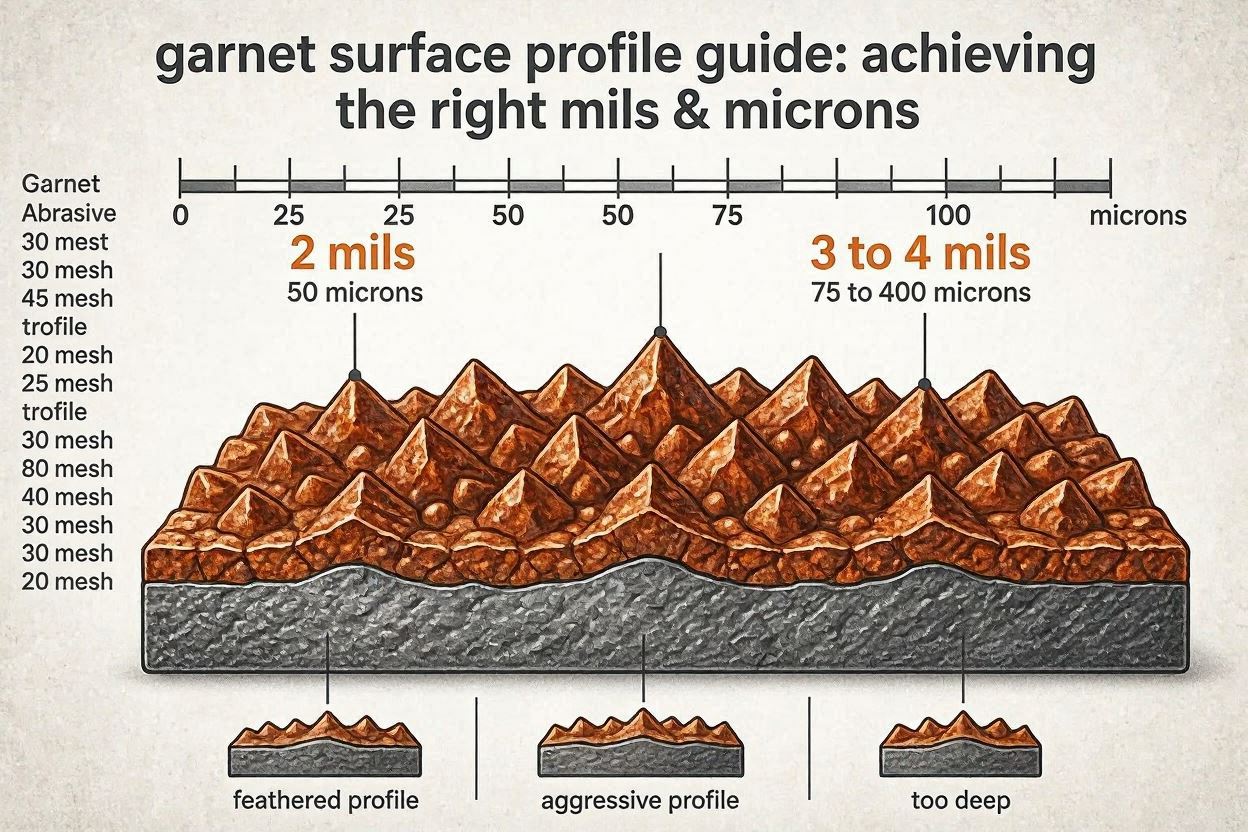
| 50 µm | 2 mils | 0.050 mm | 0.002″ |
| 75 µm | 3 mils | 0.075 mm | 0.003″ |
| 100 µm | 4 mils | 0.100 mm | 0.004″ |
| 125 µm | 5 mils | 0.125 mm | 0.005″ |
8. Frequently Asked Questions
Need Help Specifying Grit Size for Your Project?
Our technical team at Jiangsu Henglihong Technology Co., Ltd. can review your coating specification and recommend the correct grade and size of abrasive. Contact us for a fast response.
Get Technical Support →フィルター