Silicon Carbide Blast Media: The Hardest Abrasive Explained
At Mohs 9.5, silicon carbide is the hardest commercially available blasting abrasive — faster-cutting than aluminum oxide, capable of etching glass, texturing stone, and preparing surfaces that would defeat every other media type. This guide covers black vs green grades, grit sizing, key applications, cost economics, and when SiC is the only viable choice.
1. What Is Silicon Carbide Blast Media?
Silicon carbide (SiC) — also known by the trade name Carborundum, coined by its inventor Edward Acheson in 1891 — is a synthetic ceramic compound produced by fusing silica sand and petroleum coke in an electric resistance furnace (the Acheson process) at temperatures exceeding 2,000 °C. The resulting crystalline material is among the hardest substances known to chemistry, sitting at Mohs 9.5 on the hardness scale — harder than corundum (aluminum oxide), harder than topaz, harder than ruby, and surpassed only by diamond (Mohs 10) and boron carbide among commercially significant materials.
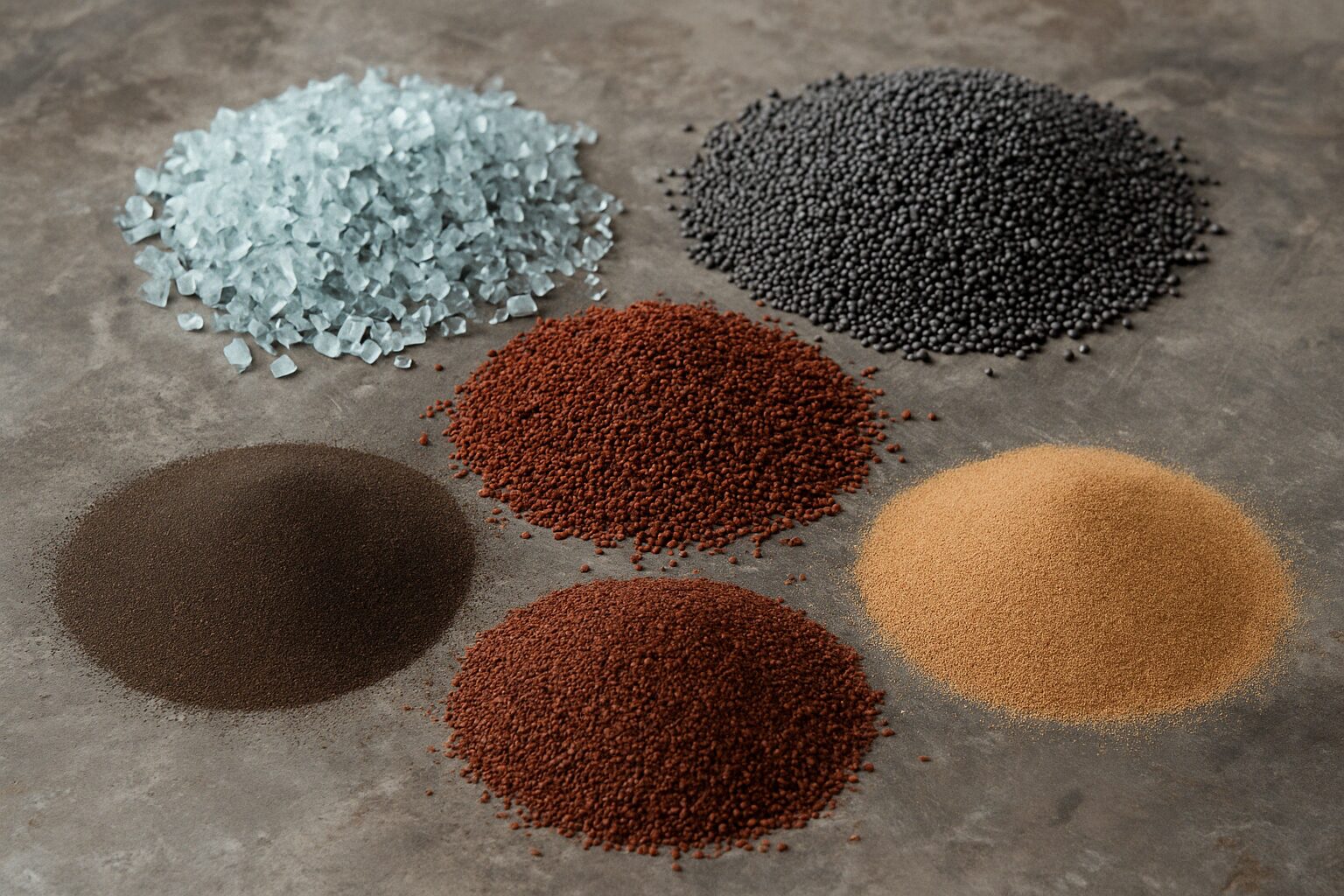
When crushed and sized into blasting grit, silicon carbide produces extremely sharp, angular particles with a characteristic splintery fracture pattern. Each fracture event during blasting exposes new, razor-sharp cutting edges — a property called friability — which means SiC maintains cutting aggression throughout its service life rather than rounding off as softer abrasives do. This self-sharpening behavior, combined with its exceptional hardness, makes silicon carbide the fastest-cutting blasting abrasive commercially available as of March 2026.
Silicon carbide is chemically inert, contains no free crystalline silica, and is non-toxic — making it compliant with OSHA 29 CFR 1926.1153 and EU Directive 2017/2398 silica exposure regulations. Standard blasting PPE remains mandatory, but SiC carries none of the silicosis risk associated with legacy silica sand blasting operations.
2. Hardness in Context — How SiC Compares
To understand why silicon carbide occupies such a unique position in the blasting media market, it helps to place its hardness in context against the full range of commercial abrasives and common industrial materials.
Mohs Hardness Comparison — Blasting Media & Common Materials
The 0.5-point Mohs difference between silicon carbide (9.5) and aluminum oxide (9.0) understates the practical performance gap. The Mohs scale is not linear — each step represents a geometrically larger increase in hardness. Silicon carbide is measurably harder than aluminum oxide in abrasive testing, cuts through glass and ceramics at a rate that aluminum oxide cannot match, and maintains cutting performance on extremely hard substrates where aluminum oxide particles would round off and lose effectiveness within a short blast cycle.
3. Black vs Green Silicon Carbide
Silicon carbide for industrial blasting and abrasive applications is produced in two principal grades that differ in purity, crystal structure, and performance characteristics.
For the large majority of blasting applications — glass etching, stone texturing, ceramic surface preparation, and hard material cleaning — black silicon carbide is the standard and correct specification. Its slightly lower purity does not affect performance in these applications, and the cost savings over green SiC are significant at production volumes. Green silicon carbide is reserved for applications where maximum purity, absolute maximum hardness, or the highest cutting speed per unit of abrasive consumed is a documented requirement — primarily semiconductor processing, optical component preparation, and the finest precision lapping operations.
4. Grit Size Selection Guide
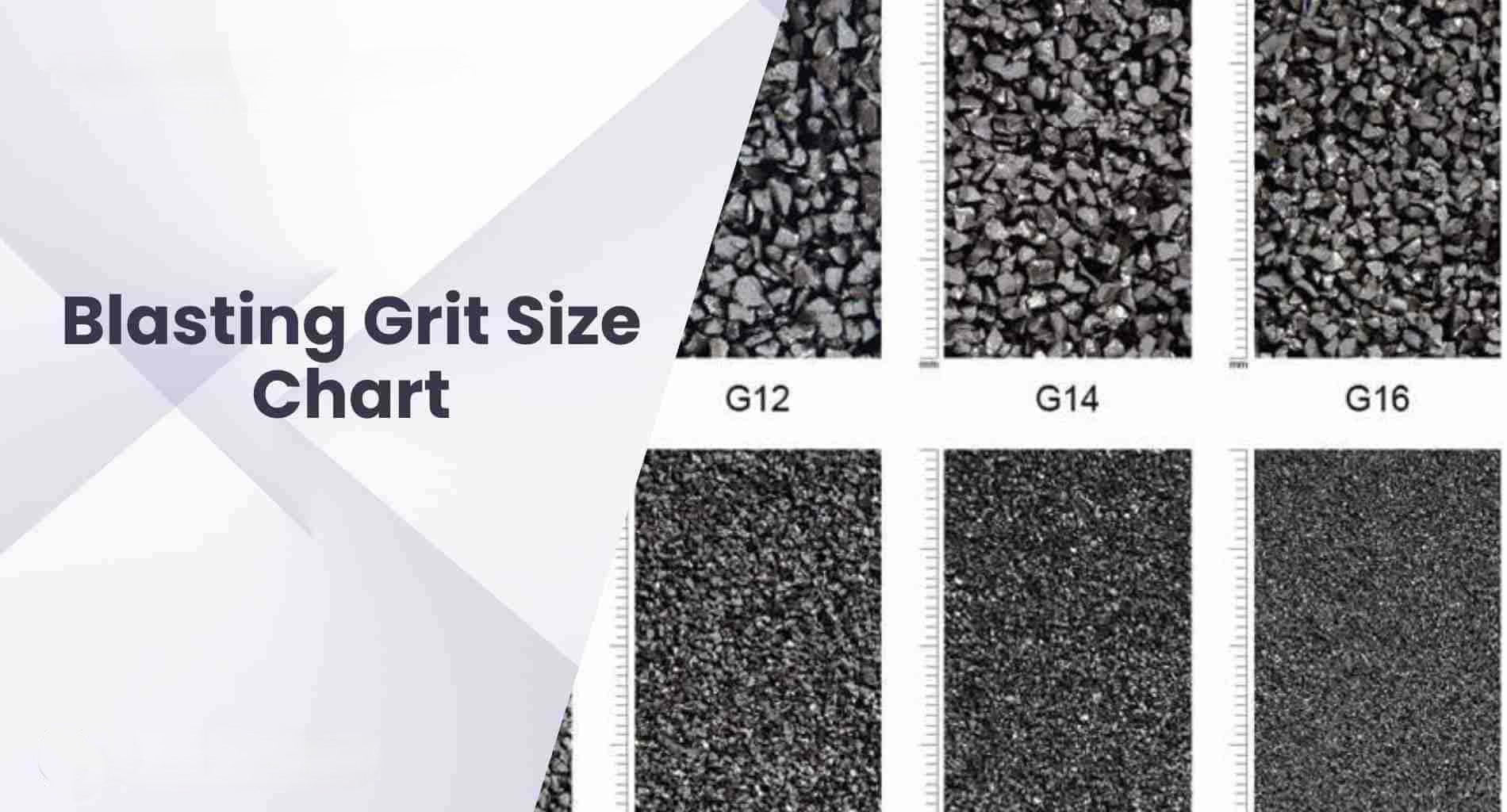
Silicon carbide for blasting and surface preparation is sized using the FEPA F-grade system (for macro grits F12–F220) and FEPA P-grade system (for finer micro grits up to P2500 and beyond used in lapping and polishing). For blasting applications, the practical range spans F12 (very coarse, maximum profile) through F220 (fine, precision finishing), with specialized micro grits used in semiconductor and optical processing.
| FEPA Grade | Particle Size (µm) | Profile / Texture | Primary Application |
|---|---|---|---|
| F12–F16 | 1,180–2,360 | Very coarse / deep | Maximum aggression on very hard materials; thick scale removal from ceramic components |
| F24–F36 Most used | 500–1,000 | Coarse — deep etch | Glass carving and heavy etching, stone monument texturing, coarse ceramic prep |
| F46–F60 Most used | 250–500 | Medium etch | General glass etching, architectural glass, silicon carbide and ceramic surface prep |
| F80–F100 | 150–250 | Fine etch / frosting | Fine glass frosting, controlled ceramic texturing, pre-metallization surface prep |
| F120–F180 | 63–150 | Very fine / matte | Optical glass matting, precision ceramic conditioning, pre-coating surface activation |
| F220+ / Micro grits Semiconductor | <63 | Ultra-fine / polish | Silicon wafer processing, optical component lapping, precision ceramic finishing |
Texture depth decreases with increasing FEPA grade number (finer particles). For glass etching, the choice of grit controls whether the result is a heavy carved texture (F24–F36) or a smooth frosted effect (F80–F120). Always test on scrap material before committing to a production grit size.
5. Applications by Industry
Silicon carbide blast media serves a specific and irreplaceable role in applications where substrate hardness, required cutting speed, or surface quality demands exceed what any other commercial abrasive can deliver.
Glass Etching & Carving
The dominant abrasive for artistic and architectural glass etching, sandblasting of decorative glassware, and glass carving for signage, memorials, and interior design applications. SiC cuts glass cleanly at speeds no other abrasive matches. F24–F60 covers most glass work.
Stone & Monument Texturing
Surface texturing of granite, marble, limestone, and sandstone for architectural panels, monuments, gravestones, and decorative paving. SiC’s hardness allows effective work on granite and quartzite where softer abrasives stall. F24–F46 for heavy texturing; F60–F80 for finer finishes.
Technical Ceramics
Surface preparation of alumina, zirconia, silicon nitride, and cemented carbide components prior to thermal spray coating, brazing, or metallization. SiC is one of the few abrasives hard enough to effectively profile these materials without excessive media consumption.
Semiconductor Processing
Green silicon carbide micro grits (F220–F1200) are used in the lapping and conditioning of silicon wafers, sapphire substrates, and compound semiconductor materials. This is a precision, tightly controlled application with stringent particle size distribution requirements.
Optical Components
Matting and controlled surface finishing of optical glass lenses, prisms, and mirrors where precise surface roughness is required. Fine-to-ultra-fine SiC grits (F120–F400) produce consistent matte surfaces with controlled Ra values for optical diffusion applications.
Hard Refractory & Carbide Parts
Cleaning and surface activation of tungsten carbide dies, boron carbide nozzles, and refractory ceramic components in tooling and wear applications. When the workpiece hardness approaches or exceeds aluminum oxide, SiC is the only practical blasting abrasive alternative.
6. Silicon Carbide vs Aluminum Oxide — When to Choose Each
The most common selection decision involving silicon carbide is whether it offers a meaningful advantage over оксид алюминия for a given application. The answer is nuanced and heavily application-dependent.
| Параметр | Карбид кремния | Оксид алюминия |
|---|---|---|
| Mohs hardness | 9.5 ▲ | 9.0 |
| Cutting speed on hard substrates | Faster ▲ | Slower on glass/ceramic |
| Возможность вторичной переработки | 10–30 cycles ▼ | 100–200 cycles ▲ |
| Unit price (USD/MT) | $1,400–2,200 ▼ | $600–900 ▲ |
| Cost/m² on carbon steel | Very high (overkill) ▼ | Low ▲ |
| Effectiveness on glass | Excellent ▲ | Slow — not ideal △ |
| Effectiveness on ceramics | Excellent ▲ | Moderate △ |
| Effectiveness on carbon steel | Works, costly △ | Ideal ▲ |
| Silica-free compliance | Yes ▲ | Yes ▲ |
| Availability of grades | F12–F1200+ ▲ | F12–F220 |
▲ Advantage · △ Acceptable · ▼ Disadvantage · Prices indicative as of March 2026 FOB China.
The decision rule is clear: use aluminum oxide for carbon steel, stainless steel, and most industrial metal surface preparation — it is adequate in hardness, far more economical, and dramatically more recyclable. Use silicon carbide when the substrate is glass, technical ceramic, cemented carbide, or any material hard enough that aluminum oxide produces an unacceptably slow blasting rate — or when the very finest micro-grit sizes for semiconductor and optical work are required.
For the complete multi-abrasive comparison across all media types, see the Blasting Media Comparison Chart. For a structured selection framework, see the complete blasting media selection guide.
7. Cost Economics
Silicon carbide is among the most expensive commercial blasting abrasives on a per-kilogram basis, reflecting the energy-intensive Acheson process required to produce it and its relatively limited global production volume compared to aluminum oxide.
Despite higher unit cost, silicon carbide can be economical in applications where no alternative abrasive achieves the required cutting rate. If aluminum oxide completes a glass etching job in 8 hours and silicon carbide completes the same job in 3 hours, the reduction in labor time and equipment amortization may offset the higher media cost — particularly in high-labor-cost markets. The cost-per-job calculation must include: media purchase cost, recycle life in the specific application, labor time saved, and equipment productivity improvement.
For cabinet blast systems processing glass or ceramic components at volume, silicon carbide’s relatively lower recycle life (10–30 cycles vs 100–200 for aluminum oxide) is partially offset by its faster cutting rate — each cycle processes more surface area per unit time. Benchmarking actual media consumption per m² of substrate processed, rather than relying on nominal recycle cycle counts, gives the most accurate cost comparison for a specific production application. See the Blasting Media Cost Guide & ROI Analysis for a full cost-per-m² modeling framework.
8. Sourcing and Quality Standards
Silicon carbide for blasting is produced primarily in China, which accounts for the large majority of global output, with additional production in the United States, Norway, South Africa, and Brazil. Quality between suppliers can vary significantly, particularly in particle size distribution consistency, purity, and the proportion of defective (non-angular, over-fused) particles in the grit. The following standards and documentation should be requested from any supplier before qualifying a source:
- FEPA Standard 42-1984 (or ISO 8486) — particle size distribution for F-grade abrasive grits, the primary sizing reference for blasting-grade SiC in international trade
- GB/T 2480 — Chinese national standard for silicon carbide abrasives (relevant when sourcing from Chinese producers)
- Chemical analysis certificate — confirming SiC content (98% min for black, 99%+ for green), free carbon content, free silicon content, and Fe₂O₃ content per batch
- Sieve analysis certificate — confirming actual particle size distribution against FEPA grade specification for the specific shipment lot
- SDS/MSDS — Safety Data Sheet confirming free crystalline silica content and relevant occupational health classifications
9. Frequently Asked Questions
Related Resources
Explore the full blasting media resource library from Jiangsu Henglihong Technology for further guidance on media selection, cost analysis, and application-specific recommendations:
- Blasting Media: Complete Industry Guide — full overview of all media types and applications
- Types of Blasting Media: Complete Guide — how silicon carbide compares to all other abrasive types
- How to Choose the Right Blasting Media — step-by-step selection framework and substrate matrix
- Aluminum Oxide Blast Media: Uses & Grit Guide — the preferred alternative for most industrial metal applications
- Garnet Blasting Media — low-dust mineral abrasive for open-air steel blasting
- Glass Bead Blasting Media — for smooth satin finishes on stainless and aluminum
- Steel Grit vs Steel Shot — metallic abrasives for high-volume automated blast rooms
- Plastic Blast Media for Aerospace & Automotive
- Blasting Media Comparison Chart — side-by-side data for all major abrasives
- Blasting Media Cost Guide & ROI Analysis — cost-per-m² modeling and price benchmarks
- Blasting Media Safety Guide — OSHA/EU compliance, PPE requirements
- Eco-Friendly Blasting Media: Low-Dust & Silica-Free Options
- Industrial Surface Prep: Best Blasting Media for Metal
- Blasting Media for Automotive Restoration
Source Silicon Carbide Blast Media from a Trusted Manufacturer
Jiangsu Henglihong Technology supplies black and green silicon carbide in FEPA F-grade macro and micro grits, with full chemical analysis certification, sieve analysis documentation, and reliable export logistics to North America, Europe, the Middle East, and beyond.
Request a Quote or Technical SampleФильтры