Aluminum Oxide vs Garnet Blast Media:
Full Comparison
A rigorous, data-driven comparison of the two most widely specified non-ferrous abrasive blast media — covering hardness, cutting speed, anchor profile, recyclability, dust generation, total cost of ownership, and application-by-application decision guidance.
- At a Glance: Key Differences
- What Is Garnet Blast Media?
- Full Properties Comparison Table
- Hardness, Cutting Speed & Anchor Profile
- Recyclability & Media Life
- Dust Generation & Safety Profile
- Total Cost of Ownership Analysis
- Eight Application Scenarios: Which Wins?
- A Special Case: Wet Blasting & Waterjet Cutting
- When to Switch from Garnet to Aluminum Oxide
- Часто задаваемые вопросы
1. At a Glance: Key Differences
Aluminum oxide and garnet are the two most commonly evaluated non-ferrous blast media for industrial surface preparation. Both are chemically inert, iron-free, and capable of achieving high-quality surface cleanliness grades without the health hazards of crystalline silica. But they differ significantly in hardness, cutting mechanism, recyclability, and total cost of ownership across different production environments — and the “better” media is genuinely application-dependent.
Гранат wins on lower dust generation, natural mineral sourcing, availability for waterjet cutting, and cost efficiency in open-blast or single-pass outdoor applications where media recovery is impractical.
This comparison focuses on abrasive-grade garnet used for dry blast cleaning — primarily almandine garnet at 20/40, 30/60, and 80 mesh — as used in industrial surface preparation for protective coating systems. For the broader aluminum oxide context, see our complete reference: Aluminum Oxide Blast Media: The Complete Buyer’s Guide.
2. What Is Garnet Blast Media?
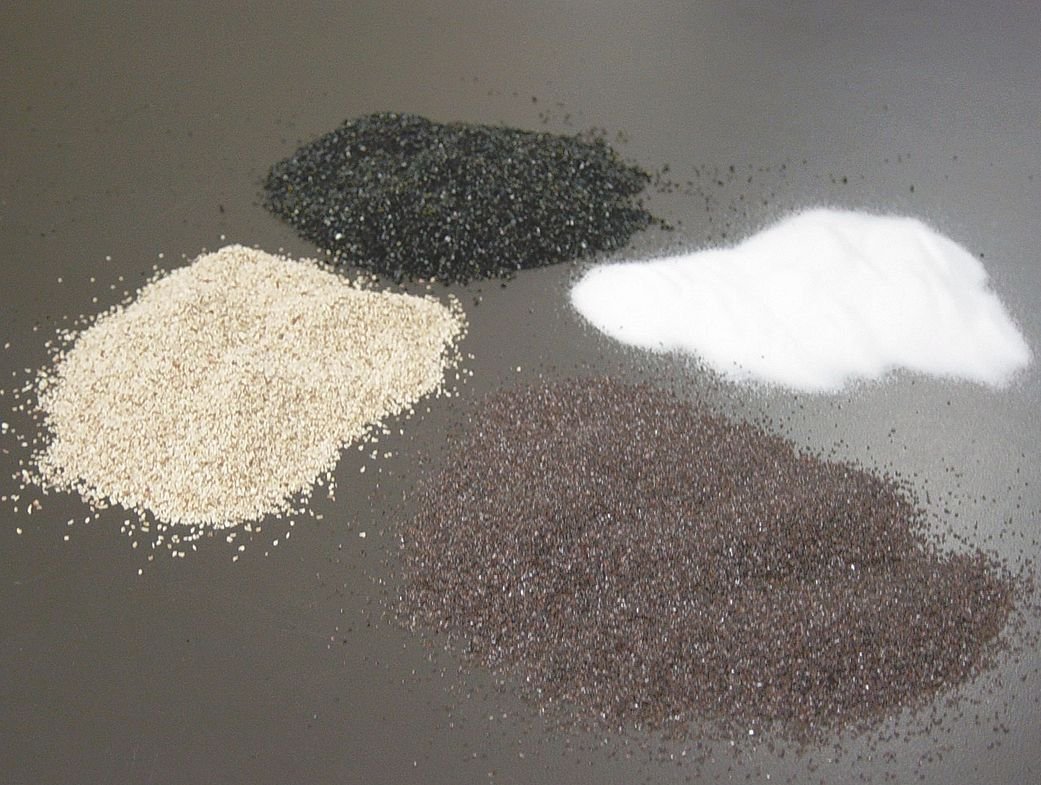
Garnet is a group of naturally occurring silicate minerals sharing the general formula A₃B₂(SiO₄)₃, where A and B represent various metal cations. For industrial blast applications, almandine garnet (Fe₃Al₂(SiO₄)₃) is the dominant type — mined primarily in India (Rajasthan state), Western Australia, and Idaho, USA. Its sub-angular grain shape, moderate hardness, and relatively low silica dust generation made it a widely adopted replacement for silica sand as the regulatory environment around crystalline silica tightened through the 1990s and 2000s.
Types of Garnet Used in Blasting
- Almandine garnet: The most common blast-grade type. Iron-aluminium silicate. Mohs 7.5–8.0. Reddish-brown to dark red color. Primary source: India, Australia.
- Andradite garnet: Calcium-iron silicate. Less common in blast applications. Mohs 6.5–7.0. Softer than almandine — lower cutting performance.
- Pyrope garnet: Magnesium-aluminium silicate. Found in South Africa. Mohs 7.5. Less commercially available than almandine.
Blast-grade garnet is classified by mesh size under SSPC, ISO, and various national standards. Common blast grades are 20/40 mesh (coarse, for heavy steel prep), 30/60 mesh (general purpose), and 80 mesh (fine, for precision cleaning). Unlike aluminum oxide, garnet is not typically designated by FEPA F-grit numbers — instead, it uses mesh range designations.
3. Full Properties Comparison Table
| Property | Aluminum Oxide (Brown/White) | Almandine Garnet | Winner |
|---|---|---|---|
| Твердость по Моосу | 9.0 | 7.5–8.0 | Al₂O₃ |
| Vickers Microhardness | 1,800–2,200 HV | 1,100–1,350 HV | Al₂O₃ |
| Истинная плотность | 3.90–3.97 g/cm³ | 3.9–4.1 g/cm³ | Similar |
| Форма зерна | Angular to blocky | Sub-angular to angular | Similar |
| Cutting Speed (hard substrates) | Higher | Умеренный | Al₂O₃ |
| Anchor Profile Depth | Higher at equiv. grit | Умеренный | Al₂O₃ |
| Profile Consistency | Высокий | Высокий | Similar |
| Recyclability (dry blast) | 4–10 cycles | 1–3 cycles | Al₂O₃ |
| Dust Generation | Low to moderate | Низкий | Гранат |
| Respirable Silica Fraction | < 0.1% (white) / < 2% (brown) | Low — silica bound in silicate lattice | Both safe |
| Iron Contamination Risk | None (white) / Trace (brown) | Very low (bound iron) | White Al₂O₃ |
| Unit Purchase Price | $$ (brown) / $$$ (white) | $$ (comparable to brown Al₂O₃) | Similar |
| Cost per m² (closed loop) | Lower (more recycles) | Higher (fewer recycles) | Al₂O₃ |
| Cost per m² (open blast, no reclaim) | Higher (premium lost if single-use) | Lower or comparable | Гранат |
| Waterjet Cutting Abrasive | Not standard | Industry standard | Гранат |
| Availability (global) | Widely available (manufactured) | Dependent on mining supply chain | Al₂O₃ |
| FEPA / International Grading | FEPA F-grits (standardized) | Mesh ranges (less standardized) | Al₂O₃ |
| Aerospace / Medical Approval | AMS 2431, MIL-A-22262 | Not typically specified | Al₂O₃ |
4. Hardness, Cutting Speed & Anchor Profile
The most fundamental performance difference between aluminum oxide and garnet is hardness — and hardness governs nearly every downstream performance variable in abrasive blasting.
The Hardness Gap
Aluminum oxide registers Mohs 9.0 across both brown and white fused grades. Almandine garnet registers Mohs 7.5–8.0. This 1–1.5 unit difference on the Mohs scale understates the actual hardness gap: the Mohs scale is ordinal, not linear. The Vickers microhardness data is more instructive — aluminum oxide at 1,800–2,200 HV is approximately 50–80% harder than almandine garnet at 1,100–1,350 HV. On substrates with a surface hardness above approximately 200 HBN (hardened steel, cast iron, tool steel, hard alloys), this hardness difference translates directly into significantly faster material removal per kilogram of abrasive consumed.
Cutting Speed on Different Substrates
On soft to medium-hard substrates — mild steel, aluminum, copper alloys — the practical cutting speed difference between aluminum oxide and garnet at equivalent mesh/grit sizes is modest, typically 10–20% in favor of aluminum oxide. Both media cut readily because the substrate is softer than either abrasive. On harder substrates — hardened steel (45+ HRC), cast iron, stainless steel, ceramic surfaces — the hardness advantage of aluminum oxide becomes progressively more decisive. At 60 HRC substrate hardness, aluminum oxide can cut at double the material removal rate of garnet at the same blast pressure, because garnet’s lower hardness causes it to deform and skate across the surface rather than penetrate it cleanly.
Anchor Profile at Equivalent Conditions
At equivalent mesh sizes and blast parameters, aluminum oxide consistently produces a deeper and somewhat more aggressive anchor profile than garnet — reflecting both its higher hardness and its more sharply angular grain geometry. On mild steel at 70 PSI with 30/60 mesh garnet versus F36 aluminum oxide (broadly equivalent particle size ranges):
- Garnet (30/60 mesh): typical Rz 35–55 µm
- Aluminum oxide (F36): typical Rz 40–65 µm
The overlap in these ranges means both media can satisfy most standard industrial coating anchor profile requirements. The aluminum oxide ceiling — the maximum achievable Rz — is higher, which matters when the specification calls for profiles above 65 µm for very high-build or immersion-service coatings.
5. Recyclability & Media Life
Recyclability is the single factor that most dramatically shifts the total cost of ownership comparison between aluminum oxide and garnet in favor of aluminum oxide — in the right production environment.
Why Garnet Recycles Poorly
Garnet’s lower hardness means its grains fracture more readily on impact with both the substrate surface and the blast cabinet walls and deflector plates. Each impact cycle generates a larger proportion of sub-size fines that no longer contribute usefully to profile generation. In a closed-loop blast cabinet with an air-wash classifier, garnet typically yields 1–3 effective recycle cycles before the particle size distribution has degraded to the point where the achieved anchor profile falls below specification. In many outdoor blasting operations, garnet is effectively used once — the economics of collecting, transporting, and processing spent media for re-use are unfavorable when the recycle yield is so low.
Aluminum Oxide Recycle Performance
Brown fused aluminum oxide’s TiO₂-reinforced crystal structure gives it significantly greater impact resistance than garnet, yielding 4–8 effective recycle cycles in a well-maintained closed-loop system. White fused aluminum oxide achieves 5–10 cycles. In both cases, the media charge maintains an acceptable particle size distribution and continues to produce on-specification anchor profiles for multiple production runs before top-up becomes necessary. For a detailed breakdown of the recycle economics and how to track media life in production, see our dedicated guide: Is Aluminum Oxide Blast Media Reusable? How Many Times?
| Параметр | Aluminum Oxide (Brown) | Almandine Garnet |
|---|---|---|
| Typical recycle cycles (closed-loop cabinet) | 4–8 | 1–3 |
| Primary wear mechanism | Progressive grain fracture → gradual D50 reduction | Rapid grain fracture → fast D50 degradation |
| Dust generation rate per cycle | Lower — fewer fines generated per pass | Higher — more fines per pass |
| Profile depth degradation rate | Gradual — predictable top-up schedule | Faster — requires more frequent monitoring |
| Practical use in open-blast (outdoor) | Higher unit cost makes single-use less attractive | More economical single-use when collection impractical |
6. Dust Generation & Safety Profile
Both aluminum oxide and garnet were widely adopted as safer alternatives to crystalline silica sand — and both represent a substantial improvement in occupational health risk profile relative to the media they replaced. However, they differ in their dust characteristics in ways that matter for operator safety and facility management.
Dust Volume
Garnet, being softer, fractures more completely on impact and generates a greater volume of fine dust per unit of media consumed. However, because garnet is a natural silicate mineral rather than a pure crystalline compound, the respirable fraction of its dust does not carry the acute silicosis risk associated with quartz or cristobalite. Almandine garnet dust is classified as a nuisance particulate under most occupational health regulations when used correctly.
Aluminum oxide generates somewhat less total dust per kilogram at the same blast conditions, due to its higher hardness and more controlled fracture behavior. High-quality white fused aluminum oxide (SiO₂ < 0.1%) is among the lowest-respirable-hazard industrial abrasives available. Brown fused aluminum oxide from reputable manufacturers (SiO₂ 0.5–2.0%) also falls well below crystalline silica thresholds.
Respirable Fraction & Regulatory Status
| Safety Parameter | Оксид алюминия | Almandine Garnet |
|---|---|---|
| IARC carcinogen classification | Not listed | Not listed |
| Crystalline silica content | < 0.1% (white) / < 2% total SiO₂ (brown) | Silica bound in silicate lattice — not free crystalline silica |
| OSHA PEL compliance (US) | Compliant with engineering controls | Compliant with engineering controls |
| Recommended respiratory protection | NIOSH P100 half-face / PAPR | NIOSH P100 half-face / PAPR |
| Total dust generation (relative) | Moderate (less than garnet at equiv. conditions) | Higher (more fines per kg consumed) |
| Dust collector requirement | Required for enclosed blast work | Required for enclosed blast work |
For either abrasive, enclosed blast operations require functional dust collection delivering adequate capture velocity at the blast enclosure, operator respiratory protection, and compliance with local occupational exposure limit (OEL) regulations. Neither medium eliminates the need for engineering controls — they simply eliminate the acute carcinogenic risk associated with crystalline silica.
7. Total Cost of Ownership Analysis
Unit purchase price comparisons between aluminum oxide and garnet are frequently misleading because they ignore the most important cost variable: how many square meters of specification-grade surface preparation each kilogram of media actually delivers across its service life. A structured TCO calculation — based on media consumption per square meter, recycle cycles, and disposal cost — almost always reverses the apparent cost advantage that garnet’s unit price suggests in closed-loop production environments.
Closed-loop cabinet system
Open blast, single-use
Worked Example: Cabinet Blast Shop, 500 m²/week
A fabrication shop with a closed-loop blast cabinet processing 500 m² of mild steel per week to SSPC-SP 10, targeting a 45–65 µm anchor profile, with a media reclaim system:
| Cost Item | Brown Al₂O₃ (F36, 6 cycles) | Garnet (30/60 mesh, 2 cycles) |
|---|---|---|
| Initial media consumption (kg/m²) | 2.5 kg/m² | 2.5 kg/m² |
| Effective cycles before replacement | 6 | 2 |
| Net consumption per m² (kg) | 2.5 ÷ 6 = 0.42 kg | 2.5 ÷ 2 = 1.25 kg |
| Weekly net media purchase (500 m²) | 0.42 × 500 = 210 kg | 1.25 × 500 = 625 kg |
| Weekly spent media disposal (kg) | ~210 kg | ~625 kg |
| Relative weekly media + disposal cost | Lower — despite higher unit price | Higher — despite lower unit price |
8. Eight Application Scenarios: Which Wins?
9. A Special Case: Wet Blasting & Vapor Blasting
Wet blasting (also called vapor blasting or slurry blasting) introduces water into the blast stream to suppress dust and reduce substrate heating. Both aluminum oxide and garnet are used in wet blasting applications, but their relative performance shifts compared to dry blasting.
Wet Blast Performance Comparison
In wet blast systems, the water film surrounding each abrasive particle cushions the initial impact slightly — reducing the peak impact stress and, with it, the profile depth per pass compared to dry blasting at the same pressure. Aluminum oxide’s superior hardness means this cushioning effect costs it less cutting performance than it costs garnet, so the relative performance advantage of aluminum oxide over garnet is maintained or slightly amplified in wet blast conditions.
Garnet is widely used in wet blast and vapor blast cabinets for sensitive substrates — aluminum, magnesium, and thin-walled aerospace components — where its slightly lower cutting aggression is actually a benefit, reducing the risk of substrate damage from over-blasting. For these applications, garnet at 60–80 mesh in a wet blast cabinet is a well-established combination.
Waterjet Cutting — Garnet Only
In waterjet cutting systems (not to be confused with wet blast cleaning), the abrasive is introduced into a supersonic water jet stream and used to cut through metal, stone, glass, and composites. Garnet — specifically 80 mesh alluvial almandine — is the universal standard abrasive for waterjet cutting. Aluminum oxide is not used in waterjet cutting because its hardness (Mohs 9.0) causes excessive and rapid wear of the waterjet focusing nozzle (typically tungsten carbide or boron carbide), multiplying maintenance costs. This is the one application category where garnet has a clear and uncontested advantage.
10. When to Switch from Garnet to Aluminum Oxide
Many industrial contractors and fabrication shops begin with garnet — familiar, widely available, and operationally simple — and only evaluate the switch to aluminum oxide when a trigger event occurs. The following scenarios each represent a legitimate and commercially justified reason to make the switch:
- Production volume crosses ~300 m²/week. At this threshold, investing in a media reclaim classifier (air-wash separator) becomes economically justified, and aluminum oxide’s recyclability advantage begins to deliver a measurable net cost reduction. The payback period on the classifier is typically 6–18 months depending on media price and throughput.
- The specification changes to stainless steel, aluminum, or titanium substrates. Garnet, while low-iron, is not approved under AMS 2431 or most aerospace and medical device procurement specifications. The specification upgrade forces a media change — and white fused aluminum oxide is the correct response.
- The coating specification calls for Rz above 65 µm. Standard blast-grade garnet struggles to reliably deliver profiles above this threshold at practical blast pressures on mild steel. Coarser aluminum oxide achieves this range more consistently.
- The substrate is harder than approximately 45 HRC. On hardened steel, tool steel, or hard-facing alloys, garnet cuts too slowly for production efficiency. Aluminum oxide’s superior hardness makes it the only practical media choice for these substrates.
- The project requires FEPA-graded media documentation. Some quality plans, particularly in power generation, chemical processing, and nuclear applications, require the blast media to be certified to FEPA F-grits or equivalent. Aluminum oxide has a well-established FEPA certification ecosystem; garnet does not.
11. Frequently Asked Questions
In single-use, open-blast outdoor applications where spent media collection is impractical, garnet is often the more cost-effective choice. Aluminum oxide’s main advantage — recyclability — cannot be realized in this scenario, so its higher unit purchase price becomes a straight cost disadvantage. Garnet’s cutting performance on mild steel is adequate for SSPC-SP 6 and SP 10 work at standard pressures. However, if the outdoor substrate is hard (cast iron, hardened steel) or the specification calls for Rz above 65 µm, aluminum oxide delivers performance that garnet cannot match regardless of the media recovery situation.
Garnet’s iron content is structurally bound within the almandine silicate lattice (Fe₃Al₂(SiO₄)₃) rather than present as free iron oxide particles. This significantly reduces — but does not eliminate — the iron contamination risk relative to brown fused aluminum oxide. In general industrial applications, garnet is acceptable on stainless steel where the service environment is moderate and the specification does not explicitly prohibit iron-bearing abrasives. However, for pharmaceutical stainless, aerospace components, and high-purity chemical plant equipment, white fused aluminum oxide (< 0.05% Fe₂O₃, structurally iron-free) is the more conservative and more commonly specified choice. Always check your specific coating specification and inspection test plan before selecting a media for sensitive stainless steel applications.
FEPA F36 aluminum oxide has a D50 of approximately 600 µm and a particle range of 500–710 µm. The closest garnet equivalent in standard blast grades is 20/40 mesh (passing 20 mesh / retained on 40 mesh), which corresponds to approximately 420–840 µm — slightly coarser than F36 at the upper end. For a closer match, some garnet suppliers offer a 30/60 mesh grade (250–600 µm), which aligns better with F36’s D50. Note that garnet and aluminum oxide particle size standards are not directly interchangeable — always validate the equivalent by measuring the achieved anchor profile on a representative test panel, not by relying on nominal mesh equivalents alone.
Yes. SSPC and NACE (now AMPP) surface preparation standards specify cleanliness grades and anchor profile depths but do not mandate specific abrasive media types for most standard applications — they define the result, not the method. Aluminum oxide is fully capable of achieving SSPC-SP 5, SP 10, SP 6, and SP 7 cleanliness grades when correctly specified and applied. Certain project-specific inspection test plans (ITPs) may impose additional media requirements — such as specifying FEPA-certified media or prohibiting iron-bearing abrasives — but these are project-level additions, not SSPC/NACE standard requirements.
The two processes have fundamentally different optimal media requirements. In waterjet cutting, the abrasive is suspended in a supersonic water jet and the cutting action is primarily erosive — particle hardness matters, but so does the particle’s ability to flow consistently through the focusing nozzle without causing excessive nozzle wear. Garnet at Mohs 7.5–8.0 cuts effectively while causing acceptable nozzle wear rates on tungsten carbide or boron carbide focusing nozzles. Aluminum oxide at Mohs 9.0 cuts just as well but causes nozzle wear rates two to four times higher, making it economically unacceptable for waterjet. In abrasive blasting, nozzle wear is much less of a constraint (blast nozzles are much larger and cheaper than waterjet focusing tubes), so aluminum oxide’s superior hardness and recyclability become net advantages rather than liabilities.
Switching from garnet to aluminum oxide in an existing cabinet is straightforward but requires a few practical steps. First, fully evacuate and clean the blast cabinet, reclaim system, and hopper of all garnet — residual garnet mixed with the new aluminum oxide charge will degrade your anchor profile consistency and compromise the iron-free status if switching to white grade for stainless work. Second, check that the hopper feed rate and air-wash classifier settings are appropriate for aluminum oxide’s different bulk density compared to garnet. Third, verify that the nozzle bore diameter is compatible with the aluminum oxide grit size you are switching to (see our grit selection guide: Aluminum Oxide Grit Size Chart & Selection Guide). Finally, run a trial blast on a test panel and measure the anchor profile with ISO 8503 replica tape before committing to full production, as aluminum oxide typically produces a slightly deeper profile than equivalent-mesh garnet at the same blast parameters.
Ready to Switch to Aluminum Oxide?
Jiangsu Henglihong Technology supplies brown fused and white fused aluminum oxide abrasives globally, with full FEPA-certified grit documentation, lot-specific Certificates of Analysis, and ISO 9001:2015 quality management on every shipment.
Related Resources
Explore more technical guidance from the Henglihong resource library:
- Aluminum Oxide Blast Media: The Complete Buyer’s Guide
- Aluminum Oxide Grit Size Chart & Selection Guide
- Brown vs White Aluminum Oxide: Which Should You Use?
- How to Choose Aluminum Oxide Blast Media for Steel Surfaces
- Is Aluminum Oxide Blast Media Reusable? How Many Times?
- Aluminum Oxide Blast Media for Aerospace & Medical
- Aluminum Oxide for Glass Etching & Frosting
- Bulk Aluminum Oxide Blast Media – Wholesale Pricing & RFQ
- Aluminum Oxide Anti-Slip Additive for Floor Coatings
Фильтры