Silicon Carbide Abrasive for Aerospace Surface Preparation: Standards & Specs
MIL-SPEC compliance, NADCAP requirements, approved substrate-specific SiC grades, and process parameters for aerospace-grade surface preparation of titanium alloys, nickel superalloys, and structural composites.
SECTION 01Why Silicon Carbide Is Used in Aerospace Surface Preparation
Aerospace surface preparation imposes requirements that eliminate most commercially available abrasive media from consideration. Substrates include titanium alloys (Mohs 6–7), nickel superalloys (Mohs 6–8), hardened stainless steel fasteners, silicon carbide-reinforced composite (SiC/SiC) hot section components, and carbon fiber reinforced polymer (CFRP) structures — all of which demand an abrasive that is simultaneously hard enough to achieve required surface cleanliness and profile, chemically inert enough to avoid surface contamination, and pure enough to meet strict acceptance testing.
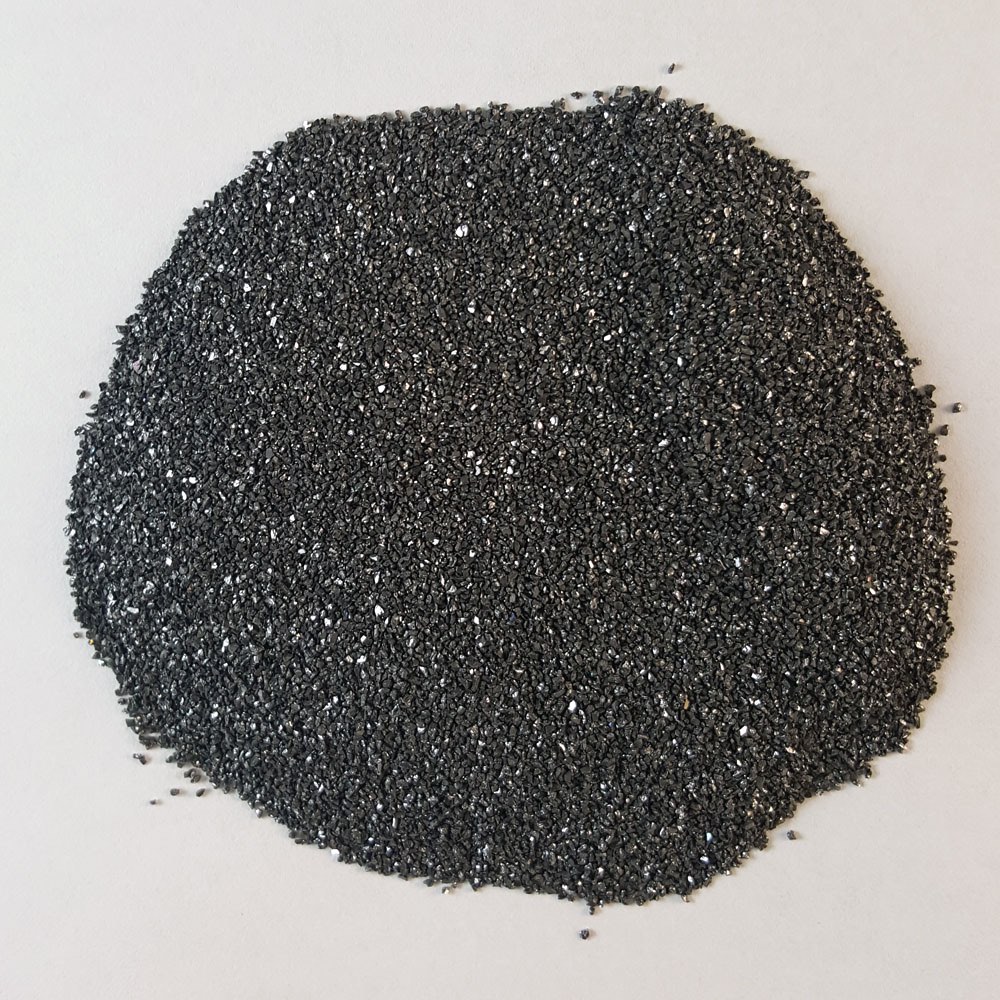
Silicon carbide — specifically high-purity Green SiC in most aerospace applications — meets all three requirements. Its Mohs 9.3–9.5 hardness provides adequate cutting power on nickel superalloys and titanium. Its chemical inertness means no reactive species are deposited on the surface. And its very low iron content (Fe₂O₃ ≤ 0.08% for Green SiC) eliminates the risk of iron contamination that would cause galvanic corrosion on titanium or interfere with subsequent diffusion bonding, thermal barrier coating (TBC) deposition, or high-temperature brazing.
For a full overview of SiC properties: Complete Buyer’s Guide to SiC Abrasive Blasting Media.
SECTION 02Applicable Standards for Aerospace Abrasive Blasting
Aerospace abrasive blasting operations are governed by a layered hierarchy of standards — from international quality management system standards at the top to substrate-specific process specifications at the component level. SiC media used in aerospace must be traceable and certified to the applicable standards at each level.
| Standard | Level | Scope | SiC Relevance |
|---|---|---|---|
| AS9100 Rev D | QMS | Aerospace quality management system | Traceability and documentation of all materials including abrasive media |
| MIL-A-22262B | Material Spec | Abrasive blasting media — aluminum oxide and silicon carbide | Directly specifies SiC purity, grit sizing, and composition requirements for military applications |
| MIL-PRF-9954 | Material Spec | Abrasive blasting media — glass beads (reference for comparison) | Defines glass bead — used where SiC would be inappropriate (soft alloys) |
| AMS 2430 | Process Spec | Shot peening (SAE AMS standard) | Defines intensity requirements; SiC used when angular media required for peening |
| SSPC-SP 6 / ISO 8501 | Surface Prep | Commercial blast cleaning cleanliness grades | Defines Sa 2, Sa 2.5, Sa 3 — target cleanliness grades for structural aero components |
| ASTM D4285 | Test Method | Indicating oil or water in compressed air | Required air quality verification before aerospace blasting operations |
| FEPA Standard 42-1 | Material Spec | Grain size classification | Grit sizing standard for SiC abrasive media used in aerospace applications (Europe/Asia) |
Supplier documentation note: For aerospace procurement, always request the following with each SiC shipment: Certificate of Conformance (CoC) to applicable standard, Chemical Analysis Report (SiC%, Fe₂O₃%, free SiO₂%, free C%), Sieve Analysis Report (D10, D50, D90 per FEPA), and Lot Traceability Number. Jiangsu Henglihong Technology Co., Ltd. provides all standard QC documentation with each lot.
SECTION 03NADCAP Requirements for Abrasive Blasting
NADCAP (National Aerospace and Defense Contractors Accreditation Program) accreditation is required for surface treatment operations — including abrasive blasting — on safety-critical aerospace components for most major OEM prime contractors (Boeing, Airbus, Lockheed Martin, GE Aviation, Pratt & Whitney, Rolls-Royce, etc.). NADCAP accreditation is audited by the Performance Review Institute (PRI) against the AC7109 checklist for chemical processing and surface finishing.
Key NADCAP Requirements Affecting SiC Media Selection
- Media qualification: The specific abrasive media type and grit size must be approved in the process specification (customer or prime contractor engineering specification). Substituting media without engineering approval is a NADCAP nonconformance.
- Contamination control: Abrasive media used on titanium must not contain iron-bearing media (no steel grit contamination). Green SiC with documented Fe₂O₃ ≤ 0.08% is standard for titanium applications.
- Media segregation: Media used on different substrate alloy families (titanium vs. nickel vs. steel) must be stored and used in dedicated, clearly labeled containers to prevent cross-contamination.
- Media testing frequency: Incoming media lots must be verified against purchase specification. For NADCAP facilities, testing frequency is defined in the process specification — typically each lot or every 6 months at minimum.
- Equipment calibration: Blast pressure gauges, nozzle wear measurement, and air quality testing equipment must be on a documented calibration program.
- Operator certification: Blasting operators must be trained and certified to the process specification — undocumented operators cannot perform NADCAP-required blasting operations.
SECTION 04Substrate-Specific Guidance Overview
| Substrate | SiC Grade | Grit Range | Pressure Range | Key Concern |
|---|---|---|---|---|
| Ti-6Al-4V (Grade 5) | Green SiC | #100–180 | 40–70 PSI | Iron contamination; hydrogen embrittlement risk at excessive pressure |
| Ti-3Al-2.5V (Grade 9) | Green SiC | #120–180 | 35–60 PSI | More sensitive than Grade 5; use lower pressures |
| Inconel 625 / 718 | Green SiC preferred | #80–150 | 50–80 PSI | Hard alloy; verify profile depth per TBC process spec |
| Hastelloy X | Green SiC preferred | #100–180 | 50–75 PSI | High-temperature alloy; used for combustor components |
| CFRP (structural composites) | Black or Green SiC | #120–240 | 25–50 PSI | Fiber damage / delamination risk above threshold pressure |
| SiC/SiC CMC (hot section) | Green SiC | #180–320 | 20–40 PSI | Ultra-precise — must not damage SiC matrix fibers |
| 17-4PH / 15-5PH SS fasteners | Black SiC acceptable | #80–120 | 50–80 PSI | Standard stainless; less contamination sensitivity |
SECTION 05Titanium Alloys: Ti-6Al-4V and Related Grades
Titanium alloys are among the most demanding substrates for abrasive blasting due to titanium’s high reactivity (propensity to absorb oxygen, nitrogen, and hydrogen at elevated temperatures) and its susceptibility to galvanic corrosion from iron contamination. These properties drive two critical requirements for SiC media used on titanium:
Iron Contamination Control
Iron contamination on titanium surfaces creates galvanic cells that accelerate corrosion under salt fog or high-humidity service conditions — a critical failure mode for airframe structural components. Silicon carbide media used on titanium must have a documented Fe₂O₃ content ≤ 0.08% (Green SiC specification). Media must also be stored and used in dedicated, iron-free equipment (no steel blast pots, no steel media previously used in the equipment). Post-blast inspection for iron contamination is typically performed using the ferroxyl test (blue-spot test) or high-resolution XRF surface analysis.
Hydrogen Embrittlement Risk
Titanium alloys are susceptible to hydrogen embrittlement at elevated temperatures from abrasive impact. High-pressure blasting (above 80 PSI) generates localized surface heating during impact that can cause hydrogen absorption from moisture in the blast air. For Ti-6Al-4V and other alpha-beta titanium alloys, limit blast pressure to 60–70 PSI maximum, maintain air dew point below −40°C at the nozzle, and conduct blasting in a temperature-controlled environment (15–25°C ambient).
Recommended specification for Ti-6Al-4V: Green SiC #120–150, 45–65 PSI direct pressure, 200 mm standoff, 85–90° nozzle angle, air dew point ≤ −40°C, boron carbide nozzle. Verify surface profile Ra 1.5–4 µm per coating process specification.
SECTION 06Nickel Superalloys: Inconel 718 and Hastelloy
Nickel-based superalloys are used extensively in hot section turbine components (blades, vanes, combustor liners, nozzle guide vanes) where temperatures exceed 1,000°C. Surface preparation of these components prior to thermal barrier coating (TBC) deposition is one of the most demanding applications for SiC abrasive blasting — the surface profile created by blasting directly determines the bond strength and long-term spallation resistance of the TBC.
For TBC applications on nickel superalloys, the target surface profile is typically Ra 3–8 µm (Rz 18–45 µm), depending on the specific bond coat system (MCrAlY, Pt-aluminide, or YSZ). SiC #80–120 grit at 60–80 PSI direct pressure achieves this profile range effectively on Inconel 718 (Mohs ~7–8). The surface must be blasted immediately before bond coat deposition (no more than 4 hours before, per most TBC process specifications) to prevent re-oxidation of the active surface.
SECTION 07CFRP and Structural Composites
Carbon fiber reinforced polymer (CFRP) composites present a unique challenge for abrasive blasting — the fiber-resin interface is sensitive to impact energy, and excessive blast pressure can cause subsurface delamination, fiber breakage, or matrix cracking that is not visible on the surface but creates structural weaknesses. Abrasive blasting of CFRP is typically limited to surface resin removal, adhesive bond preparation, and paint adhesion profiling — not aggressive material removal.
For CFRP, SiC at fine grit (#150–240) and carefully controlled low pressure (25–50 PSI) with a large standoff (300–450 mm) is used to gently abrade the surface resin without disturbing the fiber architecture. Blast time is kept short (typically 2–5 seconds per 100 cm² area for bond preparation). The resulting surface profile is Ra 0.5–2 µm — sufficient for adhesive bonding or epoxy primer adhesion, but deliberately non-aggressive to protect fiber integrity.
Validation required: Abrasive blasting parameters for structural CFRP components must be validated against the prime contractor engineering specification and confirmed by coupon testing (pull-off adhesion test, void content via C-scan NDI) before production blasting. Do not establish CFRP blasting parameters empirically without engineering process validation.
SECTION 08QC Documentation Requirements
For aerospace procurement of SiC abrasive blasting media, the following documentation should be requested and retained for each production lot:
- Certificate of Conformance (CoC) — Supplier declaration that the lot meets the specified standard (MIL-A-22262, FEPA, ANSI, or customer-specified standard)
- Chemical Analysis Report — SiC content (%), Fe₂O₃ (%), free SiO₂ (%), free carbon (%), moisture content (%) — per lot, not per shipment aggregate
- Sieve Analysis Report — D10, D50, D90 particle size per FEPA or ANSI sieve method — confirms grit sizing conformance
- Bulk Density Certificate — Packed bulk density (g/cm³) per standardized test method
- Magnetic Content Report — Critical for titanium applications; maximum allowable magnetic content per applicable spec
- Lot Traceability Number — Unique identifier linking the shipment to the production lot, enabling recall and investigation if quality issues emerge
SECTION 09ЧАСТО ЗАДАВАЕМЫЕ ВОПРОСЫ
SECTION 10Related Guides
Aerospace-Grade Green SiC with Full QC Documentation
Jiangsu Henglihong Technology Co., Ltd. supplies Green Silicon Carbide with Fe₂O₃ ≤ 0.08%, lot-level chemical analysis, sieve analysis, and full traceability documentation — designed to meet the requirements of NADCAP-audited aerospace surface treatment facilities.
Request a Quote →Фильтры