Компания Jiangsu Henglihong Technology Co., Ltd.
Glass Beads Sandblasting Media: Smooth Finish & Peening Applications
A complete technical guide to glass bead blasting media — covering manufacturing standards, grit sizes, peening vs. cleaning applications, aerospace and medical use cases, equipment parameters, and how glass beads compare to angular abrasives.
What Are Glass Bead Blasting Media?
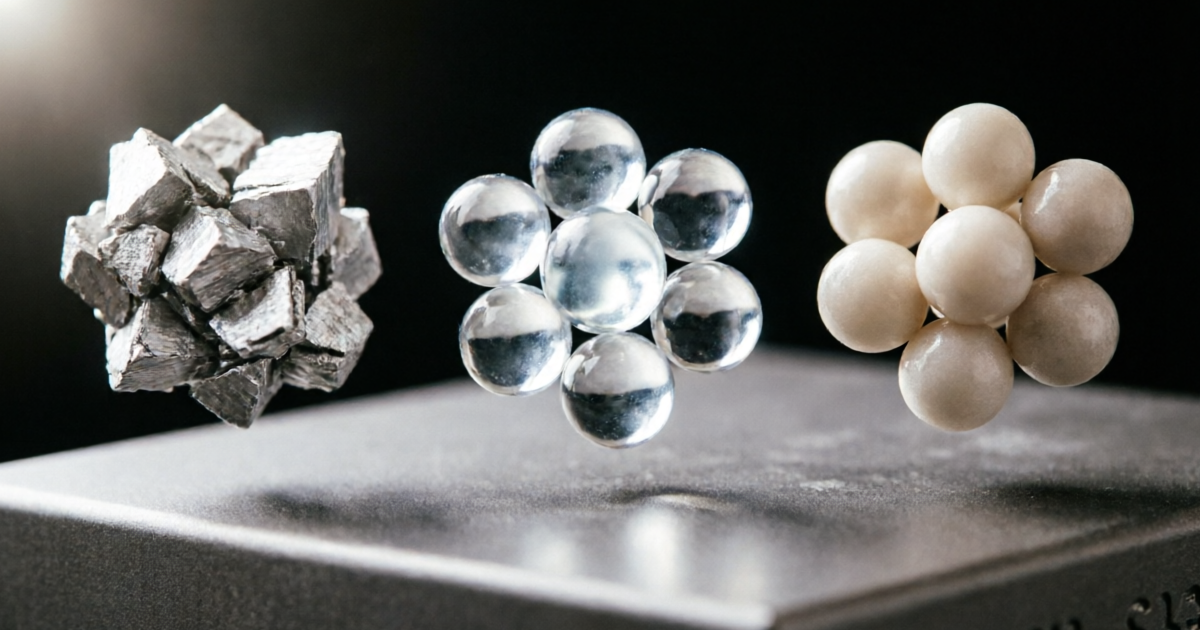
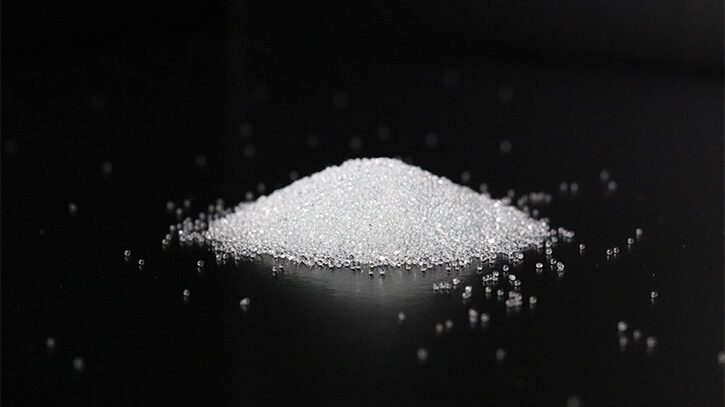
Glass bead blasting media are precision-manufactured spherical particles produced from high-quality soda-lime glass, ground and screened to tight dimensional tolerances. Unlike crushed or angular abrasives — which have jagged, irregular edges that cut aggressively into surfaces — glass beads have a perfectly round, smooth surface that allows them to strike and peen rather than cut. This fundamental difference in particle geometry is the source of every distinctive property that makes glass beads uniquely suited to a specific class of finishing applications.
Glass beads are manufactured by melting carefully formulated soda-lime glass and atomizing the molten glass into a controlled stream that resolidifies as spheres. The resulting beads are then screened to precise size fractions and inspected for roundness, surface quality, and chemical composition. Premium-grade glass beads for aerospace and medical applications meet strict U.S. Military Specification MIL-PRF-9954C, which governs chemistry, size distribution, roundness, and contamination levels.
This page is part of Henglihong’s complete resource hub on abrasive blasting media. For the overall selection framework, see our guide to sandblasting material types and selection.
Glass bead blasting media is the preferred choice when you need to clean, deburr, or peen a surface without creating an anchor profile or adding dimensional material removal. It is the defining abrasive for aerospace shot peening, medical implant finishing, stainless steel brightening, and any application where a smooth, satin, or specular finish is the target outcome.
Properties: Why Spherical Shape Is Everything
The defining physical characteristic of glass beads is their spherical geometry. This single attribute — roundness — cascades into a distinct set of performance properties that no angular abrasive can replicate.
Peening Action, Not Cutting Action
When a glass bead strikes a metal surface at high velocity, it transfers kinetic energy in a compressive wave that deforms the surface microscopically without removing material in the way a sharp, angular particle would. This compressive plastic deformation — the peening effect — has two valuable engineering outcomes. First, it introduces compressive residual stress into the surface layer of the part, which significantly improves fatigue resistance and resistance to stress corrosion cracking. Second, it smooths and closes surface micro-cracks, pores, and sharp machining marks that would otherwise act as stress concentration points in service.
Smooth, Bright Surface Finish
Rather than creating the rough, jagged anchor profile characteristic of angular abrasives, glass beads produce a smooth, satin-to-bright finish. On stainless steel, this results in a uniform, aesthetically appealing appearance that is highly valued in food processing equipment, kitchen appliances, medical instruments, and decorative architectural metalwork. The surface after glass bead blasting is clean, decontaminated of surface oxides, and has a consistent reflectivity that angular media cannot match.
Low Dust Generation
Because glass beads are round and relatively tough at their hardness level, they do not fracture as rapidly or as completely as angular mineral abrasives on initial impact. This translates to significantly lower airborne dust generation per unit of surface area treated — an important safety and visibility advantage in enclosed blast cabinet operations. Less dust also means less contamination of the workpiece surface, reducing cleaning requirements before the next process step.
No Iron Contamination
Like aluminum oxide and garnet, glass beads introduce no ferrous contamination to the blasted surface. This is essential for stainless steel applications and any substrate where subsequent processes (plating, anodizing, passivation, bonding) are sensitive to iron ions. Steel shot and grit cannot be used in these applications without the risk of rust staining and process failure.
⬤ Glass Beads (Round) — What They Produce
- Smooth, satin, or bright surface finish
- No anchor profile (minimal Ra)
- Compressive residual stress (peening effect)
- Improved fatigue & stress-corrosion resistance
- Consistent surface reflectivity
- Low dust, low contamination risk
⬤ Angular Media — What They Produce
- Rough, textured anchor profile
- High Ra and Rz surface roughness
- Aggressive material removal rate
- Tensile surface stress possible
- Faster cleaning of heavy contamination
- Essential for mechanical coating adhesion
Size Classification & MIL-SPEC Standards
Glass bead size is typically expressed as a mesh range or as a MIL-PRF-9954C size designation. The table below maps the most common commercial size ranges to their MIL-SPEC designation, particle diameter, and primary application context. For a full grit-to-application cross-reference across all abrasive types, see our sandblasting grit size chart.
| MIL-SPEC Size | US Mesh Range | Diameter (µm) | Давление взрыва | Primary Application |
|---|---|---|---|---|
| Size 8 | #8–#12 | 1,600–2,400 | 30–50 PSI | Heavy peening, large structural parts |
| Size 13 | #14–#18 | 1,000–1,600 | 40–60 PSI | Industrial peening, springs, gears |
| Size 16 | #18–#30 | 600–1,000 | 50–70 PSI | General-purpose peening and cleaning |
| Size 25 | #25–#45 | 355–710 | 50–70 PSI | Automotive cleaning, deburring |
| Size 35 | #35–#60 | 250–500 | 60–80 PSI | Stainless steel finishing, general blast |
| Size 60 | #60–#120 | 125–250 | 60–80 PSI | Fine finishing, medical & precision parts |
| Size 110 | #100–#170 | 90–150 | 40–60 PSI | Ultra-fine finishing, jewelry, dental |
| Size 170 | #140–#230 | 63-106 | 30–50 PSI | Polishing, cosmetic finishing |
Glass beads should be blasted at lower pressures than angular abrasives — typically 40–80 PSI depending on size. Excessively high pressure causes beads to fracture on first impact, dramatically reducing their reuse life and generating sharp glass fragments that can embed in soft substrates. Always use the minimum pressure that achieves the target finish.
Shot Peening vs. Surface Cleaning: Two Distinct Functions
Glass beads serve two fundamentally different process functions, and understanding which one you need determines the correct size and operating parameters.
Shot Peening (Fatigue Life Improvement)
Shot peening is an engineered surface treatment process — not merely cleaning — in which controlled glass bead impacts introduce compressive residual stress into the surface layer of metal components. This stress layer suppresses the initiation and growth of fatigue cracks, extending component service life by factors of two to ten times in demanding cyclic-load applications. Shot peening with glass beads is specified in aerospace (landing gear, turbine blades, structural airframe components), automotive (crankshafts, connecting rods, coil springs, leaf springs, gear teeth), and precision manufacturing (mold surfaces, medical implants) wherever fatigue life is a design-critical parameter.
Peening intensity is quantified using Almen strips — standardized spring steel strips that arc under the residual stress induced by a controlled peening dose. The arc height at a standard Almen gauge reading defines the peening intensity, expressed in Almen units (e.g., 0.008A). Aerospace and automotive specifications mandate specific Almen intensities and coverage percentages, making process control and media consistency critical requirements.
Surface Cleaning & Finishing
In cleaning and finishing applications, glass beads remove surface oxides, light rust, machining marks, casting skin, and light coatings from metal parts without altering part dimensions or creating surface roughness that would compromise fit and function. This is the standard process for brightening stainless steel equipment, cleaning electronic components, preparing aluminum die castings for anodizing, and producing the uniform matte finish required on medical instrument handles and orthopedic implant surfaces.
Applications by Industry
MIL-SPEC glass beads for shot peening turbine blades, landing gear components, airframe structural members. Compressive stress extends fatigue life in cyclic-load environments.
Peening crankshafts, camshafts, connecting rods, coil springs, and gear teeth. Cleaning aluminum die castings before anodizing or painting without dimensional alteration.
Producing consistent matte or satin finishes on surgical instruments, orthopedic implants, and dental instruments. Removing machining marks while maintaining dimensional tolerances to ±0.001″.
Brightening and decontaminating stainless steel tanks, vessels, conveyor components, and cutting tools. Glass beads leave no ferrous contamination and produce hygienically acceptable surfaces.
Producing uniform satin or matte finishes on architectural hardware, jewelry, watch cases, consumer electronics housings, and architectural stainless steel panels.
Removing release agent buildup and surface deposits from injection molds and die-casting dies without altering the precision-machined cavity surface finish or dimensions.
Very fine glass beads (Size 110–170) for gentle defluxing, deburring of PCB edges, and surface preparation of electronic component housings without static buildup risk.
Stripping paint from aluminum panels, engine components, and wheels without warping thin sheet metal. For full automotive media guidance, see our automotive restoration media guide.
Equipment & Operating Parameters
Blast Cabinets (Suction & Pressure Feed)
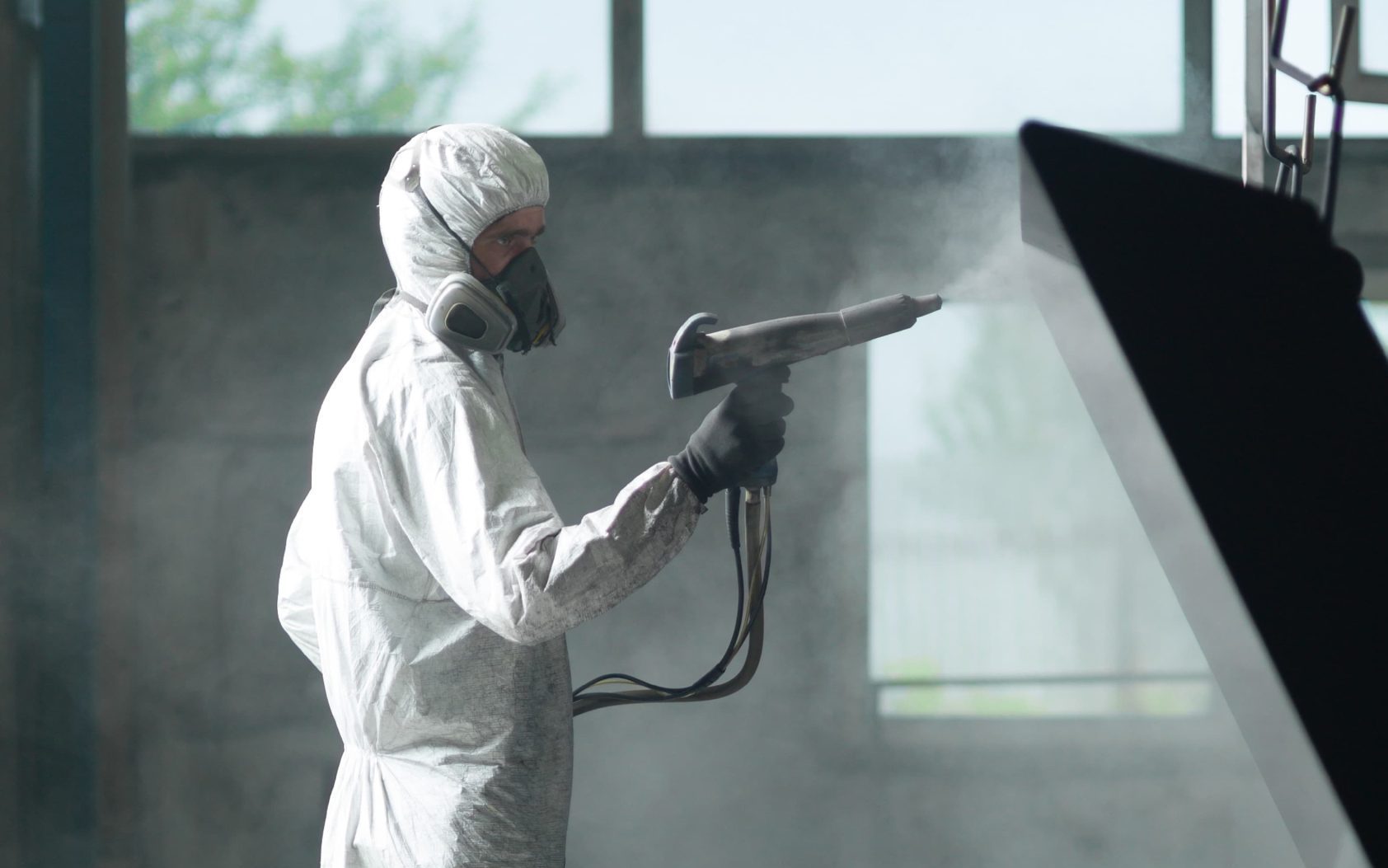
Glass beads are most commonly used in enclosed blast cabinets with reclaim systems. Both suction-feed (siphon) and pressure-feed cabinets are suitable, though pressure-feed systems offer better process control and higher throughput. Recommended operating pressures for glass beads are 40–80 PSI, significantly lower than the 80–110 PSI typical for aluminum oxide. The cabinet must be equipped with a media classifier to continuously remove shattered bead fragments (fines) and recirculate only intact spherical beads — a critical step to maintaining surface finish consistency and protecting the cabinet’s suction system from abrasive fines.
Automated Peening Systems
For high-volume aerospace and automotive shot peening, automated rotary table or conveyor belt systems with precise media flow rate control, Almen strip monitoring, and programmable intensity and coverage settings are the standard. These systems require consistent, high-quality glass bead media with tight size distribution tolerances to maintain process repeatability across production batches.
Влажная абразивная обработка
Glass beads perform well in wet (vapor) blasting systems, where the addition of water to the blast stream further reduces dust and produces an even smoother, more uniform surface finish. The water film acts as a lubricant between the beads and the surface, moderating the impact energy and producing a consistently bright result. Wet blasting with glass beads is the preferred process for finishing medical implants and precision hydraulic components.
Use tungsten carbide nozzles when blasting with glass beads — while beads are softer than aluminum oxide or silicon carbide, their abrasive action will still erode ceramic or steel nozzles relatively quickly at production volumes. Boron carbide nozzles offer the longest service life and lowest per-hour nozzle cost in continuous production environments.
Recyclability & Cost Considerations
Glass beads offer moderate recyclability — typically 10 to 20 effective cycles in a well-maintained blast cabinet with a classifier that removes broken fragments after each cycle. Unlike angular abrasives, which fracture into new angular particles that retain some cutting ability, broken glass beads become irregular glass shards that can scratch and damage surfaces if not removed. This makes the media classifier not merely helpful but essential to maintaining process quality over the life of a glass bead charge.
On a cost-per-cycle basis, glass beads sit at the mid-range of blasting media. They cost more per kilogram than crushed glass or slag-based media but offer significantly better recyclability. Their true economic advantage is not in cost per kilogram but in the value of the surface quality they produce — applications that require their specific finishing characteristics simply cannot be served by cheaper alternatives, regardless of those alternatives’ lower unit cost. For a full cost-per-cycle comparison across media types, see our sandblasting media comparison chart.
Glass Beads vs. Angular Abrasives: When to Choose Each
The decision between glass beads and angular abrasives (aluminum oxide, steel grit, garnet) should always be driven by the surface finish requirement and the substrate characteristics — not by price alone.
| Criterion | Choose Glass Beads | Choose Angular Media |
|---|---|---|
| Surface profile needed for coating | No — smooth finish only | Yes — anchor profile required |
| Fatigue life improvement (peening) | Yes | No (wrong mechanism) |
| Substrate is thin aluminum or titanium | Yes — no warping risk | Use with caution (lower grit, lower pressure) |
| Heavy rust or mill scale removal | No — too slow, wrong profile | Yes — aluminum oxide or steel grit |
| Stainless steel cleaning/brightening | Yes — ideal | White Al₂O₃ only (no iron contamination) |
| Medical/aerospace precision finish | Yes — MIL-SPEC available | Rarely |
| High throughput, aggressive cleaning | No | Yes |
If your requirement is somewhere in between — for example, removing light rust from stainless steel while maintaining a smooth finish — consider alternating between a light glass bead pass for finishing and a prior aluminum oxide pass for contamination removal. Many production lines run exactly this two-stage process.
Часто задаваемые вопросы
Glass beads manufactured from soda-lime glass contain silica (silicon dioxide, SiO₂) as a primary component — but this is amorphous silica, not crystalline silica. The respiratory hazard associated with sandblasting (silicosis) is caused specifically by respirable crystalline silica (RCS), the form present in natural quartz sand. Amorphous silica in glass beads does not carry the same silicosis risk. However, glass bead blasting does generate fine glass dust that can cause respiratory irritation and eye hazards, so appropriate respiratory protection (half-face respirator with P100 filters as a minimum), eye protection, and gloves remain mandatory for all operators. For a full safety overview across all blasting media types, see our sandblasting media safety guide.
Yes, glass beads can remove paint from steel, but they work more slowly than angular abrasives and leave a smoother surface with minimal anchor profile. For removing paint from carbon steel where subsequent repainting will be carried out, angular media (aluminum oxide, garnet, or crushed glass) is a better choice because it simultaneously removes the paint and creates the anchor profile required for the new coating to adhere. Glass beads are the correct choice for paint removal from thin aluminum panels, fiberglass, or any substrate where the dimensional integrity and surface smoothness must be preserved after stripping.
Glass beads are spherical particles manufactured to precise size tolerances for peening, cleaning, and polishing applications. Crushed glass media is irregular, angular, and sharp — produced by crushing post-consumer recycled glass. The two products serve entirely different purposes. Crushed glass is an economical angular abrasive for rust removal, paint stripping, and surface profiling — it functions similarly to garnet but at lower cost, and it is eco-friendly due to its recycled content. Glass beads are a precision finishing media for peening, polishing, and smooth-finish applications. Using crushed glass where glass beads are specified will damage the workpiece; using glass beads where crushed glass is appropriate will produce an inadequate surface profile. For more on crushed glass, see our crushed glass sandblasting media guide.
Request a Quote
Tell us your required MIL-SPEC size, volume, and application. We will provide a competitive price and technical data sheet within 24 hours.
Get a Free Quote →Talk to a Technical Advisor
Not sure which glass bead size or grade is right for your peening or finishing application? Our engineers will advise on the optimal specification.
Contact Our Team →Фильтры