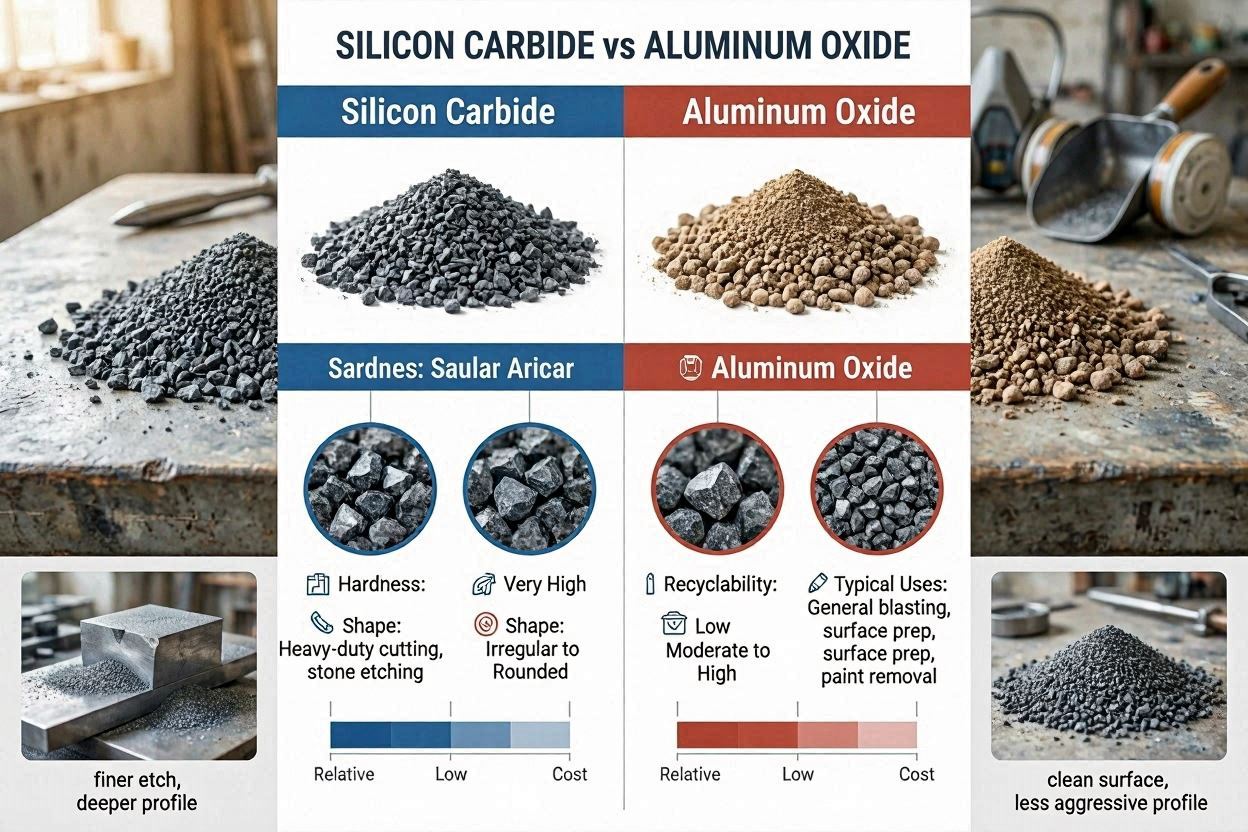
Blasting Media Cost Guide: Price per Pound, ROI & Total Cost Analysis
Unit price per kilogram is the worst way to evaluate blasting media value. This guide shows you how to calculate true cost per m² of surface treated — including price benchmarks for all major abrasives, recycle life data, worked ROI comparisons between recyclable and single-use media, disposal cost factors, and a framework for building your own cost model.
1. Why Unit Price Is a Misleading Metric
The most common mistake industrial buyers make when sourcing blasting media is comparing suppliers and media types on price per kilogram or price per tonne alone. This approach consistently leads to the wrong purchasing decision — and often to higher total operating costs than the more expensive alternative would have produced.
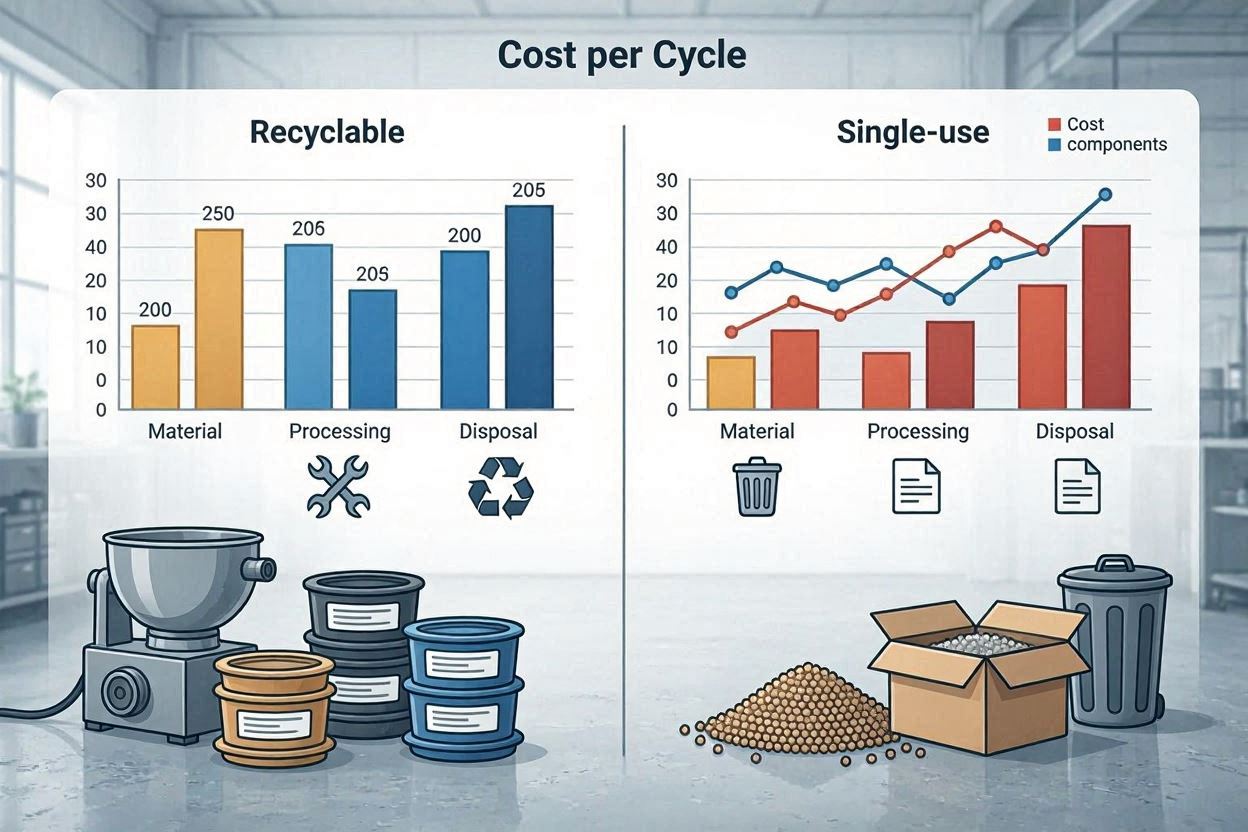
The reason is simple: blasting media is consumed at vastly different rates depending on its recycle life. A media that costs $800/MT but survives 150 blast cycles before degrading delivers its value across 150 production runs. A media that costs $150/MT but lasts only one cycle must be purchased for every single run. When the volumes involved are large, the per-cycle cost of the cheaper media rapidly exceeds the per-cycle cost of the more expensive recyclable alternative — often by a factor of 5–20×.
The correct comparison metric is cost per m² of acceptable, inspected surface delivered — a figure that integrates media purchase price, recycle life, consumption rate per cycle, waste disposal cost, and any rework cost attributable to media performance. This guide shows you how to calculate it.
2. Price Benchmarks — All Major Blasting Media (March 2026)
The following price ranges reflect indicative FOB China export pricing for standard commercial grades in March 2026. Prices vary by grade, grit size, order volume, packaging, and shipping destination. Use these as a starting reference — always obtain current quotations from qualified suppliers for actual budget planning.
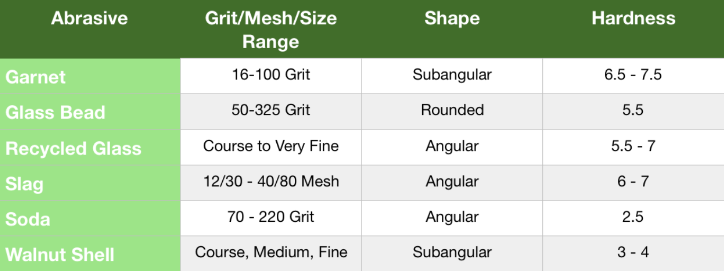
| Тип носителя | USD/MT (indicative) | USD/lb (approx.) | Unit Price Range | Recycle Cycles | Cost Type |
|---|---|---|---|---|---|
| Coal Slag Highest cost/m² | $80–180 | $0.04–0.08 | 1 (single-use) | Single-use | |
| Copper Slag | $100–200 | $0.05–0.09 | 1 (single-use) | Single-use | |
| Garnet (almandine) | $400–700 | $0.18–0.32 | 3–5 | Limited recycle | |
| Glass Bead | $500–900 | $0.23–0.41 | 30–50 | Recyclable | |
| Aluminum Oxide (BFA) Best for cabinets | $600–900 | $0.27–0.41 | 100–200 | High recyclability | |
| Aluminum Oxide (WFA) | $900–1,400 | $0.41–0.64 | 150–200+ | High recyclability | |
| Steel Grit / Steel Shot | $700–1,100 | $0.32–0.50 | 500–2,000+ | Very high recyclability | |
| Plastic Blast Media | $1,200–2,000 | $0.55–0.91 | 20–50 | Recyclable | |
| Карбид кремния | $1,400–2,200 | $0.64–1.00 | 10-30 | Specialist — high unit cost |
All prices are indicative FOB China, March 2026, standard commercial grades, 20MT+ order quantities. Prices vary by grit/grade, volume, packaging, and destination. Request current quotations before budget finalization.
3. The Cost-Per-m² Formula
Once you have a unit price and recycle life figure, calculating cost per m² requires two additional inputs: consumption rate (how many kg of media are lost per m² blasted per cycle, primarily through fracture into sub-size fines removed by the classifier) and disposal cost (the cost per kg to dispose of spent media, including collection, classification, and licensed disposal where required).
Cost per m² Calculation Formula
(Unit price per kg ÷ Recycle cycles) × Consumption rate (kg/m²/cycle)
+ Disposal cost per kg × Waste generated per m²
— Unit price per kg: Purchase price divided by 1,000 (from MT price)
— Recycle cycles: Number of usable blast cycles before media degrades below threshold
— Consumption rate: Typically 0.004–0.008 kg/m² per cycle for aluminum oxide in a cabinet; 0.6–1.0 kg/m² for single-use slag
— Disposal cost: $0.03–0.15/kg for non-hazardous waste; $0.30–1.50/kg for hazardous waste (lead-contaminated media)
The formula reveals why single-use media almost always loses on a per-m² basis. The consumption rate per m² for single-use slag (0.6–1.0 kg/m²) is orders of magnitude higher than for recycled aluminum oxide in a cabinet system (effectively 0.004–0.008 kg/m² per cycle when amortized over 150 cycles). The large consumption volume also means a proportionally large disposal cost — multiplying the disadvantage.
4. ROI Comparison: Recyclable vs Single-Use Media
The following worked example compares aluminum oxide (recyclable, cabinet system) against copper slag (single-use, pressure blast) for the same task: preparing 1,000 m² of carbon steel to Sa 2.5 with a 50–70 µm anchor profile. All figures are indicative for a standard production scenario in March 2026.
In this example, aluminum oxide in a cabinet system costs approximately $0.026/m² versus copper slag at $0.150/m² — a 5.8× difference in favor of aluminum oxide, despite aluminum oxide costing 5× more per kilogram. The critical driver is waste volume: the slag run generates 750 kg of spent media requiring disposal versus only 5 kg for the aluminum oxide run. At hazardous waste disposal rates (if lead-painted surfaces are involved), the slag cost advantage disappears by an even wider margin.
5. Annual Cost Modelling — Production Scale Impact
The cost-per-m² advantage of recyclable media compounds dramatically at production scale. Consider a fabrication shop or blast contractor processing 50,000 m² of carbon steel per year.
Annual Cost Comparison — 50,000 m²/year Production Volume
For high-volume automated blast rooms using steel grit, the economics are even more compelling. Steel grit’s 500–2,000+ cycle recycle life delivers a per-m² media cost that can be 10–30× lower than single-use mineral or slag abrasives at the same production volume. The capital investment in a proper recirculating blast room with classifier and separator is almost always recovered within 12–24 months through media cost savings alone at typical industrial production volumes.
6. Disposal Costs — The Hidden Budget Item
Disposal cost is the most consistently underestimated component of blasting media total cost of ownership. Many operations budget only for media purchase and overlook the full disposal liability until the spent media starts accumulating and a licensed disposal company provides a collection quote.
Disposal cost depends on two variables: the volume of spent media generated, and its hazardous waste classification. Volume is directly controlled by media selection — recyclable media generates minimal waste volume per m² compared to single-use alternatives. Classification is determined by what the media was blasted against.
- Non-hazardous spent media (uncontaminated clean steel, no heavy metal coatings): typically $0.03–0.10/kg in most markets. Some non-hazardous spent garnet and aluminum oxide can be reused as aggregate fill or road sub-base, reducing or eliminating disposal cost.
- Hazardous spent media (blasted on lead-painted, chromate-primed, or heavy-metal-coated surfaces): $0.30–1.50/kg or more in most markets, requiring licensed collection, characterization testing, and treatment at an approved facility. At these rates, a single-use slag run on a lead-painted structure can generate disposal costs that exceed the media purchase cost by 2–3×.
- Steel grit from clean steel work: often classified as non-hazardous ferrous scrap and may have a positive resale value to scrap metal dealers — a small but real offset to media cost.
7. Seven Cost Factors Beyond the Price List
What to include in your total cost of ownership model
8. Sourcing Considerations That Affect Total Cost
Beyond the media specification itself, several sourcing decisions affect the total cost of blasting media over a production year. Working through these with your supplier before signing a supply agreement can deliver meaningful savings.
Volume Discounts and Annual Contracts
Most blasting media suppliers offer meaningful volume discounts — typically 10–25% reduction on unit price for annual supply commitments above certain volume thresholds. For operations consuming more than 5–10 MT per year of any single media type, a negotiated annual supply agreement almost always delivers a lower total cost than spot purchasing. Request tiered pricing from suppliers and negotiate against your actual or projected annual volume.
Grit Blends vs Single Grades
For cabinet and room blast systems, running a specific grit blend (e.g. 50% F36 + 50% F54 aluminum oxide) can optimize both cutting speed and profile consistency better than a single grade. Some suppliers offer pre-blended media at a modest premium that saves the in-house labor of maintaining separate stock and blending at the equipment. Evaluate whether a tailored blend from your supplier reduces total system cost.
Packaging and Logistics
Big bag (1,000 kg) packaging typically costs 10–15% less per kg than 25 kg bag packaging at equivalent order quantities, and significantly reduces packaging waste. For operations with a bulk loading system or forklift access, big bags are almost always the more cost-effective packaging option. Confirm moisture barrier quality for sea freight shipments — damaged packaging that allows moisture into the media charge creates clumping and feed problems that cost far more than the packaging saving.
Supplier Quality Consistency
The most expensive blasting media scenario is receiving an off-spec delivery — wrong grit size, elevated moisture, or contaminated particles — that is loaded into your blast system and runs through an entire production batch before the quality problem is detected. The cost of reworking a non-compliant surface preparation batch can exceed the entire media purchase cost of the delivery. Request and verify batch-level test certificates (sieve analysis, chemical analysis) on every delivery, and maintain an incoming inspection protocol.
9. Frequently Asked Questions
Related Resources
Explore the full blasting media resource library from Jiangsu Henglihong Technology for technical selection guidance and media-specific data:
- Blasting Media: Complete Industry Guide — full overview of all media types and applications
- How to Choose the Right Blasting Media — selection framework including cost considerations
- Types of Blasting Media: Complete Guide — technical data on all major abrasive types
- Blasting Media Comparison Chart — side-by-side data including recyclability
- Aluminum Oxide Blast Media — the recyclability leader for cabinet blast systems
- Garnet Blasting Media — cost-effective for open-air blasting
- Steel Grit vs Steel Shot — lowest cost/m² for high-volume automated blast rooms
- Glass Bead Blasting Media
- Silicon Carbide Blast Media
- Plastic Blast Media for Aerospace & Automotive
- Eco-Friendly Blasting Media — environmental cost factors including disposal
- Industrial Surface Prep: Best Blasting Media for Metal
- Blasting Media for Automotive Restoration
- Blasting Media Safety Guide: Silica Risks & PPE
Get Competitive Pricing on Industrial Blasting Media
Jiangsu Henglihong Technology supplies aluminum oxide, garnet, glass bead, silicon carbide, and specialty abrasives with competitive pricing, volume discount structures, and reliable export logistics to North America, Europe, the Middle East, and beyond.
Request a Quote with Volume PricingФильтры