How to Choose Sandblasting Media: A Step-by-Step Selection Guide
Choosing the wrong sandblasting media costs money in multiple ways: reduced blast productivity, inadequate surface preparation leading to coating failures, equipment damage from incompatible abrasives, regulatory violations, and waste disposal complications. Yet many procurement decisions in this category are still made primarily on unit price — a single-variable approach that almost always produces suboptimal outcomes.
This step-by-step guide provides a structured framework for specifying abrasive blasting media correctly, the first time. It is part of our complete Sandblasting Media Suppliers: Industrial Buyer’s Complete Guide from Jiangsu Henglihong Technology Co., Ltd.
1. Why Media Selection Matters
Abrasive blasting media selection affects six critical project variables simultaneously:
- Surface cleanliness achieved — some media cannot achieve Sa 2.5; others easily achieve Sa 3
- Anchor profile depth — directly determines coating adhesion performance
- Blast productivity rate — harder, denser media blast faster per unit time
- Substrate integrity — wrong media causes warping, contamination, or dimensional damage
- True cost per m² — unit price divided by recyclability and consumption rate
- Соблюдение нормативных требований — wrong media can violate OSHA, EPA, or project specifications
A systematic six-step selection process eliminates guesswork and ensures every variable is addressed before you place an order.
2. Step 1 — Identify Your Substrate Material
What material are you blasting?
The substrate material is the first and most fundamental filter. It determines the hardness ceiling for your media (you cannot use media significantly harder than the substrate without causing damage), and whether iron contamination from metallic abrasives is acceptable.
| Substrate | Permitted Media | Excluded Media | Key Reason |
|---|---|---|---|
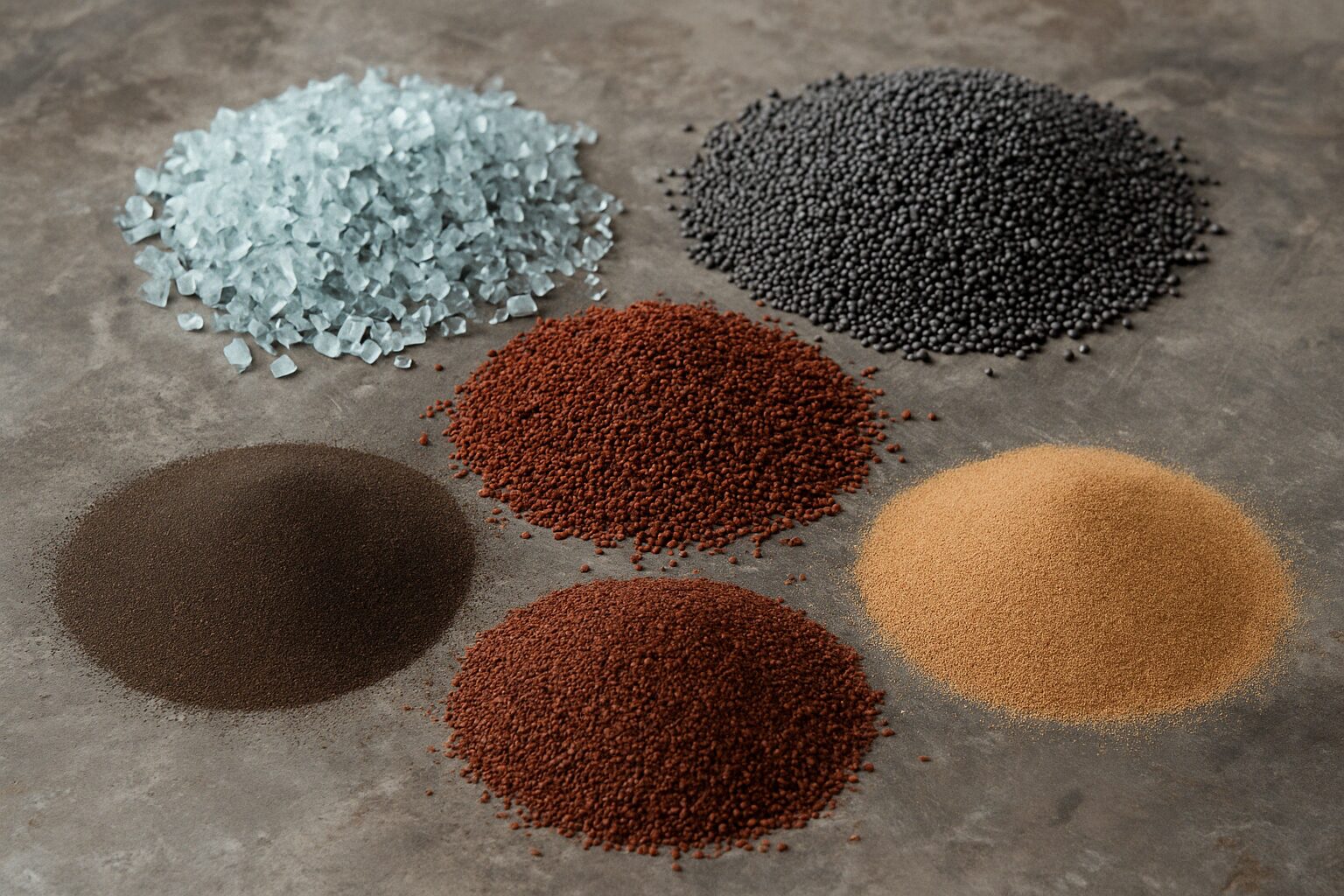
| Carbon steel / structural steel | Steel grit, Al₂O₃, garnet, slag, crushed glass | None (all types viable) | Hard substrate tolerates all abrasives |
| Нержавеющая сталь | White Al₂O₃ (WFA), garnet, glass beads | Steel grit, steel shot, coal slag | Iron contamination destroys passivation layer |
| Aluminum alloys | Glass beads, plastic media, walnut shell, WFA (low pressure) | Steel grit, coarse Al₂O₃ at high pressure | Soft substrate; dimensional damage risk |
| Титан | WFA, glass beads, plastic media | Steel abrasives (iron contamination), coal slag | Iron contamination causes galvanic corrosion |
| Carbon fiber / CFRP | Plastic media Type I–II, walnut shell | All hard media (garnet and above) | Hard abrasives damage fiber matrix |
| Concrete / masonry | Steel shot, crushed glass, Al₂O₃, garnet | Soft media (inadequate cutting) | Hard surface requires aggressive abrasive |
| Wood | Walnut shell, corn cob (gentle cleaning only) | All hard/metallic media | Soft material; hard abrasives destroy surface |
3. Step 2 — Define Your Cleanliness Requirement
What cleanliness standard does your coating specification require?
The ISO 8501-1 / SSPC / NACE cleanliness standard defines how completely the surface must be cleaned before coating application. This standard is always specified by your coating manufacturer or project engineer — it is not optional.
| ISO 8501-1 | SSPC / NACE Equivalent | Описание | Media Capable |
|---|---|---|---|
| Sa 1 | SSPC-SP 7 / NACE 4 | Brush-off: loose material removed; tightly adhered residues remain | All media types |
| Sa 2 | SSPC-SP 6 / NACE 3 | Commercial: most scale, rust, paint removed | All abrasive media |
| Sa 2.5 | SSPC-SP 10 / NACE 2 | Near-white: ≥95% free of all contaminants | Steel grit, Al₂O₃, garnet, copper slag |
| Sa 3 | SSPC-SP 5 / NACE 1 | White metal: 100% free of all contaminants | Steel grit (GH hardness), Al₂O₃ only |
4. Step 3 — Determine Required Surface Profile
What anchor profile depth does your coating system require?
The surface profile (anchor depth) is the microscopic roughness of the blasted surface. It is specified in your coating manufacturer’s product data sheet as a range in micrometers (µm) or mils (1 mil = 25.4 µm). Coating adhesion depends on the mechanical interlock between coating and profile.
Profile depth is controlled by two variables: media hardness (harder media creates deeper profiles) and media particle size (larger particles create deeper profiles). To hit a specific profile depth, you must match both variables to your coating specification.
| Required Profile | Recommended Media & Grade | Typical Coating System |
|---|---|---|
| 8–20 µm | Glass beads Grade 8–10; Al₂O₃ #120–#220 | Thin-film coatings, anodize pre-treatment |
| 20–40 µm | Steel grit G80–G120; Al₂O₃ #80; garnet 80 mesh | Epoxy primers on thin plate; automotive |
| 40–65 µm | Steel grit G40–G50; Al₂O₃ #46–#60; garnet 30/60 | Standard heavy-duty epoxy systems; most structural coatings |
| 65–100 µm | Steel grit G25; Al₂O₃ #36–#46; garnet 20/40 | High-build epoxy; zinc-rich primers; offshore coatings |
| 100–150 µm | Steel grit G16–G18; Al₂O₃ #24 | Very heavy coatings; offshore immersion service |
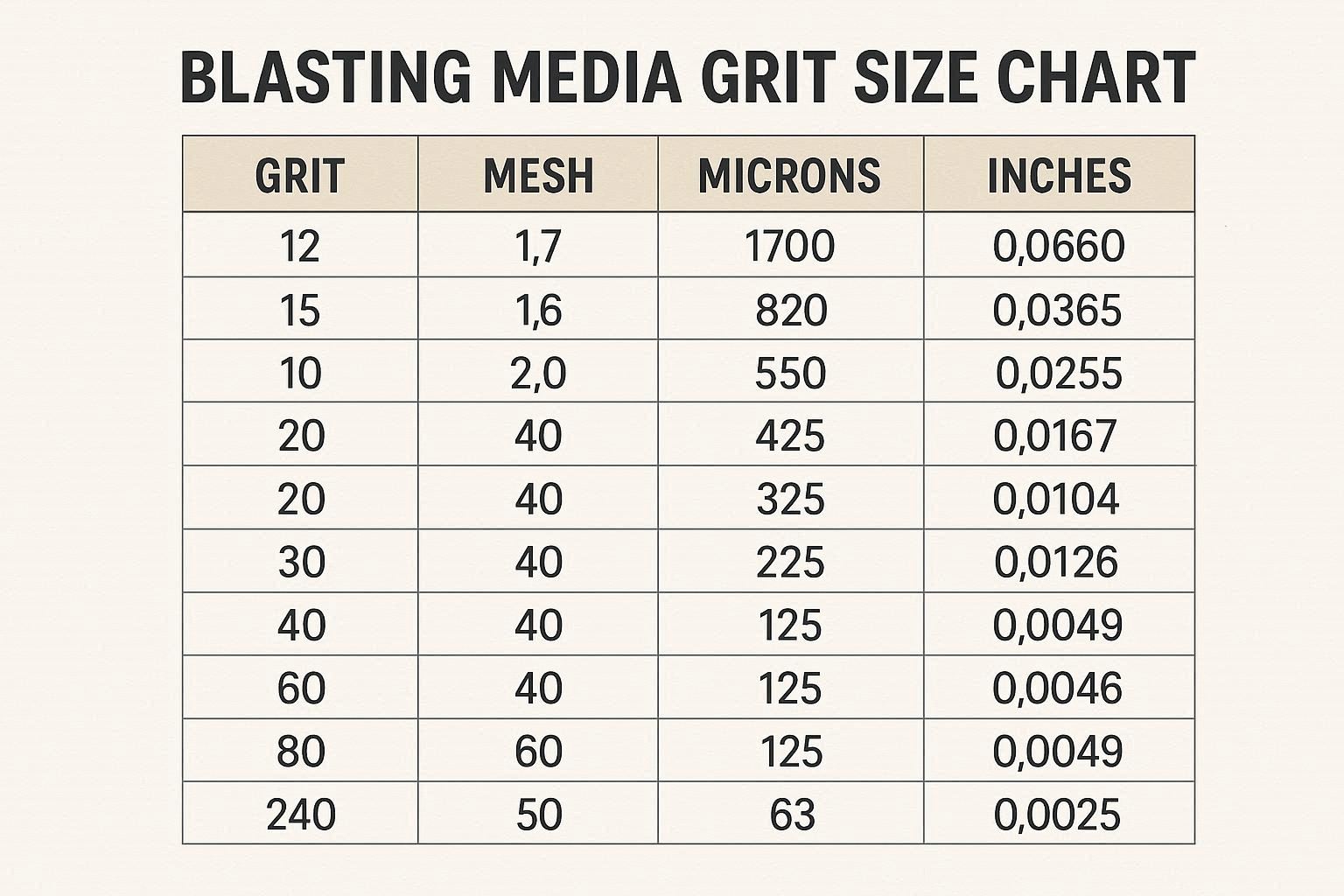
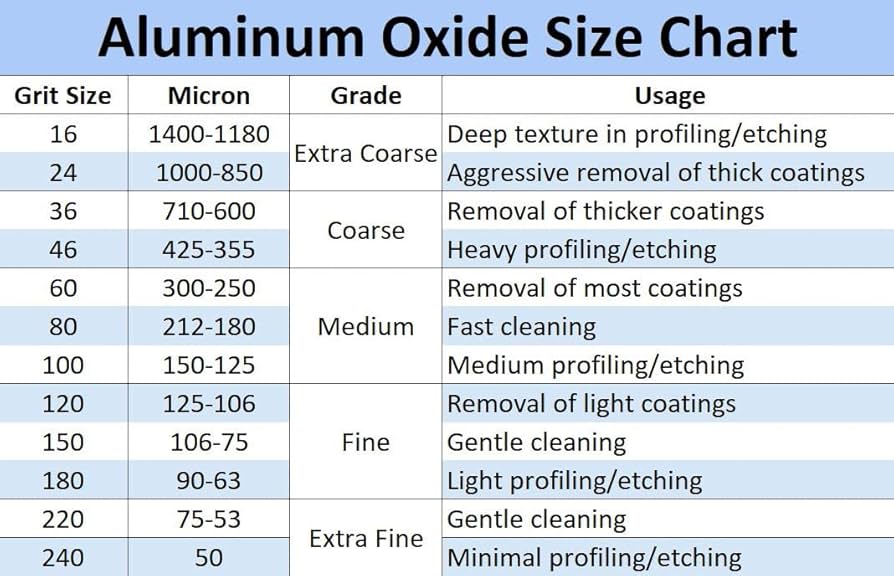
For a complete grit size cross-reference with micron sizes, mesh numbers, and profile depths, see: Sandblasting Media Grit Size Chart: What Each Mesh Number Means.
5. Step 4 — Assess Your Operating Environment
Is your blasting operation enclosed or open-air?
The operating environment fundamentally changes the economics of media selection by determining whether the media can be recovered and reused — the single biggest driver of true cost per square meter.
- Enclosed blast room / blast cabinet with recovery system: Recyclable media (steel grit, aluminum oxide) are strongly preferred. The recovery system collects, separates, and recirculates usable media while removing fines and spent particles. Over hundreds to thousands of cycles, the per-m² cost of recyclable media drops to a fraction of single-use alternatives.
- Open-air pressure blast (once-through): Media falls to the ground and cannot be practically recovered. Single-use media (garnet, slag, crushed glass) are economically competitive in this scenario. Garnet is preferred over slag for lower dust and environmental risk.
- Wet blasting / vapor blasting: Specially formulated media with low moisture sensitivity is required. Aluminum oxide and garnet perform well in wet blast systems; steel grit is generally unsuitable due to rust formation in the wet blast slurry.
6. Step 5 — Consider Safety & Regulatory Requirements
What OSHA, environmental, and project specification compliance is required?
Every professional blasting operation must comply with OSHA 29 CFR 1910.94 at minimum. Additional regulations may apply depending on media type, location, and substrate contamination.
- Free silica: Media must contain <1% crystalline silica per SDS documentation. This eliminates unprocessed beach sand, river sand, and many sandstones from consideration entirely.
- Heavy metals: If blasting lead paint or chromate-coated substrates, spent abrasive may be classified as hazardous waste. Choosing low-heavy-metal abrasives (garnet, aluminum oxide, glass) minimizes the added contamination from the media itself.
- Project specifications: Many coating contracts specify approved abrasive types (e.g., “garnet per ISO 11126-10 only” or “no slag abrasives”). Always review project specifications before sourcing.
For the complete OSHA regulatory framework, see: OSHA Sandblasting Safety: Why Silica Sand Is Banned and What to Use Instead.
7. Step 6 — Calculate True Cost Per m²
What is the actual cost per square meter of prepared surface?
Unit price (cost per ton) is a misleading metric. True cost per m² integrates consumption rate, recyclability, disposal cost, and productivity differences between media types.
Formula: True cost/m² = (Unit price/MT ÷ Recycle cycles ÷ Coverage rate/MT) + (Disposal cost/MT ÷ Coverage rate/MT)
For a fully worked cost-per-cycle analysis with real numbers for all major media types, see: Reusable vs. Single-Use Blast Media: Cost-Per-Cycle Analysis.
8. Quick Selection Matrix
| Scenario | Recommended Media | Grade |
|---|---|---|
| Heavy rust on structural steel, blast room, Sa 2.5 | Стальная крошка | G25 or G40, Medium HRC |
| Open-air pipeline blasting, Sa 2.5, low dust requirement | Гранат | 30/60 mesh |
| Stainless steel surface prep, no iron contamination | White fused aluminum oxide | #60–#80 |
| Aircraft paint stripping, aluminum skin | Пластиковые носители | Type II, medium grade |
| Decorative satin finish on stainless | Стеклянные бусины | Grade 6–7 |
| Concrete floor prep before epoxy coating | Steel shot or crushed glass | S230 / 20/40 mesh |
| Food equipment cleaning, no contamination allowed | Walnut shell grit | 12/20 mesh |
| Aggressive open-air field blasting, low budget | Copper slag | Medium grade |
9. Frequently Asked Questions
Need Media Specified for Your Project?
Share your substrate, coating specification, and operating setup with our technical team at Jiangsu Henglihong Technology Co., Ltd. We will recommend the optimal abrasive and provide a competitive quotation.
Get Technical Advice →Фильтры