Компания Jiangsu Henglihong Technology Co., Ltd.
Best Sandblasting Material for Metal: Surface Prep Before Painting & Coating
A complete application guide to sandblasting media selection for metal surface preparation — covering carbon steel, stainless steel, aluminum, cast iron, and galvanized steel, with media recommendations for every major protective coating system and industry application.
Why Surface Prep Is the Most Critical Step in Any Coating System
Surface preparation is consistently identified in coating failure investigations as the single most common root cause of premature coating breakdown — responsible for an estimated 80% of all protective coating failures in industrial environments. The best coating in the world, applied by the most skilled painter, will fail prematurely if the substrate was not properly cleaned and profiled before application.
The reason is fundamental: protective coatings adhere to metal surfaces through a combination of chemical bonding and mechanical interlocking. Chemical adhesion requires a clean, contamination-free surface — any oil, rust, mill scale, or moisture between the coating and the metal acts as a barrier that prevents bonding and creates a pathway for under-film corrosion. Mechanical interlocking requires a specific roughness (anchor profile) that the abrasive blasting process creates — coating films penetrate the peaks and valleys of the blasted surface and physically lock themselves in place once cured.
This page is part of Henglihong’s complete blasting media resource hub. For the full media type overview, see our complete guide to sandblasting material types and selection.
1. Cleanliness: Remove all rust, mill scale, old coatings, oil, moisture, and surface salts to the cleanliness level specified by the coating manufacturer.
2. Anchor profile: Create a controlled surface roughness (Ra/Rz range) that provides mechanical adhesion sites for the primer and subsequent coating layers.
3. Substrate integrity: Achieve goals 1 and 2 without introducing new contaminants (iron particles on stainless steel), causing dimensional changes (warping thin sections), or damaging the substrate structure.
Cleanliness Standards: ISO, SSPC & NACE
International surface preparation standards provide a common language for specifying and verifying the cleanliness of blasted metal surfaces before coating application. The most widely used standards are ISO 8501-1 (visual assessment of steel surface cleanliness), SSPC (Society for Protective Coatings) standards, and NACE (now AMPP) standards.
| ISO 8501-1 | SSPC Equivalent | NACE Equivalent | Описание | Typical Application |
|---|---|---|---|---|
| Sa 1 | SP-7 Brush-Off | NACE 4 | Light blast — removes loose rust and paint; tightly adherent materials remain | Low-corrosivity environments, temporary protection |
| Sa 2 | SP-6 Commercial | NACE 3 | Thorough blast — removes most rust, scale, and paint; slight staining permitted | Moderate environments with standard coatings |
| Sa 2.5 | SP-10 Near-White | NACE 2 | Very thorough — removes all rust, scale, paint except light staining on max 5% area | Most industrial and marine protective coating systems |
| Sa 3 | SP-5 White Metal | NACE 1 | Full removal — uniformly gray-white appearance, no staining permitted | Immersion service, offshore, chemical environments |
In practice, ISO Sa 2.5 (SSPC-SP 10 Near-White) is the most commonly specified cleanliness level for industrial protective coatings applied to structural steel, pipelines, marine structures, and industrial equipment. Most zinc-rich primers, epoxy coatings, and high-performance topcoat systems require Sa 2.5 as the minimum surface condition. Sa 3 is reserved for the most demanding environments — immersion service, offshore splash zones, chemical containment.
Carbon Steel: The Full Media Selection Guide
Carbon steel is the most important substrate in industrial abrasive blasting — the majority of structural fabrication, pipeline, shipbuilding, and heavy equipment manufacturing involves carbon steel in various forms. The choice of blasting media for carbon steel depends on the severity of contamination, the required cleanliness standard, the required anchor profile, and the operating environment (open blast vs. reclaim system).
Media Selection by Application Type
Stainless Steel: Avoiding Iron Contamination
Stainless steel surface preparation has one absolute constraint that overrides all other selection criteria: no ferrous (iron-containing) abrasives. Steel shot and steel grit embed microscopic iron particles into the stainless steel surface on impact. These embedded iron particles corrode rapidly — within days in humid environments — producing rust staining (also called “rouge” in pharmaceutical and food industries) and, more critically, destroying the passive chromium oxide film that provides stainless steel its corrosion resistance.
This restriction applies equally to the blasting equipment. Blast cabinets, blast rooms, blast hoses, and nozzles that have been used with steel media must be thoroughly cleaned before processing stainless steel. Cross-contamination of even trace steel media particles into a non-ferrous blasting operation can cause surface failures in demanding environments.
Recommended Media for Stainless Steel
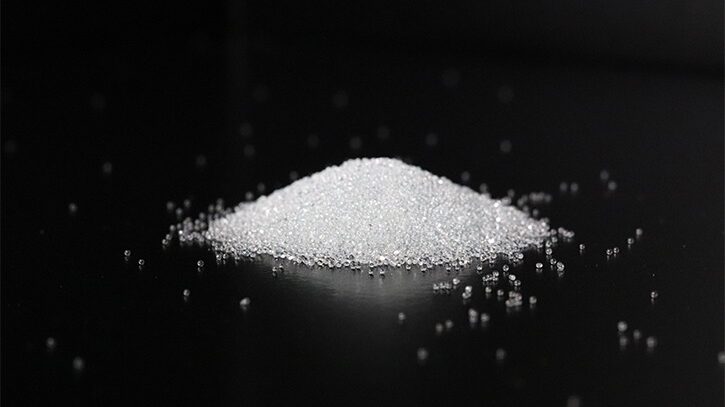
- Glass Beads (Size 35–60): The standard choice for cleaning and brightening stainless steel to a uniform satin finish. Zero iron contamination, low dust, produces no anchor profile — ideal for aesthetic and functional surface cleaning of food, pharmaceutical, and chemical equipment.
- White Aluminum Oxide (F60–F120): For stainless steel applications requiring an anchor profile for coating adhesion (e.g., epoxy lining of stainless tanks). White Al₂O₃ (99%+ purity) minimizes contamination risk from trace elements. Never use brown Al₂O₃ on stainless — it contains small amounts of iron oxide.
- Garnet (G50–G80): Acceptable for most industrial stainless steel applications. Introduces negligible free metallic iron. The preferred choice for stainless steel structures in marine or outdoor environments where a mild surface profile is needed before painting.
Any blast cabinet, blast room, blast hose, or pressure pot that has ever contained steel media must be thoroughly cleaned and purged before use with stainless steel. Residual steel media particles trapped in reclaim system screening, media storage hoppers, or blast hose interiors can contaminate a supposedly iron-free media charge. For high-purity stainless applications (pharmaceutical, food grade), dedicate specific equipment exclusively to non-ferrous blasting.
Aluminum & Non-Ferrous Metals
Aluminum, copper alloys, titanium, and other non-ferrous metals require significantly gentler surface preparation than carbon steel. These metals are generally softer (aluminum: Mohs 2.5–3; copper alloys: Mohs 3–4) and thin-section components are susceptible to warping, stretching, and dimensional change if blasted with heavy media at high pressures. The goal for non-ferrous metal surface preparation is to create adequate adhesion surface without dimensional change, warping, or embedded abrasive contamination.
Media Recommendations for Aluminum
- Glass Beads (Size 25–60, low pressure): The preferred choice for aluminum cleaning and light surface preparation. Creates no aggressive profile, introduces zero contamination, and at low pressure (40–60 PSI) does not warp thin-walled sections. Also used for shot peening of aluminum aircraft structural components to improve fatigue life.
- Aluminum Oxide F80–F120 (very low pressure, 40–60 PSI): Where a mild anchor profile is required for adhesive bonding or coating adhesion on aluminum structural components. Must be used with care on thin-section aluminum — always test on scrap material first.
- Walnut Shell (Medium-Fine): For paint stripping from aluminum body panels, aircraft skins, or decorative aluminum components where dimensional accuracy must be preserved. See our dedicated guide on sandblasting material for automotive restoration.
Cast Iron & Foundry Components
Cast iron presents unique surface preparation challenges. Foundry castings are typically covered with casting sand, oxide scale, and foundry release compound — a thick, tenacious contamination layer that requires hard, aggressive abrasives to remove efficiently. At the same time, cast iron is brittle and porous; localized stress concentrations from very hard or very coarse media at high pressures can cause surface cracking in low-ductility grades.
Recommended Approach for Cast Iron
- Steel Shot (S-330 to S-550, SAE GP grade) in tumble blast or hanger-type blast machines is the global standard for foundry cleaning of iron and steel castings. The round particles clean effectively without the stress concentration risk of angular grit on brittle cast iron. High throughput at low cost in continuous-cycle automated equipment.
- Steel Grit (G40–G80, GL grade) where a more aggressive anchor profile is needed for heavy-duty industrial coating of cast components (engine blocks, pump housings, valve bodies).
- Aluminum Oxide F36–F60 where iron contamination is a concern (e.g., cast iron components in food machinery) or where a blast room setup without steel media handling infrastructure is available.
Matching Media to Coating System Requirements
| Coating System | Required Profile Ra (µm) | Minimum Cleanliness | Recommended Media | Grit Size |
|---|---|---|---|---|
| Inorganic zinc silicate | 40–75 | Sa 2.5 | Al₂O₃ or Steel Grit GL | F24–F36 / G40 |
| Zinc-rich epoxy primer | 30–65 | Sa 2.5 | Al₂O₃ or Garnet | F30–F46 / G25 |
| High-build epoxy | 20–50 | Sa 2.5 | Al₂O₃ or Steel Grit GL | F36–F60 / G40–G80 |
| Fusion-bonded epoxy (FBE) | 40–75 | Sa 2.5 | Steel Grit GH or Al₂O₃ | G25 / F24–F36 |
| Polyurea / Polyurethane | 25–60 | Sa 2.5 | Al₂O₃ | F36–F60 |
| Thermal spray (HVOF) | 50–90 | Sa 3 | Al₂O₃ or SiC | F16–F30 |
| Powder coating (steel) | 8–25 | Sa 2 | Al₂O₃ or Glass Beads | F80–F120 |
| Antifouling (marine) | 30–60 | Sa 2.5 | Garnet or Al₂O₃ | G25–G30 / F36–F46 |
| Food-grade epoxy lining (SS) | 10–25 | Sa 2.5 | White Al₂O₃ or Glass Beads | F80–F120 |
For the full grit-size-to-surface-profile reference, see our comprehensive sandblasting grit size chart and surface profile guide.
The Complete Surface Preparation Process for Metal Coating
Degrease and clean the surface
Remove all oil, grease, wax, and soluble salts before blasting. Blasting over an oily surface does not clean it — it embeds the oil beneath the blasted profile. Use solvent cleaning (SSPC-SP 1) or steam cleaning before any blasting operation. Chloride and sulfate contamination must also be removed — these soluble salts cause osmotic blistering under coatings even when invisible to the eye.
Abrasive blast to the specified cleanliness and profile
Select the media type and grit size matched to the coating specification (see table above). Set blast pressure, nozzle-to-surface distance, and angle to achieve the target anchor profile. Verify cleanliness against ISO 8501-1 photo reference standards and measure anchor profile with profilometer or Testex tape.
Remove blast dust and spent media
After blasting, all abrasive dust, embedded media fines, and residual particles must be removed from the surface before coating. Use clean, dry compressed air blowoff or vacuum cleaning. Do not use water on freshly blasted carbon steel — flash rust begins within minutes in humid conditions.
Apply primer within the specified overcoat window
The interval between blast completion and primer application must not exceed the coating manufacturer’s specified overcoat window — typically 4–8 hours in ambient conditions, shorter in high humidity or aggressive environments. Carbon steel begins to form flash rust within 30–90 minutes in humid air. If flash rust forms before primer application, the surface must be re-blasted.
Verify and document the completed surface condition
Record cleanliness grade (ISO 8501-1), anchor profile measurement (Ra/Rz), ambient conditions (temperature, relative humidity, dew point), surface temperature, and time of blast completion and primer application. This documentation supports quality assurance requirements and provides evidence of specification compliance for the end client or inspector.
Industry-Specific Media Recommendations
| Промышленность | Substrate | Primary Media | Key Standard |
|---|---|---|---|
| Oil & Gas — pipeline | Carbon steel pipe | Steel Grit G25–G40 | ISO 8501, DIN 30670, NACE SP0188 |
| Oil & Gas — vessels | Carbon & alloy steel | Al₂O₃ F36–F46 | SSPC-SP 10, NACE 2 |
| Shipbuilding — new build | Carbon steel plate | Steel Shot S-330/S-460 | ISO 8501-1 Sa 2.5 |
| Marine — maintenance | Carbon steel hull | Garnet G25 or Al₂O₃ F36 | ISO Sa 2.5, SSPC-SP 10 |
| Structural steel fab | Carbon steel (beams, plate) | Steel Shot/Grit blend | ISO Sa 2.5, EN 1090 |
| Food & pharma | Stainless steel 316L | White Al₂O₃ F80 / Glass Beads | FDA 21 CFR, EHEDG |
| Automotive OEM | Steel body panels | Steel Shot S-230 / Al₂O₃ F80 | OEM coating spec |
| Aerospace — structures | Aluminum 7075/2024 | Glass Beads Size 35–60 | MIL-PRF-9954C, AMS 2430 |
| Bridge & infrastructure | Carbon steel | Garnet G25 (outdoor) / Al₂O₃ F36 (shop) | SSPC-SP 10, AASHTO |
For the step-by-step media selection methodology applicable to any substrate and coating combination, see our dedicated guide: how to choose sandblasting material: step-by-step selection guide.
Request a Quote
Specify your substrate, target cleanliness standard, coating system, and annual volume. We’ll recommend the optimal media grade and respond with competitive pricing within 24 hours.
Get a Free Quote →Talk to a Technical Advisor
Have a coating specification and need help matching the surface preparation requirement to the right media grade and grit size? Our engineers will advise you.
Contact Our Team →Фильтры