Plastic Tumbling Media vs Blast Media: What’s the Difference?
Walk into any industrial finishing supplier’s catalog and you will find “plastic media” listed under both blast abrasives and tumbling/vibratory media — often in the same product family, sometimes from the same manufacturer. The name overlap is genuinely confusing, and it leads to a surprisingly common and costly mistake: specifying the wrong process entirely for a given application.
Plastic blast media and plastic tumbling media are not the same product used in different machines. They are fundamentally different materials, engineered for different physical processes, producing different outcomes on different part geometries. Using blast media in a tumbling bowl, or expecting a vibratory machine to do what a blast cabinet does, will waste time, money, and media — and may produce unacceptable parts.
This guide explains both processes from first principles: how they work mechanically, what media is used in each, what finishing outcomes each is capable of, and — critically — how to determine which one your application actually requires. For a broader overview of the full plastic media family, see: What Is Plastic Media? The Complete Guide.
The Fundamental Difference: Energy Delivery
The single most important concept in understanding the blast vs. tumbling distinction is how energy is delivered to the part surface. Everything else — media shape, machine type, achievable outcomes — follows from this difference.
- Media is accelerated to high velocity (200–400 ft/s) and directed as a focused stream at a specific surface area
- Energy delivery is concentrated and directional — operator controls exactly where and how much energy reaches the part
- Part is stationary; the blast stream moves across it
- Each media particle delivers a high-energy single impact before being reclaimed
- Suitable for large, flat, or accessible surfaces where the nozzle can reach
- Primary action: coating removal, surface profiling
- Media and parts move together in a low-velocity cascading or vibrating mass — no directed stream
- Energy delivery is gentle, distributed, and omnidirectional — every surface of a part is worked simultaneously
- Parts are immersed in the media mass and move with it
- Each media-to-part contact is a low-energy sliding, rubbing, or light impact event, repeated thousands of times
- Suitable for small-to-medium parts with complex geometry processed in bulk
- Primary action: deburring, edge radiusing, burnishing, cleaning
How Plastic Blast Media Works
Plastic Blast Media — The Physics BLAST
In a blast operation, compressed air — typically at 20–65 PSI depending on application — accelerates a stream of angular plastic abrasive particles through a nozzle and directs them at a target surface at velocities of 200–400 ft/s. Each particle arrives at the surface as an independent high-energy projectile. On contact, it transfers its kinetic energy through a combination of direct mechanical cutting (from its angular edges) and shockwave generation (from the rapid deceleration of the particle mass). The particle itself fractures on impact — a feature, not a flaw — because the brittle fracture mechanism concentrates energy delivery at the particle-surface interface rather than wasting it as elastic rebound.
The operator controls where this energy goes by directing the nozzle. Blast is inherently a line-of-sight process: any surface that the nozzle stream cannot reach remains unprocessed. This is both a strength (precise targeting of specific areas) and a limitation (recessed features, internal surfaces, and complex cavities are difficult or impossible to process uniformly).
The result of blast action on a coated surface is coating delamination: the impact energy overcomes the adhesion between the coating and substrate, lifting the coating layer. On an already-bare metal surface, blast produces surface profiling — creating a micro-textured anchor pattern that improves subsequent coating adhesion.
How Plastic Tumbling Media Works
Plastic Tumbling Media — The Physics TUMBLING
In a vibratory or tumbling mass finishing operation, parts and shaped plastic media are loaded together into a bowl, tub, or barrel. The machine imparts motion to the entire mass — vibration (in vibratory bowl/tub machines), rotation (in barrel tumblers and centrifugal disk finishers), or a combination. This causes the media-part mixture to flow in a continuous, slow-moving cascade, typically at media-to-part surface velocities of just 1–15 ft/s — a tiny fraction of blast velocities.
The finishing action is not impact-based in the blast sense. Instead, plastic media pieces make continuous sliding, scrubbing, and light-compressive contacts with part surfaces. Because these contacts are omnidirectional — the part is fully immersed in the media mass and rotates freely within it — every accessible surface, including inside edges, undercuts, holes, and complex contours, receives processing action simultaneously. No line-of-sight limitation applies.
The result is cumulative surface refinement through thousands of gentle contacts over the processing cycle (typically 20–120 minutes for plastic media). The primary mechanisms are abrasive cutting of burrs and sharp edges (which are weaker than part faces and remove preferentially), edge radiusing (progressive rounding of sharp corners as material is removed uniformly around edge geometry), and surface smoothing (progressive reduction of surface Ra as peaks are worn down by repeated contact). Unlike blast, tumbling media does not remove intact bonded coatings or create directional surface profiles.
The Media Itself: Shape, Size & Material
The physical form of blast media and tumbling media reflects their different operating mechanisms. These are not interchangeable products:
Plastic Blast Media: Angular and Irregular
Plastic blast media — whether Type II urea, Type III melamine, or Type V acrylic — is produced by grinding cured resin into angular, irregular particles and screening to specific mesh size ranges. The angular, irregular shape is intentional: it provides the sharp edges needed for the cutting/fracture impact mechanism to work on coatings. The particle size is described by mesh number (e.g., Mesh 20, Mesh 40), corresponding to standard sieve apertures. Blast media is sold by weight in bags or supersacks, and is loaded into the hopper of a blast cabinet where it flows to the nozzle under gravity and air pressure.
Plastic Tumbling Media: Precision-Shaped Geometric Forms
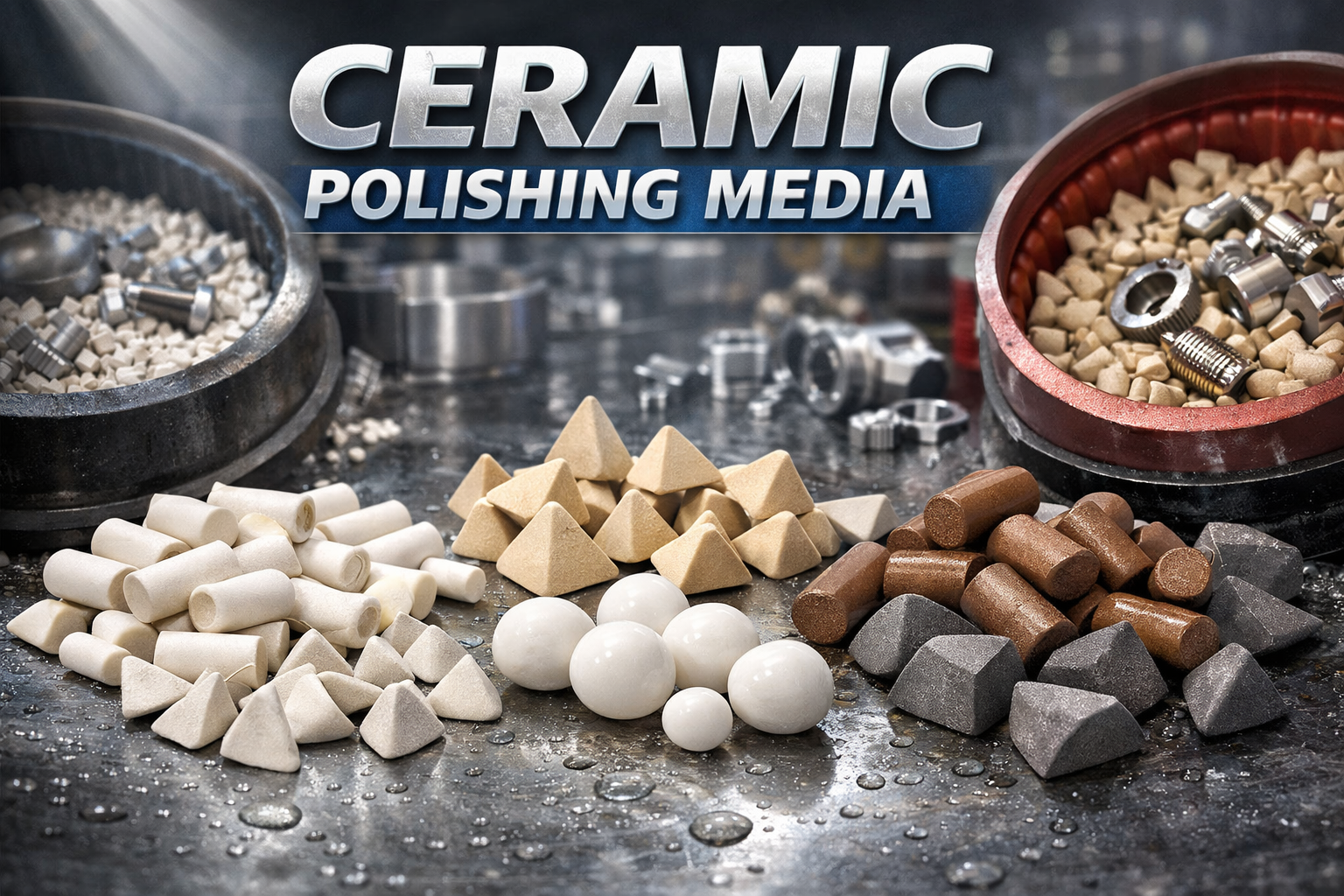
Plastic tumbling media is manufactured in specific engineered geometric shapes — not irregular particles. Each shape is optimized to reach different part geometries without lodging in features, provide specific edge radiusing geometry, and flow predictably in the machine. The most common shapes and their applications are:
Material Comparison: Blast vs Tumbling
| Property | Plastic Blast Media | Plastic Tumbling Media |
|---|---|---|
| Shape | Angular, irregular (ground particles) | Precision geometric (molded: cones, cylinders, wedges, triangles, etc.) |
| Size Description | Mesh number (e.g., Mesh 20 = 0.84 mm) | Dimensional (e.g., 10×10 mm cylinder, 15 mm triangle) |
| Common Resins | Urea (Type II), Melamine (Type III), Acrylic (Type V) | Polyester, Urea, Melamine, Polyurethane, Thermoset composite |
| Hardness Range | Mohs 3.0–4.0 | Mohs 2.5–4.5 (wider range available; softer compounds for burnishing) |
| Operating Velocity | 200–400 ft/s (nozzle exit) | 1–15 ft/s (cascade velocity in machine) |
| Impact Type | Single high-energy directional impact per particle | Thousands of low-energy omnidirectional sliding contacts |
| Resin Selection Driver | Substrate hardness and coating system | Part material, desired surface finish Ra, and deburring aggressiveness |
| Breakdown Mechanism | Brittle fracture on impact; produces fines | Gradual abrasive wear; maintains shape until fully consumed |
| Typical Media Life | 3–8 blast cycles (with reclaim) | Months to years of continuous use (gradual size reduction) |
| Sold By | Weight (lb / kg bags) | Weight or volume (bags, drums); often with ongoing top-up supply |
Machine Types for Each Process
Pressure Blast Cabinet
Blast · Most common for plastic media
- Closed cabinet with glove ports or automated nozzle
- Integrated reclaim system (air wash + screen)
- Manual or automated nozzle traversal
- Best for: aerospace depaint, automotive panels, medium parts
Centrifugal Wheel Blast
Blast · High throughput
- Spinning wheel(s) propel media mechanically (no compressed air)
- Very high throughput; suited to large flat parts
- Less common for plastic media (wheel wear is higher)
- Best for: high-volume steel or aluminum sheet processing
Portable / Outdoor Blast
Blast · Large structure work
- Portable blast pots for on-site or open-air blasting
- Requires media containment system or vacuum recovery
- Used for aircraft in hangars, large marine structures
- Best for: large assemblies that cannot be moved to a cabinet
Vibratory Bowl
Tumbling · Most common
- Round or tub-shaped bowl; eccentric weight motor creates vibration
- Parts and media circulate continuously in a spiral flow path
- Capacity: 1 to 50+ cubic feet; scalable for volume
- Best for: small-to-medium metal parts; deburring; edge radiusing
Centrifugal Disc Finisher
Tumbling · High intensity
- Rotating disc at the bottom of a fixed tub accelerates media
- 5–25× faster than vibratory; suited to tight cycle time requirements
- Higher part-on-part impact risk; requires careful loading
- Best for: aggressive deburring; short cycle times; small parts
Barrel Tumbler
Tumbling · Simple / low cost
- Rotating polygonal barrel; parts and media tumble by gravity
- Slower and less consistent than vibratory; prone to part damage
- Lowest capital cost; suitable for robust parts only
- Best for: small, durable parts; simple deburring; light cleaning
Centrifugal Barrel Finisher
Tumbling · High precision
- Barrels rotate on a spinning turret; centrifugal force increases media-part pressure
- Very consistent results; excellent for tight Ra spec requirements
- Higher capital cost; batch sizes typically small
- Best for: precision parts requiring controlled edge radius and Ra spec
Drag / Spindle Finishing
Tumbling · Precision single-part
- Part is fixtured on a spindle and dragged through stationary media mass
- Controlled single-part process; highest consistency
- Very fast (minutes per part); suitable for high-value components
- Best for: turbine blades, cutting tools, orthopedic implants
What Each Process Can and Cannot Do
Understanding the capability boundaries of each process prevents the most costly application errors. Here is a direct comparison of what each process achieves — and where it reaches its hard limits:
Удаление покрытия
Burr Removal
Edge Radiusing
Surface Profiling (Anchor)
Surface Ra Improvement
Compressive Stress (Peening)
Internal / Blind Features
Bulk Batch Processing
Large Panel / Sheet Work
Wet Processing Option
The most important insight from this comparison: blast and tumbling do not overlap in most of their primary capabilities. Blast can do things tumbling cannot (coating removal, surface profiling, large panel work), and tumbling can do things blast cannot (edge radiusing, internal feature access, bulk processing, Ra improvement). This is why many precision finishing operations use both — in sequence — rather than choosing one exclusively.
Application Matching Guide
Here is how common industrial finishing requirements map to the correct process:
| Finishing Requirement | Correct Process | Тип носителя | Notes |
|---|---|---|---|
| Strip paint / coating from aircraft aluminum | Blast | Type II Urea, Mesh 20–30 | See: Aerospace Depainting Guide |
| Strip paint from automotive steel panels | Blast | Type II Urea, Mesh 20–30 | See: Automotive Stripping Guide |
| Strip paint from CFRP composite structures | Blast | Type V Acrylic, Mesh 30–50 | See: Type V Acrylic Guide |
| Deburr aluminum die-cast parts (bulk) | Tumbling | Polyester or Urea shaped media | Vibratory bowl; 30–90 min cycle |
| Edge radius on stamped steel brackets (bulk) | Tumbling | Angle-cut cylinder or triangle | Cycle time proportional to edge radius size required |
| Pre-plate finish on brass / copper parts | Tumbling | Fine plastic media + burnishing compound | Wet process with water and compound; yields bright finish |
| Deflash injection-molded plastic components | Blast | Type V Acrylic, Mesh 50–80 | See: Deflashing Guide; cryogenic option available |
| Deflash thermoset electronic housings (bulk) | Tumbling | Plastic tumbling media (cryogenic) | Cryogenic embrittlement often combined with tumbling for electronics |
| Surface prep before powder coat (steel parts) | Blast | Type II or Type III, Mesh 16–30 | Creates anchor profile for coating adhesion |
| Deburr precision machined aluminum parts | Tumbling | Soft plastic media or polyester | Centrifugal barrel or vibratory; controlled Ra outcome |
| Clean mold tool cavity surfaces | Blast | Type V Acrylic, Mesh 50–80 | See: Mold Cleaning Guide |
| Finish turbine blade edges (fatigue-critical) | Tumbling | Precision plastic tumbling media | Drag/spindle finishing for controlled edge radius; see OEM spec |
| Prepare aluminum parts for anodizing | Tumbling | Fine plastic tumbling media + acid compound | Wet vibratory process; removes machining marks, improves anodize uniformity |
| Strip antifouling from fiberglass boat hull | Blast | Type V Acrylic, Mesh 30–40 | Portable blast with vacuum recovery; contained media protocol required |
Part Geometry: The Biggest Decision Driver
If there is a single factor that most reliably determines whether blast or tumbling is the right process, it is part geometry. Here is how to read part geometry as a process selection signal:
| Part Geometry Characteristic | Favors Blast | Favors Tumbling | Explanation |
|---|---|---|---|
| Large flat surface area | ✅ Strongly | ❌ | Blast nozzle covers large areas efficiently; large flat parts cannot be tumbled without damage risk |
| Simple geometry (panel, sheet, slab) | ✅ | ⚠️ Possible but inefficient | Simple geometry is fully accessible to blast nozzle; tumbling adds no access advantage |
| Complex 3D geometry with many surfaces | ⚠️ Difficult | ✅ Strongly | Blast requires nozzle repositioning for each surface; tumbling processes all simultaneously |
| Internal bores, blind holes, undercuts | ❌ Cannot reach | ✅ (with correct media shape) | Blast is line-of-sight only; shaped tumbling media can reach internal features |
| Sharp machined edges requiring radiusing | ❌ Cannot radius | ✅ Strongly | Edge radiusing requires omnidirectional progressive material removal — only tumbling achieves this |
| Part with both coated and internal surfaces | ⚠️ For external coating only | ⚠️ For internal deburring only | This geometry often requires both processes in sequence (blast exterior coating first, then tumble for internal deburr) |
| Very small parts (<25 mm / 1 inch) | ⚠️ Requires fixturing | ✅ Ideal for batch | Small parts are difficult to hold and blast individually; tumbling handles hundreds simultaneously |
| Very large parts (>1 meter / 3 feet) | ✅ | ❌ Cannot fit in machine | Large parts cannot enter tumbling machines; blast (cabinet or portable) is the only option |
| Thin-walled parts (risk of distortion) | ⚠️ Reduce pressure, qualify carefully | ✅ Gentler | Tumbling’s distributed low-energy contacts cause less distortion risk than blast on thin walls |
Production Volume Considerations
Production volume interacts with process selection in ways that are not always obvious. Here is how volume should factor into your decision:
Blast Media: Volume Scaling Characteristics
Blast operations are inherently serial for non-automated systems — one part (or one surface area) processed at a time. Manual blast cabinet throughput scales with operator count and cabinet size, but the relationship is roughly linear: twice the operators gives roughly twice the throughput, subject to fatigue, cabinet access, and setup overhead. Automated blast systems with conveyor feed or robotic nozzle traversal break this linearity and can achieve high throughput on standardized parts, but the capital investment is significant.
For low-to-medium volume operations (single digits to dozens of parts per shift), manual blast cabinets are economically appropriate. For very high volumes of standardized large parts (hundreds of identical aircraft panels, for example), automated blast systems become cost-effective. The blast process scales well with part size — a large part that would take hundreds of individual tumbling cycles to process takes one blast cycle.
Tumbling: Volume Scaling Characteristics
Tumbling is inherently a batch process — the machine processes all parts loaded into it simultaneously. This creates an inverse volume relationship compared to blast: throughput scales with machine capacity (load size), not operator count. A single operator can run a vibratory bowl finisher processing hundreds of small parts simultaneously. The limiting factor is machine capacity and cycle time — for very large batches, multiple machines running in parallel are typically more economical than one very large machine.
Tumbling is particularly cost-effective for high volumes of small, identical parts where individual handling for blast operations would be labor-prohibitive. A job that would require an operator to individually fixture and blast 5,000 small castings per day can be accomplished by one vibratory bowl running continuously with periodic loading and unloading.
| Production Scenario | Better Process | Причина |
|---|---|---|
| 1–10 large parts per day (aircraft skins) | Blast | Individual parts; large area; blast scales to part size naturally |
| 100–10,000 small castings per day | Tumbling | Batch processing; individual blast handling is not economical at this volume |
| Prototype or one-off parts | Blast | No batch size to fill; blast cabinet handles single parts immediately |
| High-volume stamped parts with burrs | Tumbling | Continuous-feed vibratory systems handle very high throughput at low cost per part |
| Mixed part sizes in job shop environment | Blast | Flexibility for different part sizes without machine changeover; tumbling requires machine sizing per batch |
Cost Comparison: Blast vs Tumbling Operations
The total cost structure of blast and tumbling operations differs substantially. Understanding these differences helps justify equipment investment and calculate per-part finishing costs accurately:
💨 Blast Operation Cost Structure
🔄 Tumbling Operation Cost Structure
When You Need Both: Hybrid Finishing Sequences
Many precision-finished components require both blast and tumbling operations — not as alternatives, but as complementary steps in a sequential finishing process. Here are the most common hybrid sequences and why each step is necessary:
Sequence 1: Blast Strip → Tumble Deburr (Aerospace Structural Parts)
A machined aluminum aerospace bracket may arrive from the machine shop with both a protective primer coating (from a previous corrosion event or repair cycle) and machining burrs along drilled hole edges. The correct sequence is: (1) blast with Type II urea to remove the coating and prepare the bare aluminum surface; (2) tumble in a vibratory bowl with fine plastic media to remove machining burrs from the hole edges and interior features that the blast nozzle could not reach. Each process accomplishes what the other cannot.
Sequence 2: Tumble Deburr → Blast Surface Prep → Coat
For a new precision die-casting going into service for the first time: (1) tumble vibratory to remove casting flash and deburr all edges uniformly; (2) blast with plastic media to create a controlled anchor profile on the cleaned surface; (3) apply powder coat or liquid paint to the profiled surface. Tumbling prepares the geometry; blast prepares the surface chemistry and profile for coating adhesion. Reversing this sequence would defeat both operations — blasting before tumbling re-roughens surfaces that tumbling would need to re-process; tumbling after blasting removes the anchor profile that blast created.
Sequence 3: Blast Clean → Tumble Burnish (Pre-Plate Finishing)
For zinc die-cast hardware being prepared for chrome plating: (1) blast lightly with fine plastic media to remove oxide scale and surface contamination without creating significant profile; (2) tumble with plastic burnishing media and chemical compound to achieve the sub-microinch Ra surface needed for an optically bright electroplate basis. The blast cleaning step removes contamination that would resist the vibratory burnishing chemistry; the tumbling step achieves a surface finish quality that blast cannot produce.
Sequence 4: Blast Depaint → Inspect → Tumble Edge Condition (Turbine Components)
For turbine blade maintenance: (1) blast with fine plastic media to remove thermal barrier coating or bond coat from the blade airfoil; (2) inspect the bare substrate for damage; (3) drag-finish (a specialized tumbling variant) the blade edges in plastic media to restore the precise edge radius specifications that govern airfoil aerodynamic performance. Each step addresses a distinct functional requirement that the other step cannot.
Decision Framework: Which Process Is Right?
Work through these questions in order. The first question that produces a clear answer determines your process:
Common Mistakes When Choosing Between Processes
Mistake 1: Using Blast to Try to Deburr Complex Castings
Blast is often attempted for deburring because the equipment is already on-site and the process is familiar. On simple, accessible external burrs it can work adequately. But on castings with internal passages, cored holes, and undercut features — which is the majority of die castings and investment castings — blast simply cannot reach the areas that need processing. The visible external surfaces are over-blasted while internal features remain completely untreated. A vibratory bowl with appropriately shaped plastic media processes all surfaces simultaneously in a single cycle.
Mistake 2: Loading Irregular Blast Media into a Tumbling Machine
This mistake is made when operators assume that “plastic media is plastic media.” It is not. Angular blast media particles lodge in part features — threaded holes, slots, blind bores — and may require difficult manual removal. They also produce unpredictable, non-uniform surface results in a vibratory machine because their random shape provides no controlled geometry-to-part contact. Always use purpose-built shaped tumbling media in mass finishing machines.
Mistake 3: Expecting Tumbling to Remove Intact Coatings
Tumbling media can remove very light surface films, rust scale, and loose contamination through cumulative scrubbing action. But it cannot remove intact, well-adhered paint, primer, or powder coat systems. The energy per contact in a tumbling machine is simply insufficient to overcome coating adhesion — the coating flexes under each gentle contact without delaminating. If coating removal is the objective, blast is the only mechanical option.
Mistake 4: Ignoring Tumbling for Post-Machining Operations
Shops with strong blast infrastructure sometimes default to blast for all finishing needs, including post-machining edge conditioning where tumbling would be faster, more consistent, and more economical. Vibratory finishing of machined aluminum parts is one of the highest-return investments in production finishing — the capital cost of a vibratory bowl is typically recovered in labor savings within months when replacing manual deburring operations.
Mistake 5: Wrong Media Shape for Tumbling Application
Choosing the wrong tumbling media shape is a common and costly error. A cylinder that is too large will not enter blind holes; a shape with sharp points may cause part damage; a sphere provides no deburring action on sharp burrs. Media shape selection for tumbling requires understanding the specific geometry of the part — slot widths, hole diameters, corner radii, and edge configurations. Consult with your media supplier’s application engineers before committing to a shape for a new part.
Часто задаваемые вопросы
Can I use the same plastic media supplier for both blast and tumbling media?
Yes — many plastic media manufacturers produce both blast media (irregular angular particles, sold by mesh size) and tumbling media (shaped geometric pieces, sold by shape and dimension) from similar or identical base resins. Buying from a single supplier simplifies procurement and can provide pricing advantages. However, confirm that the supplier has application engineering expertise in both areas — blast media and tumbling media selection involve different technical knowledge, and some suppliers specialize in one or the other. A good supplier will ask detailed questions about your part geometry, material, and finishing objectives before recommending specific products in either category.
How long does a typical vibratory tumbling cycle take with plastic media?
Cycle times for plastic tumbling media in vibratory bowl finishing typically range from 20 minutes to 4 hours, depending on the finishing objective, part material, media type, and machine intensity. Light deburring of aluminum parts with soft plastic media can often be achieved in 20–45 minutes. Aggressive deburring of steel stampings may require 60–120 minutes. Ra improvement for pre-plate finishing typically requires 60–180 minutes depending on the starting and target surface finish. Centrifugal disc finishers and centrifugal barrel machines run 5–20× faster than standard vibratory bowls, so the same result might be achieved in 5–20 minutes in these higher-energy machines. Always determine cycle time through test runs on representative sample parts — published cycle time estimates are guidelines, not specifications.
What media-to-part ratio should I use in a vibratory bowl with plastic media?
For plastic tumbling media in vibratory bowl finishing, the typical media-to-part ratio by volume ranges from 3:1 to 10:1 (media to parts). A 4:1 to 6:1 ratio is a common starting point for general deburring of aluminum or steel parts. The correct ratio depends on part geometry and the desired finishing action: higher ratios provide more media-to-part contacts per unit time (gentler, more uniform action) while lower ratios increase part-to-part contacts (potentially increasing part damage risk on delicate parts, but faster on robust ones). For fragile or high-value parts, use higher media ratios (8:1 to 10:1) and consider separating individual parts by inserting small separator pieces to prevent direct part contact. Your vibratory machine manufacturer and media supplier can provide ratio guidelines specific to your part profile.
Does plastic tumbling media work dry, or does it need water and compound?
Plastic tumbling media can be used both dry and wet (with water and chemical compound), and the choice matters significantly for the outcome. Dry plastic media tumbling is faster and more aggressive — it is suited to deburring operations where maximum material removal rate is the objective. Wet plastic media tumbling with water and compound is gentler, produces better surface finish (Ra) outcomes, and carries away fine debris during processing rather than allowing it to accumulate and re-scratch part surfaces. Wet processing is generally preferred for pre-plate finishing, brightening, and any application requiring a controlled, consistent surface finish. The compound chemistry (alkaline, acidic, neutral, brightening, corrosion-inhibiting) is selected based on the part material and subsequent processing steps. When in doubt, wet processing is the safer starting point for new applications.
Can tumbling media damage parts by causing them to impact each other?
Yes, part-on-part impact (called “impingement”) is a real risk in vibratory and tumbling mass finishing, particularly at high media-to-part ratios below 3:1, in high-energy machines (centrifugal disc, centrifugal barrel), and with geometrically complex parts whose protruding features can strike adjacent parts. The risk is reduced by increasing the media-to-part ratio, using separator media (dedicated separator pieces mixed in to keep parts apart), reducing machine amplitude or speed, or switching to a lower-energy machine type. For high-value parts at any production volume, a preliminary trial with low machine settings and high media ratio is strongly recommended before running production settings. Impingement damage typically presents as dents, nicks, or edge damage at part contact points, and is usually immediately visible on inspection.
Фильтры