How to Evaluate a Sandblasting Media Supplier: 8 Quality Checkpoints
Substandard abrasive blast media creates problems that compound through your entire operation: inconsistent surface profiles that cause coating failures, OSHA violations from undisclosed silica content, equipment damage from moisture-laden or incorrectly sized media, and project delays from supply reliability failures. A rigorous supplier evaluation process — conducted before placing a first container order — is the most cost-effective quality control investment a blast operation can make.
This guide provides the complete 8-checkpoint framework used by experienced industrial procurement professionals when qualifying new abrasive suppliers. It is part of the master resource at Sandblasting Media Suppliers: The Industrial Buyer’s Complete Guide from Jiangsu Henglihong Technology Co., Ltd.
1. Why Supplier Evaluation Matters
The consequences of a failed supplier qualification in abrasive procurement are real and costly. Common failure modes from inadequate supplier vetting include:
- Out-of-spec particle size distribution — produces incorrect surface profiles; coatings fail adhesion tests; rework costs multiply
- Undisclosed silica content — OSHA violation; worker health risk; potential criminal liability
- Excessive moisture — blast machine clogs, reduced blast efficiency, rust contamination of freshly blasted surfaces
- Inconsistent hardness — erratic anchor profiles; accelerated equipment wear; unpredictable blast productivity
- Heavy metal contamination — spent abrasive classified as hazardous waste; dramatically increased disposal costs
- Supply reliability failure — production stoppages; emergency procurement at premium prices
2. The 8 Quality Checkpoints
ISO 9001:2015 Certification
What to verify: Request the actual certificate (not just a logo on their website). Check the certificate number against the issuing certification body’s public registry. Verify the certificate scope includes manufacture of abrasive blast media and has not expired. ISO 9001 certifies the quality management system, not the product quality itself — but it is the baseline indicator of a supplier who takes quality seriously.
Sample question to ask: “Can you provide your current ISO 9001 certificate with the certificate number and the name of your certification body, so I can verify it online?”
Product Standard Compliance (SAE / ISO)
What to verify: The product data sheet should explicitly state the standard(s) the product complies with: SAE J444 and ISO 11124-3 for steel grit; SAE J827 and ISO 11124-2 for steel shot; ISO 11126 for non-metallic abrasives; FEPA for mineral abrasive sizing. Ask which edition of the standard is cited and when compliance was last verified by third-party testing.
Sample question: “Which specific edition of SAE J444 does your G25 steel grit comply with, and do you have recent third-party test data confirming compliance?”
Batch-Level Chemical Analysis (MTC)
What to verify: The Mill Test Certificate (MTC) should be batch-specific (tied to the production lot number that will ship to you), not a generic catalog certificate. For steel grit, key parameters: carbon content (0.7–1.2%), manganese, silicon, sulfur (<0.05%), phosphorus (<0.05%). Request at least the last three production batch MTCs to verify consistency. Batch-to-batch variation in carbon content indicates production control problems.
Hardness Test Data (Steel Abrasives)
What to verify: Hardness must be tested per SAE J827 (Rockwell C scale, minimum 10-sample average per batch). Acceptable ranges: Low (GL/SL) HRC 40–47; Medium (GM/SM) HRC 47–56; High (GH/SH) HRC 56–65. Verify the testing laboratory is internal (less reliable) or external/accredited. Ask for the hardness range of the last three production batches — a range wider than ±3 HRC within the stated grade is a concern.
Particle Size Distribution (Sieve Analysis)
What to verify: Request a batch-level sieve analysis showing the percentage retained on each relevant screen size. The distribution should conform to the SAE J444 or FEPA grade specification for the grade ordered. Particular attention: fines content (particles passing the finest specified screen) affects dust generation and blast efficiency; oversize content (particles retained on the coarsest screen) affects anchor profile uniformity. Consistent PSD across batches is the most important quality indicator for repeatable blast performance.
Free Silica Content (XRD Analysis)
What to verify: The Safety Data Sheet (SDS) must state the crystalline silica content. For OSHA compliance, free silica must be below 1%. For blasting operations where worker exposure to dust is a concern, below 0.1% is the professional standard. Crystalline silica must be verified by X-ray diffraction (XRD) analysis — not just chemical SiO₂ content, which includes amorphous silica and does not indicate silicosis risk. Request the XRD test report, not just the SDS statement.
Содержание влаги
What to verify: Moisture content specification is typically <0.5% by weight for metallic abrasives. Request the moisture test result from the most recent production batch. For shipments to humid climates (Southeast Asia, Gulf Coast, tropical regions), confirm that packaging includes desiccant and that bags are sealed with moisture-barrier inner liners. Moisture above specification causes blast machine hoppers and hoses to clog, and can cause surface rust on freshly blasted steel before coating application.
Sampling Policy and Export Track Record
What to verify: A credible supplier will provide a certified sample of 25–50 kg (for steel abrasives) before any commercial order, accompanied by the COA for that sample lot. Walk away from any supplier who refuses to provide a sample or who requires a minimum commercial order before sampling. Additionally, verify: How many countries does the supplier export to? Can they provide references in your country or industry? Do they have experience with your destination country’s import documentation requirements?
3. Red Flags to Watch For
- Generic, undated quality certificates — certificates that are not batch-specific and cannot be matched to a specific production lot are meaningless quality documentation
- Inability to provide XRD silica test data — any professional abrasive supplier serving global markets should have XRD data on file; inability or refusal to provide it suggests the product has not been properly characterized
- Prices significantly below market range — very low prices (more than 20–30% below market) usually indicate compromised raw material quality, undisclosed lower hardness grade, or incorrect PSD that has been adjusted to reduce production cost
- No factory visit / audit willingness — for orders above $50,000, any credible manufacturer should welcome a factory audit (in person or virtual). Refusal to allow auditing is a significant red flag
- Claims of multiple certifications without documentation — “We are ISO 9001, ISO 14001, OHSAS 18001, and AMS certified” without any verifiable documentation should prompt immediate skepticism
- Refusal to provide sample before commercial order — this is the single most reliable red flag; all credible suppliers offer samples
4. Virtual Audit Process
For orders above $30,000–$50,000, a virtual factory audit via video call is a reasonable request and most established manufacturers will accommodate it. A structured virtual audit should cover:
- Production facility tour — raw material storage, furnace or production equipment, tempering/quenching lines, screening/classification equipment
- Quality laboratory — on-site testing equipment (hardness tester, sieve set, moisture analyzer, XRF analyzer)
- Packaging line — bag filling, sealing, palletizing equipment and process
- Documentation review — live review of the ISO 9001 quality manual, incoming material inspection records, outgoing quality control records
- Reference contact — request to speak directly with an existing customer (ideally in your country) as a reference
5. Sampling Protocol
When you receive a sample from a potential supplier, test it against your actual application before approving. A minimum sampling protocol for steel grit includes:
- Sieve the sample yourself (or have an independent lab do it) to verify the PSD matches the supplier’s COA
- Measure hardness of 5–10 particles using a portable Rockwell tester or send to a lab
- Test moisture content by weighing a 500 g sample, drying at 105°C for 2 hours, and re-weighing
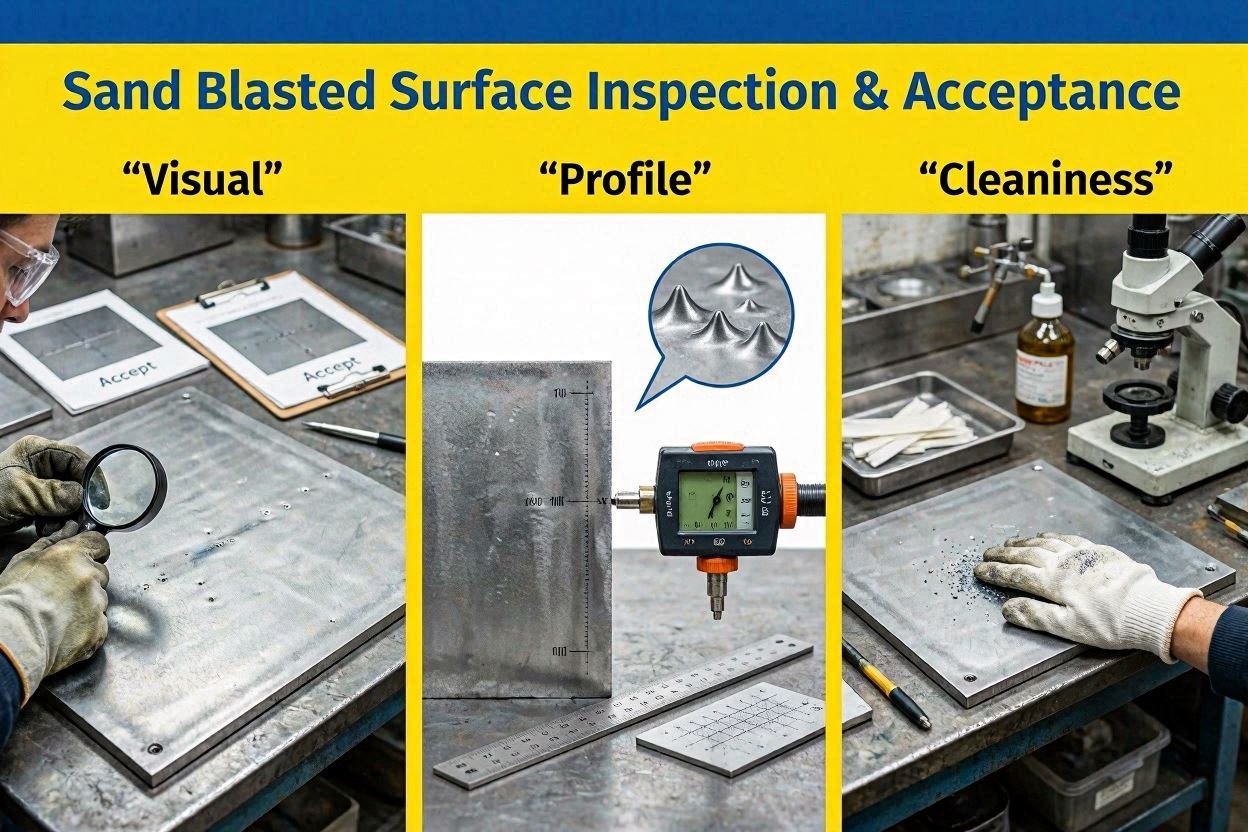
- Conduct a blast test on a standard test panel (Sa 2.5 surface condition) and measure resulting anchor profile with Testex tape — compare against your specification requirement
- Send a 100 g sample to an accredited laboratory for XRD silica analysis and chemical composition verification
6. Ongoing Quality Monitoring
Supplier qualification is not a one-time event. Maintain quality across ongoing orders with these practices:
- Require batch-level COA with every shipment — compare against approved parameters
- Retain a sealed 500 g sample from each incoming shipment for 12 months (allows retroactive testing if blast performance degrades)
- Conduct a working mix sieve analysis monthly in your blast room to monitor media degradation rate
- Track blast productivity (m²/hour at Sa 2.5) as a leading indicator — declining productivity before visible media degradation suggests PSD shift
- Re-audit supplier annually for high-volume accounts
7. Frequently Asked Questions
Evaluate Jiangsu Henglihong Technology Co., Ltd.
We welcome audit requests, sample orders, and documentation reviews. Contact us with your qualification requirements and we will provide the full documentation package — ISO certificate, batch MTCs, XRD silica analysis, and sample shipment — within our standard lead time.
Start Supplier Qualification →Фильтры