Surface Finishing Ti-6Al-4V Titanium 3D Printed Parts: Blasting for Roughness Reduction and Fatigue Life
Ti-6Al-4V (Grade 5 titanium) is the dominant material in metal additive manufacturing for high-performance applications, accounting for an estimated 35–45% of all metal AM production volume in 2026. It is processed by SLM, DMLS, EBM, and DED across applications ranging from turbine components and aircraft structural parts to spinal implants and dental prosthetics. Each of these application areas has specific surface finish requirements, and every one of them requires abrasive blasting as an essential step in the post-processing workflow. The critical constraint that governs all titanium AM blasting decisions is the iron-contamination restriction: steel media of any kind must never contact titanium parts. This guide covers the complete blasting protocol for Ti-6Al-4V AM parts — from media selection and process parameters to medical and aerospace-specific surface specifications.
1. Ti-6Al-4V in Additive Manufacturing
Ti-6Al-4V is an alpha-beta titanium alloy with nominally 6% aluminum and 4% vanadium. In SLM/DMLS, the alloy is processed from powder with particle size distribution of 15–45 µm. In EBM, coarser powder (45–150 µm) is used. The AM process produces a distinctly different microstructure from wrought Ti-6Al-4V — a columnar prior-beta grain structure with fine acicular alpha martensite — which gives as-built SLM Ti-6Al-4V higher strength but lower ductility than annealed wrought material. Post-build heat treatment (stress relief at 650–800°C or HIP + solution anneal) modifies the microstructure toward better ductility for structural applications.
Grade 23 (ELI — Extra Low Interstitial) Ti-6Al-4V is specified for implantable medical devices, with tighter impurity limits (oxygen ≤0.13%, nitrogen ≤0.05%) that improve ductility and fracture toughness for fatigue-loaded implants. The surface finishing requirements for Grade 23 ELI parts are more stringent than for aerospace Grade 5 parts, with complete traceability of all post-processing materials including blasting media batch certificates.
2. As-Built Surface Characteristics of SLM and EBM Titanium
The as-built Ti-6Al-4V surface from SLM/DMLS shows Ra values that depend strongly on build orientation and the specific SLM machine parameters:
- Up-skin (top) surfaces: Ra 8–14 µm — the laser scan passes directly over these surfaces with minimal overhang effects
- Vertical side walls: Ra 10–18 µm — layer stacking creates periodic ridges; partially melted powder particles adhere
- Down-skin / overhang surfaces: Ra 18–30 µm — the most difficult surfaces, where the melt pool bridges unsupported powder
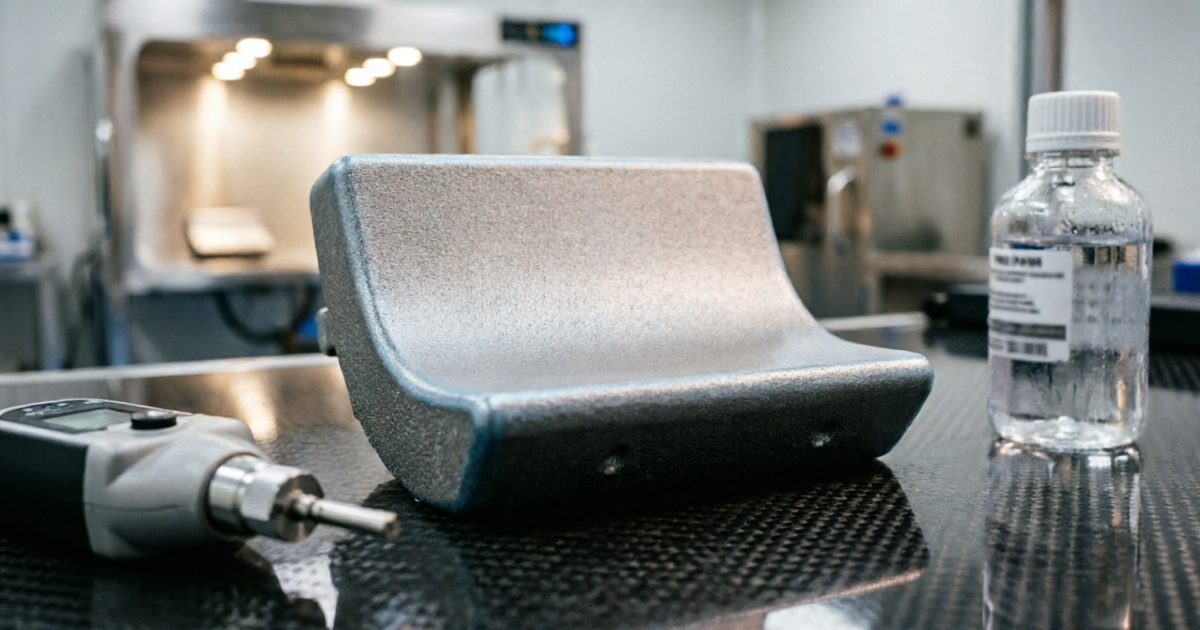
As-built SLM titanium also shows a distinctive golden-to-blue oxidation colouring caused by a titanium oxide film of varying thickness (20–200 nm) formed by atmospheric oxygen during the build. This oxide film is non-uniform in thickness and composition, which is visible as colour variation across the part surface. Blasting removes this variable oxide layer and returns the surface to a uniform silver-grey metallic appearance.
EBM titanium — processed in vacuum — avoids this atmospheric oxidation, but the coarser powder and higher build temperature produce a rougher, more complex surface. EBM Ti-6Al-4V typically shows Ra 25–40 µm, making it the most challenging titanium AM surface to finish.
3. The Iron-Free Media Requirement: Why It Is Non-Negotiable
Titanium’s outstanding corrosion resistance and biocompatibility are provided by a passive surface layer of titanium dioxide (TiO₂). This film forms spontaneously on clean titanium in air within microseconds, and it is self-healing — if damaged, it re-forms immediately. However, this passive layer is severely compromised by iron contamination:
- Galvanic corrosion: Iron and titanium have different electrochemical potentials. Iron particles embedded in the titanium surface create galvanic corrosion cells where iron corrodes preferentially — producing iron oxide (rust) that discolours the part surface and creates pitting in the titanium beneath.
- Pitting and crevice corrosion: Iron contamination disrupts the TiO₂ passive layer continuity, creating vulnerable sites for pitting corrosion in chloride-containing environments (seawater, physiological fluids).
- Cytotoxicity in medical applications: Released ferric (Fe³⁺) and ferrous (Fe²⁺) ions from corroding iron particles are cytotoxic at concentrations above approximately 1 mg/L — well within the range achievable from even trace iron contamination in an implant environment. This disqualifies iron-contaminated titanium parts from all implantable medical device applications.
The ferroxyl test — applying a potassium ferricyanide solution that turns blue in the presence of iron ions — is the standard field test for iron contamination on titanium. Any blue coloration is a failure that requires re-cleaning, re-blasting with confirmed iron-free media, and re-test. This test is mandatory after blasting for all titanium medical implants and is standard practice in aerospace titanium part manufacture.
Steel shot, steel grit, cast iron grit, and any other iron-based blasting media must never be used on titanium 3D printed parts — regardless of application. This applies even to non-medical titanium parts: once iron contamination is present in a blast cabinet’s media, it can transfer to all parts processed in that cabinet. Dedicate blast cabinets to titanium processing with confirmed iron-free glass or zirconia media only.
4. Glass Bead Blasting Protocol for Ti-6Al-4V
- Verify media and equipment. Confirm glass beads are from a certified iron-free batch. Inspect the blast cabinet for any residual steel media from previous operations — clean the cabinet thoroughly before loading glass beads for titanium parts.
- Verify compressed air supply. Use a coalescing filter and moisture separator on the compressed air line. Oil or moisture contamination in the air stream will deposit on the titanium surface during blasting, creating hydrocarbon or water contamination that compromises subsequent passivation.
- Initial cleaning pass. Glass beads 100–150 mesh at 60–70 psi, multi-axis coverage. This removes the as-built oxide film (the golden/blue colouring) and adherent partially melted powder particles. 2–5 minutes for a typical bracket or implant-scale part.
- Finishing pass. Glass beads 150–200 mesh at 55–70 psi. This refines the surface to the target Ra range. For medical implants (Ra target 1.5–3.5 µm), this finishing pass is critical — measure Ra on a test coupon at the planned parameters before processing production parts.
- Blow off with clean dry air. Use oil-free, moisture-free compressed air. For medical parts, use nitrogen purge rather than compressed air to avoid any atmospheric contamination.
- Perform ferroxyl test (medical and aerospace). Swab the surface with ferroxyl reagent. Confirm no blue colouration. Document the test result with part serial number, date, and operator for the batch record.
5. Surface Finishing for Medical Implants
Bone-contacting titanium implants have a unique surface finish requirement: a controlled roughness in the range Ra 1.5–4.0 µm that promotes osseointegration while minimising the risk of bacterial colonisation. This is the only major medical surface finishing application where a rougher surface is clinically superior to a smooth one — the controlled micro-texture created by glass bead blasting is the deliberate therapeutic goal, not merely a cleanliness step.
The biological basis: titanium surface features in the 1–10 µm range influence osteoblast (bone-forming cell) adhesion, spreading, and differentiation. Cells attach to the micro-textured surface and initiate bone matrix deposition at a higher rate than on smooth surfaces (Ra < 0.5 µm) where cells cannot form stable attachment points. Studies on commercially pure titanium and Ti-6Al-4V Grade 23 dental implants consistently show 15–30% higher bone-implant contact (BIC) at Ra 1.5–3.0 µm compared to machined smooth surfaces (Ra < 0.5 µm).
The SLA (Sandblasted, Large grit, Acid-etched) surface treatment used on many commercial dental implants was historically performed on wrought titanium components. For SLM titanium implants, bead blasting to Ra 1.5–4.0 µm achieves a functionally equivalent surface without the acid etching step in many designs — though some manufacturers add an HF-based acid etch after blasting to add micro-roughness at the sub-micron scale for additional cell attachment benefit.
Process documentation requirements for medical titanium blasting under ISO 13485: media type and batch certificate, blast equipment ID and calibration record, operator qualification, blast pressure and parameters, inspection results (ferroxyl test and Ra measurement), and part batch traceability. This documentation forms part of the Device History Record (DHR) for each implant batch.
6. Surface Finishing for Aerospace Applications
Aerospace titanium AM parts require surface finishing for three distinct purposes: corrosion protection, Ra compliance with drawing specifications, and fatigue life enhancement through shot peening. The applicable standards include AS9100 (quality management), NADCAP (special processes), AMS 2430/2432 (shot peening), and ASME B46.1 (surface finish specification).
Typical aerospace Ra specifications for SLM titanium parts (as called out on part drawings):
- General surfaces: Ra ≤ 3.2 µm — achievable directly by glass bead blasting
- Mating and sealing surfaces: Ra ≤ 1.6 µm — requires blasting + vibratory finishing or electropolishing
- Fatigue-critical surfaces (before shot peening): Ra ≤ 3.2 µm — glass bead blasting typical pre-peen condition
- Coating preparation surfaces: Ra 3–6 µm anchor profile — Al₂O₃ NOT used on titanium; glass beads at optimised parameters
NADCAP accreditation for shot peening of titanium aerospace AM parts requires: calibrated Almen strip test equipment (SAE J442), documented blast system calibration, operator qualification records, traceable media batch certification, and first-article Almen strip measurements retained for each production batch. The specific Almen intensity (arc height in 0.001″ on N or A strip) is called out on the part drawing or engineering specification.
7. Shot Peening Titanium AM Parts for Fatigue Life
Shot peening of SLM Ti-6Al-4V introduces compressive residual stress in the surface layer that directly improves fatigue resistance. The scientific basis: SLM titanium parts contain tensile residual stress in the as-built surface layer (from the thermal gradients of the laser process), which promotes fatigue crack initiation. Shot peening reverses this to compressive stress, significantly raising the stress amplitude needed to initiate surface fatigue cracks.
Published fatigue data from literature and industry testing shows that shot peening of SLM Ti-6Al-4V improves high-cycle fatigue strength by 25–65% compared to as-built conditions, and by 15–40% compared to bead-blasted (non-peened) conditions. The improvement is most pronounced for specimens loaded at stress amplitudes below the tensile yield strength — the regime most relevant to long-life aerospace structural parts.
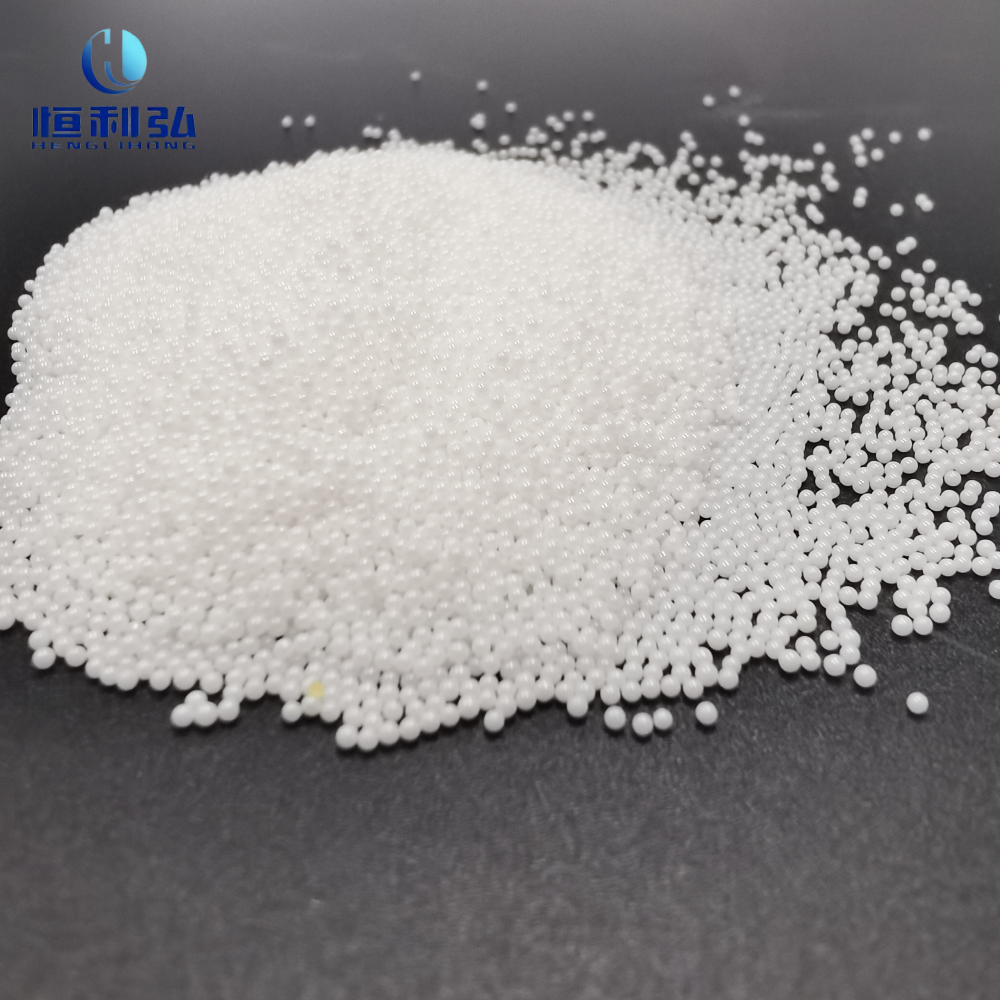
For titanium AM parts, glass beads or zirconia shot are specified for shot peening — never steel shot. At equivalent Almen intensity, zirconia shot provides deeper compressive stress penetration due to its higher density (3.85 g/cm³ vs 2.5 g/cm³ for glass). For maximum fatigue improvement from peening:
- Media: ZrO₂ shot Z150–Z300, or glass beads at higher intensities where Almen specification permits
- Intensity: Almen A 0.15–0.25 inch arc height (verified on N or A strip per SAE J442)
- Coverage: 98–100% minimum
- Температура: Peening at room temperature; avoid elevated temperatures that could relax compressive stress
For the complete shot peening specification and fatigue data, see: Shot Peening 3D Printed Metal Parts: Improving Fatigue Life with Compressive Residual Stress.
8. EBM-Specific Blasting Considerations
EBM titanium presents the most challenging blasting scenario in AM post-processing due to the extreme as-built surface roughness (Ra 25–40 µm). The following adaptations to the standard SLM protocol are required for EBM parts:
- Initial pass with coarser media: Use glass beads 80–120 mesh (125–177 µm) at 65–80 psi for the initial cleaning and peak-removal pass. Standard 150–200 mesh glass beads used for SLM would require too many passes to address EBM’s depth of surface irregularity efficiently.
- Multi-stage cascade: Stage 1 with 80–120 mesh glass beads → Stage 2 with 150–200 mesh glass beads provides the most efficient path from Ra 25–40 µm to Ra 2–5 µm.
- Sintered powder cake removal: Before blasting, the EBM “sintered cake” surrounding the part must be removed mechanically (compressed air, brushing, or dedicated cake-removal equipment). Blasting through the sintered cake contaminates the media and produces inconsistent results.
- Lattice structure internal surfaces: EBM is commonly used for porous lattice implants (acetabular cups, spinal cages with trabecular lattice). Internal lattice surfaces require specialised nozzle setups or wet blasting systems to achieve adequate coverage inside the porous architecture.
- Alpha case: EBM’s vacuum environment reduces alpha case formation compared to SLM in marginal argon atmosphere, but EBM parts may still require chemical verification of alpha-case depth if the build atmosphere is not confirmed. Blasting removes the outermost 10–20 µm per pass; deep alpha case requires acid etching.
9. Process Parameters Reference
| Приложение | Media | Mesh | Pressure (psi) | Standoff (in) | Notes |
|---|---|---|---|---|---|
| SLM Ti-6Al-4V — cleaning | Стеклянные бусины | 100–150 | 60–70 | 8–12 | Removes oxide, partial powder |
| SLM Ti-6Al-4V — finish | Стеклянные бусины | 150-200 | 55–70 | 8–12 | Target Ra 1.5–4 µm |
| EBM Ti-6Al-4V — cleaning | Стеклянные бусины | 80–120 | 65–80 | 8–10 | Coarser for high Ra start |
| EBM Ti-6Al-4V — finish | Стеклянные бусины | 150-200 | 60–75 | 8–12 | After coarse pass |
| Medical implant (Ra 1.5–4 µm) | Стеклянные бусины | 150-200 | 55–65 | 8–12 | Validate Ra on coupons |
| Aerospace (pre-peen) | Стеклянные бусины | 100–200 | 55–75 | 8–12 | Per drawing Ra callout |
| Shot peening | ZrO₂ or glass beads | Z150–Z300 | 55–75 | 6–10 | Almen A 0.15–0.25″; 100% coverage |
Часто задаваемые вопросы
Why must only iron-free media be used on titanium 3D printed parts?
Titanium’s corrosion resistance and biocompatibility depend on a self-healing passive oxide layer of titanium dioxide (TiO₂) that forms spontaneously on clean titanium surfaces. Iron particles embedded in the titanium surface by steel media blasting disrupt this oxide layer — iron is electrochemically incompatible with the TiO₂ passive film, creating galvanic corrosion initiation sites. In aerospace applications, this causes pitting corrosion and stress corrosion cracking. In medical applications, released iron ions are cytotoxic and can cause tissue reactions, disqualifying a titanium implant. The ferroxyl test (potassium ferricyanide solution) detects even trace surface iron — mandatory for all medical titanium parts. Use only glass beads or zirconia beads (ZrO₂) for all titanium AM blasting operations.
What surface roughness is optimal for titanium bone implants after blasting?
For bone-contacting titanium implants (spinal cages, acetabular cups, dental implants, orthopaedic screws), the optimal Ra range for osseointegration — the biological bonding of bone cells to the implant — is 1.5–4.0 µm (Sa values of 1.5–4.0 µm when measured aerially per ISO 25178). This range has been validated in extensive in vivo and in vitro studies. Surfaces smoother than 1.5 µm show reduced osteoblast (bone-forming cell) attachment. Surfaces rougher than 4.0 µm harbour bacteria that can lead to peri-implant infection and implant failure. Glass bead blasting of SLM Ti-6Al-4V at 55–70 psi with 150–200 mesh glass beads reliably produces Ra 1.5–3.5 µm — within the clinical target range — making blasting the standard surface treatment for bone-contacting titanium AM implants.
What is alpha case on titanium and does blasting remove it?
Alpha case is a brittle, oxygen-enriched surface layer that forms on titanium alloys when exposed to oxygen or air at elevated temperatures (above approximately 600°C). In SLM/DMLS processing, despite the use of argon atmosphere, residual oxygen in the build chamber can create a thin alpha case layer (typically 10–100 µm) on the outer surface. Alpha case is harder and more brittle than the bulk Ti-6Al-4V, reducing fatigue resistance and ductility at the surface. Glass bead blasting at standard parameters removes the outermost 5–20 µm of surface material per pass — sufficient to address light alpha case (below 20 µm). For deeper alpha case (20–100 µm), chemical milling (acid etching in HF/HNO₃ or H₂SO₄/HF solution) is required after blasting to fully remove the affected layer. Alpha case formation in EBM titanium is generally less of a concern due to the vacuum build environment, but EBM parts may still require blasting to remove sintered powder cake and surface oxides.
Can zirconia beads be substituted for glass beads on titanium AM parts?
Yes — zirconia shot (ZrO₂) is an excellent alternative to glass beads for titanium AM blasting, particularly for shot peening applications. Zirconia is chemically inert (no iron contamination), harder than glass (Mohs 7.5 vs Mohs 6), and significantly denser (3.85 g/cm³ vs 2.5 g/cm³ for glass), providing higher peening energy per particle. For titanium medical implants, glass beads at 55–75 psi deliver the required Ra range and are more economical. For aerospace titanium parts requiring shot peening to Almen intensity specifications that glass beads cannot achieve, zirconia shot at appropriate sizes (ZrO₂ 100–150 µm / Z150–Z300) is the preferred choice. Zirconia media costs significantly more than glass beads but has a longer service life (5,000–10,000 impacts to fracture vs 300–500 for glass beads).
How does EBM titanium blasting differ from SLM titanium blasting?
EBM (Electron Beam Melting) titanium parts start with significantly higher as-built Ra (25–40 µm) compared to SLM Ti-6Al-4V (Ra 8–18 µm). EBM uses coarser powder (45–150 µm diameter), operates at higher temperatures (600–1000°C), and is processed under vacuum rather than argon atmosphere. These factors produce a rougher, coarser surface texture. Blasting EBM parts requires coarser glass beads (80–120 mesh for the first pass, versus 100–200 mesh for SLM) at higher pressure (65–80 psi) to effectively treat the deeper surface irregularities. Multiple blast passes are typically needed to bring EBM titanium to Ra below 4 µm. The vacuum atmosphere of EBM reduces (but does not eliminate) alpha case formation. After thorough blasting, EBM and SLM titanium parts can achieve similar final Ra values (1.5–4 µm for medical, ≤1.6 µm target for aerospace with additional processing).
Is shot peening required for all aerospace titanium AM parts?
Not all aerospace titanium AM parts require shot peening, but it is specified for fatigue-critical applications — structural brackets, engine components, landing gear parts, and any component under cyclic loading. The decision is made by the design engineer based on the part’s fatigue loading spectrum, safety factor requirements, and inspection intervals. Shot peening is specified by Almen intensity (AMS 2430, AMS 2432) and coverage, and must be performed by a NADCAP-accredited process provider for certified aerospace parts. Parts that are not fatigue-critical (non-structural brackets, fluid fittings, non-load-bearing housings) typically require only bead blasting for surface finishing and contamination removal, without the formal Almen intensity specification of shot peening.
What is the typical cost difference between glass bead and zirconia bead blasting for titanium?
Glass beads are significantly less expensive than zirconia beads on a per-kilogram basis — typically 3–6× lower cost. However, zirconia beads last 10–30× longer before breaking down below the specified mesh size, significantly reducing media replacement frequency. For continuous production blasting of titanium parts, the total cost of ownership (media cost per part) for zirconia may be competitive with or lower than glass beads, depending on production volume and the blast pressure used (higher pressure accelerates glass bead breakdown faster than zirconia breakdown). For low-volume production or where standard glass bead Ra is sufficient, glass beads remain the more economical choice. Zirconia is economically justified when the required Almen intensity for peening exceeds what glass beads can deliver, or when part count justifies the higher initial media investment.
Source Iron-Free Blasting Media for Titanium AM Parts
Jiangsu Henglihong Technology Co., Ltd. manufactures certified iron-free glass beads for titanium SLM and EBM post-processing — with batch certificates suitable for aerospace and medical device manufacturing records. Our zirconia shot and ceramic bead range is also available for shot peening applications. Contact our technical team for media specifications and application support.
Contact Our Technical TeamPublished July 2026 by Jiangsu Henglihong Technology Co., Ltd. — Specialists in industrial abrasive blasting media for additive manufacturing post-processing.
Фильтры