How to Choose the Right Abrasive Blasting Media for Steel Surface Preparation
A practical decision framework — from SSPC-SP specification to media type selection — for industrial contractors, coating inspectors, and procurement engineers working on structural steel projects.
1. The Four Variables That Govern Media Selection
Every abrasive blasting media selection decision is governed by the intersection of four variables. Getting all four right produces a specification that is safe, compliant, productive, and cost-effective. Missing even one typically results in coating failures, regulatory non-compliance, or unnecessary project cost.
- Required surface cleanliness level — specified by the coating system manufacturer or the project owner; expressed as an SSPC-SP grade
- Required anchor profile depth — the Mil range within which the blasted surface profile must fall; specified by the coating data sheet
- Substrate condition — the existing rust grade (A through D per SSPC-VIS 1) and the nature of existing coatings being removed
- Operational constraints — available equipment, environment (indoor/outdoor), health and safety regulations, budget, and whether media reuse is practical
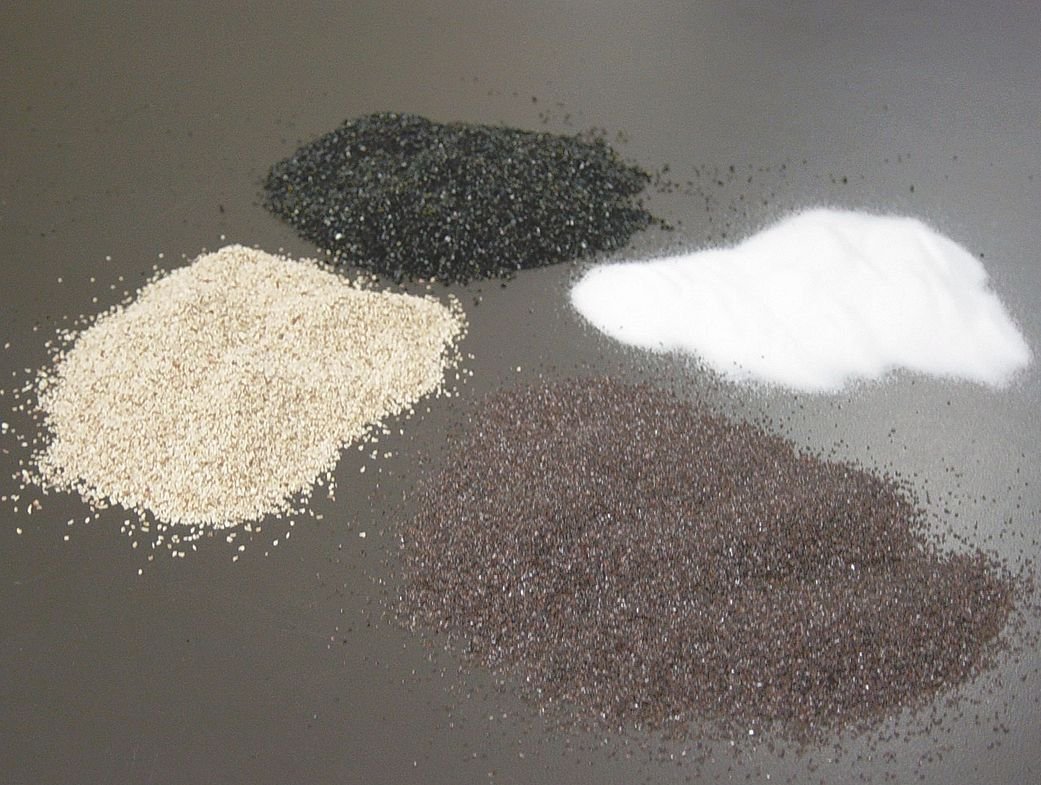
This article guides you through each variable and synthesizes them into a practical selection decision. For the full product-focused reference, see our comprehensive guide: Black Beauty Abrasive Blasting Media: The Complete Buyer’s Guide.
2. Understanding SSPC-SP Cleanliness Standards
The SSPC (Society for Protective Coatings) surface preparation standards define the degree of cleaning required before applying protective coatings. These are the universal reference for industrial coating specifications on structural steel, bridges, tanks, ships, and pipelines worldwide:
| SSPC-SP Level | Common Name | Описание | Typical Application |
|---|---|---|---|
| SP 7 | Brush-Off Blast | Removes loose mill scale, rust, and coatings. Tightly adherent material may remain. | Maintenance recoating where tight adherent coating is acceptable; low-performance systems |
| SP 6 | Commercial Blast | At least 2/3 of each unit area free from all visible residue. Shadow, staining, and streaks allowed. | General maintenance, agricultural equipment, moderate-service environments |
| SP 10 | Near-White Blast | At least 95% of each unit area free of all visible residue. Only slight staining allowed. | High-performance coatings, structural steel, bridges, offshore — the most common specification |
| SP 5 | White Metal Blast | 100% free of all visible rust, mill scale, paint, and foreign matter. | Tank linings, nuclear applications, immersion service, severe chemical environments |
| SP 14 | Industrial Blast | At least 2/3 of each unit area free from all visible residue; similar to SP 6 with different shadow allowance | Interim standard for situations between SP 7 and SP 6 requirements |
3. Anchor Profile Requirements by Coating System
Cleaning level and anchor profile are two separate requirements that must both be satisfied. The anchor profile — measured in thousandths of an inch (Mil) — is the peak-to-valley depth of the surface texture created by blasting. This mechanical profile is what the primer bonds to.
| Coating System Type | Min. Profile (Mil) | Max. Profile (Mil) | Notes |
|---|---|---|---|
| Wash primer / thin alkyd | 0.5 | 1.5 | Deep profiles leave peaks exposed above film |
| Inorganic zinc silicate | 2.0 | 3.5 | IZ requires intimate contact; smooth peaks reduce bond strength |
| Organic zinc-rich primer | 2.5 | 4.0 | Standard for structural steel maintenance programs |
| High-build epoxy | 2.0 | 4.5 | Wide tolerance; match to total DFT specification |
| Coal tar epoxy | 3.0 | 5.0 | Immersion service standard; needs deep mechanical anchor |
| Fusion Bonded Epoxy (FBE) | 2.5 | 4.5 | Pipeline coating; strict profile tolerance in OEM specifications |
| Polyurea / polyurethane lining | 3.0 | 6.0 | Spray-applied; high-build systems tolerate wider profiles |
| Thermal spray metalizing | 3.0 | 5.0 | Wire arc or flame spray zinc/aluminum requires deep angular profile |
4. Substrate Condition and Rust Grade Assessment
SSPC-VIS 1 defines four initial surface conditions (rust grades) for steel substrate assessment before blasting:
- Grade A: Mill scale fully covering the surface, little or no rust visible
- Grade B: Beginning to rust; mill scale lifting or flaking in places
- Grade C: Rust widespread; mill scale completely rusted away or may be pitted
- Grade D: Heavy rust and visible pitting across the surface
Rust grade directly influences media selection. Grade A and B surfaces with intact mill scale require a more aggressive media (coarser grit, higher hardness) to cut through the scale before rust removal begins. Grade C and D surfaces — already deeply corroded — often respond better to medium grit that efficiently removes loose rust without over-profiling the softer corroded substrate.
5. Operational Constraints: Equipment, Environment, Reuse
5.1 Open Field vs. Enclosed Blast Room
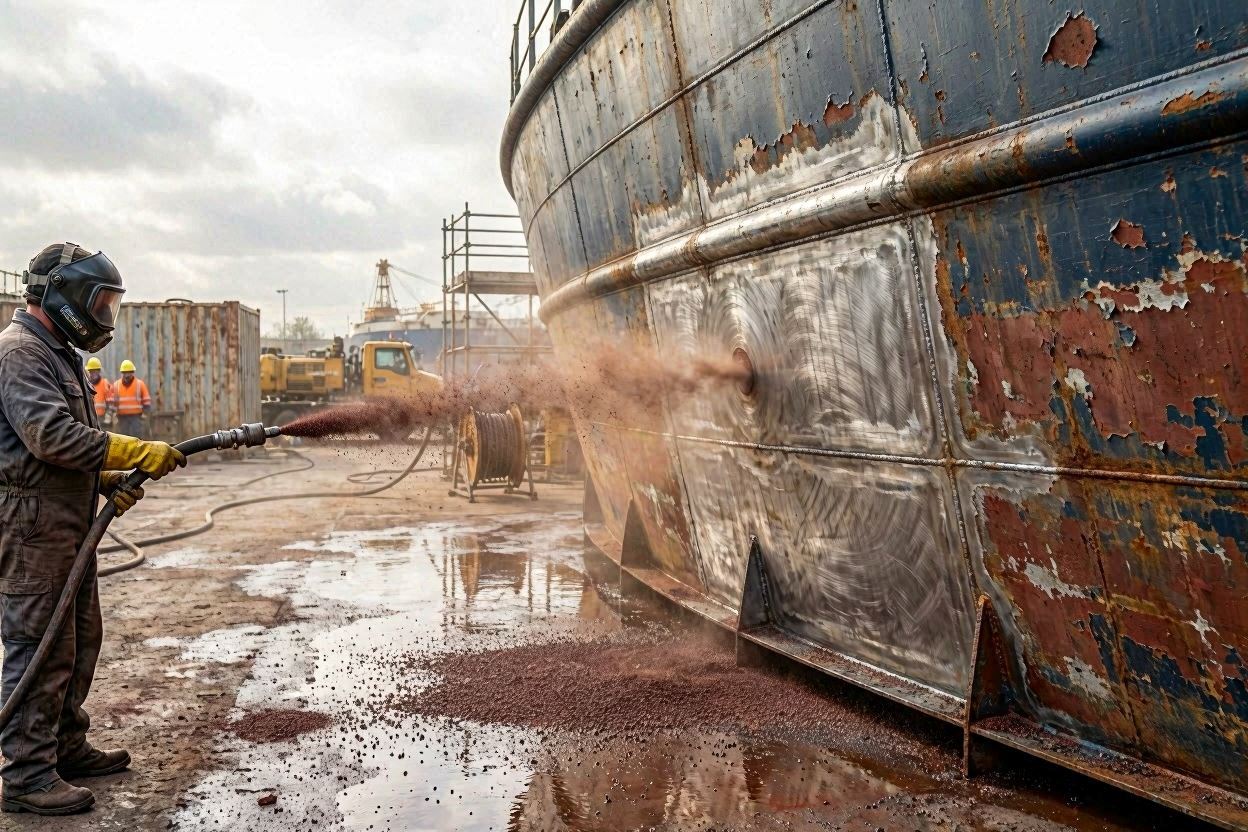
Field blasting on bridges, tanks, and structures requires media that comply with environmental containment regulations (dust suppression, spent media collection) and can be managed with conventional pressure blast pots. Black Beauty’s single-use economics are well-suited to field applications where media reclaim is impractical.
Blast rooms and cabinet operations, conversely, benefit from media with higher reuse cycles — steel grit or aluminum oxide — where the capital cost of reclaim equipment is justified by volume. Black Beauty can be used in blast rooms but typically achieves only 1–2 productive cycles before fines accumulation degrades performance.
5.2 Indoor Air Quality and Silica Regulations
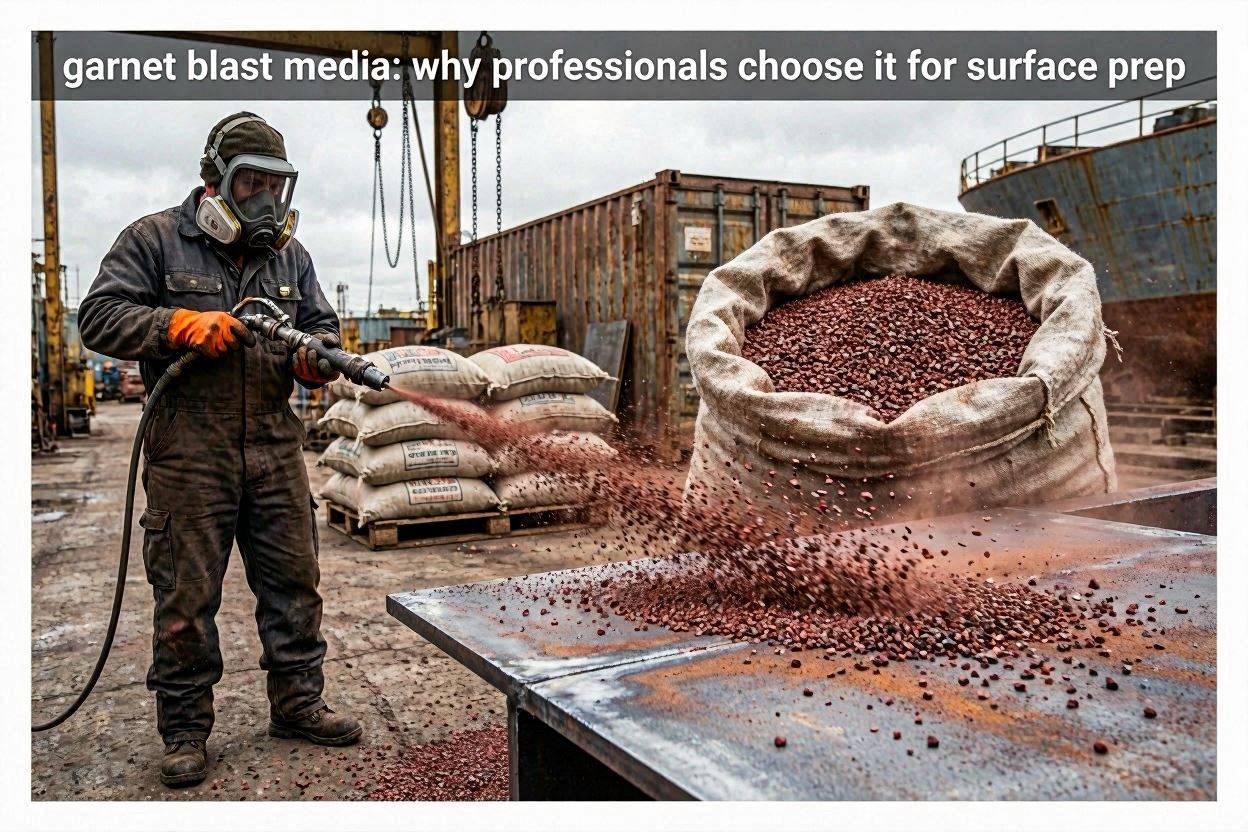
Indoor blasting in enclosed spaces demands the lowest possible dust-generating media. Garnet produces the least airborne fines of any commonly available abrasive and is often specified for enclosed blast rooms, bridge interior girder spaces, and tank interiors. Black Beauty’s low but non-zero dust generation requires full supplied-air respiratory protection and engineered ventilation in enclosed applications.
5.3 Budget and Throughput
For price-sensitive maintenance blasting with no reuse requirement, Black Beauty’s cost per ton is among the lowest of any compliant abrasive. For high-value, reclaim-equipped operations where cost per square foot is the relevant metric, steel grit or aluminum oxide may offer lower true cost despite higher initial media price.
6. Media Selection Matrix
| Scenario | Best Media | Why |
|---|---|---|
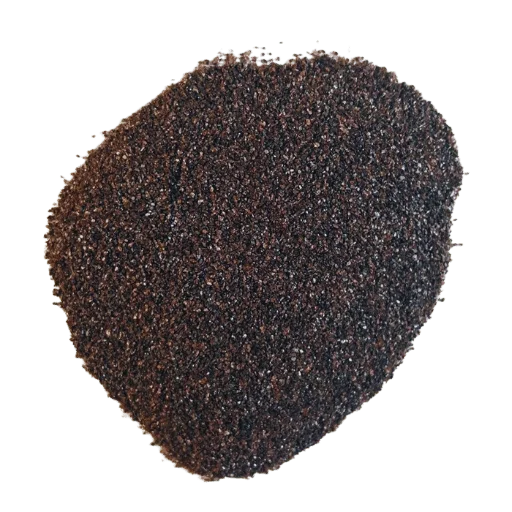
| Large-area structural steel maintenance, field blasting, no reclaim | Black Beauty (Coal Slag) Medium or Fine | Lowest disposable cost; SSPC SP 10 compliant; adequate profile for zinc/epoxy systems |
| Bridge maintenance, highway spec, DOT project | Black Beauty Medium (12/40) | SP 10 at 3–4.8 Mil; widely accepted in DOT standard blasting specifications |
| Ship hull dry-dock preparation | Black Beauty Coarse or Copper Slag | Aggressive profile for antifouling systems; high throughput per nozzle-hour |
| Blast cabinet, workshop parts stripping | Black Beauty Extra Fine or Fine | Compatible with cabinet nozzle sizes; adequate for paint/rust removal |
| Enclosed space, indoor tank interior | Гранат | Lowest dust generation; lowest silica content; smallest enclosed-space ventilation burden |
| Precision engineering, aerospace, thin-wall components | Aluminum Oxide or Glass Bead | Highest hardness (Al₂O₃) for controlled profile; glass bead for peening/finishing |
| High-volume blast room with reclaim system | Стальная крошка | 50–200+ reuse cycles dramatically reduce per-square-foot media cost at scale |
| Pipeline FBE coating preparation | Black Beauty Fine or Copper Slag | 2.5–4.5 Mil profile window; low chloride; compliant with most OEM pipe specs |
7. The Case for Black Beauty Coal Slag in Heavy Industrial Work
For the broadest category of heavy industrial surface preparation — structural steel maintenance, bridge recoating, industrial equipment overhaul, and field blasting of pipelines and tanks — Black Beauty coal slag delivers the optimal combination of attributes:
- SSPC AB 1 compliant — accepted on virtually every project specification worldwide
- Medium grade achieves SP 10 cleanliness and 3.0–4.8 Mil profile in a single productive pass on C-grade rust
- Cost per ton is among the lowest of any SSPC-compliant abrasive — typically 40–60% less per ton than garnet
- Single-use economics are ideal for field blasting where media reclaim is logistically impractical
- Low free silica (<0.1%) satisfies health and environmental regulations in all major markets
- TCLP non-hazardous status (when not contaminated by heavy metals from substrate) reduces disposal costs
For a complete head-to-head cost analysis versus garnet and aluminum oxide, see: Black Beauty Pricing Guide & Bulk Buying Tips.
8. When to Choose an Alternative
Black Beauty is not the right answer for every blasting application. Choose an alternative when:
- Indoor enclosed spaces with limited ventilation — garnet’s dramatically lower dust generation reduces ventilation burden and worker exposure
- High-reuse blast room operations — steel grit at 50–200 cycles has a much lower per-square-foot media cost than single-use coal slag
- Hardened alloy steel or precision components — aluminum oxide (Mohs 9) provides faster cutting and tighter profile control on very hard substrates
- Decorative finishing or part deburring — glass beads provide the peened surface texture required; coal slag creates too aggressive a profile
- Marine immersion zones where chloride contamination is a concern — some copper slag products have lower chloride levels than coal slag from certain sources; verify with supplier chloride content certificates
Detailed comparison guides: Black Beauty vs. Garnet · Black Beauty vs. Aluminum Oxide · Black Beauty vs. Copper Slag
9. Step-by-Step Selection Checklist
Use this checklist before every blast media specification decision:
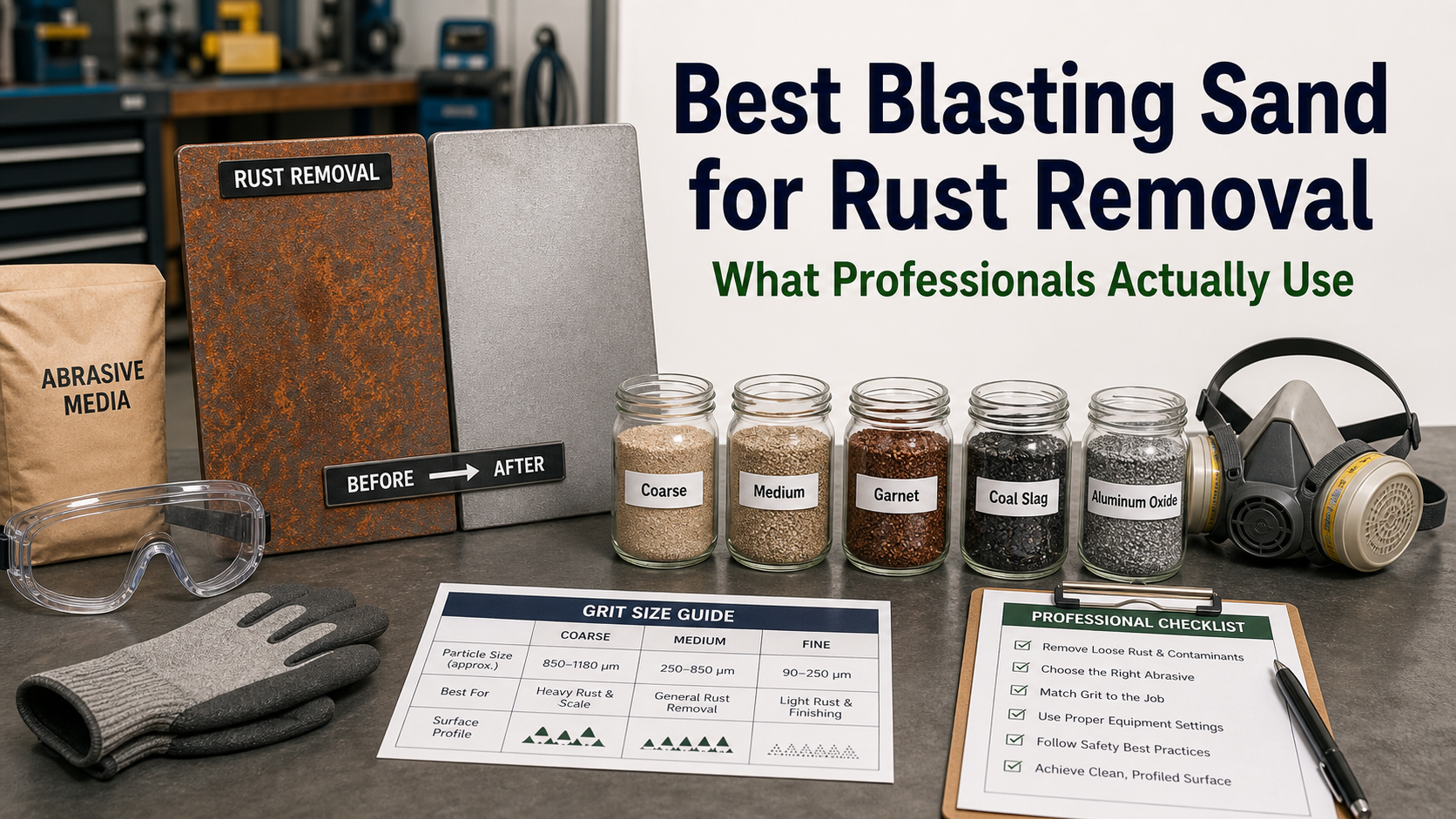
- Obtain the coating data sheet — identify minimum SSPC-SP cleanliness level and anchor profile range (Mil).
- Assess the substrate — determine SSPC-VIS 1 rust grade (A–D) and identify any hazardous coatings (lead paint, chromates) present.
- Evaluate your equipment — confirm available nozzle orifice sizes and compressor CFM output versus the media requirements.
- Determine the blasting environment — open field, contained field, blast room, or enclosed interior space; each has different dust and containment requirements.
- Confirm regulatory requirements — check SSPC AB 1, silica regulations, and any project-specific blast media specifications.
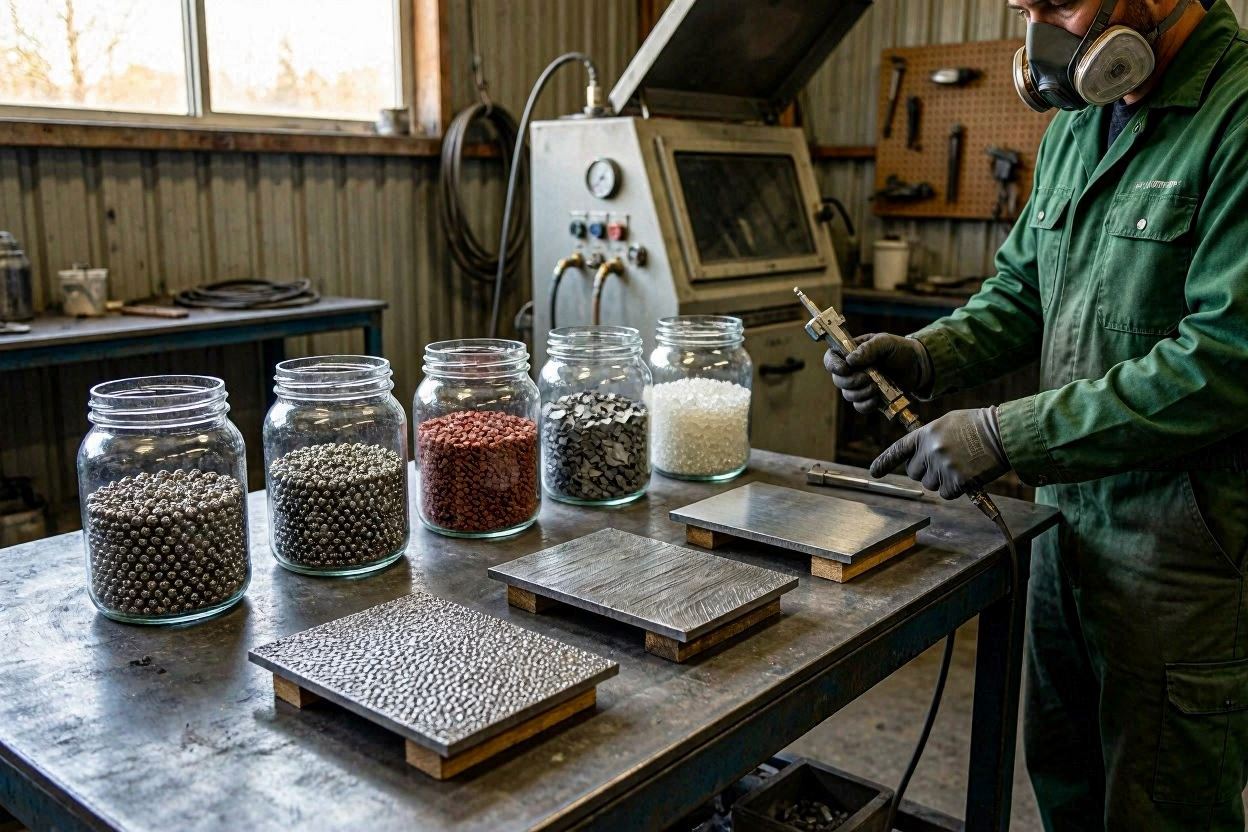
- Select media type and grade from the matrix above; cross-reference with the grit size chart for your chosen media.
- Order a trial quantity — perform a test blast on representative sample panels; verify cleanliness with SSPC-VIS 1 and profile with Testex tape before production blasting.
- Plan spent media management — confirm disposal pathway (TCLP status) before blasting begins.
Return to the overview: Complete Buyer’s Guide · Related: Grit Size Chart · Technical Specifications
Фильтры