Wet vs. Dry Ceramic Bead Blasting for SLS Nylon Powder Removal: Process Comparison
Both wet and dry ceramic bead blasting can depowder SLS nylon parts effectively — but they deliver different surface finish results, carry different operational requirements, and suit different production contexts. For most PA12 and PA11 operations, dry blasting is the right answer. For applications requiring the finest possible Ra or processing certain flexible TPU geometries, wet blasting earns its higher capital cost and operational complexity. This guide provides the complete comparison so you can make the right choice for your specific production requirements.
1. How Dry Ceramic Bead Blasting Works for SLS Depowdering
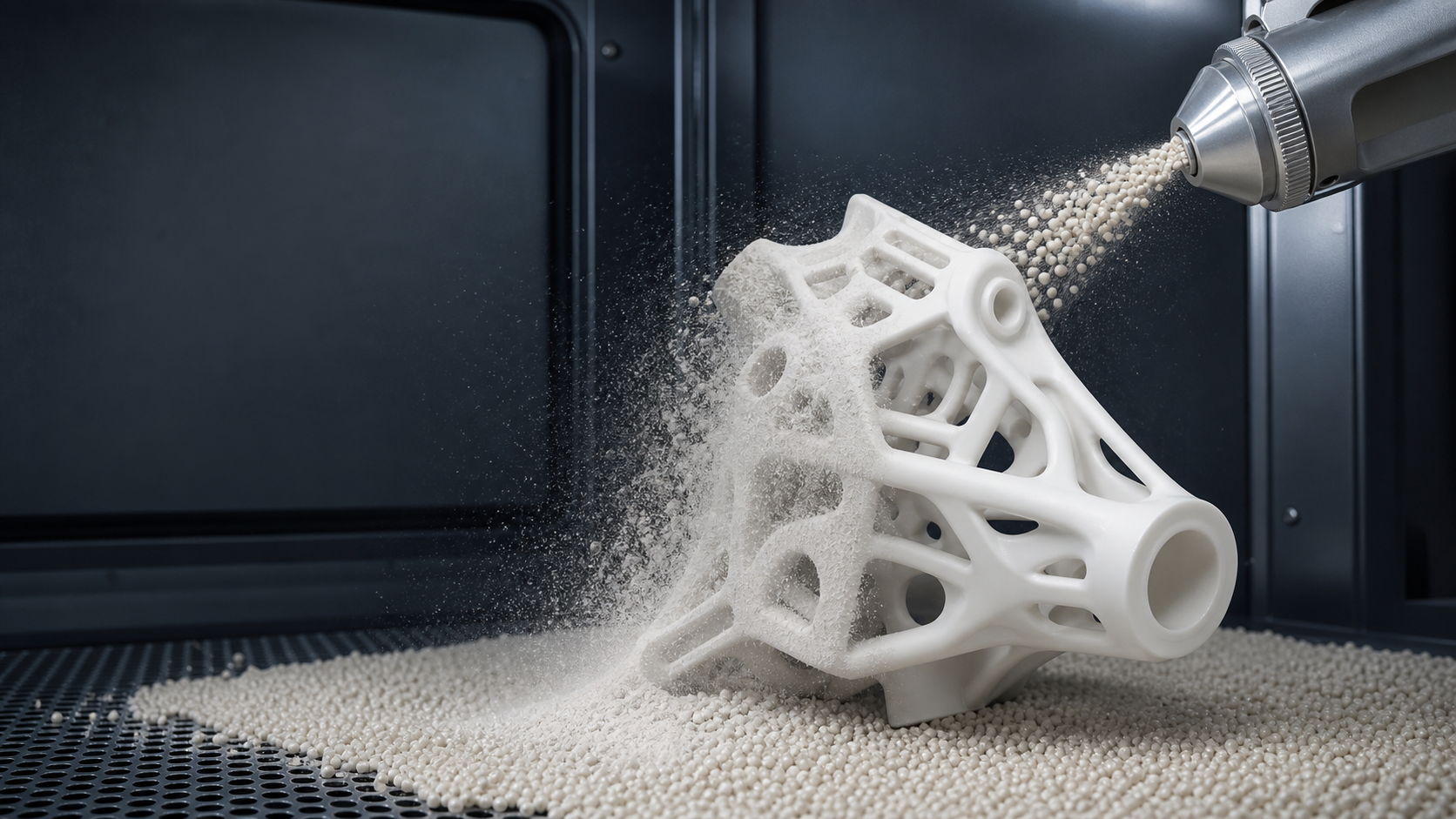
In dry ceramic bead blasting, compressed air carries ceramic beads from a reservoir — either by venturi suction (suction-feed) or from a pressurised media pot (pressure-feed) — through a blast hose and nozzle directed at the part surface inside an enclosed blast cabinet. The cabinet contains the bead and nylon powder debris, which is carried to a dust collector by the air flow while beads fall to the cabinet floor for recirculation.
Dry blasting is the dominant configuration in SLS post-processing operations worldwide as of July 2026, and for good reason: it is faster to set up, simpler to operate, easier to adjust, and lower in capital and operating cost than wet blasting. The principal operational consideration is dust: SLS nylon powder is a fine, inhalable particulate that accumulates rapidly in dry blast cabinet dust collectors and creates an explosion hazard at sufficient concentrations in enclosed spaces. Adequate dust extraction, a correctly sized dust collector, proper PPE (particulate respirator at minimum), and periodic ductwork cleaning are essential for safe dry blast operation on nylon SLS parts.
2. How Wet Ceramic Bead Blasting (Hydroblast) Works
In wet blasting (also called hydroblasting or wet abrasive blasting), ceramic beads are mixed with water in a recirculating slurry system. Compressed air propels the slurry through the blast gun and nozzle. The water film that coats each ceramic bead at impact acts as a thin lubricating layer between the bead and the part surface, cushioning the peak stress of each impact and distributing the force over a slightly larger contact area.
This cushioning effect has two practical consequences: the surface finish Ra achieved at a given bead size is 1–3 µm lower than dry blasting, and the risk of surface deformation on flexible materials is reduced. The water also suppresses the nylon dust cloud that is the primary safety concern of dry blasting — wet blast cabinets operate essentially dust-free, with all debris captured in the recirculating water.
The operational complexity of wet blasting is meaningfully higher than dry blasting: the recirculating slurry must be maintained at the correct ceramic bead concentration; nylon powder contamination of the slurry must be managed (it does not settle cleanly like metal swarf); the system requires water supply, drain connection, and often pH adjustment for discharge compliance; and nylon SLS parts must be dried immediately and thoroughly after wet blasting to prevent moisture uptake.
3. Surface Finish Ra Comparison: Dry vs. Wet at Matched Bead Sizes
The surface finish advantage of wet blasting is real and consistent across SLS nylon materials and bead grades. At the same bead size and equivalent blast pressure, wet blasting produces Ra values 1 to 3 µm lower than dry blasting on PA12 SLS.
| Bead Size (ZS) | Dry Blast Ra — PA12 | Wet Blast Ra — PA12 | Ra Advantage (Wet) |
|---|---|---|---|
| 0.05–0.10 mm | Ra 4–7 µm | Ra 3–5 µm | ~1–2 µm |
| 0.10–0.15 mm | Ra 5–9 µm | Ra 4–7 µm | ~1–2 µm |
| 0.15–0.25 mm | Ra 7–12 µm | Ra 5–9 µm | ~2–3 µm |
| 0.25–0.35 mm | Ra 9–16 µm | Ra 7–12 µm | ~2–4 µm |
The practical implication: if your Ra specification requires ≤5 µm and fine dry blasting at 0.10–0.15 mm can only reliably achieve Ra 5–9 µm, wet blasting at 0.10–0.15 mm can consistently reach Ra 4–7 µm — bringing you into specification with a safety margin. For many operations, this is the decisive factor in choosing wet over dry for appearance-critical parts.
4. Moisture Risk for SLS Nylon Parts
PA12 and PA11 are hygroscopic — they absorb water from their environment over time. This hygroscopicity creates specific risks in wet blast applications that dry blasting entirely avoids.
| SLS Material | Equilibrium Moisture Absorption | Wet Blast Exposure Risk | Consequence if Not Dried |
|---|---|---|---|
| PA12 | ~0.25% at saturation | Low-Moderate (absorbs slowly) | Dimensional change ~0.05–0.10%; lighter dye colour |
| PA11 | ~1.0–1.2% at saturation | Moderate-High (absorbs faster) | Dimensional change ~0.10–0.20%; significant dye colour shift |
| TPU (Shore A 85–95) | 0.5–1.5% (grade-dependent) | Умеренный | Dimensional change; surface tackiness; dye inconsistency |
The equilibrium absorption values above represent saturation — a condition reached only after prolonged immersion. In a wet blast cycle of 5–15 minutes, SLS nylon parts absorb a fraction of their equilibrium value. However, even a 0.05–0.15% moisture uptake in PA12 or 0.20–0.40% in PA11 is sufficient to cause:
- Dimensional swelling that shifts reference dimensions by 10–30 µm — measurable and potentially non-conforming for tight-tolerance parts
- Lighter dye colour due to moisture occupying surface pores that dye molecules would normally penetrate
- Reduced coating adhesion if parts proceed to painting or powder coating with residual moisture
None of these consequences are permanent — drying restores the part to its pre-wet-blast condition. The risk only materialises if the drying step is skipped or abbreviated.
5. Post-Wet-Blast Drying Protocol
Mandatory drying protocol after wet ceramic bead blasting
- Step 1: Remove parts from wet blast cabinet immediately upon cycle completion
- Step 2: Blow surface water from all accessible surfaces and cavities with clean dry compressed air
- Step 3 — PA12: forced-air oven at 60–70°C for 2 to 4 hours (thin-wall parts: 2 h; thick-wall parts: 4 h)
- Step 3 — PA11: forced-air oven at 70–80°C for 3 to 6 hours
- Step 3 — TPU: forced-air at 40–60°C for 2 to 4 hours (temperature must stay below material softening point)
- Step 4: Verify dimensional return on reference features (pre-wet-blast dimension should be restored within measurement uncertainty)
- Step 5: Transfer to dyeing, coating, or inspection within 1 hour of removing from oven; or seal in airtight packaging if longer holding is needed
Never allow wet-blasted nylon SLS parts to air-dry at ambient temperature. PA12 and PA11 will absorb ambient humidity during the air-drying period, potentially reaching higher moisture content than immediately post-blast. Forced-air oven drying at elevated temperature drives moisture out of the nylon structure reliably and quickly.
6. Operational and Equipment Comparison
| Factor | Dry Blast Cabinet | Wet Blast System |
|---|---|---|
| Capital cost | USD 2,000–20,000 | USD 8,000–45,000 + water treatment |
| Operating cost | Compressed air + media + labor + dust disposal | Above + water + water treatment + drying energy |
| Setup time | 5–10 minutes | 15–30 minutes (slurry check, bead concentration) |
| Throughput | Высокий | Moderate (slower slurry flow; drying step adds time) |
| Образование пыли | High — requires extraction and PPE | Minimal — water suppresses nylon dust |
| Ra at same bead size | Baseline | 1–3 µm lower (finer) |
| Moisture risk for parts | Нет | Mandatory drying step required |
| Media monitoring | Sieve analysis | Sieve analysis + slurry concentration check |
| Water treatment | Not applicable | Settling + pH adjustment + discharge compliance |
7. Decision Guide: When to Choose Wet or Dry
Choose dry ceramic bead blasting when:
- Processing PA12 or PA11 at any production volume where Ra ≥ 5–6 µm is acceptable
- Dyeing or coating will follow blasting — simplest to avoid moisture management entirely
- Capital budget favours a simpler, lower-cost setup
- Throughput is the primary driver
- Your facility lacks the water supply and drain infrastructure for wet blasting
Consider wet ceramic bead blasting when:
- Ra specification is ≤ 5 µm and fine dry blasting cannot consistently reach that target
- Processing flexible TPU SLS parts where the water-cushioned impact reduces deformation risk
- Air quality or dust management regulations in your facility make dry blasting impractical
- You have existing wet blast infrastructure from other manufacturing operations
- Parts require the most uniform, visually consistent matte surface for premium appearance applications
Часто задаваемые вопросы
Yes. Wet blasting with the same bead size typically achieves Ra values 1 to 3 µm lower than dry blasting. At 0.15–0.25 mm ZS beads, dry blasting produces Ra 7–12 µm on PA12 SLS; wet blasting produces Ra 5–9 µm. The water film cushions the impact, reducing peak stress per particle and producing a finer, more uniform surface texture. For operations with Ra requirements below 5–6 µm that fine dry beads cannot consistently achieve, wet blasting is worth evaluating — but the mandatory drying protocol for hygroscopic nylon must be implemented immediately after blasting.
PA12 SLS parts should be dried in a forced-air oven at 60–70°C for 2 to 4 hours immediately after wet blasting. Never allow parts to air-dry at ambient temperature — PA12 absorbs ambient humidity during uncontrolled air drying, potentially reaching higher moisture content than immediately post-blast. PA11 SLS parts require 70–80°C for 3 to 6 hours due to their higher moisture absorption rate. Transfer parts to the dye bath within 1 hour of removing from the oven, or seal in airtight packaging if a longer holding time is required.
Wet blasting is worth considering for flexible TPU SLS parts because the water film provides additional impact cushioning, giving a safer margin against deformation compared to dry blasting at the same pressure. However, TPU materials vary significantly in moisture sensitivity — dry them at 40–60°C for 2–4 hours immediately after wet blasting and measure reference dimensions before and after to confirm dimensional return. For very soft TPU (Shore A below 80), wet blasting at reduced pressure (25–35 PSI) is often the preferred depowdering approach when the dry blast protocol cannot stay below the deformation threshold.
A wet blast system for SLS nylon requires: a wet blast cabinet with recirculating slurry pump, blast gun, enclosed chamber, and viewing window; a water supply and drain; a slurry agitation system to keep ceramic beads suspended; a settling tank or centrifugal separator to remove nylon powder from the recirculating slurry; and a forced-air oven at minimum 70°C capability for post-blast drying. Total capital cost is typically 3–6× higher than an equivalent dry blast cabinet. For most PA12 and PA11 operations where Ra 6–12 µm is acceptable, the additional capital and operational cost of wet blasting is difficult to justify.
Related Articles in This Series
Return to the Ceramic Beads for SLS Powder Removal — Complete Guide for the full overview.
Complete Ra dataset for dry blasting — context for the wet vs. dry Ra comparison.
Pressure parameters for dry blast systems — the protocol underpinning both wet and dry approaches.
How the choice of wet or dry blasting affects pre-dye surface condition and colour depth.
When wet blasting offers a meaningful safety margin for flexible SLS materials.
PA11’s higher moisture absorption makes drying protocol especially important after wet blast.
Bead size selection principles that apply equally to wet and dry blast processes.
Ceramic Beads for Both Wet and Dry SLS Depowdering
Jiangsu Henglihong Technology Co., Ltd. supplies ZS and ZrO₂ ceramic blasting beads in ISO-classified size ranges from 0.05 mm to 0.60 mm — suitable for both dry and wet blast applications. Tell us your Ra target and blast system type and we will recommend the right grade and size.
Request Samples & Technical SupportФильтры