Shot Peening Titanium SLM Aerospace Parts: AMS 2430, Fatigue Life Improvement, and NADCAP Compliance
Shot peening is the primary fatigue life improvement process for titanium SLM aerospace components. The SLM build process introduces tensile residual stress at the surface — a direct fatigue liability. Shot peening reverses this with a compressive residual stress layer that raises the high-cycle fatigue limit toward and in some cases above the wrought material baseline. This guide covers the complete technical and compliance framework: residual stress mechanics, AMS 2430 requirements, ceramic shot selection, and NADCAP AC7117 audit criteria.
1. The Fatigue Problem in Titanium SLM and the Peening Solution
Titanium SLM components used in load-bearing aerospace structures operate under cyclic loading where fatigue is the dominant failure mode. The SLM build process introduces a specific fatigue liability: tensile residual stress at the part surface, arising from the steep thermal gradients and rapid solidification of laser powder bed fusion. Measured surface tensile residual stresses of 200–600 MPa are routinely reported for Ti-6Al-4V SLM, representing 20–60% of the material’s ultimate tensile strength applied as a pre-existing tensile load before any service loading begins. The result is a high-cycle fatigue (HCF) limit that can be 20–40% below the equivalent wrought Ti-6Al-4V baseline — a structural deficit incompatible with aerospace primary structure design margins.
Shot peening directly reverses this deficit. By bombarding the surface with high-velocity spherical media under defined process conditions, the process plastically deforms the surface layers and introduces compressive residual stress (CRS) extending 0.1–0.5 mm into Ti-6Al-4V. This compressive zone must be overcome by the applied tensile loading before fatigue crack nucleation can proceed at the surface, effectively raising the allowable cyclic stress amplitude for the same fatigue life requirement. Published fatigue life improvements for peened Ti-6Al-4V SLM components range from 30–100%+ over unpeened as-built surfaces, with higher-intensity peening protocols bringing the HCF limit close to the wrought material benchmark. This article is part of the series on abrasive finishing for titanium SLM parts.
2. Compressive Residual Stress: Mechanism and Measurement
The compressive residual stress induced by shot peening arises from plastic deformation of the surface and near-surface layers. Each spherical media particle impact deforms the titanium surface locally beyond its yield point, elongating the deformed material laterally. The surrounding elastic bulk constrains this elongation, generating biaxial compressive stress in the deformed zone. For Ti-6Al-4V, achievable CRS magnitudes are −400 to −800 MPa at the surface, transitioning through zero and into tensile stress at depths of 0.3–0.7 mm (equilibrium requires a compensating tensile zone deeper in the part).
CRS depth profiles are measured by X-ray diffraction (XRD) using the sin²ψ method, which relates measured lattice d-spacing changes to biaxial stress through elasticity theory. XRD measurements at the surface and at successive electropolished depths build the complete stress-vs-depth profile. For NADCAP-audited peening processes, XRD measurement on Almen coupon companion specimens or actual parts is a periodic documented requirement. The depth of the compressive zone (typically defined as the depth at which the CRS crosses zero) should exceed the crack nucleation depth for the component’s critical stress concentration features to be effective in fatigue life improvement.
3. AMS 2430: Intensity, Coverage, and Documentation
AMS 2430 (Shot Peening, Computer Controlled) is the aerospace standard that defines controlled shot peening for metal components. For titanium SLM aerospace parts, the key AMS 2430 requirements are:
- Almen intensity: Measured using calibrated steel strips (type A for most Ti-6Al-4V applications) clamped to an Almen block fixture before and after peening. The arc height difference in thousandths of an inch defines the intensity. Typical specifications for Ti-6Al-4V structural components: 6A–18A; for higher-stress applications (turbine attachments, wing spars), 14A–22A may be required. Intensity specification must be traceable to the design requirement via a CRS depth calibration study.
- Coverage: ≥98% of the specified surface area must show evidence of impact, verified by fluorescent tracer method or approved visual inspection under defined conditions. Over-peening (coverage >200%) is also controlled, as excessive impact reduces the compressive layer benefit by inducing competing tensile residual stress at the surface from over-work-hardening.
- Saturation curve: AMS 2430 requires establishing a saturation curve (Almen arc height vs. peening time) to confirm that the process intensity is stable and defined. The operational intensity must be at least 80% of the saturation value.
- Documentation: Every production peening run requires batch records documenting: Almen strip results, media batch/certification, machine settings (pressure, nozzle size, work distance, traverse speed), operator ID, and part identity. Records are retained for the component life cycle.
4. Media Selection: Ceramic Shot vs. Conditioned Glass vs. Steel
| Тип носителя | AMS Spec | Intensity Range | Fe Contamination | Recommendation for Ti |
|---|---|---|---|---|
| Ceramic shot (ZrO₂) | AMS 2431/7 | S110–S330 = 4A–20A | Нет | Preferred: all Ti applications |
| Conditioned glass beads | AMS 2431/6 | S110–S230 = 4A–12A | Very low | Acceptable: lower-intensity Ti |
| Cast steel shot (SAE) | AMS 2431/1 | S110–S330 = 4A–20A | Высокий | With post-peen passivation + verification only |
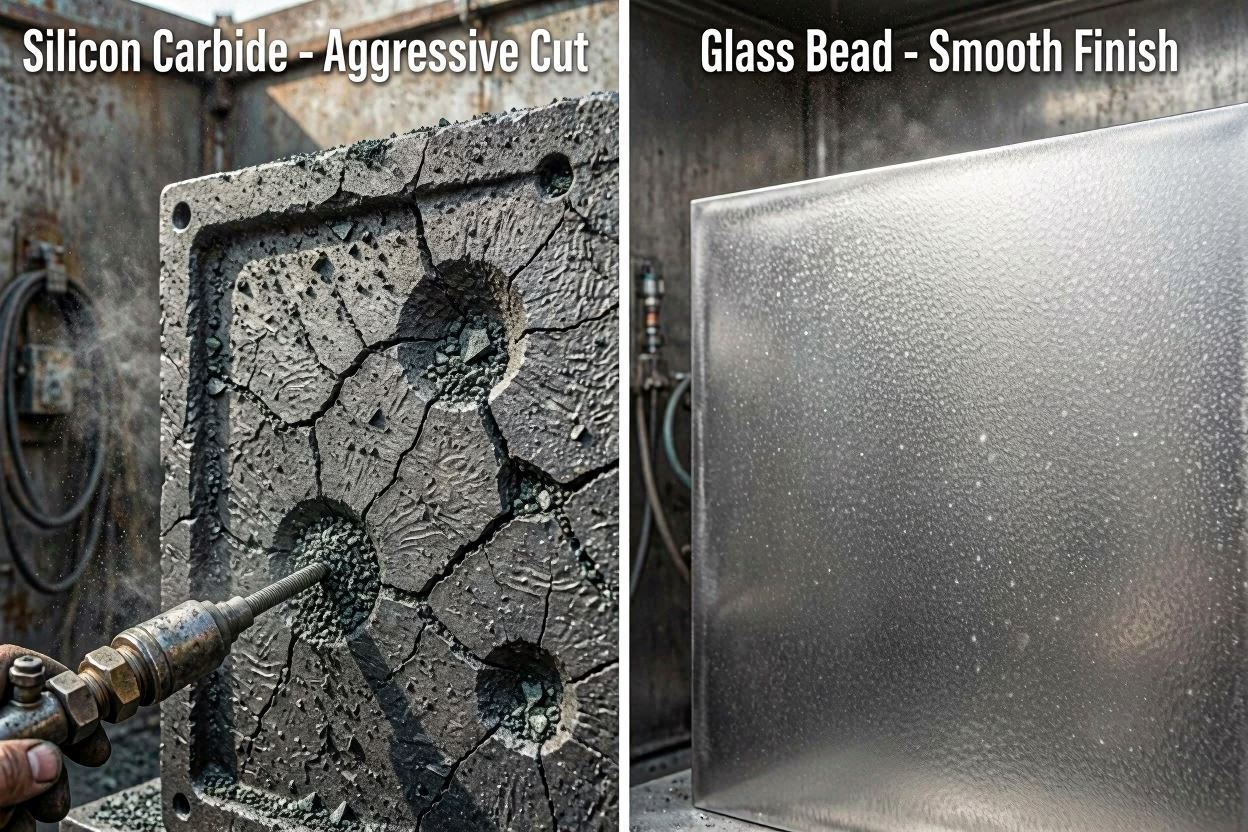
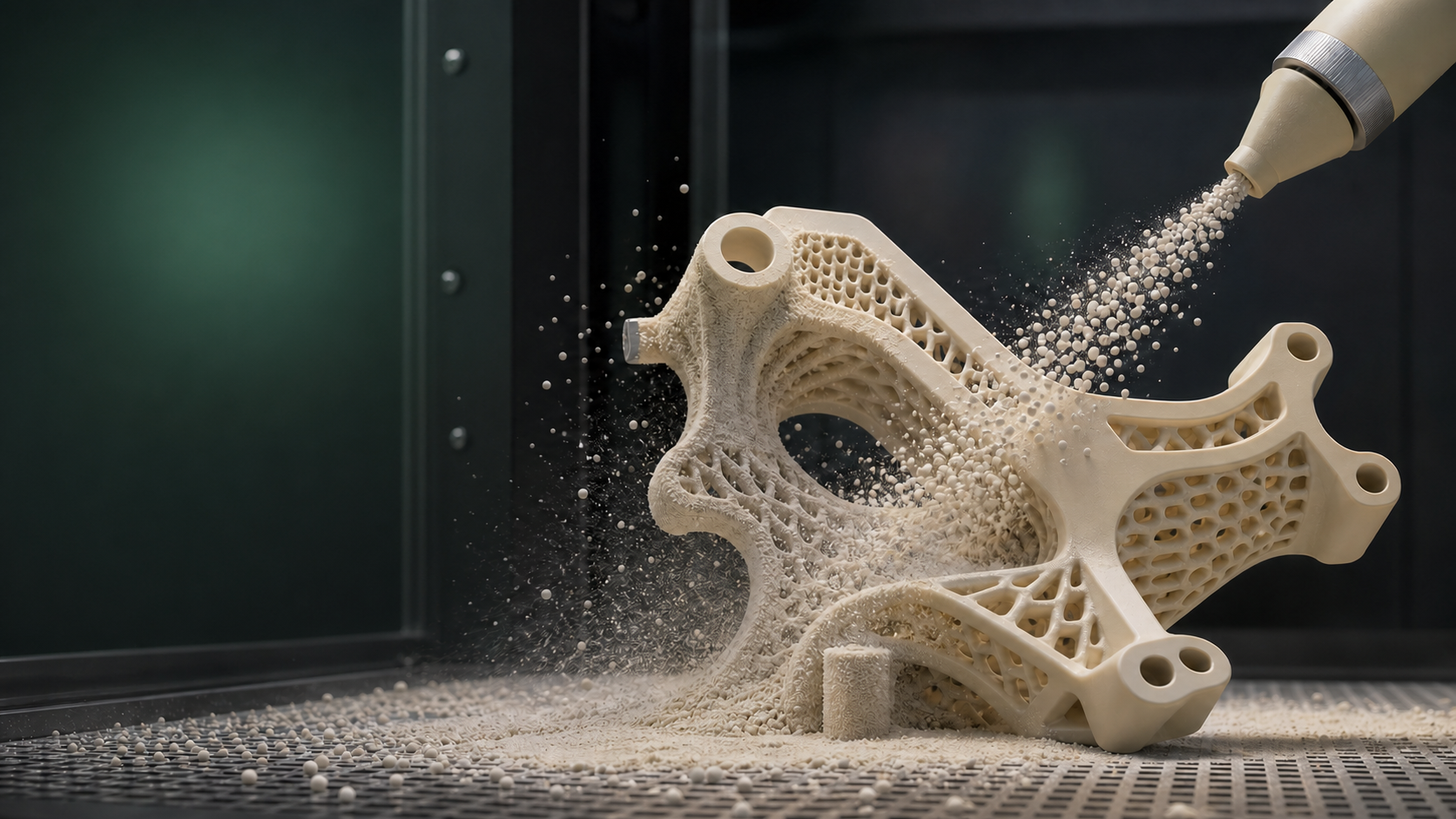
Ceramic ZrO₂ shot is the definitive choice for aerospace titanium SLM peening. It delivers the full Almen intensity range required for structural Ti-6Al-4V components, produces no iron contamination, maintains consistent spherical morphology through 2,000–4,000 blast cycles (vs. 400–800 for glass), and conforms to AMS 2431/7. S110–S170 ceramic shot covers the 6A–12A range typical of structural components; S230–S330 reaches 14A–20A for high-intensity applications. Conditioned glass beads (AMS 2431/6) are acceptable for lower-intensity applications where the maximum required intensity does not exceed 12A and iron contamination can be managed by equipment segregation and passivation. Cast steel shot introduces unacceptable iron contamination risk for titanium in corrosion-sensitive or medical-adjacent aerospace applications.
5. NADCAP AC7117: Audit Requirements and How to Qualify
NADCAP accreditation for shot peening (AC7117) is required by most major aerospace primes for flight-critical component special processes. The AC7117 checklist assesses six key areas that a qualifying facility must demonstrate:
- Equipment calibration: Blast pressure gauges, Almen strip gauges, nozzle orifice gauges, and work distance fixtures must be calibrated to traceable standards at defined intervals. Calibration records must be current and retrievable.
- Almen strip control: Strips must be sourced from NADCAP-approved suppliers, stored correctly (flat, no contact with ferrous surfaces), applied to the correct block configuration, and read on a calibrated gauge. Strip deflection results must be recorded with part/batch traceability.
- Coverage verification: The method (fluorescent tracer, visual) must be documented, and operators must demonstrate consistent application. For complex geometries, coverage on all specified surfaces must be demonstrably achievable.
- Media management: Media lot traceability, condition monitoring (hardness, size distribution, broken particle content), and replacement intervals must be defined and followed. Media condition records are a frequent NADCAP audit finding area.
- Operator qualification: Training, testing, and periodic re-qualification records for all peening operators must be maintained and current.
- Process change control: Any change to media, equipment, or parameters requires documented change control, engineering review, and re-qualification before implementation. Unauthorized deviations are a major finding in AC7117 audits.
Initial NADCAP audit preparation typically requires 6–12 months for a facility new to the process. Annual surveillance audits maintain accreditation status.
Complex titanium SLM geometries require careful masking during peening to protect non-peened precision surfaces. See our guide on masking and fixturing for abrasive blasting complex titanium SLM geometries for masking approaches applicable to peening operations.
6. First-Article Qualification and Production Control
First-article qualification for a new titanium SLM component establishes the validated peening parameters for all subsequent production. The sequence: intensity–CRS calibration study (coupon peening trials at multiple Almen intensities, followed by XRD measurement to build the intensity–CRS depth curve for the specific material and geometry); fatigue life verification (peening specimens at the qualified intensity and testing to confirm the required HCF life improvement); and first-article hardware peening with complete documentation review before production release.
The qualified process specification defines all controlled parameters: media type and grade per AMS 2431, nominal Almen intensity and tolerance, coverage requirement, equipment model and configuration, nozzle size, work distance range, blast pressure range, and media recycling frequency. Any deviation from the qualified specification triggers a non-conformance and requires engineering disposition before affected parts can ship. The process specification document is maintained under document control and is the reference for all production peening runs of that part number.
Часто задаваемые вопросы
Published data for Ti-6Al-4V SLM consistently show fatigue life improvements of 30–100%+ over unpeened as-built surfaces, depending on peening intensity, test geometry, and stress level. At Almen intensity 14A–18A with ceramic shot, improvements approaching the wrought Ti-6Al-4V HCF limit are achievable for some geometries. At 8A–12A, 50–80% improvement over unpeened SLM is typical. The exact improvement for a specific component must be determined by coupon testing during first-article qualification — literature values cannot be directly extrapolated due to geometry and loading sensitivity.
AMS 2430 governs the shot peening process: equipment, parameters, intensity measurement, coverage verification, documentation, and quality system requirements. AMS 2431 is a series of sub-specifications for the peening media themselves — each sub-spec defines composition, hardness, size, and certification for a specific media type (AMS 2431/1 for cast steel, AMS 2431/6 for conditioned glass, AMS 2431/7 for ceramic). A complete peening specification references both: AMS 2430 for process control and the appropriate AMS 2431 sub-spec for media qualification. Both are required by aerospace primes for NADCAP-audited peening.
You can perform shot peening without NADCAP, but aerospace primes who flow down NADCAP requirements for flight-critical special processes will not accept non-NADCAP peening on those parts. The restriction is commercial, not technical. For non-flight-critical aerospace parts, or for applications outside the prime’s NADCAP flow-down scope, in-house peening per AMS 2430 without NADCAP is feasible. Many manufacturers run in-house peening for lower-criticality parts while outsourcing NADCAP-required peening to accredited job shops for primary structure.
For complex geometry, position multiple Almen strips at representative locations across all surfaces to be peened — including worst-case standoff distance points, shielded areas, and recesses. Coverage is verified using fluorescent tracer coating applied before peening and inspected under UV light after: all coated surfaces must show complete removal of the tracer by peening impact. For internal recesses or features that cannot be reached by the external nozzle, robotic nozzle positioning or multiple-nozzle fixtures may be needed, and their adequacy must be demonstrated during first-article qualification by strip and coverage testing on each critical surface location.
Need Specialist Abrasive Media for Titanium SLM Finishing?
Jiangsu Henglihong Technology Co., Ltd. supplies ceramic shot (ZrO₂-based, AMS 2431/7 conforming) and conditioned glass beads in S110–S330 sizes for aerospace titanium SLM shot peening, with full batch certification for NADCAP-audited processes. Contact our technical team for media grade selection and supply documentation.
Contact Our Technical TeamФильтры