Pump Materials for Abrasive Media: High-Chrome Alloy vs. Rubber vs. Ceramic vs. Polyurethane
Selecting the wrong pump material for an abrasive media application is one of the most common and expensive mistakes in industrial pump specification. A rubber liner on a pump handling Mohs 8 alumina will fail in weeks. A high-chrome alloy impeller in fine, low-velocity mineral slurry will outlast rubber but represent over-investment. Ceramic inserts in a high-impact zone will shatter. Material selection is not about choosing the “hardest” or “most abrasion resistant” option—it is about matching the material’s wear-resistance mechanism to the specific characteristics of the particles, velocity, and chemistry in your application.
This guide covers the four dominant material families used in abrasive pump construction, their wear-resistance mechanisms, selection criteria, and a practical selection matrix. For the full pump selection framework, see: Pumps for Abrasive Media: The Complete Selection & Buying Guide.
1. Two Fundamentally Different Wear-Resistance Mechanisms
All abrasion-resistant pump materials fall into one of two categories, based on how they resist wear:
- Hardness-based resistance (hard metals and ceramics): The pump material is harder than the abrasive particle. The particle cannot cut into the surface because the surface resists deformation. This requires the pump material Mohs equivalent hardness to exceed the particle hardness—ideally by a significant margin. High-chrome alloys (Mohs equivalent ~8–9) and ceramics (Mohs 9+) use this mechanism.
- Elastic deformation-based resistance (rubber and polyurethane): The pump material is softer than the particle but flexes elastically under impact, absorbing and returning kinetic energy without permanent deformation. The particle dents the surface momentarily and is ejected rather than cutting through. This mechanism works best for fine, rounded particles at moderate velocities. It fails when particles are angular (cutting through the elastic surface), coarse (exceeding the elastic recovery depth), or when velocity is very high (rate of impact exceeds elastic recovery speed).
Understanding which mechanism applies to your specific abrasive is the starting point of any material selection decision. For more on why particles damage pump materials, see: How Abrasive Particles Damage Pumps: Wear Mechanisms Explained.
2. High-Chrome White Iron Alloys
High-chromium white iron is the dominant material for heavy-duty abrasive pump impellers, volute casings, and wear plates. The alloy typically contains 26–30% chromium and 2.5–3.5% carbon, which combine to form a dense dispersion of hard chromium carbide particles within a tough iron matrix. The chromium carbide particles (Vickers hardness 1400–1800 HV) provide the primary abrasion resistance, while the iron matrix provides the fracture toughness needed to resist impact without shattering.
High-chrome alloys are produced by casting and are used as wear liners and impellers in applications involving rock, ore, sand, and other mineral abrasives where particles are coarse, hard, and angular. The material’s high chromium content also provides moderate corrosion resistance in near-neutral slurries (pH 4–10), though it is not appropriate for strongly acidic or oxidizing environments.
Best for: Mining tailings and ore concentrate pumps; dredging; sand and gravel; cement slurry; any coarse, hard, angular mineral abrasive above Mohs 6.5 at high flow rates.
Ограничения: Brittle—susceptible to fracture in high-impact applications; not suitable for pH below 4 or for fine, low-velocity slurries where rubber would provide equivalent life at lower cost; heavier than polymer options.
3. Natural & Synthetic Rubber
Rubber liners and impellers resist abrasion through elastic deformation: a particle striking the rubber surface causes temporary local deformation, absorbs energy, and is ejected as the rubber springs back. No material is permanently removed. This mechanism is highly effective for fine, rounded particles at moderate velocities and concentrations—conditions common in fine mineral slurry, water treatment, and chemical slurry applications.
Natural rubber (NR) offers excellent resilience and performs well with most fine mineral slurries and water-based carrier fluids. Neoprene (CR) extends the temperature limit to 80°C and improves oil resistance. EPDM is preferred for hot water, steam-traced pipelines, and mildly oxidizing conditions up to 120°C. Nitrile (NBR) is chosen for oil-containing or hydrocarbon slurry applications.
Rubber fails rapidly in three situations: when particles are angular (cutting through the surface rather than deforming it); when particles exceed approximately Mohs 6.5–7 (rubber cannot elastically recover fast enough to avoid progressive cutting); and when particles are coarser than approximately 6–8 mm (individual particles carry too much energy for elastic recovery).
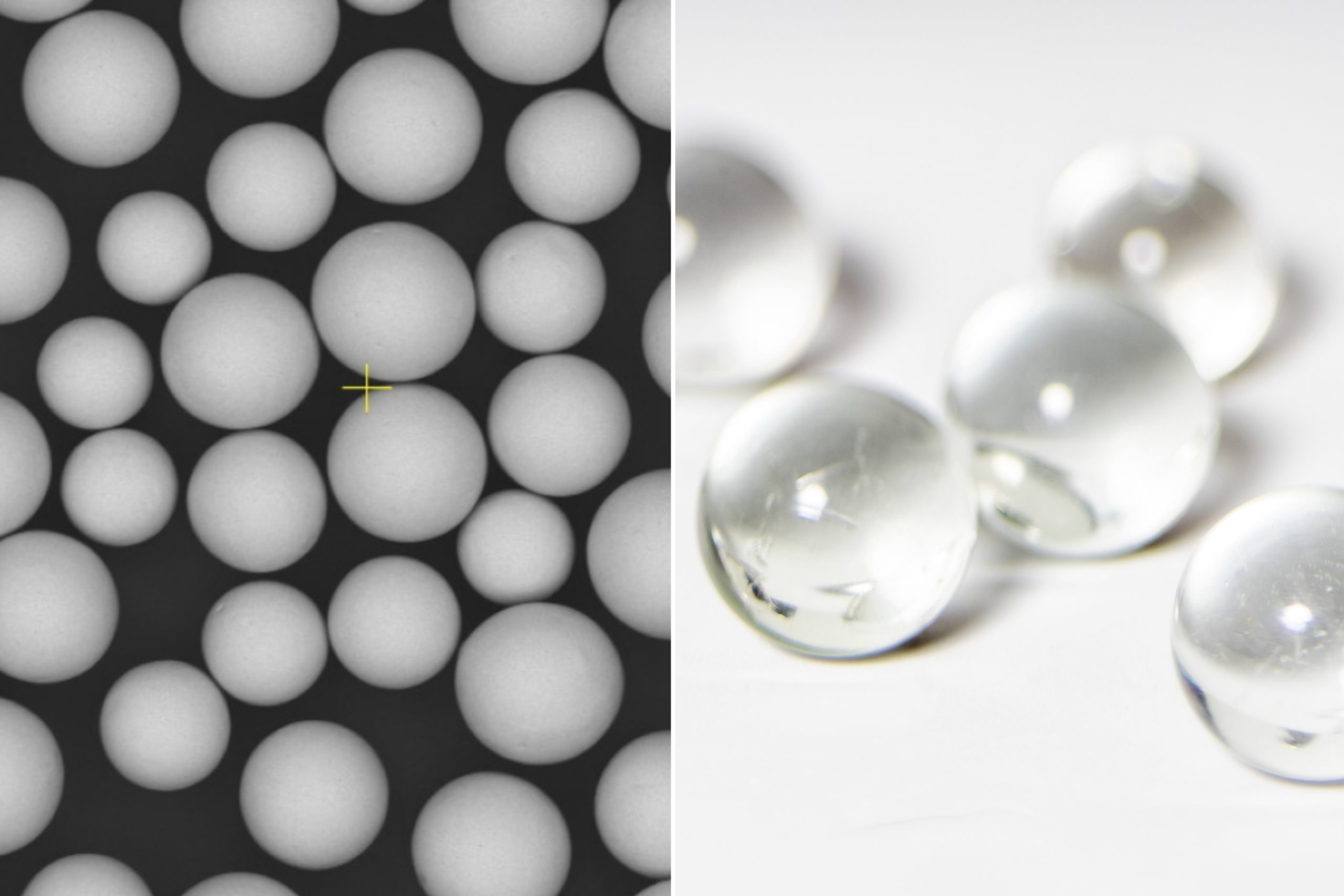
Best for: Fine mineral slurries (d50 below 3 mm); rounded particles (glass beads, steel shot, soft ore minerals); water treatment sludge; chemical slurries with mildly acidic or alkaline carriers at moderate temperature.
Ограничения: Fails rapidly with angular particles above Mohs 6.5; temperature limited; degraded by hydrocarbon carriers (NR) and strong oxidizing agents.
4. Polyurethane
Polyurethane occupies the space between rubber and hard metals—harder than rubber (better resistance to angular particles) but still relying partly on elastic deformation for its abrasion resistance. It typically delivers 2–3× the service life of natural rubber in fine-to-medium abrasive applications where particles are moderately angular or where particle size exceeds the range where soft rubber is optimal.
Polyurethane performs well in applications where particles have moderate hardness (Mohs 5–7), moderate angularity, and concentrations in the 10–30% range. It is less chemical-resistant than most rubbers and more susceptible to hydrolytic degradation in hot water or strongly acidic environments. It is not appropriate for particles above Mohs 7 or in applications requiring broad chemical resistance.
Best for: Fine to medium mineral slurries; intermediate hardness particles (Mohs 5–7); applications where rubber service life is inadequate but hard metal is over-specified; cyclone feeds and product sumps in mineral processing.
5. Ceramics & Ceramic Composites
Alumina (Al₂O₃) and silicon carbide (SiC) ceramics provide extreme hardness with excellent chemical resistance, making them the material of choice for the most demanding abrasive applications—very fine, very hard particles (Mohs 8+) in precision pumping or chemical applications where metal contamination is unacceptable. Ceramic components are used as impellers, wear inserts, shaft sleeves, and liner tiles in applications where their extraordinary hardness advantage justifies the premium cost and brittleness risk.
The critical limitation of ceramics is brittleness. Unlike hard metals, ceramics cannot absorb energy through plastic deformation. They fail catastrophically under impact loads, mechanical shock, or thermal cycling. Ceramics are therefore appropriate only for applications where flow is steady and continuous, particle impact is low-energy, and the pump is not subject to external mechanical shock. Never use ceramics in high-velocity, large-particle impact zones.
Best for: Semiconductor slurry and precision polishing compounds; alumina and SiC slurry in advanced materials manufacturing; fine chemical abrasive slurries at moderate velocity; applications requiring zero metal contamination of the process fluid.
Ограничения: Brittle — fails under mechanical shock or thermal cycling; high cost; limited availability in complex geometries; not suitable for coarse particles or high-impact zones.
6. Material Selection Matrix
| Selection Criterion | High-Chrome Alloy | Natural Rubber | Polyurethane | Ceramic (Al₂O₃/SiC) |
|---|---|---|---|---|
| Particle hardness < Mohs 6.5 | Overkill (cost) ◎ | ★★★★★ Best | ★★★★☆ Good | Overkill (cost/risk) ◎ |
| Particle hardness Mohs 6.5–8 | ★★★★★ Best | ✗ Not suitable | ★★★☆☆ Marginal | ★★★★☆ Good |
| Particle hardness > Mohs 8 | ★★★★☆ Good | ✗ Not suitable | ✗ Not suitable | ★★★★★ Best |
| Angular particle shape | ★★★★★ | ★★☆☆☆ Poor | ★★★☆☆ Fair | ★★★★★ |
| Fine particles (d50 < 0.5 mm) | ★★★☆☆ Good | ★★★★★ Best | ★★★★☆ Good | ★★★★★ Best |
| Coarse particles (d50 > 5 mm) | ★★★★★ Best | ★★☆☆☆ Poor | ★★★☆☆ Fair | ✗ Fracture risk |
| pH < 4 (strongly acidic) | ✗ Not suitable | ★★★☆☆ Verify | ★★☆☆☆ Poor | ★★★★★ Best |
| pH 4–10 (near-neutral) | ★★★★☆ | ★★★★☆ | ★★★☆☆ | ★★★★★ |
| Operating temp > 80°C | ★★★★★ | ★★☆☆☆ (NR), ★★★★☆ (EPDM) | ✗ Not suitable | ★★★★★ |
| High-impact/shock loading | ★★★☆☆ (risk of fracture) | ★★★★★ | ★★★★☆ | ✗ Will fracture |
| Relative material cost | Medium | Low–Medium | Low–Medium | Высокий |
7. Common Material Selection Mistakes
- Choosing rubber for angular particles above Mohs 6.5: Angular particles with hardness above this threshold cut through rubber rather than deforming it. This produces rapid failure that looks like chemical degradation but is actually mechanical cut-through. The solution is polyurethane (Mohs 5–7) or high-chrome alloy (Mohs 6.5+).
- Specifying high-chrome alloy for fine, soft slurry: In applications with fine, soft particles at low velocity and concentration, high-chrome alloy provides marginally better service life than rubber or polyurethane at significantly higher cost and weight. Rubber is usually the better economic choice below Mohs 6.5 and d50 below 2 mm.
- Using ceramics in high-impact or high-flow applications: Ceramics fail catastrophically under impact loads. Any application with coarse particles, high velocity, or mechanical shock risk should not use brittle ceramic components without specialist engineering review. Ceramic inserts are appropriate only in steady-flow, low-impact zones.
- Ignoring temperature limits when selecting elastomers: Natural rubber begins losing mechanical properties above 65°C. In hot-water slurry applications, EPDM (to 120°C) or PVDF (to 150°C) should be specified. Failing to account for temperature produces accelerated elastomer degradation that masquerades as abrasion failure.
For guidance on impeller and liner design options within each material category, see: Wear-Resistant Impeller & Liner Design for Abrasive Pumps.
Часто задаваемые вопросы
Consistent Abrasive Media — Consistent Pump Material Performance
The wear-resistance mechanism of every pump material depends on the particle hardness, size, and shape interacting with it. Jiangsu Henglihong Technology Co., Ltd. manufactures steel shot, steel grit, glass beads, and other abrasive media to certified hardness grades and tight size distributions — so your material selection produces the service life it was designed for, every batch.
Request Product Certifications →Фильтры