Blast Media & Equipment Compatibility Guide: Pressure vs Suction vs Wheel
Abrasive blast media and blast equipment are not independently interchangeable — the combination of media type and equipment type determines whether a blasting operation delivers the required surface preparation standard efficiently and economically, or whether it causes equipment damage, produces inconsistent results, and consumes media at two or three times the expected rate. Every abrasive media family has an optimal equipment context: silicon carbide belongs in a pressure blast or suction cabinet, not a centrifugal wheel machine; steel shot belongs in a wheel blast line, not a suction siphon pot. Using the wrong combination does not merely produce sub-optimal results — it can destroy nozzles, impellers, and liners in days and produce surfaces that fail coating inspection.
This guide explains how each of the three principal blast equipment types works, what it is optimized for, and which abrasive media families perform best — and worst — in each system. For the full media range overview, see the Abrasive Media Supplies Buyer’s Guide.
Pressure Blast Systems
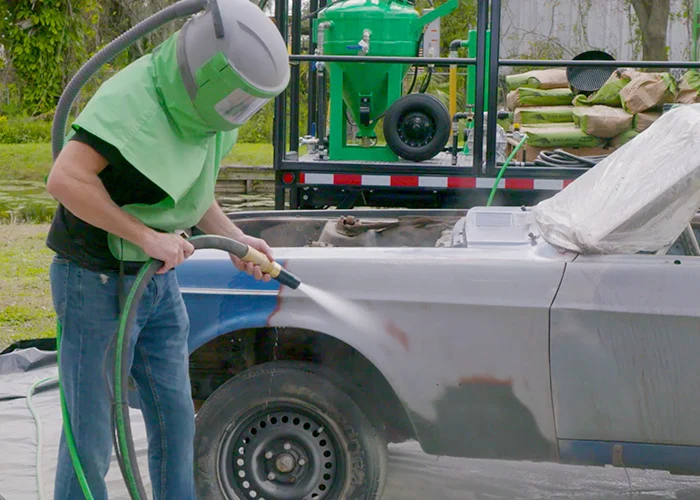
A pressure blast system uses a sealed, pressurized vessel (the blast pot) to hold the abrasive media, with compressed air simultaneously pressurizing the pot and flowing through a metering valve that combines air and media into the blast stream. The media-air mixture travels through the blast hose at high velocity to the nozzle, where it exits at particle velocities of 100–250 m/s depending on particle density, size, and air pressure. The operator controls the nozzle, directing the blast stream manually or through automated equipment.
Key Characteristics
- Operating pressure: Typically 60–120 psi at the nozzle, adjustable from the compressor and regulator
- Throughput: Moderate to high; depends on nozzle size (#4 through #8) and media feed rate
- Mobility: Fully portable — the blast pot can be taken to the work rather than moving the work to the equipment. Essential for field operations, large structures, and on-site maintenance
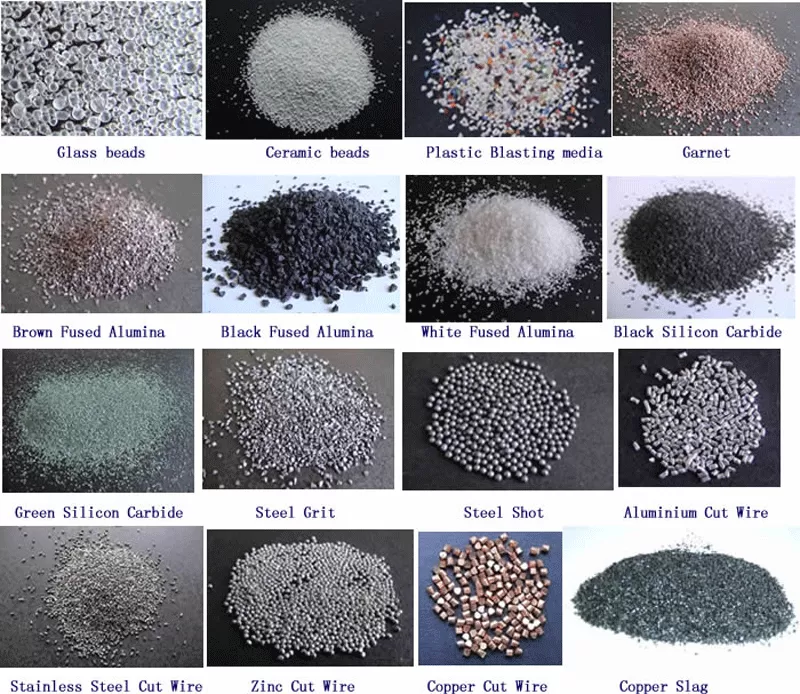
- Media compatibility: Broadest of all equipment types — handles mineral abrasives (garnet, copper slag, aluminum oxide, silicon carbide), metallic (steel shot and grit at moderate rates), organic media (walnut shell, plastic grit), and glass beads
- Media consumption: Higher than wheel blast systems because a significant proportion of kinetic energy is provided by compressed air rather than by the media mass. Requires efficient separator if media is to be recycled
Pressure Blast — Best Media
- Garnet #30/60 (field blast, pipeline, marine)
- Steel Grit GL 25–GL 40 (structural steel, Sa 3)
- Aluminum Oxide F 36–F 80 (precision prep, thermal spray)
- Copper Slag coarse (large-area single-use)
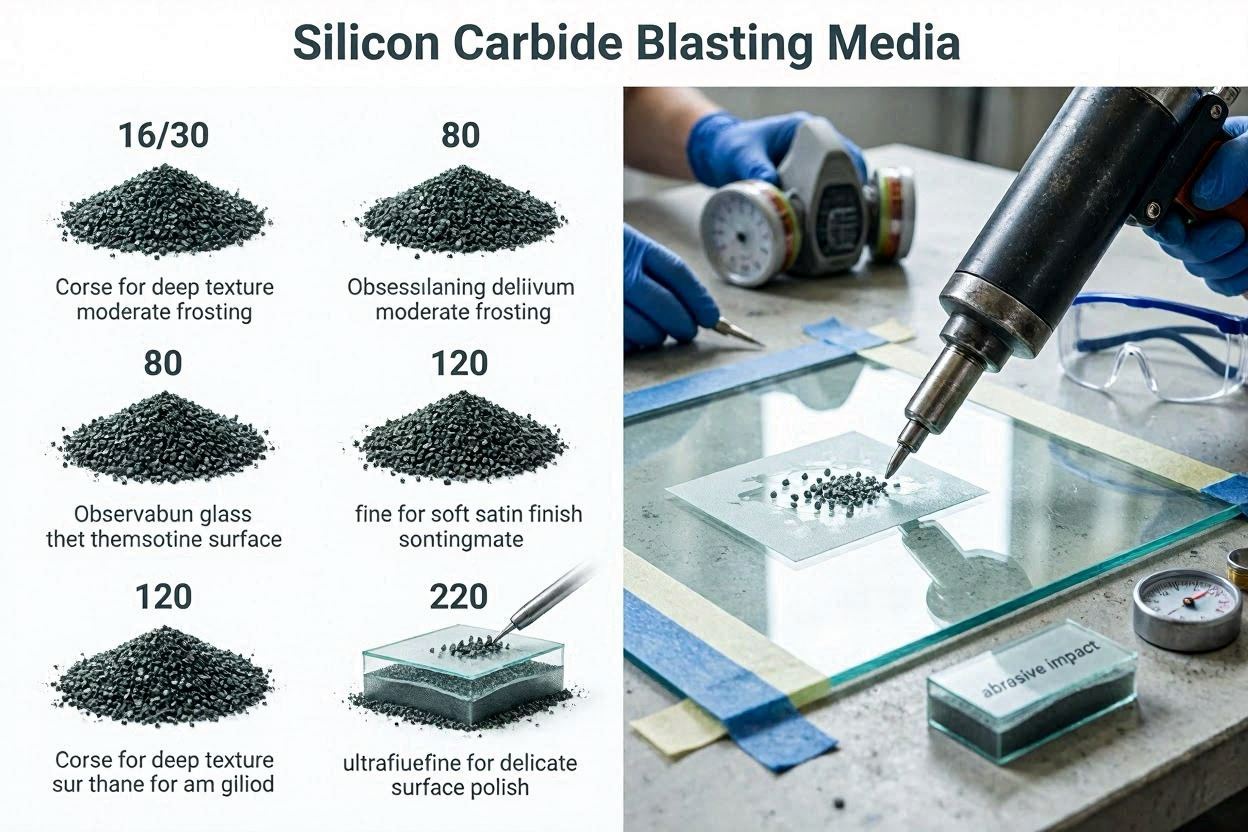
- Silicon Carbide F 60–F 120 (glass etching, stone)
Pressure Blast — Avoid
- Steel Shot in large sizes — high nozzle and hose wear
- Very fine powder media (below F 150) — clogs metering valve
- Wet or clumped media — blocks the blast pot bottom valve
Suction (Siphon) Blast Systems
A suction (siphon) blast system uses compressed air passing through a venturi nozzle inside a blast gun or cabinet to create a low-pressure zone that draws media up from a hopper through a siphon tube. The media is mixed with the air stream at the gun and exits through the nozzle at lower velocity than in a pressure system — typically 60–130 m/s, roughly 30–40% lower than equivalent pressure blast at the same air pressure. The lower velocity limits the achievable surface profile depth and cut rate, but makes suction blasting well-suited to controlled-precision applications in enclosed blast cabinets.
Key Characteristics
- Operating pressure: Typically 40–90 psi
- Throughput: Lower than pressure blast; suited to smaller workpieces and controlled-finish applications
- Mobility: Generally fixed cabinet systems; not field-portable
- Media compatibility: Broad, but limited to media that can be siphoned (flows freely through the pick-up tube) — very fine powders and very coarse granules can cause flow problems
- Best use: Cabinet blast rooms for precision aerospace components, automotive parts, medical instruments, glass etching cabinets, lapidary media application
Suction Cabinet — Best Media
- Glass Beads Class A–C (peening, aerospace, medical)
- Aluminum Oxide F 60–F 180 (precision surface prep)
- Silicon Carbide F 60–F 220 (glass etching, sandcarving)
- Plastic Grit 20–60 grit (aerospace MRO, automotive)
- Walnut Shell 20/40 mesh (delicate cleaning)
Suction Cabinet — Avoid
- Coarse metallic media (S-330+ steel shot) — too heavy to siphon efficiently
- Very fine fume-grade powders (below F 280) — airborne dust problems
- Wet or humid media — blocks siphon tube
Centrifugal Wheel Blast Machines
Centrifugal wheel blast machines accelerate abrasive media using a high-speed spinning impeller wheel rather than compressed air. Media fed into the center of the wheel is picked up by impeller blades rotating at 1,200–3,600 RPM and thrown outward at high velocity — typically 60–80 m/s. This produces a controlled, fan-shaped blast pattern that sweeps across the workpiece surface as it travels through the machine on a conveyor, hanger system, or tumble drum. Because the energy comes from the wheel motor rather than compressed air, wheel blasting is significantly more energy-efficient per square meter blasted than air-powered systems — consuming approximately 1–3 kWh/m² vs 5–10 kWh/m² for pressure blast at comparable throughput.
Key Characteristics
- Throughput: Highest of all blast equipment types; production rates of 50–500+ m²/hour on continuous conveyor lines
- Media compatibility: Highly constrained — designed and optimized for metallic media (steel shot S-110 to S-780, steel grit GL 16 to GL 120). Light, angular mineral abrasives are not suitable
- Media consumption: Lowest of all systems due to the efficient closed-loop reclaim and separation system integral to wheel blast machine design
- Workpiece limitations: Workpiece must fit through the machine envelope and be robust enough to handle the automated handling system (conveyor, hooks, or tumble drum)
- Best use: High-volume structural steel fabrication, automotive parts cleaning, foundry casting cleaning, pipe and tube blast cleaning
Wheel Blast — Best Media
- Steel Shot S-110 to S-780 (standard wheel blast)
- Steel Grit GL 16 to GL 80 (aggressive profiling)
- Steel Shot + Grit blends 70:30 to 50:50 (intermediate profile)
- Cast iron shot/grit (specialized foundry applications)
Wheel Blast — Avoid
- Garnet, copper slag, Al₂O₃ — rapid impeller and liner wear
- Glass beads — too light for efficient wheel acceleration
- Plastic or organic media — cannot withstand wheel impact
- Any media below SG 4.0 g/cm³ — insufficient centrifugal force
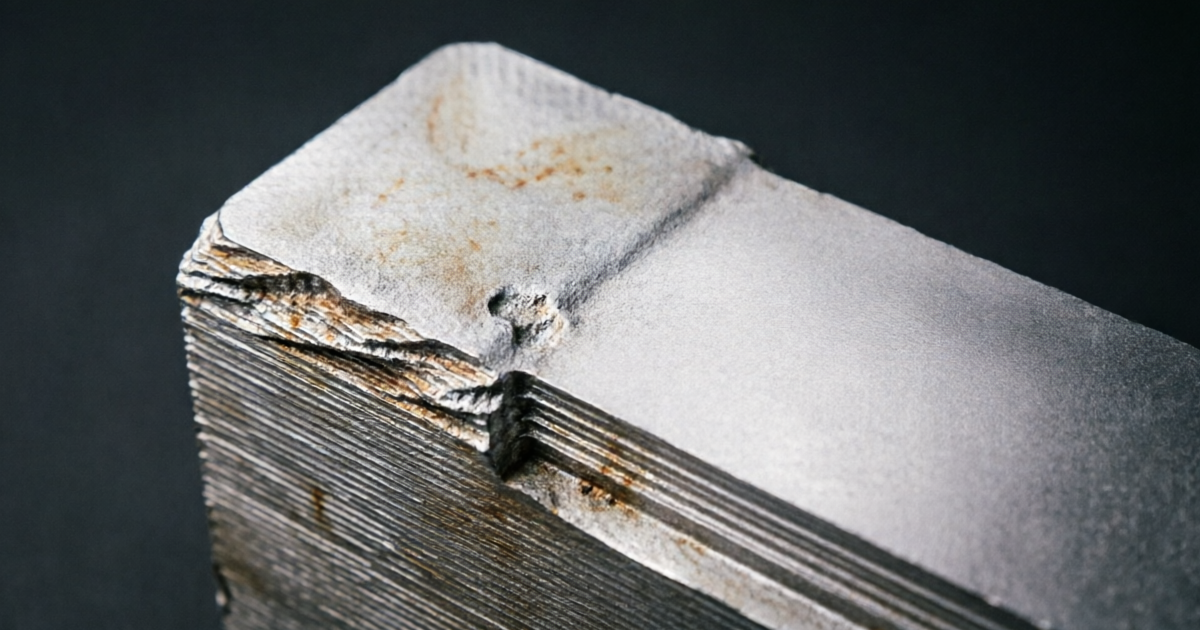
Why mineral abrasives damage wheel blast machines: Impeller blades and liners in wheel blast machines are designed to withstand the repeated impact of dense metallic media (SG 7.8 g/cm³). Lighter mineral abrasives (SG 2.5–4.1 g/cm³) require higher rotational speed to achieve equivalent particle velocity, increasing centrifugal stress on the impeller assembly. More importantly, the angular mineral particles create abrasive wear on the impeller and paddle surfaces that metallic media — which rounds and smooths with use rather than cutting — does not. Running garnet or aluminum oxide in a wheel blast machine can destroy the impeller in as little as 20–40 operating hours, compared to thousands of hours with correctly specified metallic media.
Media–Equipment Compatibility Matrix
| Тип носителя | Pressure Blast | Suction Cabinet | Wheel Blast | Notes |
|---|---|---|---|---|
| Steel Shot (S-110 to S-780) | Хорошо | Limited (coarser sizes only) | Optimal | Primary wheel blast media; pressure blast viable for smaller sizes |
| Steel Grit (GL 16 to GL 120) | Хорошо | Limited | Хорошо | Wheel blast accelerates liner wear vs shot; pressure blast preferred for field use |
| Garnet #30/60 | Optimal | Хорошо | Avoid | Destroys wheel blast impeller; excellent in pressure blast field operations |
| Aluminum Oxide F 36–F 120 | Хорошо | Optimal | Avoid | Cabinet blast standard; pressure blast suitable for larger grit sizes |
| Silicon Carbide F 46–F 220 | Хорошо | Optimal | Avoid | Glass etching and stone: suction cabinet; stone/ceramic: pressure blast |
| Glass Beads Class A–D | Fair (low vel.) | Optimal | Avoid | Suction cabinet is standard; pressure blast possible at low pressure (<60 psi) |
| Copper Slag coarse/medium | Хорошо | Fair | Avoid | Pressure blast only; high dust — requires containment and filtration |
| Plastic Grit 14–60 grit | Хорошо | Хорошо | Avoid | Both pressure and suction cabinet viable; low density requires pressure adjustment |
| Walnut Shell 6/10–20/40 | Fair | Хорошо | Avoid | Suction cabinet preferred for controlled delicate cleaning |
Nozzle Materials and Media Wear
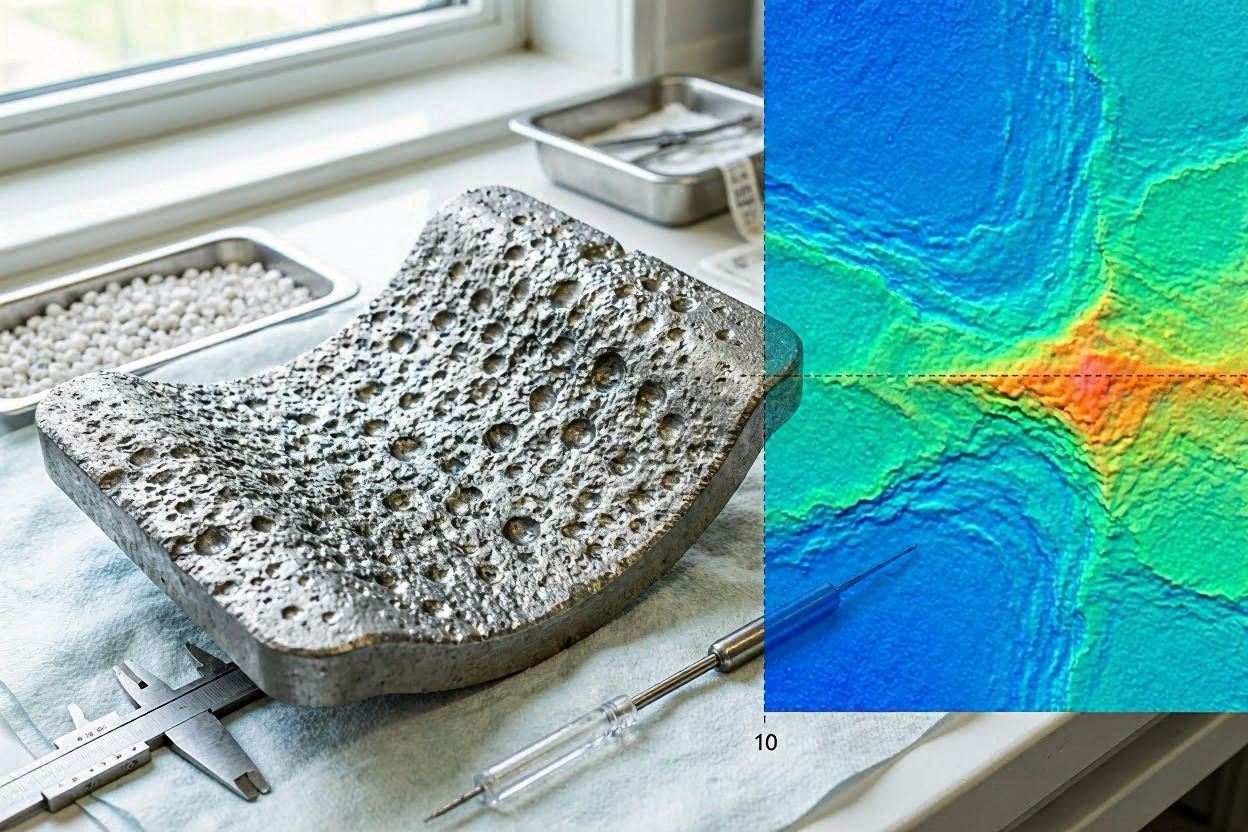
Nozzle selection is a secondary equipment-media interaction that significantly affects operating cost. The nozzle bore widens as it wears — reducing blast velocity, increasing air consumption, and eventually producing an irregular blast pattern that causes surface inconsistency. The rate of nozzle wear is determined by the abrasive hardness and the nozzle material:
| Nozzle Material | Relative Life vs Garnet | Best Media Match | Notes |
|---|---|---|---|
| Ceramic (alumina) | 1× (baseline) | Low-abrasion media only | Shortest life; not suitable for hard abrasives |
| Cast iron | 0.5× | Low-pressure soft media | Very short life; rarely used in industrial blasting |
| Tungsten carbide | 5–10× | Garnet, copper slag, glass beads, Al₂O₃ | Standard industrial nozzle; best cost-life balance for most applications |
| Boron carbide | 25–35× | All media types including SiC and steel | Longest life; higher unit cost offset by dramatically lower replacement frequency |
| Карбид кремния | 3–5× | Low to medium hardness media | Not suitable for SiC media (same hardness as nozzle) |
For high-volume pressure blast operations with hard abrasives (Al₂O₃ or SiC), the higher cost of boron carbide nozzles is recovered in fewer nozzle changes, reduced downtime, and consistent surface quality throughout the nozzle service life. For moderate-volume field operations with garnet or copper slag, tungsten carbide nozzles provide the best cost-performance balance.
Часто задаваемые вопросы
Running garnet or other mineral abrasives in a centrifugal wheel blast machine at reduced wheel speed does not eliminate the damage risk — it merely slows it. The fundamental problem is not the kinetic energy of the garnet particles on the workpiece surface; it is the abrasive cutting wear those angular particles inflict on the wheel impeller blades, paddles, and liners as they are accelerated from rest to exit velocity inside the machine. The impeller materials are not designed to tolerate the sustained abrasion of hard mineral particles, regardless of wheel speed. If your application requires garnet, a pressure blast system is the correct equipment choice. If you must use a wheel blast machine, use steel shot or grit — the media the machine is engineered for.
The practical upper limit for steel shot in a suction blast cabinet is around S-170 to S-230 (0.43–0.60 mm diameter). Above this size, the shot particles become too heavy for the siphon airflow to consistently lift and transport through the pick-up tube and blast hose — resulting in erratic, low-density blast patterns and poor surface coverage uniformity. For most suction cabinet applications requiring metallic media (peening or surface preparation of small components), S-110 to S-170 shot is the effective range. For larger shot sizes (S-330 and above), a pressure blast system is required to generate sufficient air velocity to transport the heavier particles.
The primary indicator is nozzle bore diameter measurement. Use a nozzle bore gauge (bore caliper) to measure the orifice diameter periodically — typically every 4–8 hours of operation for hard abrasives, every 20–30 hours for softer media. As a general rule, replace the nozzle when the bore diameter has expanded by 1.5–2 mm beyond the new nozzle specification, or when you observe: increased air consumption at the same operating pressure, decreased blast velocity (audible as a lower-pitched impact sound on the surface), irregular blast pattern or oval instead of round blast footprint, or measurably reduced surface profile depth at the same operating parameters. Delaying nozzle replacement costs more in wasted compressed air and inconsistent surface preparation than the nozzle itself is worth.
Get the Right Media for Your Equipment
Tell Henglihong your equipment type, current media, and surface specification. Our technical team will confirm the optimal media grade and grit size for your blast system — before you order.
Request a Free Technical RecommendationФильтры