Abrasives for Aerospace Component Blasting
Aircraft MRO, turbine blade maintenance, and composite structure paint stripping demand the most precisely controlled blasting processes in any industry. Media selection errors cause irreversible substrate damage and regulatory non-compliance. Complete aerospace blasting guide from Jiangsu Henglihong Technology Co., Ltd.
Aerospace Blasting Requirements
Aerospace blasting operations are governed by the strictest process control requirements of any blasting application. Aircraft manufacturer structural repair manuals (SRMs), FAA Advisory Circulars, and process specifications such as Boeing BAC 5763, Airbus APS 2500, and the AMS 2430/2431/2432 series define acceptable media, process parameters, and quality verification methods with zero tolerance for deviation. The consequences of non-compliant blasting — substrate dimensional change, media embedding, fibre exposure in composites, metallurgical alteration from excessive peening — range from costly component rejection to airworthiness certification withdrawal.
Abrasive media for aerospace blasting must be certified to the applicable specification, lot-traceable, and accompanied by certificate of conformance documentation. Using non-certified media in an MRO blasting operation is both a quality system violation and a potential airworthiness concern.
Media Selection by Aerospace Component
| Компонент | Substrate | Recommended Media | Specification |
|---|---|---|---|
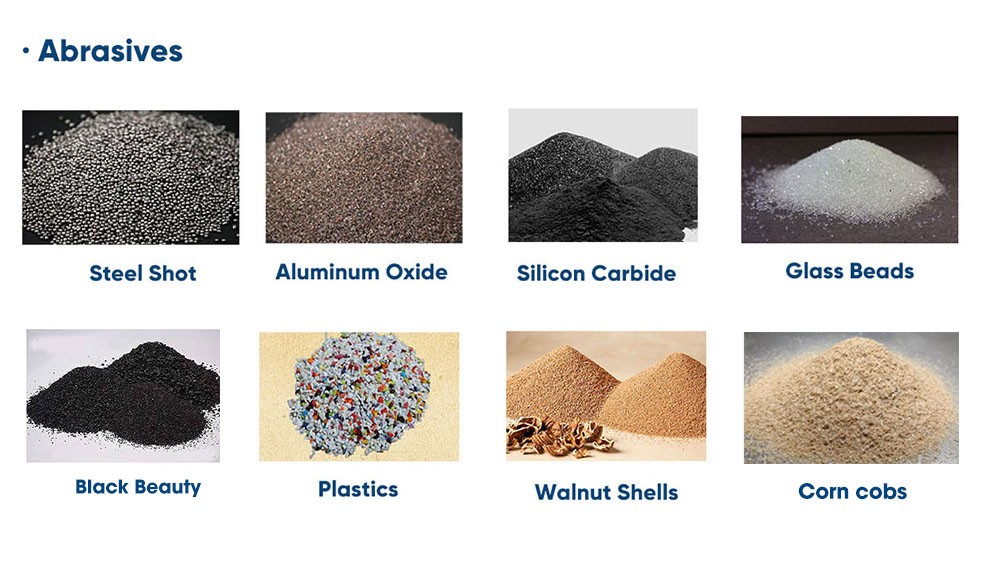
| Aluminium fuselage skin | 2024-T3, 7075-T6 Al | Plastic media Type I or II | MIL-P-85891A |
| Composite fairings / radomes | CFRP, fibreglass | Plastic media Type III or walnut shell | MIL-P-85891A |
| Titanium structural parts | Ti-6Al-4V | Glass beads (peening) | AMS 2431/6 |
| Steel landing gear | 300M, 4340 steel | Steel shot (peening) | AMS 2430 |
| Turbine blade (Ni superalloy) | IN718, Waspaloy | Aluminum oxide or glass beads | Engine OEM spec |
| Magnesium castings | Mg alloy | Plastic media Type III | MIL-P-85891A |
| Engine nacelle (Al) | Aluminium sheet | Plastic media Type I | MIL-P-85891A |
Aircraft Skin Paint Stripping
Commercial aircraft require complete paint removal at scheduled heavy maintenance intervals (typically C-check and D-check) to inspect the underlying structure for corrosion, fatigue cracks, and repair quality. Plastic blast media (Type I: urea, Type II: melamine) is the aerospace-standard method for stripping polyurethane topcoat and epoxy primer from aluminium skin without dimensional change to the substrate.
The critical process control requirements are: blast pressure limited to the SRM maximum (typically 40–60 psi); verified zero metal removal using eddy-current thickness gauge before and after blasting; media lot certification to MIL-P-85891A; and spent media testing if the stripped coating system contains lead or chromate. For the full plastic media technical guide, see Plastic Blast Media guide.
Turbine & Engine Component Blasting
Gas turbine hot section components — compressor blades, turbine blades, and vanes — require careful blasting for coating removal, bond coat preparation before thermal spray, and carbon/oxidation cleaning during overhaul. White aluminum oxide (WFA) is commonly used for thermal barrier coating bond coat preparation on nickel superalloy substrates, producing the angular 2.0–3.5 mil profile required for HVOF or plasma spray adhesion without introducing iron contamination from BFA or metallic media.
Carbon deposits on turbine blades (from hot section operation) are removed with fine walnut shell or fine glass beads — gentle enough to clean without altering the blade’s precision aerodynamic profile. Any dimensional change to a turbine blade from abrasive impact is grounds for rejection: blade tip clearance tolerances are typically ±0.1 mm, and any reduction in blade thickness changes the structural integrity calculation.
Shot Peening in Aerospace
Shot peening is a compressive stress-inducing surface treatment used to extend fatigue life of aircraft structural components: springs, landing gear, wing spars, and turbine components. The process uses certified shot media (steel shot, glass beads, or ceramic beads depending on substrate) propelled at controlled velocity to produce a specific Almen intensity, measured in thousandths-of-an-inch arc height on standardised Almen strips.
Glass beads (AMS 2431/6) are specified for peening aluminium and titanium components where steel contamination must be avoided. Steel shot (AMS 2430) is used for steel landing gear, springs, and high-strength steel components where maximum peening intensity is required. All aerospace peening operations must be performed to written process specifications with documented intensity, coverage, and media certification verification. For full glass bead peening guidance, see the Glass Bead guide.
Regulatory Compliance for Aerospace Blasting
All blasting media used in aerospace MRO must meet the following minimum documentation requirements: Certificate of Conformance to the applicable AMS or MIL specification; current Safety Data Sheet (SDS/MSDS); lot traceability documentation; and, for peening shot, Almen strip test results from the production lot. Media that cannot be traced to a certified production lot must not be used in certified aerospace blasting operations regardless of apparent visual quality.
OSHA 29 CFR 1910.1053 respiratory silica requirements apply to aerospace blasting operations; however, most aerospace-approved media (plastic, glass beads, aluminium oxide) are silica-free, simplifying compliance. For complete OSHA guidance, see the Safety Regulations guide.
Certified Aerospace Blasting Media from Jiangsu Henglihong Technology
MIL-P-85891A plastic media, AMS 2431/6 glass beads, and WFA aluminum oxide with full certification documentation for aerospace MRO and manufacturing applications.
Фильтры