Abrasive Blasting for Aerospace Additive Manufacturing Parts: Surface Standards, Media Selection, and Compliance
Aerospace is the most demanding and most consequential application environment for metal additive manufacturing. In 2026, production AM parts — fuel nozzles, swirler assemblies, heat exchangers, titanium brackets, and structural airframe components — are certified for flight on commercial and military aircraft. The surface finishing requirements for these parts are correspondingly rigorous: NADCAP-accredited processes, documented Almen intensity specifications, AS9100 quality management systems, and full material and process traceability from powder lot to delivered part. Abrasive blasting — whether bead blasting for surface conditioning or shot peening for fatigue life — is a mandatory step in every aerospace metal AM post-processing workflow. This guide covers the standards, media specifications, documentation requirements, and workflow integration for abrasive blasting of aerospace AM parts.
1. Additive Manufacturing in Aerospace in 2026
The aerospace industry’s adoption of AM has moved firmly from prototype to production. As of 2026, metal AM parts certified for flight include fuel nozzles, swirler assemblies, heat exchangers, turbine brackets, structural airframe components, satellite struts, and rocket engine injectors. GE Aerospace alone has produced over 100,000 AM fuel nozzle tips for the LEAP engine program, and virtually every major Tier 1 aerospace supplier now operates SLM or DMLS capacity or has qualified AM suppliers in their supply chain.
Materials dominating aerospace AM production: Ti-6Al-4V (structural applications, low-temperature components), Inconel 718 and 625 (hot-section engine components, exhaust structures), AlSi10Mg and Scalmalloy (lightweight structural brackets, aerostructures), and maraging steel (tooling, mould inserts). Post-processing requirements for these parts are comprehensive and non-negotiable. No aerospace AM part leaves a manufacturing facility without documented surface treatment meeting the drawing callout and applicable material and process specification.
2. Aerospace Surface Finish Standards for AM Parts
Aerospace surface finish requirements are communicated through engineering drawing callouts referencing standard specification documents:
- ASME B46.1 / ISO 4287: Surface texture measurement standards; drawing callouts specify Ra in µm or µin
- MIL-STD-10 (US DoD): Ra in microinches for military programs: 125 µin = 3.2 µm; 63 µin = 1.6 µm; 32 µin = 0.8 µm
- AMS 2430: Shot peening specification — media type, Almen intensity, coverage, and documentation requirements
- AMS 2432: Automated/computer-monitored shot peening with more stringent in-process monitoring
- MIL-STD-1246: Product cleanliness levels for optical, fuel system, and cryogenic hardware components
For coating preparation, relevant additional standards include SSPC-SP5 (White Metal Blast) for thermal spray substrates and SSPC-SP6 (Commercial Blast) for paint — plus the specific coating manufacturer’s pre-treatment specification, which always takes precedence.
3. NADCAP Special Process Requirements for Blasting
NADCAP is the industry cooperative accreditation program for aerospace special processes. Shot peening of aerospace parts requires NADCAP accreditation. The audit criteria SC7117/1 (conventional) and SC7117/2 (automated) assess:
- Equipment calibration — air pressure gauges, Almen gauges, nozzle condition measurement
- Almen strip conformance per SAE J442
- Saturation curve establishment and maintenance
- Media control — certification, contamination prevention, usage tracking
- Operator qualification and training records
- Process parameter records and batch documentation
- Corrective action processes for non-conformances
NADCAP accreditation is awarded after a successful on-site audit and maintained through periodic re-audits (typically annually or semi-annually). Parts processed by non-NADCAP providers cannot be accepted by NADCAP-compliant aerospace primes — making accreditation a practical prerequisite for aerospace AM post-processing suppliers offering shot peening services.
4. Common Aerospace AM Alloys and Blasting Requirements
| Alloy | AM Process | Typical Use | Blast Media | Prohibited Media | Post-Blast Treatment |
|---|---|---|---|---|---|
| Ti-6Al-4V | SLM, EBM, DED | Structural brackets, engine pylons, landing gear | Glass beads, ZrO₂ | All steel media | Passivation, peen per spec |
| Inconel 718 | SLM, DMLS | Hot-section components, fuel nozzles | Glass beads, Al₂O₃, steel shot | None specified | Peen per AMS 2430; TBC if required |
| Inconel 625 | SLM, DED | Marine, hot-section, exhaust | Glass beads, Al₂O₃ | Нет | Peen per spec; TBC prep |
| AlSi10Mg | SLM | Cabin brackets, heat sinks, secondary structure | Glass beads; fine Al₂O₃ pre-coat | Steel media | Anodize or primer |
| Maraging Steel MS1 | SLM | Tooling, jigs, fittings | Steel shot or Al₂O₃ | — | Peen; case harden; PVD |
5. Media Selection for Aerospace Applications
Media selection for aerospace AM blasting is driven by three constraints: alloy contamination compatibility, Almen intensity achievability, and media traceability documentation. Key principles:
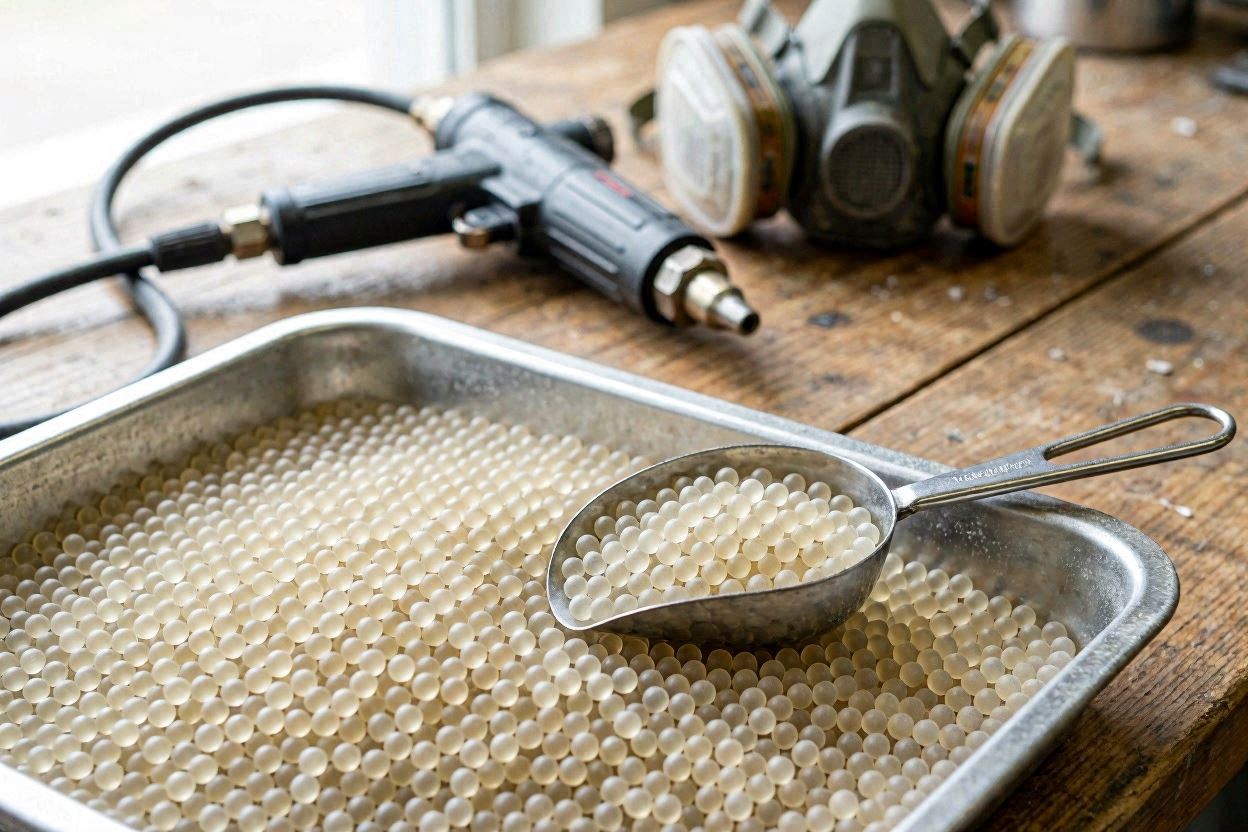
- Media certification: All blasting media used on aerospace AM parts must have a supplier Certificate of Conformance traceable to a specific batch, with chemical composition, hardness, and sieve analysis data
- Media contamination prevention: Dedicated media circuits for each alloy type — no mixed titanium/steel shot cabinets; visual inspection before use; sieve analysis at defined intervals
- Iron-free media for Ti and SS: Glass beads mandatory; zirconia when higher Almen intensity is required on titanium
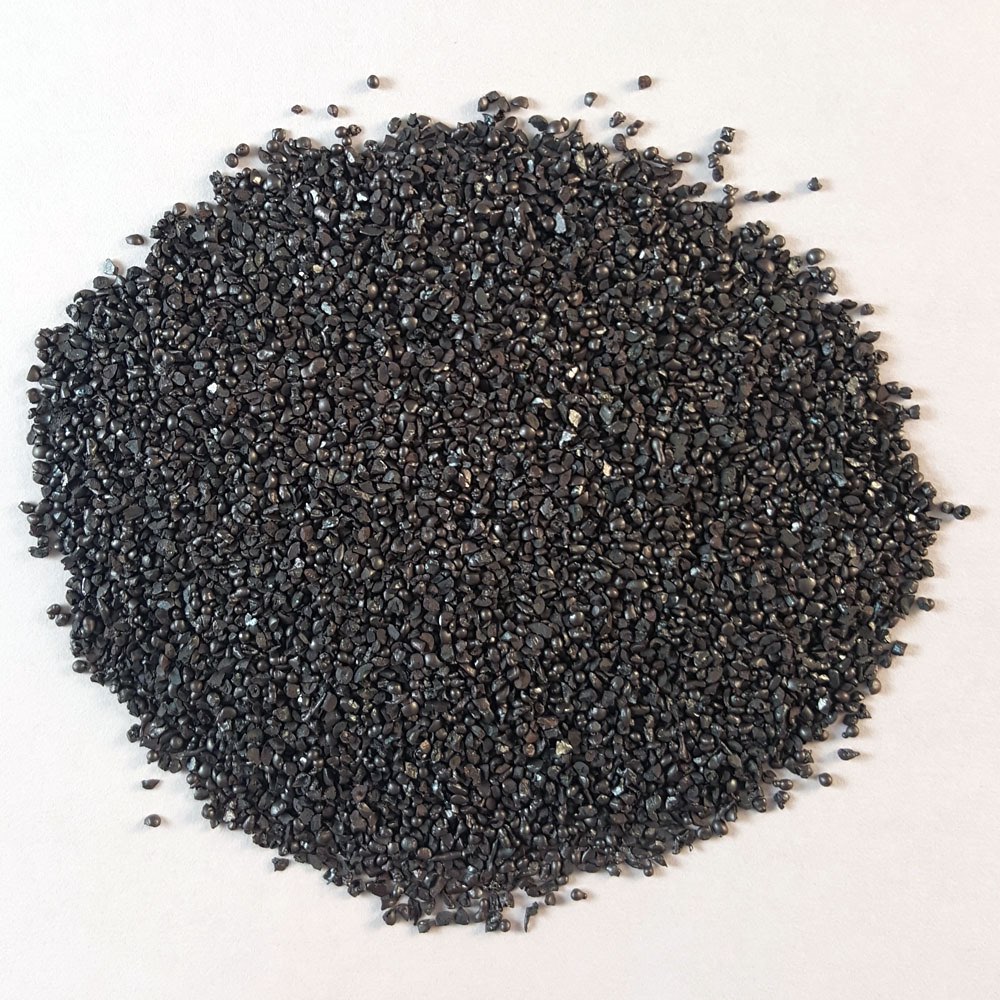
- Steel shot for Inconel and steel: SAE J441-compliant conditioned cast steel shot S110–S170 for peening Inconel 718; batch certification per SAE J1173 must accompany every lot
6. Shot Peening in Aerospace AM
Shot peening for fatigue enhancement is specified on aerospace AM drawings as Almen intensity, media type, strip type, and coverage requirement. Common Almen intensities for aerospace AM:
- Almen N 0.004–0.010 in: Very thin-walled AM structures (wall thickness 1–3 mm) — prevents distortion
- Almen A 0.008–0.016 in: Most common for aerospace AM structural components — Ti-6Al-4V and Inconel 718 brackets
- Almen A 0.016–0.025 in: Heavier-section parts (wall thickness above 5 mm) requiring deep CRS penetration
The saturation curve must be established for each new part/media/machine combination and re-validated after any equipment or media change. Production intensity must fall within ±10% of the nominal Almen arc height. See Shot Peening 3D Printed Metal Parts for complete Almen strip procedures and fatigue data.
7. Bead Blasting for Surface Conditioning
Before shot peening and as a standalone finishing process for non-peened surfaces, bead blasting of aerospace AM parts serves to:
- Remove the as-built oxide layer and achieve the pre-peen Ra specification (typically Ra ≤ 3.2 µm or as called out on drawing)
- Provide a uniform matte surface for inspection and non-destructive testing
- Prepare surfaces for primer, conversion coating, or thermal barrier coating
The pre-peen blast with glass beads is the surface baseline for shot peening. If the pre-peen Ra is too rough, the as-built surface features act as stress concentrators that peening cannot fully compensate. Establishing the correct pre-peen Ra and verifying it by profilometer measurement before peening is a critical step — some facilities skip this and encounter inconsistent fatigue test results and failed NADCAP audits when the pre-peen Ra record is not available.
8. Documentation and Traceability Requirements
Aerospace AM parts require full material and process traceability from raw powder to delivered component. For blast operations, the minimum documentation package for AS9100 compliance includes:
- Blast traveller: part number, serial number, operation sequence, blast parameters, equipment ID, operator qualification reference, date
- Media batch certificate: chemical composition, hardness, sieve analysis, batch number, supplier CoC
- Equipment calibration records: air pressure gauge calibration date and reference standard; Almen gauge calibration for peening
- Almen strip test records: strip type and batch, initial curvature reading, post-peen arc height, acceptance/rejection status, operator signature
- Surface roughness measurement records: profilometer calibration, measurement location, Ra and Rz values, acceptance criteria, inspector signature
- Ferroxyl test records for Ti and SS: test method, result, inspector signature
Record retention: typically 10 years for flight hardware, or as specified in the customer’s quality plan.
9. Inspection and Quality Assurance
- Визуальный осмотр: Uniform matte surface coverage with no shiny unblasted zones, no contamination, no embedded media. For peened surfaces, characteristic dimple pattern visible under 10× magnification at 100% coverage.
- Surface roughness: Contact profilometer per ASME B46.1 / ISO 4287 at drawing-specified locations. Results documented in the part record.
- Ferroxyl test: Mandatory for all titanium and stainless steel AM parts. Results documented with part serial number, date, and inspector.
- Fluorescent Penetrant Inspection (FPI): Many aerospace AM structural parts undergo FPI per ASTM E1417 after blast and before coating — blasting provides the clean, uniform surface needed for reliable penetrant application and indication detection.
- Dimensional verification: CMM or laser scan inspection for tight-tolerance features after blasting; for shot-peened parts, verify dimensions of features that may have changed from peening distortion.
Часто задаваемые вопросы
What NADCAP accreditations are required for blasting aerospace AM parts?
Shot peening of aerospace AM parts requires NADCAP accreditation under AC7117/1 (Conventional Shot Peening) or AC7117/2 (Automated Shot Peening). Conventional abrasive blasting without Almen specification may not always require NADCAP accreditation, but many aerospace prime contractors (Boeing, Airbus, GE Aviation, Pratt and Whitney, Safran) require NADCAP approval for any surface treatment special process. Always verify the customer’s specific NADCAP scope requirements before beginning blast operations on aerospace AM parts.
What surface finish standards apply to aerospace AM parts?
Aerospace AM part surface finish specifications use standard engineering drawing callout conventions: Ra per ASME B46.1 (US) or ISO 4287 (EU), with the numerical value in micrometres or microinches. Common callouts for SLM titanium and Inconel parts: Ra 3.2 µm (125 µin) for general surfaces; Ra 1.6 µm (63 µin) for mating and load-bearing surfaces; shot peening to AMS 2430 at a specified Almen intensity for fatigue-critical surfaces. Some customers also specify SSPC or ISO 8501-1 cleanliness levels for coating preparation. When no Ra is called out, many aerospace prime contractors use their own Surface Finish Standards documents.
What is the role of abrasive blasting in AS9100 compliance for AM parts?
Under AS9100 Rev D, abrasive blasting is a Special Process when results cannot be fully verified by subsequent inspection (e.g., shot peening for residual stress). Special processes require: defined process specifications, controlled parameters, qualified personnel, calibrated equipment, and documented records. For blast cleaning on aerospace AM parts, AS9100 compliance requires at minimum: blast procedure documentation, records of blast parameters (media, pressure, exposure time), equipment calibration records, and operator qualification records.
How does abrasive blasting fit into the First Article Inspection for aerospace AM?
AS9102 First Article Inspection requires documented evidence that the part and its manufacturing processes conform to design requirements. For blasting in the AM FAI: surface roughness measurements at specified locations (contact profilometer per ASME B46.1), Almen strip arc height measurements and saturation curves (if peening specified), media type and batch certification, blast equipment ID and calibration, and inspector qualification. The FAI surface finish data is compared to drawing callouts, and both numerical compliance and process parameter records must be customer-approved before production parts can ship.
What are the most common aerospace AM alloys and their blasting requirements?
Ti-6Al-4V: requires iron-free glass bead or zirconia blasting; used for structural brackets, engine pylons, landing gear. Inconel 718: glass beads or Al2O3 for cleaning; steel shot for peening; used for hot-section engine parts, fuel nozzles. Inconel 625: similar to 718 with higher corrosion resistance for marine and offshore AM. AlSi10Mg and Scalmalloy: glass beads for lightweight structural components; anodizing prep after blasting. Maraging Steel: Al2O3 or steel shot for tooling and mould AM; PVD after blasting. Each alloy has specific media restrictions; always cross-reference with the drawing and material specifications.
Can abrasive blasting prepare AM parts for thermal barrier coatings?
Yes — abrasive grit blasting is the standard surface preparation step before applying thermal barrier coatings (TBC) to aerospace AM hot-section components. For Inconel and other superalloy AM parts that will receive a bond coat and TBC: Al2O3 grit (60 to 80 mesh) at 70 to 90 psi creates an anchor profile of Ra 6 to 10 µm required for plasma-sprayed MCrAlY bond coat adhesion. Apply thermal spray within 2 hours of blasting to maintain surface cleanliness. The anchor profile created by grit blasting is the primary driver of TBC bond coat adhesion strength, making this blast step critical for turbine component durability.
What documentation must be retained for aerospace AM blast operations?
At minimum: blast traveller or route sheet showing part serial number, blast operation sequence and parameters, operator sign-off, and date; media batch certification; equipment calibration records; Almen strip test records for peening operations; inspection results including Ra measurement and ferroxyl test; non-conformance reports and disposition records. Record retention period is typically 10 years for aerospace components or as specified by the customer’s quality plan and purchase order.
Source Certified Blasting Media for Aerospace AM
Jiangsu Henglihong Technology Co., Ltd. manufactures NADCAP-compatible glass beads, zirconia shot, and steel shot for aerospace AM post-processing — all available with batch Certificates of Conformance traceable to chemical composition, hardness, and sieve analysis. Contact our aerospace technical team for media specifications and supply chain qualification support.
Contact Our Technical TeamPublished July 2026 by Jiangsu Henglihong Technology Co., Ltd. — Specialists in industrial abrasive blasting media for additive manufacturing post-processing.
Фильтры